Preparations for Next Moonwalk Simulations Underway (and Underwater)
Derek Abramson, Dale Reed Subscale Flight Research Laboratory chief engineer, left, communicates with the Edwards Air Force Base air traffic control tower for approval to fly the Alta-X drone near NASA’s Armstrong Flight Research Center in Edwards, California, on Thursday, Aug. 27, 2026. Justin Link, small uncrewed aircraft pilot, second from left, and laboratory chief pilot Justin Hall await flight clearance. Researchers at NASA’s Johnson Space Center in Houston developed the advanced guidance and navigation system known as the Safe and Precise Landing – Integrated Capabilities Evolution (SPLICE) experiment, which is installed on the Alta-X. SPLICE will help spacecraft land precisely and detect and avoid potential hazards, which is critical for NASA missions to the Moon and to Mars.
NASA/Ryan Kline
Long before they helped shape NASA’s future aerospace breakthroughs, Derek Abramson, Justin Hall, and Justin Link were in their garages and homes building radio‑controlled aircraft, testing new ideas, and flying their creations at hobby events. That early passion now fuels the work of NASA’s Dale Reed Subscale Flight Research Laboratory at the agency’s Armstrong Flight Research Center in Edwards, California.
At NASA Armstrong’s subscale flight lab, the team turns that lifelong enthusiasm into mission-focused innovation. The laboratory supports research that ranges from advanced navigation systems for future landings on the Moon and Mars to emerging aeronautics concepts that need quick, low-cost evaluation. NASA’s small, remotely piloted and autonomous aircraft allow engineers to explore ideas that could be difficult, risky or expensive to test at full scale.
Skilled team
Abramson, Hall, and Link play key roles in that work. Abramson serves as the laboratory’s chief engineer. Hall is the chief pilot. Link is a drone pilot. Together, they integrate emerging aerospace technologies with the lab’s subscale aircraft fleet and, when needed, design and build aircraft or flight experiments to evaluate new concepts.
Derek Abramson, chief engineer at the Dale Reed Subscale Flight Research Laboratory at NASA’s Armstrong Flight Research Center in Edwards, California, is shown with his Kalt Cyclone radio-controlled helicopter in the mid-1980s. Abramson loved flying this aircraft as a child, and he has been an aviation enthusiast for as long as he can remember.
Derek Abramson
Abramson’s expertise, built through service in the U.S. Navy and the aerospace industry, centers on technical oversight, management, and system design. Hall is known for creative approaches to problem solving and uses practical methods to address technical challenges and maintain flight safety. Link specializes in designing and fabricating research vehicles and draws on extensive hands-on experience to understand what works, and what does not, in flight.
On weekends, the team often tinkers in their garages or hangars building radio-control aircraft, researching hobby trends, or exploring new technologies. You might see them flying their creations at hobby events or attending trade shows. Their passion for flight brought Abramson, Hall, and Link together years before they one-by-one joined NASA more than a decade ago, though each discovered that spark in a different way.
Early influences
Abramson’s interest began as a child with rubber-band powered stick and tissue aircraft and radio-controlled models. His early aviation pursuits led to his first solo flight while in high school and a pilot’s license. In the Navy, he worked on multiple aircraft, including EA-6B and the F-18, as an avionics technician. As an engineer, he supported the B-1 and CV-22 Osprey aircraft flight tests. As an intern at NASA Armstrong, he used his operational and engineering experience on remotely piloted and autonomous aircraft.
Hall’s interest grew after seeing historic aircraft including the Mach 3 SR-71 fly over his elementary school playground and watching Space Shuttle Challenger land from above his dad’s shoulders. He has built and flown model and remotely piloted aircraft for as long as he can remember. His reputation flying radio-controlled hobby aircraft at fly-ins and trade events led to an offer to fly subscale aircraft at NASA.
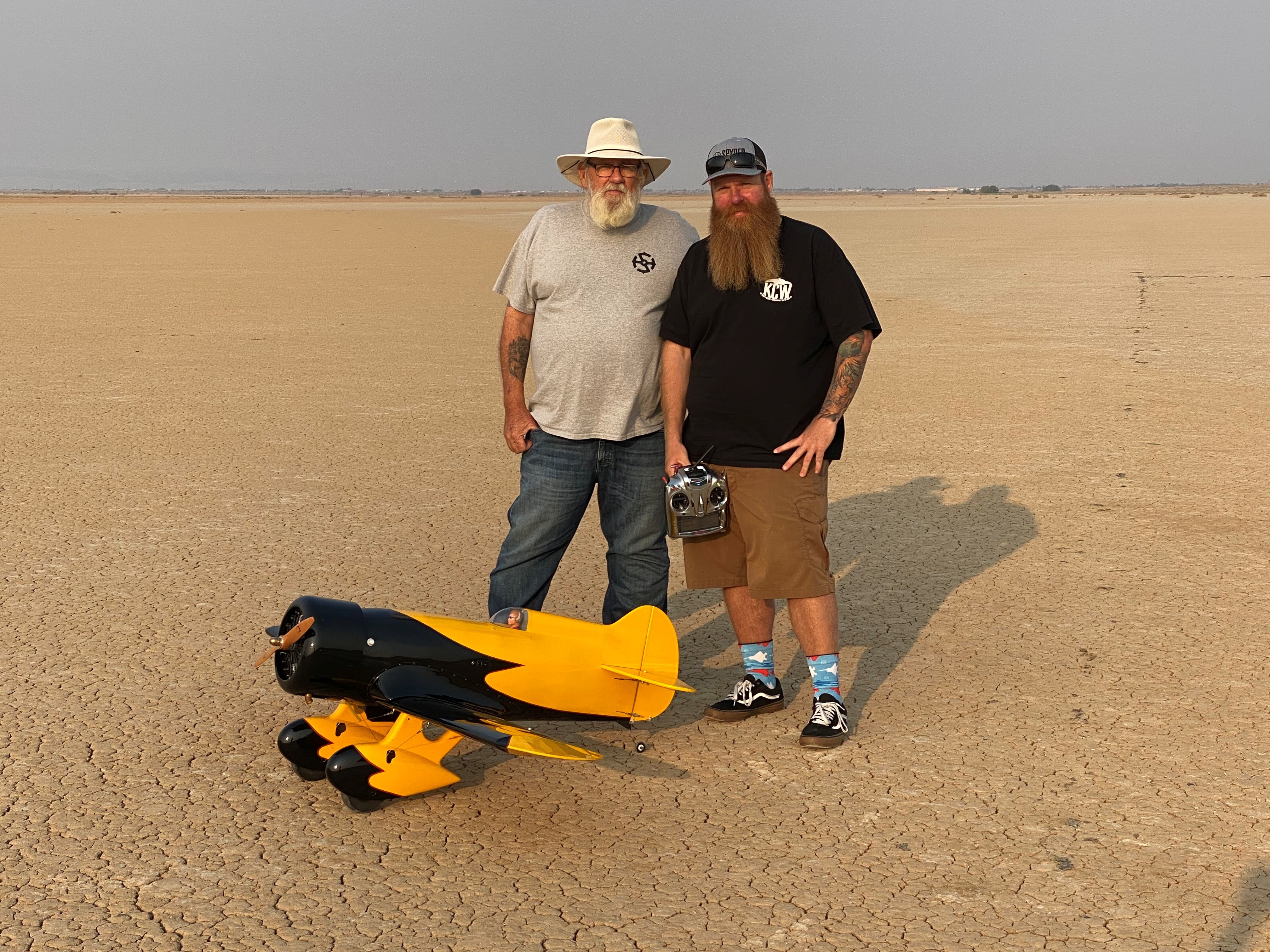
Justin Hall, chief pilot at the Dale Reed Subscale Flight Research Laboratory at NASA’s Armstrong Flight Research Center in Edwards, California, stands in front of a radio-controlled aircraft with his dad, David Hall. David Hall built the Gee Bee aircraft years earlier but was unable to fly it due to his health. He asked his son to fly the aircraft so he could see it in the air, which Justin did the day of this photo. Shortly afterward, David Hall passed away.
Justin Hall
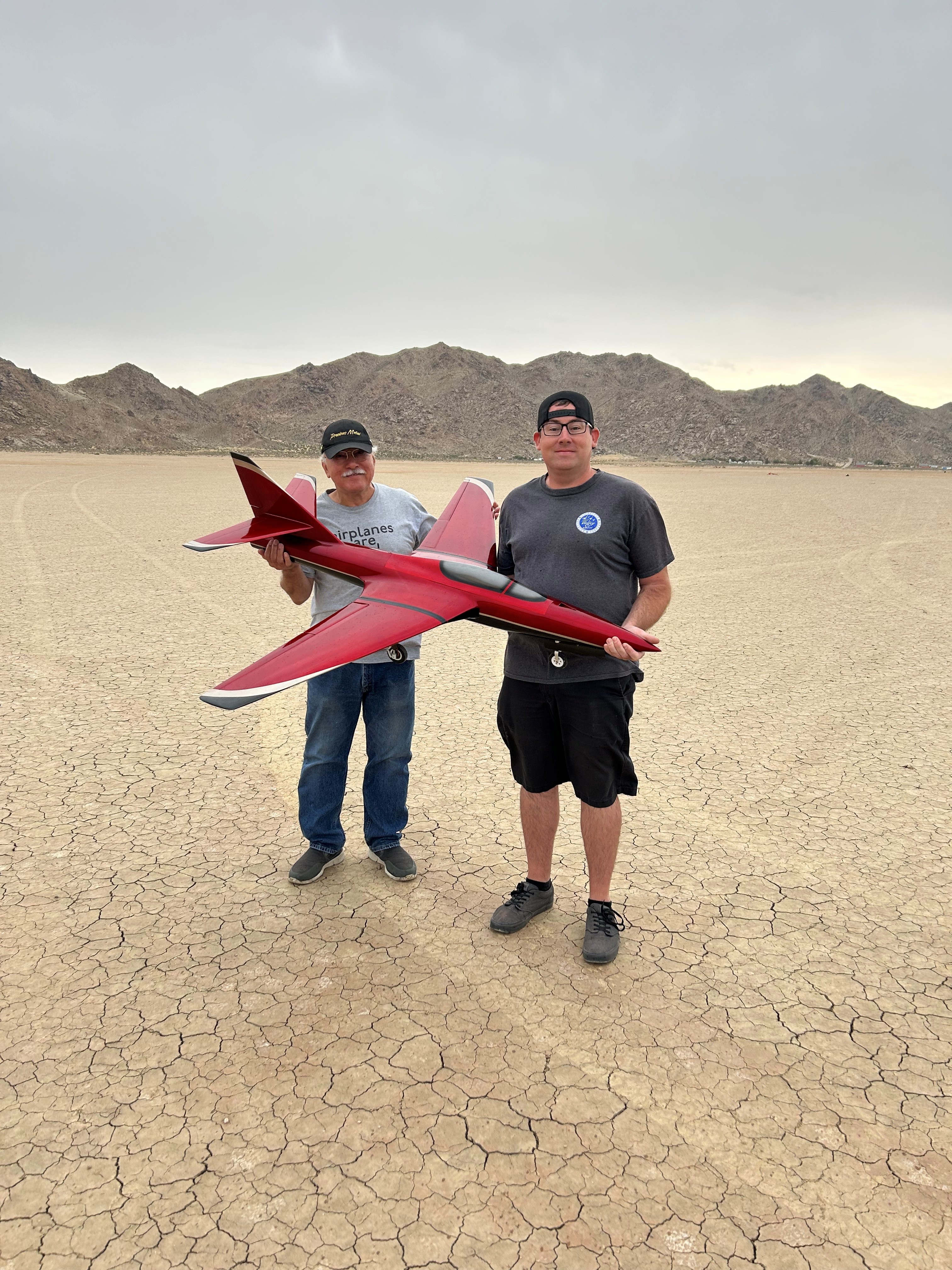
Justin link, drone pilot at the Dale Reed Subscale Flight Research Laboratory at NASA’s Armstrong Flight Research Center in Edwards, California, and his dad, Don Link, hold a Firebird radio-controlled aircraft on the day of its first flight. It was a project they worked on together. Don Link reduced the dimensions of the original larger-scale model aircraft and drew the plans, while Justin Link manufactured composite molds and built the aircraft from scratch.
Justin Link
Link was five years old when he built balsa-wood aircraft with his dad and flew them in a field near their home. As he grew older, his hobby expanded to include radio-controlled cars, boats, helicopters, and aircraft. Aviation runs deep in Link’s family. His great grandfather served in the U.S. Army Air Corps, his grandfathers served in the U.S. Air Force, and his dad was an Air Force avionics technician. Link raced sailplanes, competed with scaled warbird aircraft, and was encouraged by family and friends to pursue an aviation profession. He has worked with large drones for more than 11 years, focusing on research and development, composite materials, and specialized fabrication methods.
Together, the team applies its experience and knowledge in rapid design, fabrication, integration and flight testing to bring new ideas to flight. Their work continues to support NASA’s missions across aeronautics, science, and exploration.
A zoomed-in view of the Moon made from images from NASA’s Lunar Reconnaissance Orbiter Camera. (More information at the bottom of article.)
Credits: NASA Goddard/Intuitive Machines/Robert Wagner
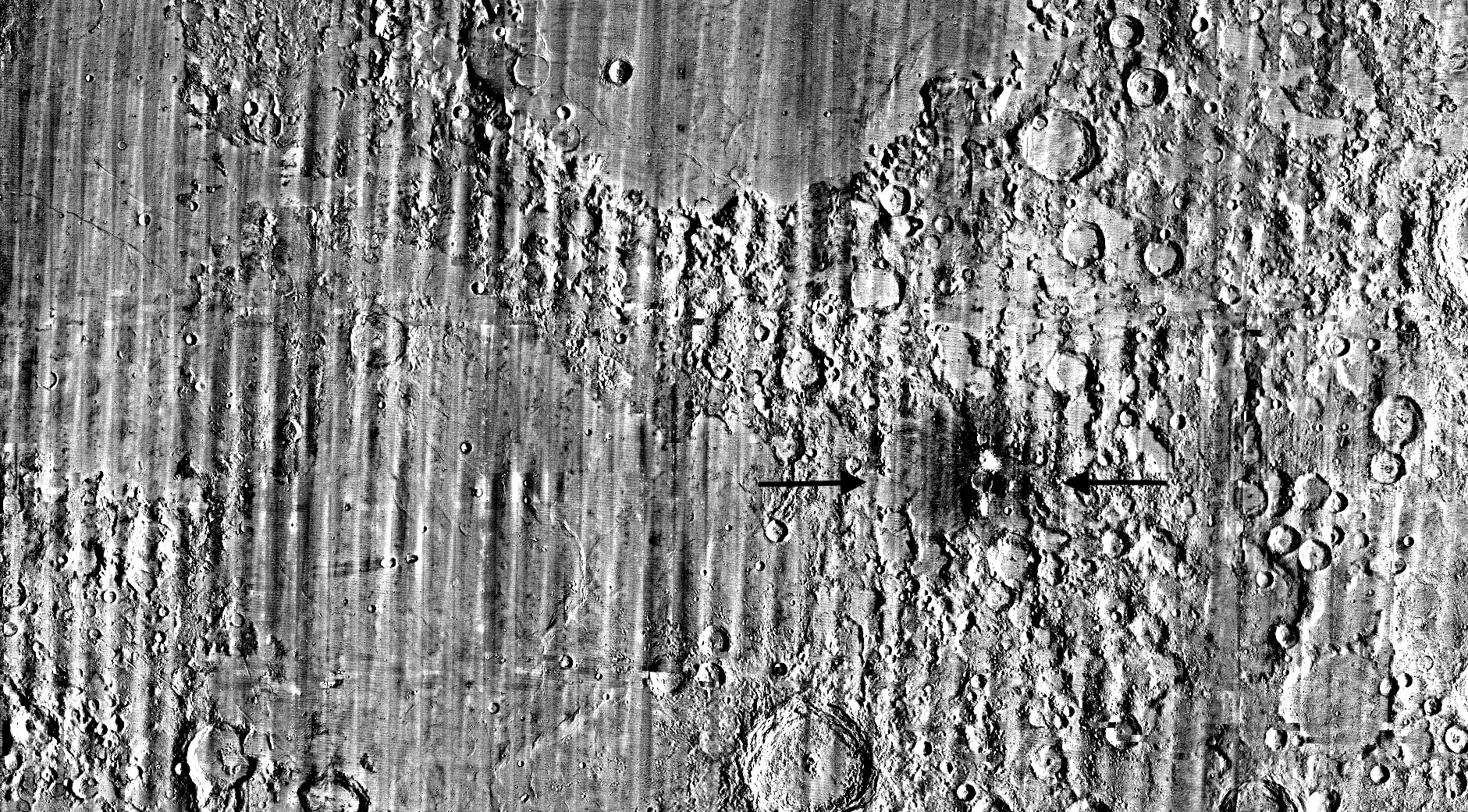
It started as a routine data-quality check. But as Robert Wagner, a scientist with NASA’s Lunar Reconnaissance Orbiter (LRO), scanned a giant Moon map on his computer screen, an unusually large bright spot circled by a dark halo caught his eye, as it implied that surface material in that area had been shaken up.
“I just stopped, dropped everything, and started looking into what that spot was,” said Wagner, an image-processing specialist from Intuitive Machines who works with data from the Lunar Reconnaissance Orbiter Camera (LROC) system.
By comparing before and after images of the Moon, Wagner realized he had discovered the largest, newly formed crater ever found in the solar system, as scientists reported Wednesday in Science Advances. This discovery highlights the value of NASA’s Moon orbiter data in studying a dynamic landscape as the agency advances a sustained human presence and expanded scientific and commercial activity on the Moon.
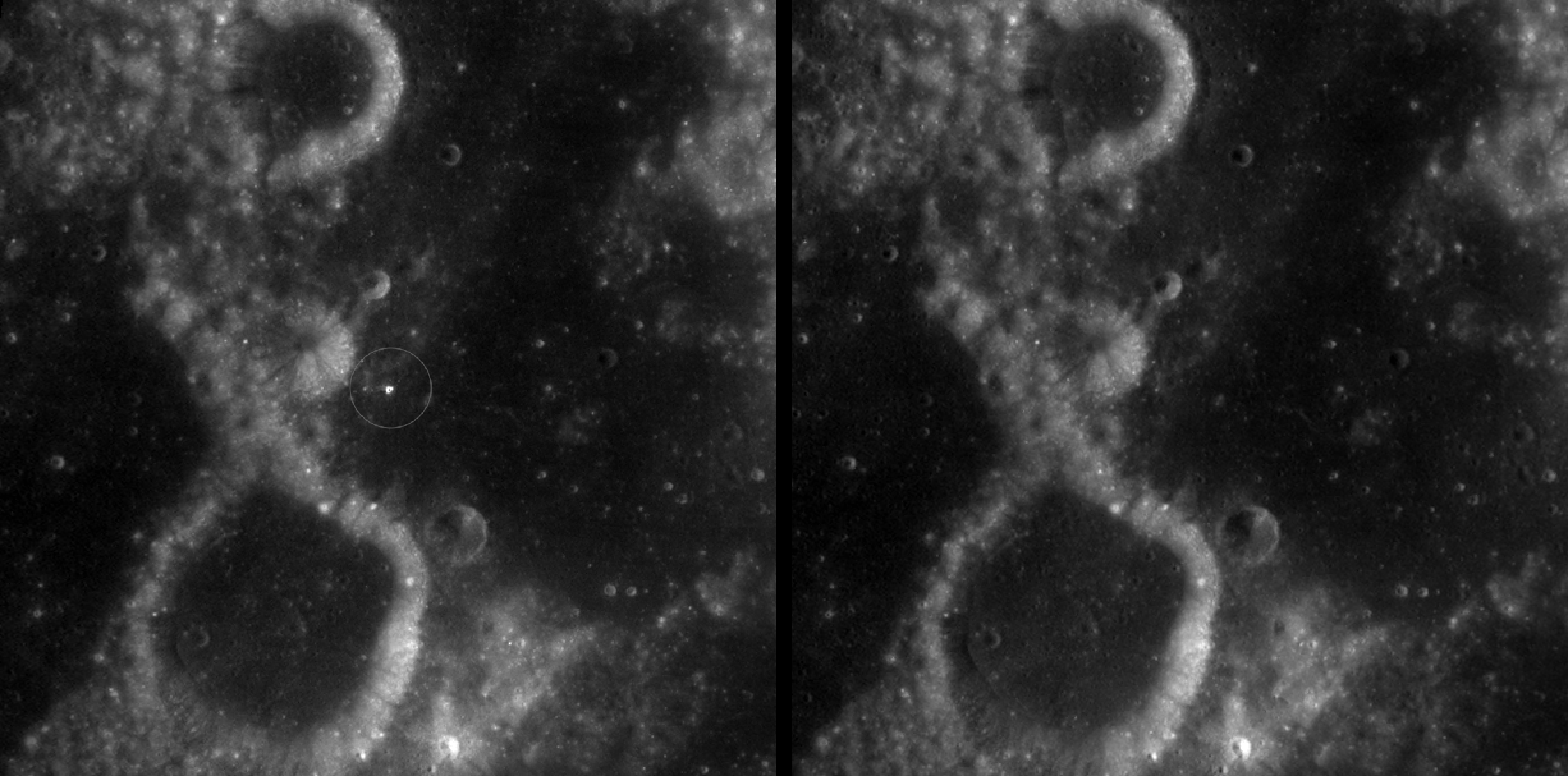
A zoomed-in view of McGetchin crater, circled on the left, next to a “before” image on the right. The panel on the left is made from images captured by NASA’s Lunar Reconnaissance Orbiter Wide-Angle Camera in summer 2025; the right panel was made from images taken in spring 2011. The white spot is not the crater itself, but rather material flung out of the crater, which formed when a rock, possibly this size of a three- to six‑story building, crashed into the Moon between April 11 and May 22, 2024 – a once-in-a-century event, as scientists reported on Sept. 15, 2026, in a pair of papers in Science Advances. The area shown in the images is 38 miles wide.
NASA Goddard/Intuitive Machines/Robert Wagner
Officially named McGetchin after pioneering lunar scientist Tom McGetchin, the crater formed on the Moon’s eastern edge sometime between April 11 and May 22, 2024, after a comet or asteroid the size of a three- to six-story building hit the surface.
The crash left a crater, 728 feet wide, that spans the length of two football fields. And at 141 feet deep, the crater could fit three vertically stacked yellow school buses.
Scientists estimate that an impact of this magnitude happens on the Moon about once in a century or even longer.
Moon takes some hits
For more than 17 years, LRO has been circling the Moon and using its seven instruments to map the topography, surface composition, temperature, and radiation environment there. The spacecraft’s team has identified at least 1,000 new impact craters throughout the mission and flagged 100,000 more surface changes from an object smashing into the Moon or from the debris that flung out after.
With no atmosphere to slow them or burn them up, space rocks and other objects easily reach the lunar surface. Most are much smaller compared to the object that carved out McGetchin crater. The smallest craters scientists can distinguish from LRO images are about 30 feet wide, the length of a three-story building laid on its side, made by rocks about 43 inches wide, the size of a monster-truck tire. Scientists estimate that impacts of this scale produce about 140 new craters across the Moon each year. But most new ones are made by microscopic projectiles that leave holes too small to identify in orbital images.
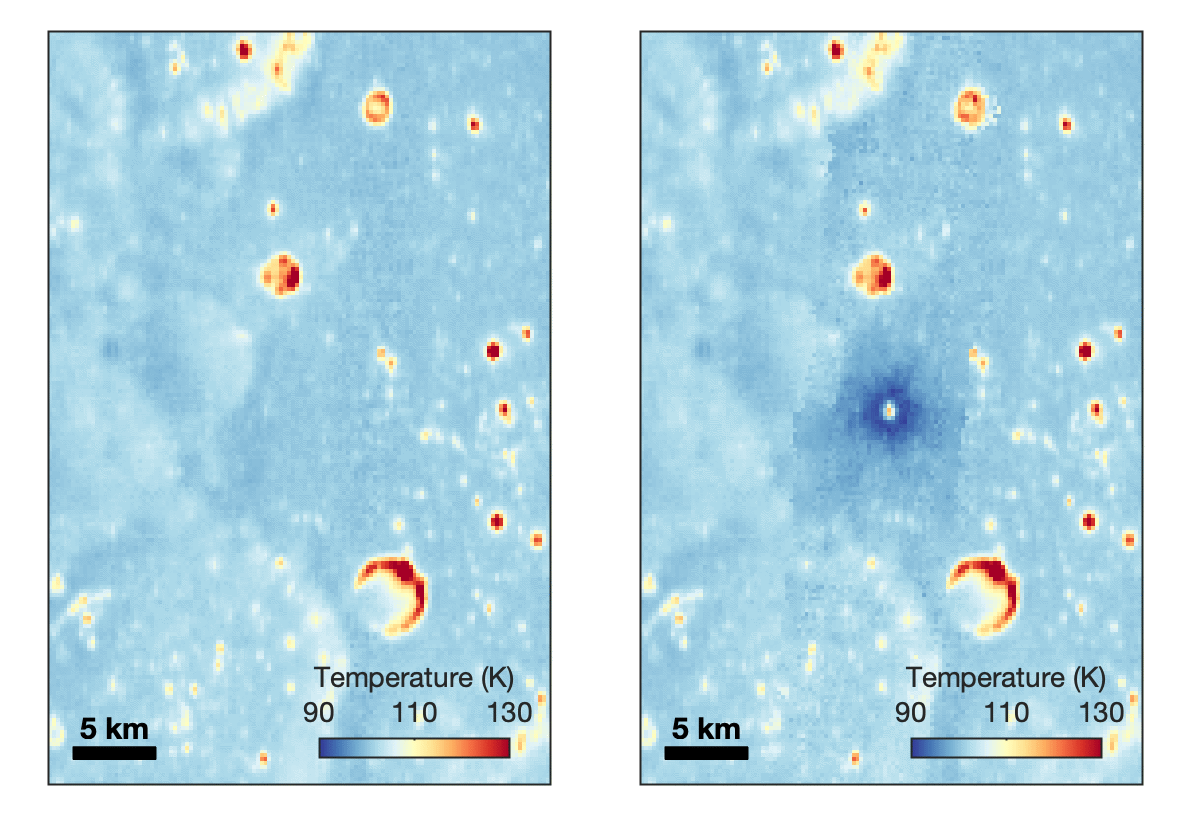
With its numerous instruments, the spacecraft can observe changes to the lunar surface that aren’t apparent in the LROC images alone. After the crater was discovered, scientists working with LRO’s thermal instrument, Diviner, made follow-up observations of the site. They found a 4-mile-wide area around the crater that is about 16 degrees Fahrenheit cooler at night than its surroundings.
This animated image set shows an area on the eastern limb of the Moon before and after McGetchin crater formed there sometime between April 11 and May 22, 2024. The post-impact image was constructed using data taken by NASA’s Lunar Reconnaissance Orbiter (LRO) thermal instrument, Diviner, between Nov. 15, 2025, and Feb. 18, 2026, after scientists discovered the crater in visible-light images taken by LRO’s Wide-Angle Camera. Pre-impact temperatures are from the Diviner Global High-Resolution Mosaics (GHRM). The crater formed on the Moon after a comet or asteroid, possibly the size of a six-story building, hit the surface in a rare, once-in-a-century collision. The dark blue strip that flashes into view reveals a 4-mile-wide “cold spot” around the crater that is about 16 degrees Fahrenheit cooler at night than its surroundings. This cooling happens because an impact fluffs up regolith around a crater, making it less dense and therefore less able to retain heat. Scientists on the Diviner team reported this finding in a paper published on Sept. 16, 2026, in Science Advances. The red and yellow spots indicate areas typically associated with rocks excavated by long-ago impacts which, though still at cryogenic temperatures like their surroundings, remain slightly warmer at night.
NASA Goddard/UCLA/JHU APL
Reporting in a second paper Wednesday in the same journal, researchers say that the cooling happens because the impact fluffs up the regolith around the crater, making it less dense and therefore less able to retain heat.
The large extent of this “cold spot” is striking, scientists say, because it shows that impacts can modify the Moon’s surface far beyond the crater itself. These physical changes could affect how rover wheels interact with the surface, for instance.
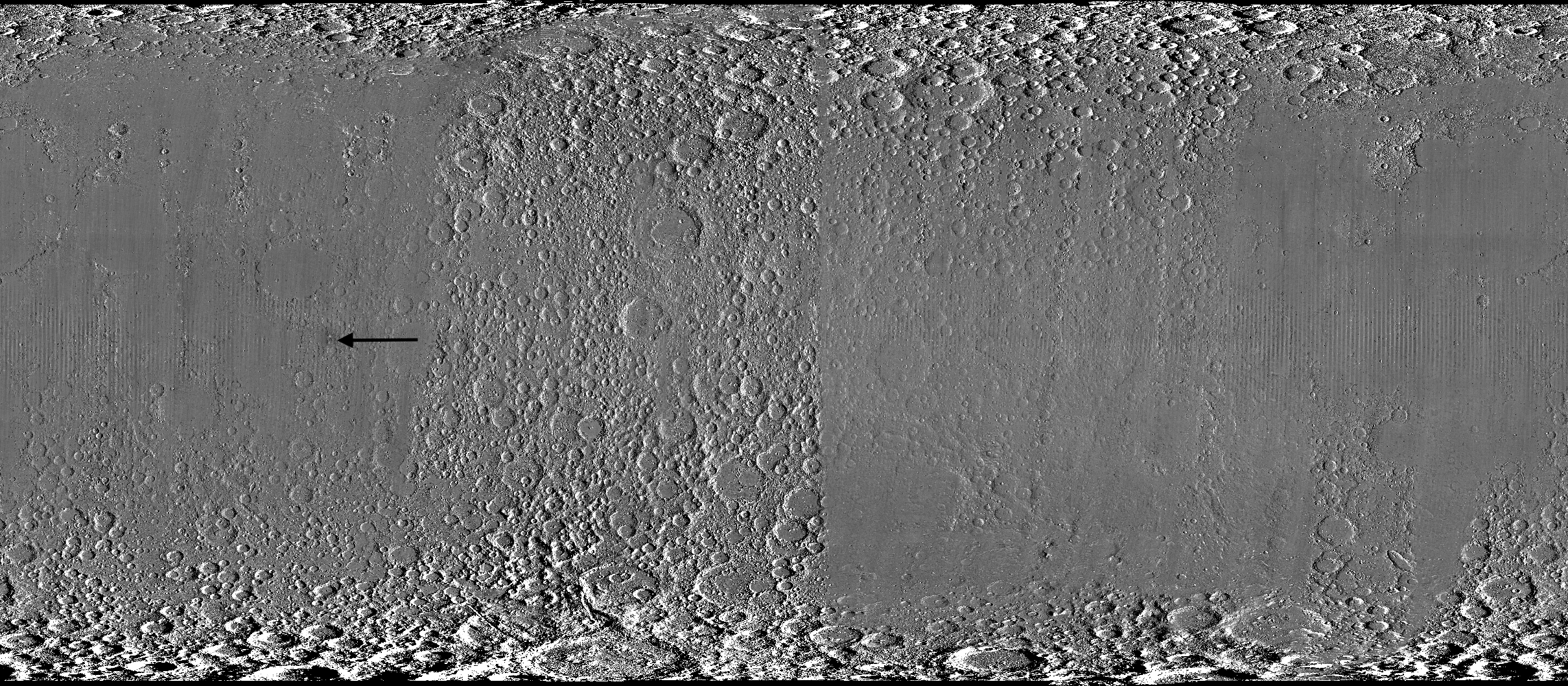
A global view of the Moon made by stitching together hundreds of images from the Wide-Angle Camera aboard NASA’s Lunar Reconnaissance Orbiter (LRO). Robert Wagner, image processing specialist for LRO, made this map using two sets of mages taken several years apart. He used a software designed to highlight any changes between the two sets. Anything that stayed the same turned gray; anything different showed up as bright or dark patches. A black arrow just left of center points to McGetchin crater.
NASA Goddard/Intuitive Machines/Robert Wagner
Road to discovery
The LROC system collects images from about 60 miles above the Moon as LRO loops from pole to pole. The system includes two cameras that capture high‑resolution black‑and‑white images and one camera for moderate‑resolution multispectral images. Over the years and thousands of passes, scientists have built maps detailed enough to spot not only new craters, but also landslides, landers, seismic faults, and even hints of lava tubes.
LROC scientists regularly analyze close-up images of small portions of the Moon’s surface taken by the Narrow-Angle Camera. Using these images, they look for changes that are typically less than 30 feet across. But every few years the team searches for large (wider than 150 feet) features by creating global Moon maps and comparing them to older versions.
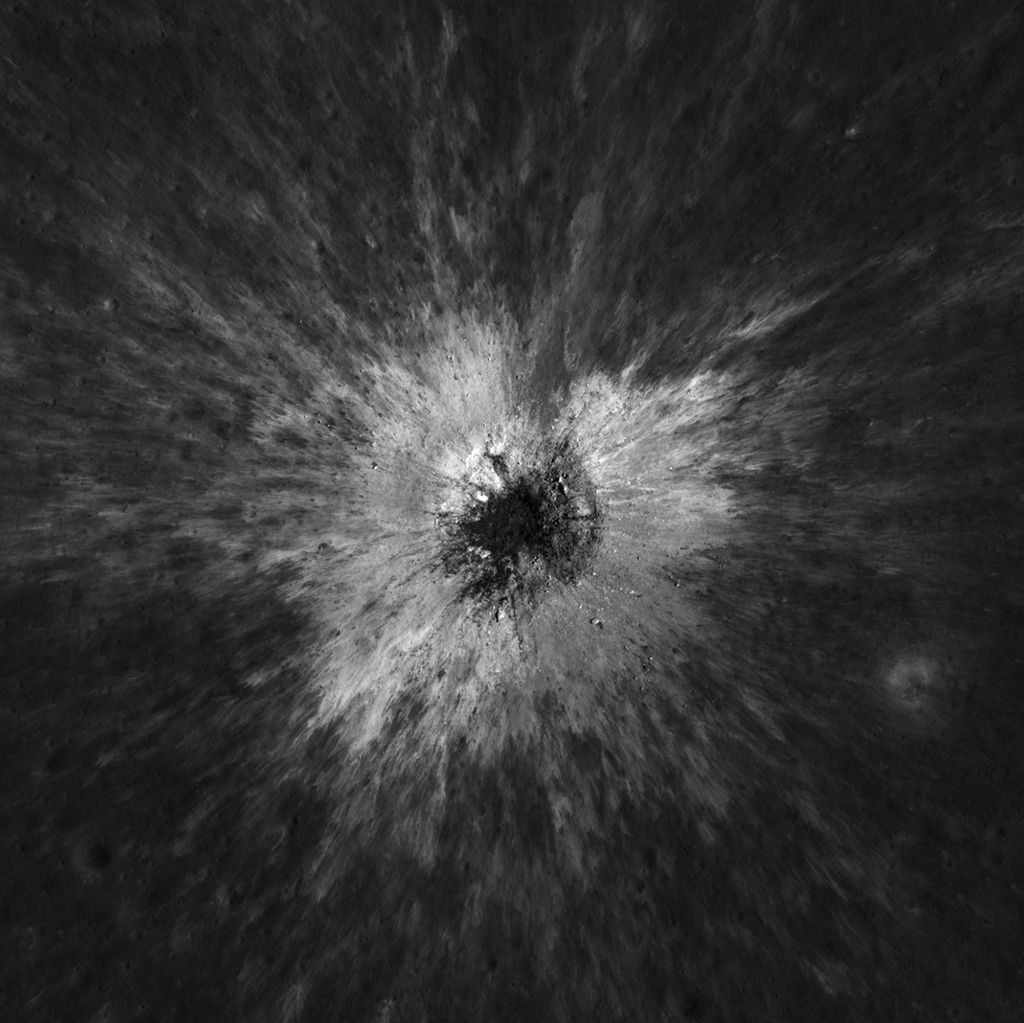
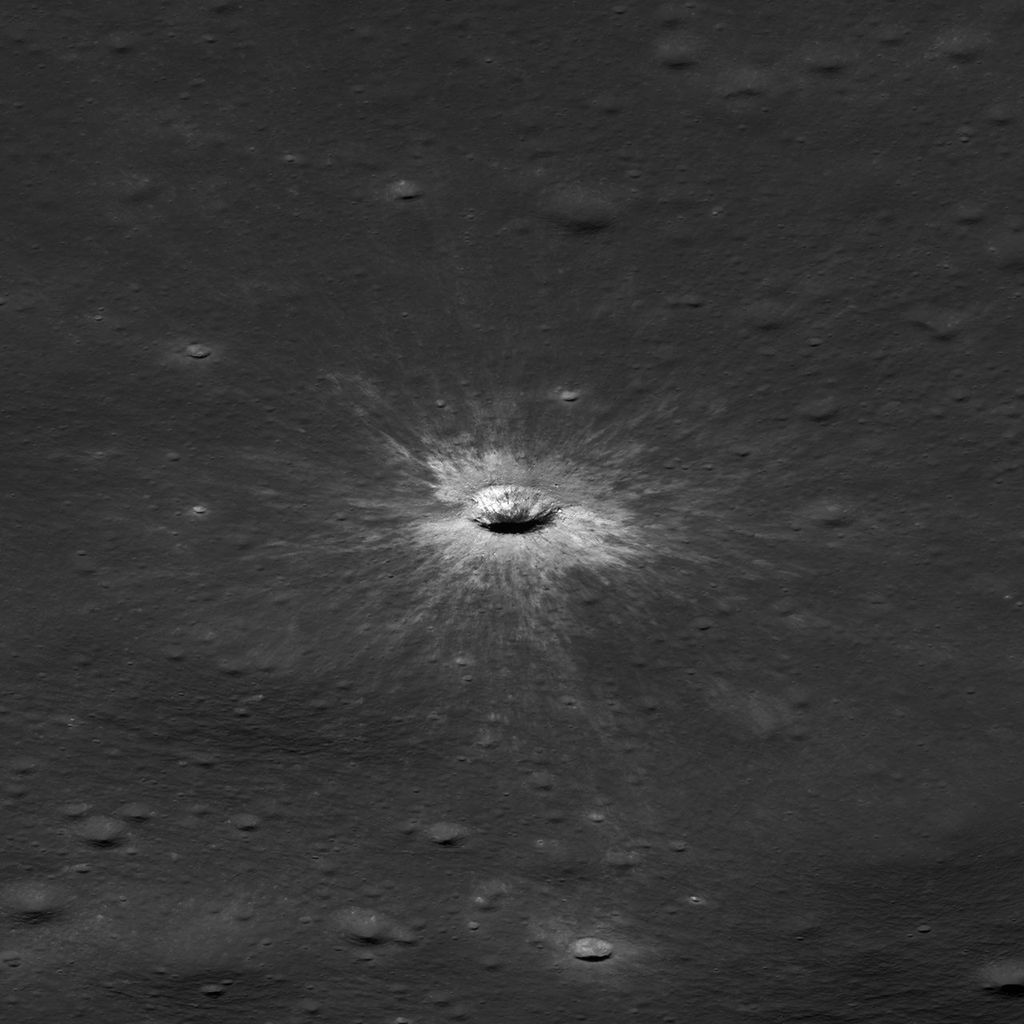
An overhead, close-up view of McGetchin crater that was taken on Dec. 5, 2025, by NASA’s Lunar Reconnaissance Orbiter (LRO) Narrow-Angle Camera (NAC). After the crater was discovered on Oct. 24, 2025, in global images from LRO’s Wide-Angle Camera, which captures broad views with pixels the size of American football fields, scientists turned to the NAC, which takes much sharper views at about 3 feet per pixel. The NAC images, taken as LRO flew over the impact site again, revealed the crater size, shape, and how the surrounding terrain was affected by the impact that carved McGetchin. The image covers an area that’s ¾ mile wide.
NASA Goddard/Intuitive Machines
This view from the side (55° away from straight down) towards the east, covers an area of the Moon that’s about 1.5 miles wide. It was taken by NASA’s Lunar Reconnaissance Orbiter Narrow-Angle Camera on March 3, 2026.
NASA Goddard/Intuitive Machines
That’s what Wagner was doing on Oct. 24, 2025, when he came across McGetchin. Using images from LROC’s Wide-Angle Camera, which captures broad views with pixels the size of football fields, he stacked hundreds of “before” and “after” frames with software designed to highlight change. Anything that stayed the same turned gray while anything different showed up as bright or dark patches.
While the process sounds straightforward, spotting real craters requires a lot of manual work. The software flags every tiny shift in lighting or shadow, generating hundreds of false alarms. For this reason, Wagner typically verifies the software, looking for small fuzzy halos around pixel‑wide bright points, which indicate splashes of regolith around a new crater.
Spanning hundreds of pixels, McGetchin stood out immediately. “It was by far the most obvious impact debris pattern I’ve ever seen in one of these images,” Wagner said.
After his discovery, scientists turned to the Narrow-Angle Camera, which takes much sharper views at about 3 feet per pixel. This camera’s close-up images, taken as LRO flew over the impact site again, revealed the crater size, shape, and how the surrounding terrain was affected. These images also helped researchers estimate the size and force of the rock fragment that formed the new crater, details that are expected to appear in a future paper.
Banner image caption: A zoomed-in view of the Moon, with debris around McGetchin crater visible as a white spot circled by a dark halo just right of center of the image (marked with black arrows). This is the view that Robert Wagner saw on Oct. 24, 2025, during a routine data-quality check. Wagner is an image processing specialist for NASA’s Lunar Reconnaissance Orbiter Camera, a system of three cameras. Using images from the Wide-Angle Camera (WAC), which captures broad views with pixels the size of American football fields, he stacked hundreds of images captured by WAC over the last several years with software designed to highlight change. Anything that stayed the same is gray; anything that changed showed up as bright or dark patches. The stripes in the image are due to slight changes in lighting between the older and newer images. This image composite shows an area of the Moon approximately 900 miles across.
About the Author
Lonnie Shekhtman
Senior Science Writer
Shekhtman helps communicate NASA planetary science to the world through news and feature stories on NASA.gov, videos for NASA+ and YouTube, and by working with the media. She reports on lunar and Mars science and exploration; NASA’s search for life; missions to Venus, Titan, and Jupiter’s Trojan asteroids; and many other topics related to NASA’s exploration of our solar system and beyond.
Scientists discovered a crater on the Moon that formed sometime between April 11 and May 22, 2024, after a comet or asteroid the size of a three- to six-story building hit the surface.
The crash left a crater, 728 feet wide, that spans the length of two football fields. And at 141 feet deep, the crater could fit three vertically stacked yellow school buses.
Curiosity Blog, Sols 5002-5009: Tough Planning To Learn More About Wind-Blown Sediments
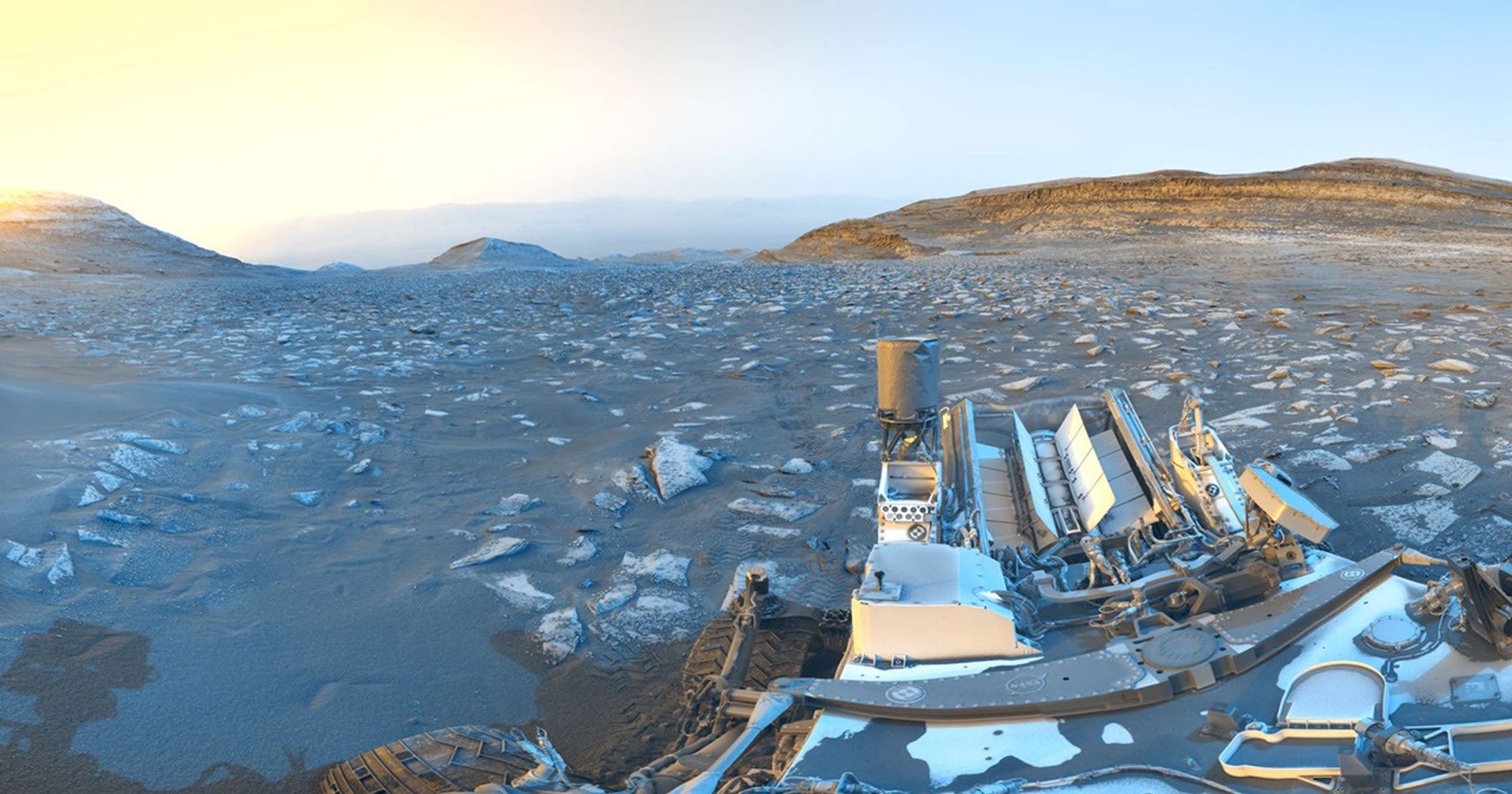
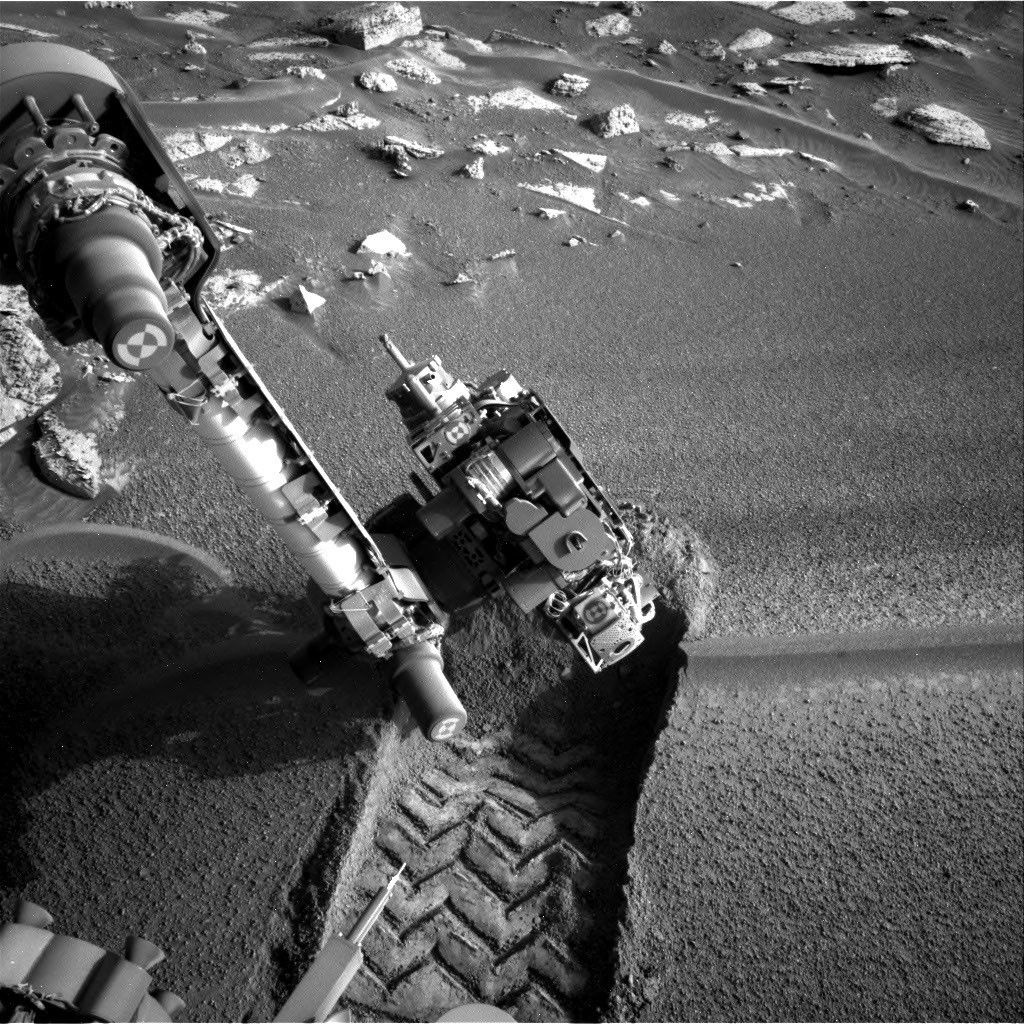
NASA’s Mars rover Curiosity acquired this image of arm operations at “Chocolatal” using its Right Navigation Camera on Sept. 2, 2026 — Sol 5003, or Martian day 5,003 of the Mars Science Laboratory mission — at 19:53:17 UTC.
NASA/JPL-Caltech
Written by Benjamin Tutolo, Professor, University of Calgary
Earth planning date: Friday, Sept. 4, 2026
Curiosity has marked several huge milestones (14 years on Mars; 5,000 sols on Mars; 1 kilometer of elevation gain since landing) over the past several weeks, and the team has duly celebrated these remarkable achievements. These celebrations punctuate the rover’s otherwise very busy and data-filled exploration of Mount Sharp, of which this week was another in a long succession of discoveries.
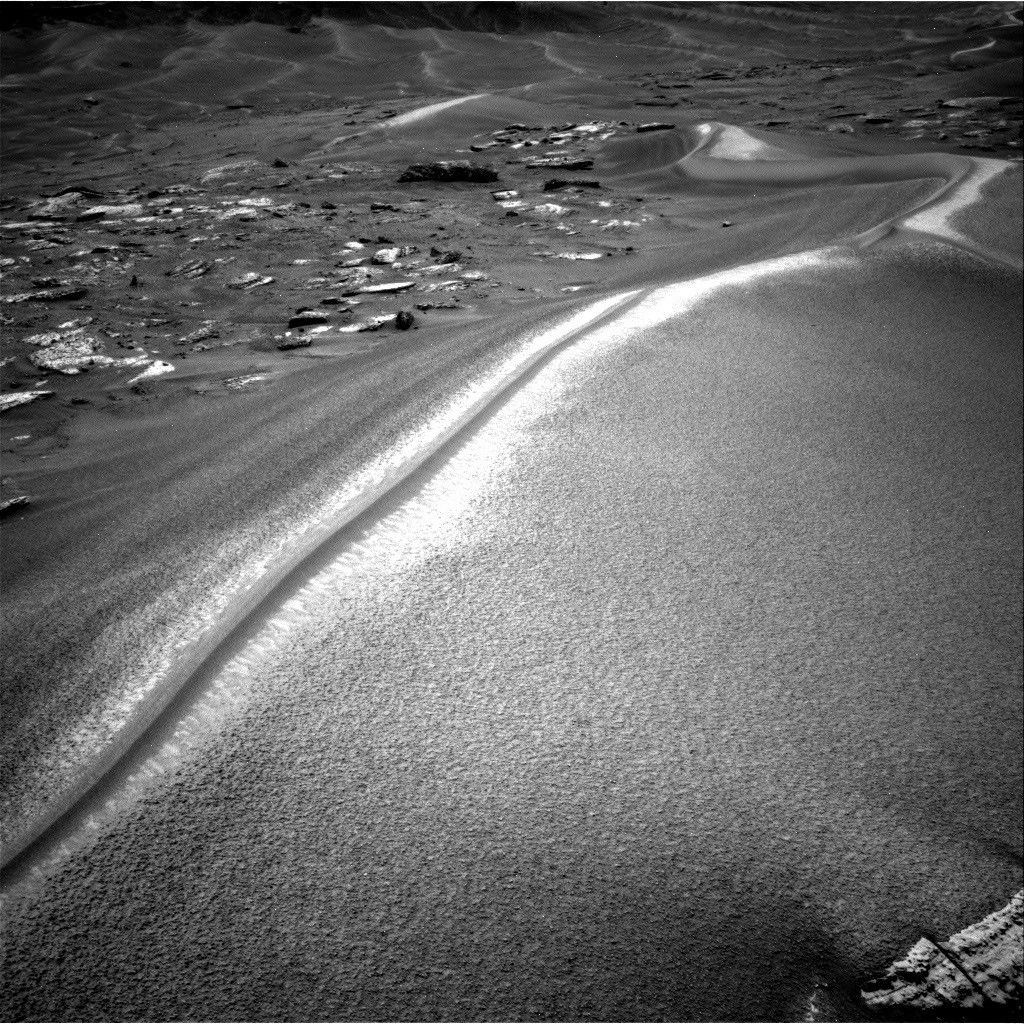
The team planned instrument activities that involved unstowing the arm on Sols 5003 and 5004 to continue investigations of the wind-formed long, narrow large ripple “Chocolatal” (see last week’s blog: “Curiosity Blog, Sols 4995-5001: 5,000 (Martian) Days on Mars”), followed by a short drive on sol 5004.
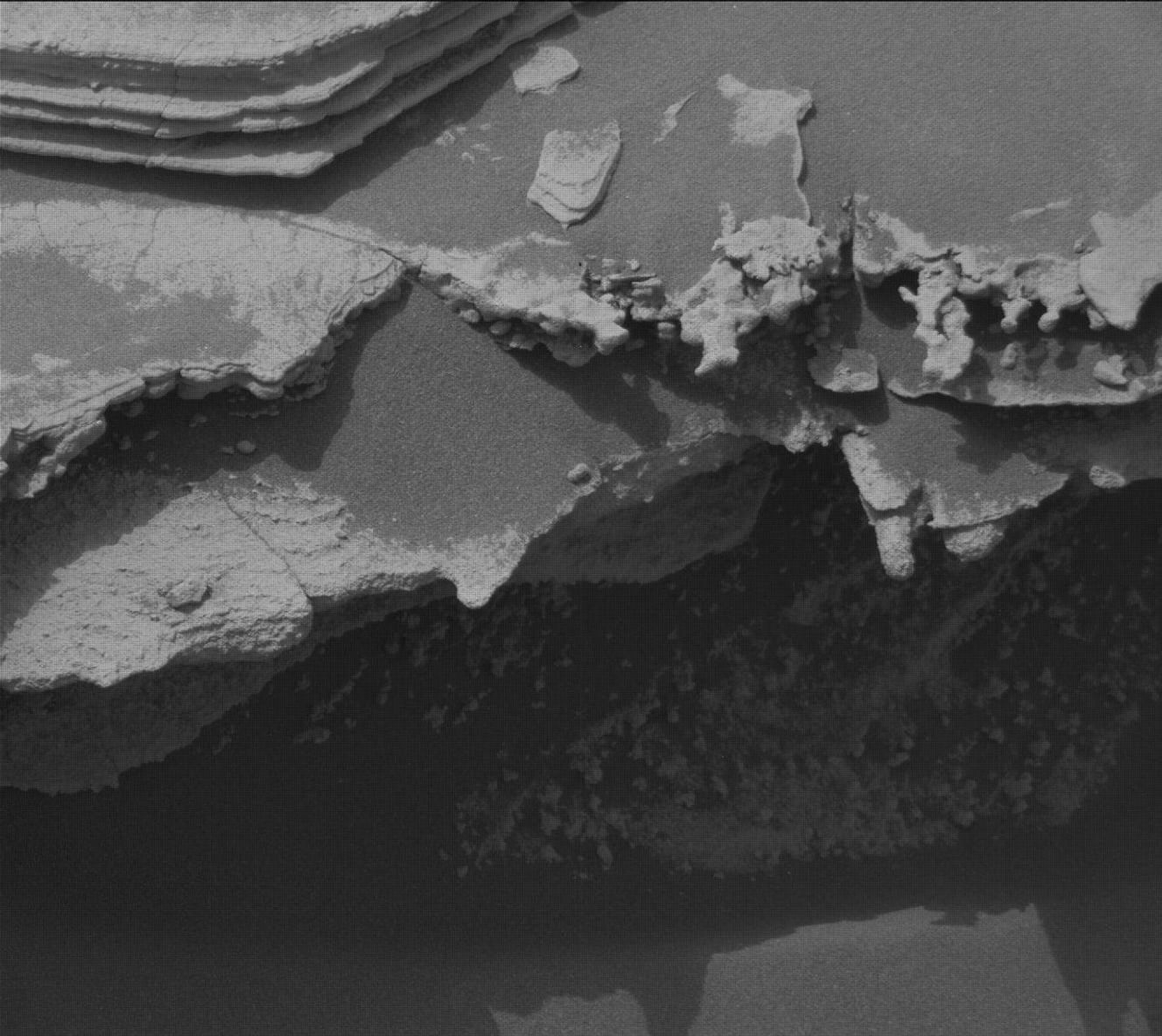
Planning for the arm activities on Monday was complex, with APXS chemical analyses and MAHLI imaging of targets within the wheel scuff and on top of the undisturbed ripple (seen in the image above), and a MAHLI “Dog’s Eye” image mosaic acquired on the way of the scuff. The team worked hard developing the plan for these arm activities this Monday due to the particular complexity of the MAHLI “Dog’s Eye” mosaic image. While the MAHLI instrument is frequently used to image features on the Martian surface from above, Dog’s Eye mosaics are reserved for targets we want to see edge-on, similar to how a dog close to ground may view a surface. In this instance, the team was interested in looking at potential layers visible on the sides of the sand scuff.
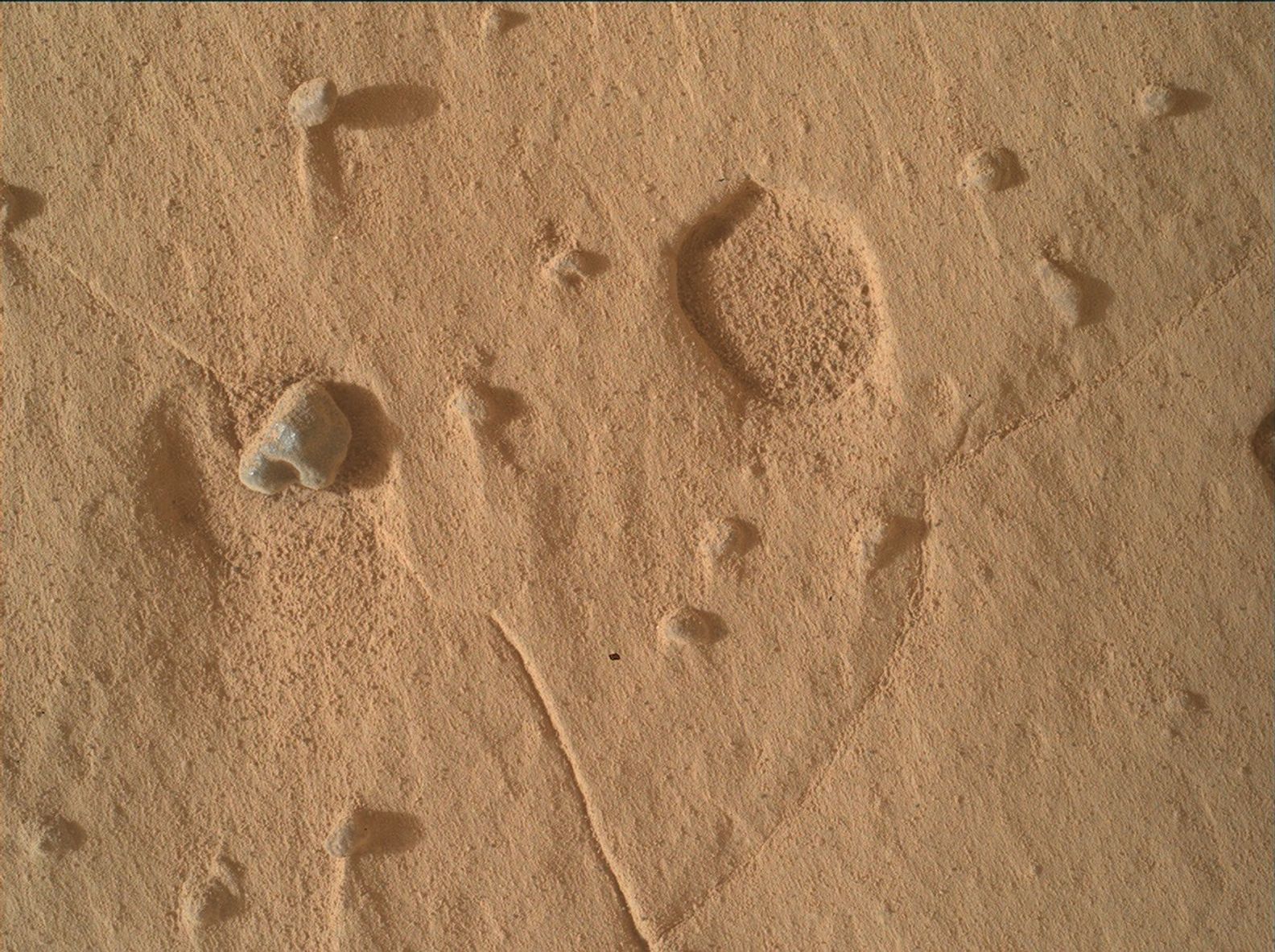
The end-of-week plan for activities over the Labor Day weekend in the United States and here in Canada includes APXS, MAHLI, and ChemCam analyses of the interesting gray stone that caught the team’s collective eye. Interestingly, the bedrock surrounding this stone appears to contain large nodules, which we have not seen for some time. The Mastcam instrument will be pointed back toward the Chocolatal area, and ChemCam will image and collect a couple of other LIBS observations on several interesting patches of the local geology.
Discover the cosmos! Each day a different image or photograph of our fascinating universe is featured, along with a brief explanation written by a professional astronomer.
Webb’s View of M64
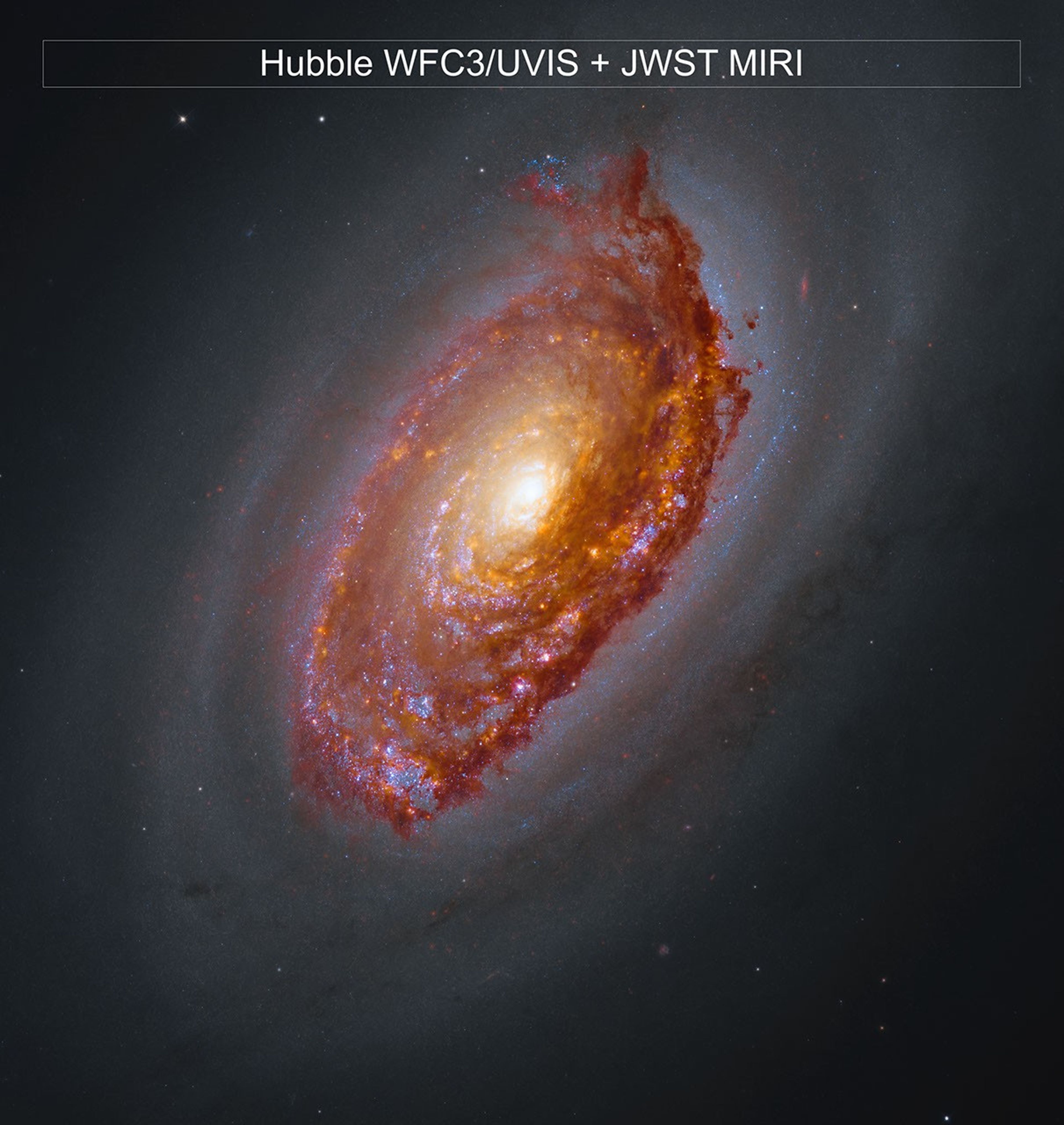
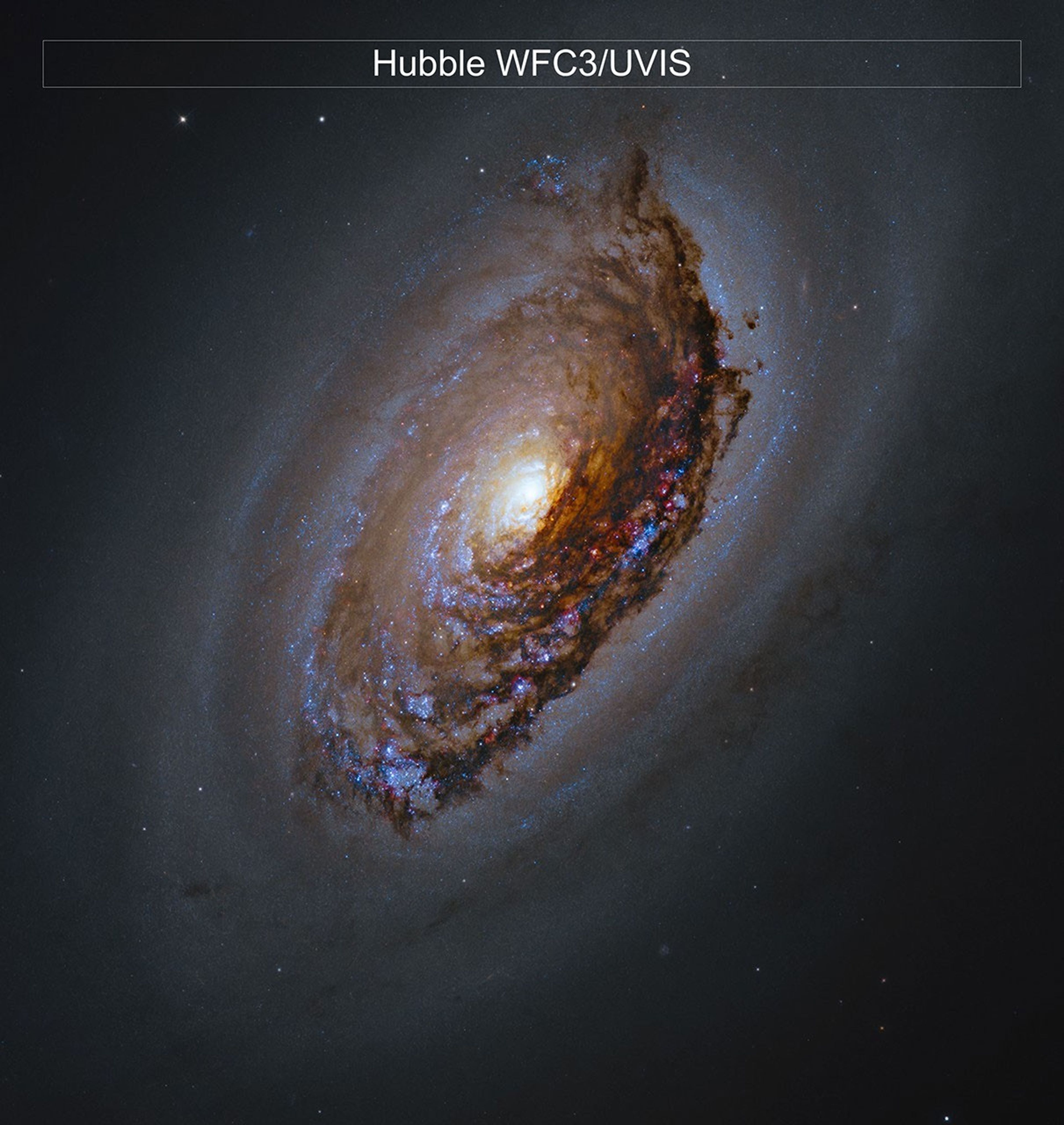
Explanation: Sometimes where Hubble finds darkness, Webb sees light. An example is today’s composite images of Messier 64 (M64), a nearby spiral galaxyof many names. The dark band of dust partially blocking its bright core earned it the moniker “the Black Eye Galaxy.” Webb’s Mid-InfraRed Instrument (MIRI) sees that dust, shown in red, as it absorbs and re-emits light from surrounding newborn stars. These young stars are embedded in pink star-forming regions in the Hubble-only image. M64’s inner and outer gas regions counter-rotate, creating regions of increased star formation where the two gas “currents” meet and compress. A merger between M64 and a smaller galaxy was likely the cause of the opposing motion of the outer gas. Spiral galaxies were once thought to have peaceful histories. M64 was key evidence that spiral galaxies, including the Milky Way, can and do experience mergers. Webb’s view of M64 will tell astronomers about the structure, motion, and composition of the galaxy’s dust and add context to the galaxy’s merger history and evolution.