Saturday, 27 September 2025

From City Lights to Moonlight: NASA Training Shows How Urban Parks Can Connect Communities with Space Science

4 min read

From City Lights to Moonlight: NASA Training Shows How Urban Parks Can Connect Communities with Space Science

When you think about national park and public land astronomy programs, you might picture remote locations far from city lights. But a recent NASA Earth to Sky training, funded by NASA’s Science Activation Program, challenges that assumption, demonstrating how urban parks, wildlife refuges, museums, and green spaces can be incredible venues for connecting communities with space science. Programs facilitated in urban spaces can reach people where they already live, work, and recreate. This creates opportunities for ongoing engagement as urban astronomy program participants can discover that the skies above their neighborhoods hold the same wonders as remote locations.

During the first week of August in 2025, NASA Earth to Sky collaborated with the National Park Service and U.S. Fish and Wildlife Service to deliver an innovative astronomy training program called “Rivers of Stars and Stories: Interpreting the Northern Night Sky” at Minnesota Valley National Wildlife Refuge in Minneapolis-St. Paul. This three-day course brought together 28 park ranger interpreters, environmental educators, and outdoor communicators from across the Twin Cities area. Presentations and discussions centered around engaging urban audiences with the wonders of space science by leveraging the benefits of metropolitan spaces and the unique opportunities that city skies provide.

Throughout this immersive training, participants explored everything from lunar observations and aurora science to NASA’s Artemis Program and astrobiology. The training empowered participants by affirming that everyone is an effective stargazer and night sky storyteller, transforming beginners into confident astronomy communicators. One participant captured their experience by noting they went from “not knowing much of anything to having a much better grasp on basic concepts and most importantly, where to find more resources!” In addition to sharing resources, this training also launched a community of practice where communicators can continue to collaborate. Participants engaged in discussions on how to respectfully incorporate the local indigenous perspectives into astronomy programming and honor the traditional stewards of the land while avoiding appropriation or misrepresentation of indigenous science.

The course also created a lasting community connection to NASA through presentations by NASA experts and demonstrations of NASA activity toolkits. As one participant noted in the evaluation, “This is just the start of a long learning journey, but I know now where to look and how to find answers.” Toolkits and resources shared included GLOBE (Global Learning & Observation to Benefit the Environment) Observer’s NUBE (cloud) game, Our Dynamic Sun by the NASA Heliophysics Education Activation Team (HEAT) and the Night Sky Network, the Aurorasaurus Citizen Science project, and the local Solar System Ambassador Network.

Participants’ sense of belonging to the Earth to Sky community increased dramatically. These outcomes support NASA’s strategic goal of building sustained public engagement with Earth and space science. The overwhelmingly positive feedback, with 100% of participants expressing interest in taking more courses like this, demonstrates the tremendous value it is for Earth to Sky to collaborate with the National Park Service and US Fish and Wildlife Service, as all agencies’ public communication goals are addressed.

This kind of collaborative work is crucial because it builds a network of science communicators who can reach thousands of visitors across Minneapolis-St. Paul’s parks, nature centers, and outdoor spaces. By training local informal educators to confidently share NASA’s discoveries and missions, the program expands access to space science for urban audiences throughout the Twin Cities region.

The Earth to Sky team will continue fostering these valuable partnerships with the National Park Service and U.S. Fish and Wildlife Service, as well as other state and local agencies and nonprofit organizations. Learn more about Earth to Sky’s work with park interpreters and nonformal educators to share NASA space science by visiting: https://science.nasa.gov/sciact-team/earth-to-sky/

Learn more about how Science Activation connects NASA science experts, real content, and experiences with community leaders to do science in ways that activate minds and promote deeper understanding of our world and beyond: https://science.nasa.gov/learn/about-science-activation/.
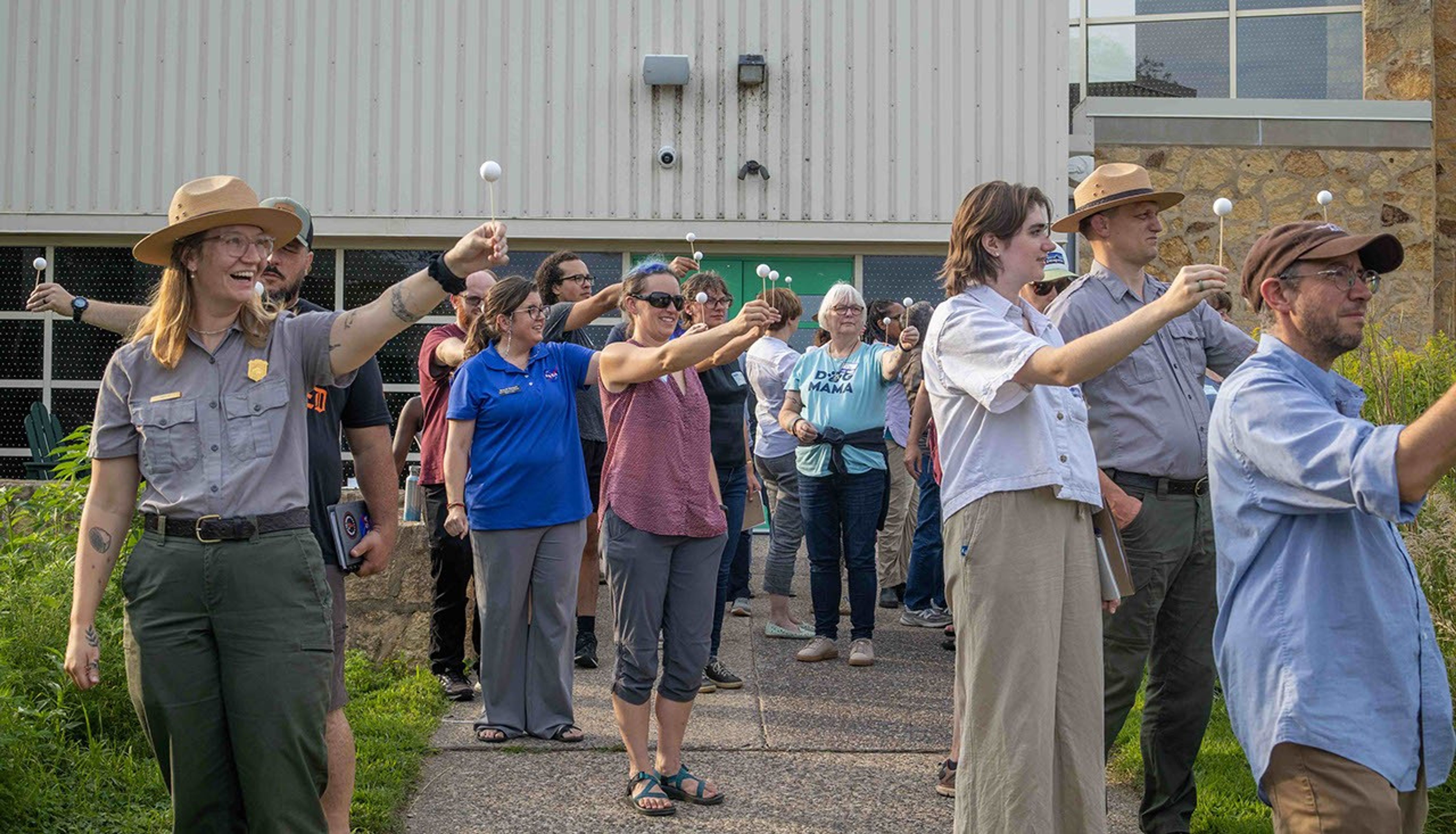
A group of people stand outside holding white Styrofoam balls on a stick with arms outstretched to model moon phases.
Participants of the “Rivers of Stars and Stories: Interpreting the Northern Night Sky” training model moon phases outside of the Minnesota Valley National Wildlife Refuge Education Center.
NASA Earth to Sky

Share

Details

Last Updated
Sep 26, 2025
Editor
NASA Science Editorial Team


from NASA https://ift.tt/rsJjHRe
NASA Awards Custodial, Landscaping Services Contract

NASA has selected Melwood Horticultural Training Center Inc. of Upper Marlboro, Maryland, to provide custodial, janitorial, landscaping, and recycling services for the agency’s Goddard Space Flight Center in Greenbelt, Maryland.

The Facilities Custodial and Landscaping award is a firm-fixed-price hybrid completion and indefinite-delivery/indefinite-quantity contract. The contract includes one 12-month base period and up to four 12-month options with a potential contract value of approximately $36 million if all options are exercised. The basic period of performance begins Wednesday, Oct. 1, 2025, and ends Sept. 30, 2026. The four option periods, if exercised, would extend the contract through Sept. 30, 2030.

For information about NASA and agency programs, visit:

https://www.nasa.gov/

-end-

Robert Garner
Goddard Space Flight Center, Greenbelt, Md.
301-286-5687
rob.garner@nasa.gov


from NASA https://ift.tt/D0l1QU6

NASA Helps Connect Astronomers and Community Colleges Across the Nation

3 min read

NASA Helps Connect Astronomers and Community Colleges Across the Nation

The NASA Community College Network (NCCN) and the American Astronomical Society (AAS) have teamed up to provide an exciting and impactful program that brings top astronomy researchers into the classrooms of community colleges around the United States.

The Harlow Shapley Visiting Lectureship Program, named for astronomer Harlow Shapley (1885-1972), has a history dating back to the 1950s, when it provided support for a scientist to give a series of astronomy-themed lectures at a college or university, coupled with a public talk to the local community. In 2024, AAS partnered with NCCN to broaden the impact of the Shapley lectureship program to community colleges, making use of NCCN’s existing network of 260 college instructors across 44 states and 120 participating Subject Matter Experts (SME) to “matchmake” community colleges with astronomers.

NCCN has supported the teaching of astronomy at community college since 2020. Community colleges serve a vital role in STEM education, with one-third of their students being first-generation college attendees and 64% being part-time students working jobs and raising families. Factor in that up to 40% of students taking introductory astronomy courses nationally each year do so at a community college, and the motivation behind NCCN and the initiatives of the AAS become clear.

In 2024, the pilot collaboration between NCCN and the AAS matched two community colleges — Chattanooga State Community College in Tennessee and Modesto Junior College in California — with SMEs from University of Virginia and Stanford University. In 2025, nine NCCN subject matter experts are engaging with 14 community colleges in six states. They are:

Joe Masiero (Caltech) at Grossmont Community College CA
Vivian U (Caltech) at Scottsdale & Chandler Gilbert Community Colleges AZ
Dave Leisawitz (NASA) & Michael Foley (Harvard) at Elgin Community College IL
Michael Rutkowski (MN State) at Dallas Area Colleges (five colleges) TX
Joe Masiero (Caltech) at Mt. San Jacinto College, Menifee Campus CA
Quyen Hart (STScI) at Casper College WY
Nathan McGregor (UCSC) at Yakima Valley College WA
Patrick Miller (Hardin-Simmons) at Evergreen Valley College CA
Kim Arcand (Harvard-Smithsonian) at Anne Arundel Community College MD
Natasha Batalha (NASA) at Modesto Junior College CA

Each visit of an AAS Shapley Lecturer is unique. The center of each event is the public Shapley Lecture, which is broadly advertised to the local community. Beyond the Shapley Lecture itself, host institutions organize a variety of local engagement activities – ranging from star parties and classroom visits to meeting with college deans and faculty – to make the most of their time with the Shapley Lecturer.

Astronomy instructor James Espinosa from Weatherford College said, “[The visiting Shapley Lecturer’s] visit made a permanent change in how my classes will be taught, in the sense that ‘honors’ projects will be available for ambitious students. I intend to keep in touch with him for several years to come, which is a big impact for our present and future students.”

Dr. Tom Rice, AAS Education Program Manager and AAS lead on the partnership with NCCN, stated, “The AAS’s Harlow Shapley Visiting Lectureship Program represents one of the most impactful ways that astronomers can share our scientific understanding with the widest possible audience, and I am very proud that we have partnered with the SETI Institute and NASA to bring astronomers to their network of community colleges.”

NCCN is supported by NASA under cooperative agreement award number 80NSSC21M0009 and is part of NASA’s Science Activation Portfolio. Learn more about how Science Activation connects NASA science experts, real content, and experiences with community leaders to do science in ways that activate minds and promote deeper understanding of our world and beyond: https://science.nasa.gov/learn/about-science-activation/.

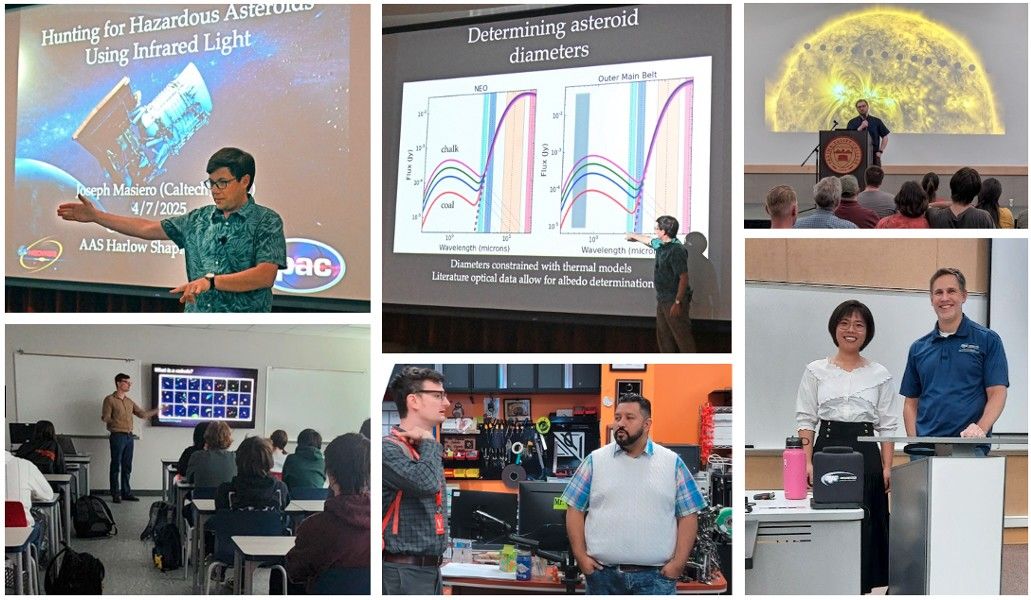
Montage of images of scientists during their visits as Shapley Lecturers. A scientist gives a presentation showing images of a spacecraft and the Sun. A scientist talks to a college instructor, and another scientist poses for a photo with an instructor.
Shapley Lecturers in action.


from NASA https://ift.tt/WwoCPrX

Friday, 26 September 2025

Hubble Captures Puzzling Galaxy

2 min read

Hubble Captures Puzzling Galaxy

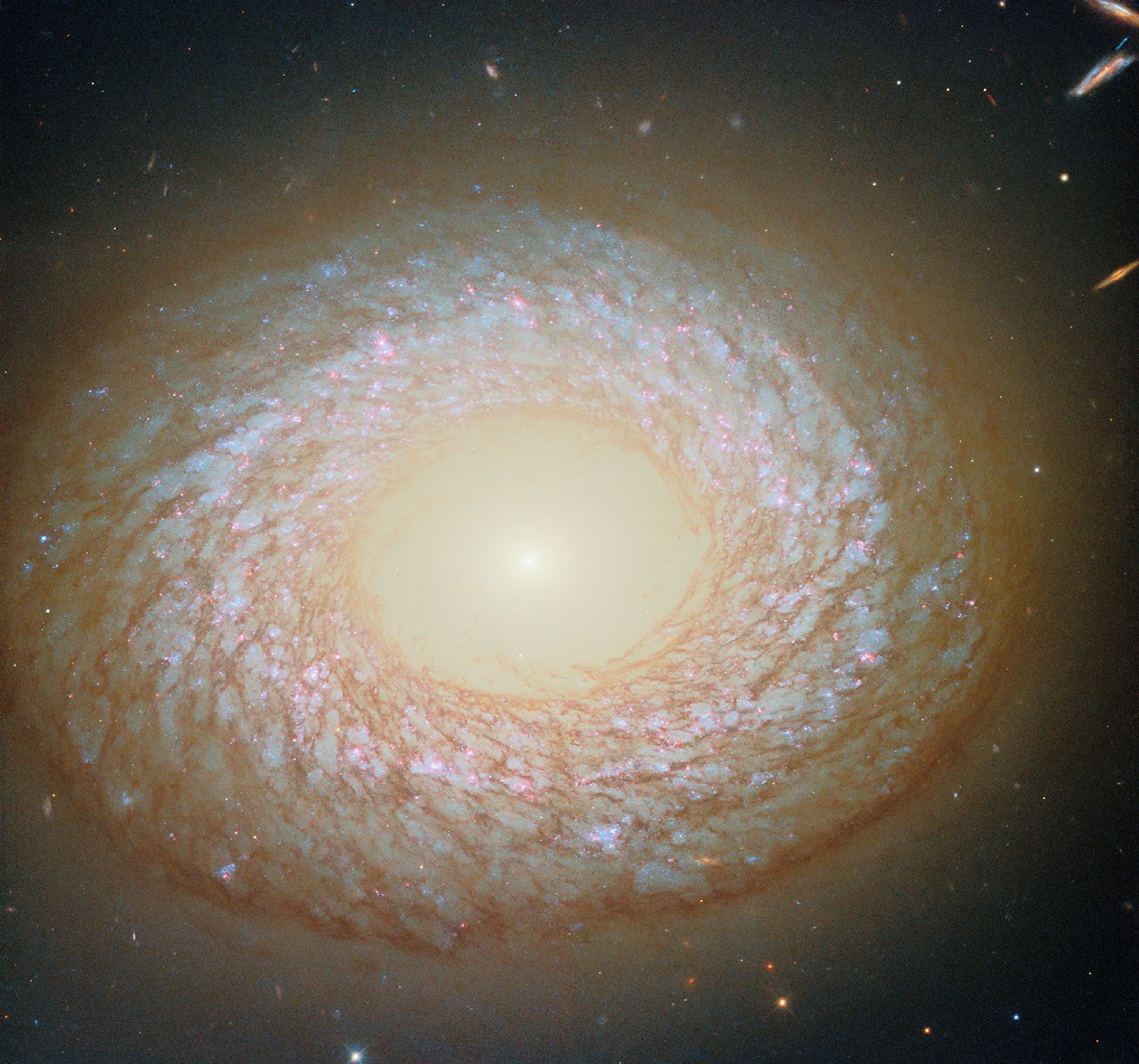
A galaxy seen face-on, with a slightly elliptical disk that appears to have a hole in the center like a doughnut. In the hole, the core is a brightly glowing point that shines light out beyond the edge of the disk. Around the hole is an inner ring of dust, and at the galaxy’s edge is a thicker outer ring of dust, with a swirling web of dust strands in between. Blue stars and red nebulae are visible behind the dust.
This NASA/ESA Hubble Space Telescope image features the galaxy NGC 2775.
ESA/Hubble & NASA, F. Belfiore, J. Lee and the PHANGS-HST Team

This NASA/ESA Hubble Space Telescope image features a galaxy that’s hard to categorize. The galaxy in question is NGC 2775, which lies 67 million light-years away in the constellation Cancer (the Crab). NGC 2775 sports a smooth, featureless center that is devoid of gas, resembling an elliptical galaxy. It also has a dusty ring with patchy star clusters, like a spiral galaxy. Which is it: spiral or elliptical — or neither?

Because we can only view NGC 2775 from one angle, it’s difficult to say for sure. Some researchers classify NGC 2775 as a spiral galaxy because of its feathery ring of stars and dust, while others classify it as a lenticular galaxy. Lenticular galaxies have features common to both spiral and elliptical galaxies.

Astronomers aren’t certain of exactly how lenticular galaxies come to be, and they might form in a variety of ways. Lenticular galaxies might be spiral galaxies that merged with other galaxies, or that have mostly run out of star-forming gas and lost their prominent spiral arms. They also might have started out more like elliptical galaxies, then collected gas into a disk around them.

Some evidence suggests that NGC 2775 merged with other galaxies in the past. Invisible in this Hubble image, NGC 2775 has a tail of hydrogen gas that stretches almost 100,000 light-years around the galaxy. This faint tail could be the remnant of one or more galaxies that wandered too close to NGC 2775 before being stretched apart and absorbed. If NGC 2775 merged with other galaxies in the past, it could explain the galaxy’s strange appearance today.

Most astronomers classify NGC 2775 as a flocculent spiral galaxy. Flocculent spirals have poorly defined, discontinuous arms that are often described as “feathery” or as “tufts” of stars that loosely form spiral arms.

Hubble previously released an image of NGC 2775 in 2020. This new version adds observations of a specific wavelength of red light emitted by clouds of hydrogen gas surrounding massive young stars, visible as bright, pinkish clumps in the image. This additional wavelength of light helps astronomers better define where new stars are forming in the galaxy.

Media Contact:

Claire Andreoli (claire.andreoli@nasa.gov)
NASA’s Goddard Space Flight Center, Greenbelt, MD


from NASA https://ift.tt/nqSXj2H

NASA Flights Study Cosmic Ray Effects for Air, Future Space Travelers

4 min read

Preparations for Next Moonwalk Simulations Underway (and Underwater)

Recent airborne science flights to Greenland are improving NASA’s understanding of space weather by measuring radiation exposure to air travelers and validating global radiation maps used in flight path planning. This unique data also has value beyond the Earth as a celestial roadmap for using the same instrumentation to monitor radiation levels for travelers entering Mars’ atmosphere and for upcoming lunar exploration.

NASA’s Space Weather Aviation Radiation (SWXRAD) aircraft flight campaign took place August 25-28 and conducted two five-hour flights in Nuuk, Greenland. Based out of NASA’s Langley Research Center in Hampton, Virginia, the mission gathered dosimetry measurements, or the radiation dose level, to air travelers from cosmic radiation. Cosmic radiation is caused by high-energy particles from outer space that originate from our Sun during eruptive events like solar flares and from events farther away, like supernovae in our Milky Way galaxy and beyond.

Photo shows two researchers sitting in the back of an aircraft working on laptops and reviewing incoming data. The image composition shows the round cabin shape and rows of round windows on either side of the aircraft with light coming in during a flight.
Science team partners from Honeywell reviewing dosimeter data on board NASA’s B200 King Air during a flight over Nuuk, Greenland.
NASA/Guillaume Gronoff

“With NASA spacecraft and astronauts exploring the Moon, Mars, and beyond, we support critical research to understand – and ultimately predict – the impacts of space weather across the solar system,” said Jamie Favors, director of NASA’s Space Weather Program at NASA Headquarters in Washington. “Though this project is focused on aviation applications on Earth, NAIRAS could be part of the next generation of tools supporting Artemis missions to the Moon and eventually human missions to Mars.”

Two heliophysics researchers are seen in the doorway of NASA's B200 King Air aircraft holding and discussing a dol
Jamie Favors, NASA Space Weather Program director, and Chris Mertens, SWXRAD principal investigator, discussing a dosimeter at NASA’s Langley Research Center as specialized instruments are integrated onto NASA’s B200 King Air aircraft before deploying to Greenland.
NASA/Mark Knopp

NASA’s Nowcast of Aerospace Ionizing Radiation System, or NAIRAS, is the modeling system being enhanced by the SWXRAD airborne science flights. The model features real-time global maps of the hazardous radiation in the atmosphere and creates exposure predictions for aircraft and spacecraft.

NASA’s B200 King Air on the runway in Goose Bay, Canada, a stop during the flight to Nuuk, Greenland.
NASA/Guillaume Gronoff

“The radiation exposure is maximum at the poles and minimum at the equator because of the effect of Earth’s magnetic field. In the polar regions, the magnetic field lines are directed into or out of the Earth, so there’s no deflection or shielding by the fields of the radiation environment that you see everywhere else.” explained Chris Mertens, principal investigator of SWXRAD at NASA Langley. “Greenland is a region where the shielding of cosmic radiation by Earth’s magnetic field is zero.”

That means flight crews and travelers on polar flights from the U.S. to Asia or from the U.S. to Europe are exposed to higher levels of radiation.

Frozen and rocky terrain in the Polar region observed from above Nuuk, Greenland during NASA’s SWXRAD science flights.
NASA/Guillaume Gronoff

The data gathered in Greenland will be compared to the NAIRAS modeling, which bases its computation on sources around the globe that include neutron monitors and instruments that measure solar wind parameters and the magnetic field along with spaceborne data from instruments like the NOAA GOES series of satellites.

“If the new data doesn’t agree, we have to go back and look at why that is,” said Mertens. “In the radiation environment, one of the biggest uncertainties is the effect of Earth’s magnetic field. So, this mission eliminates that variable in the model and enables us to concentrate on other areas, like characterizing the particles that are coming in from space into the atmosphere, and then the transport and interactions with the atmosphere.”

An aerial view of Nuuk, Greenland. Blue skies with white clouds are in the top of the frame. Mountains and villages and buildings are in the center with dark blue water seen at the bottom portion of the image.
An aerial view of Nuuk, Greenland.
NASA/Guillaume Gronoff

The SWXRAD science team flew aboard NASA’s B200 King Air with five researchers and crew members. In the coming months, the team will focus on measurement data quality checks, quantitative modeling comparisons, and a validation study between current NAIRAS data and the new aircraft dosimeter measurements.

All of this information is endeavoring to protect pilots and passengers on Earth from the health risks associated with radiation exposure while using NASA’s existing science capabilities to safely bring astronauts to the Moon and Mars.

Northern Lights, or auroras, seen over the city of Nuuk, Greenland. Auroras are considered space weather and are easily visible effects of activity from the Sun interacting with the magnetosphere and Earth’s atmosphere.
NASA/Guillaume Gronoff

“Once you get to Mars and even the transit out to Mars, there would be times where we don’t have any data sets to really understand what the environment is out there,” said Favors. “So we’re starting to think about not only how do we get ready for those humans on Mars, but also what data do we need to bring with them? So we’re feeding this data into models exactly like NAIRAS. This model is thinking about Mars in the same way it’s thinking about Earth.”

The SWXRAD flight mission is funded through NASA’s Science Mission Directorate Heliophysics Division. NASA’s Space Weather Program Office is hosted at NASA Langley and facilitates researchers in the creation of new tools to predict space weather and to understand space weather effects on Earth’s infrastructure, technology, and society.

For more information on NASA Heliophysics and NAIRAS modeling visit:

NASA Space Weather

NASA’s Nowcast of Aerospace Ionizing Radiation System

About the Author

Charles G. Hatfield

Charles G. Hatfield

Science Public Affairs Officer, NASA Langley Research Center


from NASA https://ift.tt/wFx0Hkf

NASA, Sierra Space Modify Commercial Resupply Services Contract

The Sierra Space Dream Chaser winged spacecraft is seen stacked atop its Shooting Star cargo module on the vibration table at NASA’s Armstrong Test Facility in Sandusky, Ohio, while undergoing testing to simulate launch and re-entry conditions.
NASA

In 2016, NASA awarded a Commercial Resupply Services-2 contract to Sierra Space, formerly part of Sierra Nevada Corporation, to resupply the International Space Station with its Dream Chaser spaceplane and companion Shooting Star cargo module. As part of its contract, Sierra Space was awarded a minimum seven flights, and the agency previously issued firm-fixed price task orders for four Dream Chaser resupply missions based on the needs of the space station.

After a thorough evaluation, NASA and Sierra Space have mutually agreed to modify the contract as the company determined Dream Chaser development is best served by a free flight demonstration, targeted in late 2026. Sierra Space will continue providing insight to NASA into the development of Dream Chaser, including through the flight demonstration. NASA will provide minimal support through the remainder of the development and the flight demonstration. As part of the modification, NASA is no longer obligated for a specific number of resupply missions, however, the agency may order Dream Chaser resupply flights to the space station from Sierra Space following a successful free flight as part of its current contract. 

“Development of new space transportation systems is difficult and can take longer than what’s originally planned.  The ability to perform a flight demonstration can be a key enabler in a spacecraft’s development and readiness, as well as offering greater flexibility for NASA and Sierra Space,” said Dana Weigel, manager of NASA’s International Space Station Program. “As NASA and its partners look toward space station deorbit in 2030, this mutually agreed to decision enables testing and verification to continue on Dream Chaser, as well as demonstrating the capabilities of the spaceplane for future resupply missions in low Earth orbit.”

NASA, and its commercial and international partners, will continue to supply the orbital complex with critical science, supplies, and hardware as the agency prepares to transition to commercial space stations in low Earth orbit.   NASA continues to work with a variety of private companies to develop a competitive, space industrial base for cargo services, which will be needed for future commercial space stations. With a strong economy in low Earth orbit, NASA will be one of many customers of private industry as the agency explores the Moon under the Artemis campaign and Mars along with commercial and international partners.


from NASA https://ift.tt/MeOvfun

Thursday, 25 September 2025

NASA’s Astrobee Robots Advance Through Strategic Partnership

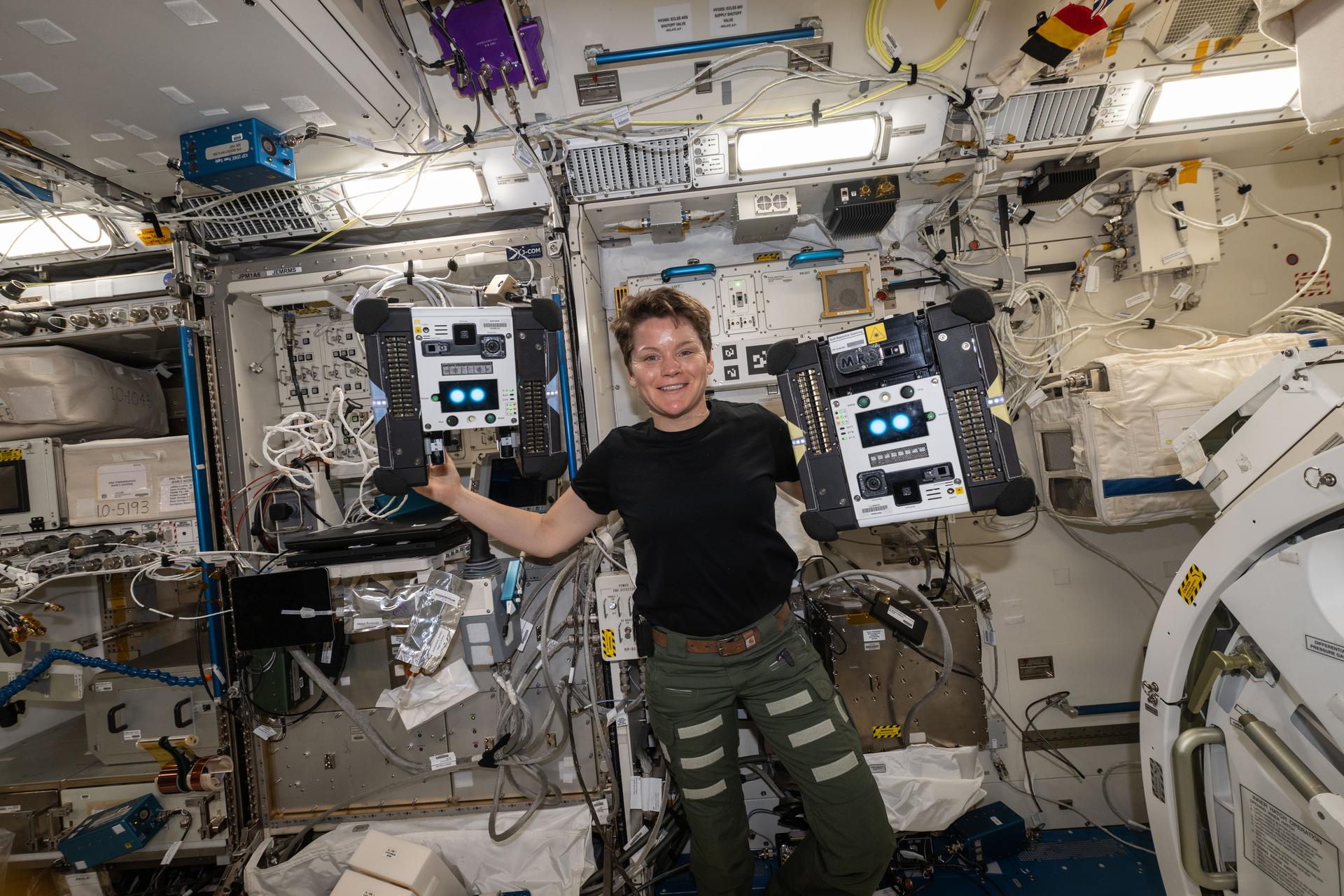
NASA astronaut Anne McClain performs the first series of tests of an Astrobee robot, Bumble, during a hardware checkout.
NASA astronaut and Expedition 73 Flight Engineer Anne McClain shows off a pair of Astrobee robotic free-flyers inside the International Space Station's Kibo laboratory. Ground controllers were monitoring the cube-shaped, toaster-sized devices as they autonomously performed docking maneuvers using multi-resolution scanning units installed earlier by McClain.
(Top) NASA astronaut Anne McClain performs the first series of tests of an Astrobee robot, Bumble, during a hardware checkout in May, 2019.  
(Bottom) NASA astronaut McClain poses with Astrobee robots Bumble (left) and Honey during their latest on orbit activity in May, 2025.  
NASA

NASA is continuing the Astrobee mission through a collaboration with Arkisys, Inc., of Los Alamitos, California, who was awarded a reimbursable Space Act Agreement to sustain and maintain the robotic platform aboard the International Space Station. As the agency returns astronauts to the Moon, robotic helpers like Astrobee could one day take over routine maintenance tasks and support future spacecraft at the Moon and Mars without relying on humans for continuous operation.

In March, the agency issued a call for partnership proposals to support its ongoing space research initiatives. Arkisys was selected to maintain the platform and continue enabling partners to use the Astrobee system as a means to experiment with new technologies in the microgravity environment of the space station.

NASA launched the Astrobee mission to the space station in 2018. Since then, the free-flying robots have marked multiple first-in-space milestones for robots working alongside astronauts to accomplish spacecraft monitoring, alert simulations, and more in partnership with researchers from industry and academia.

The Astrobee system includes three colorful, cube-shaped robots – named “Bumble,” “Honey,” and “Queen” – along with software and a docking station for recharging. The mission has advanced NASA’s goal of developing robotic systems and technologies that can perform tasks and support exploration, maintenance, and monitoring as humans venture further into space for longer durations.

The International Space Station is a convergence of science, technology, and human innovation enabling research not possible on Earth. For nearly 25 years, NASA has supported a continuous U.S. human presence aboard the orbiting laboratory, where astronauts have learned to live and work in space for extended periods of time. The space station is a springboard for developing a low Earth economy and NASA’s next great leaps in human exploration at the Moon and Mars.


from NASA https://ift.tt/9ytTiZ3

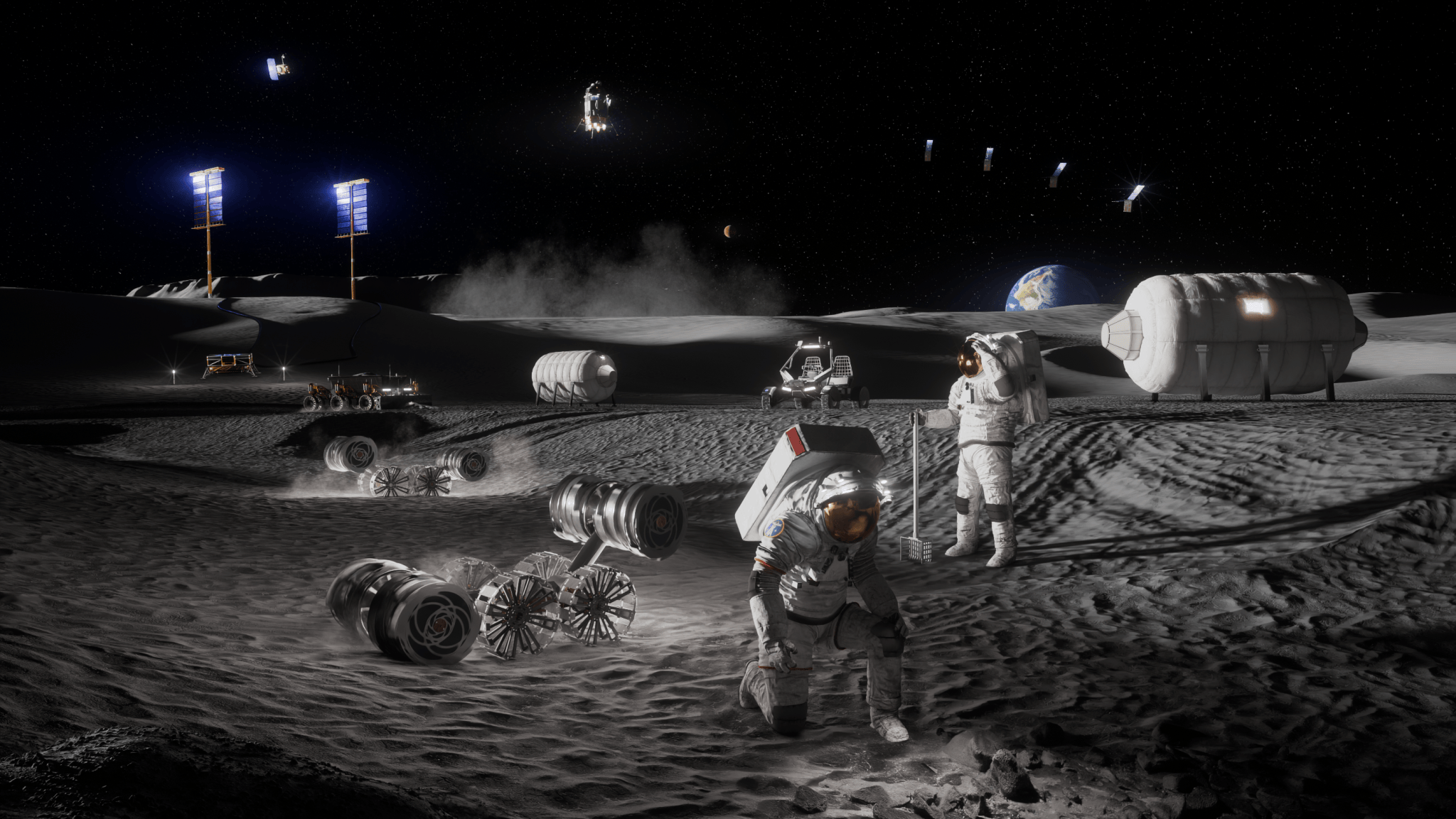
NASA Announces $1 Million to Students for Moon Base Challenge

Artist’s concept depicting astronauts, habitats, rovers, power systems, and cargo operations supporting sustained human activities at the Mo...