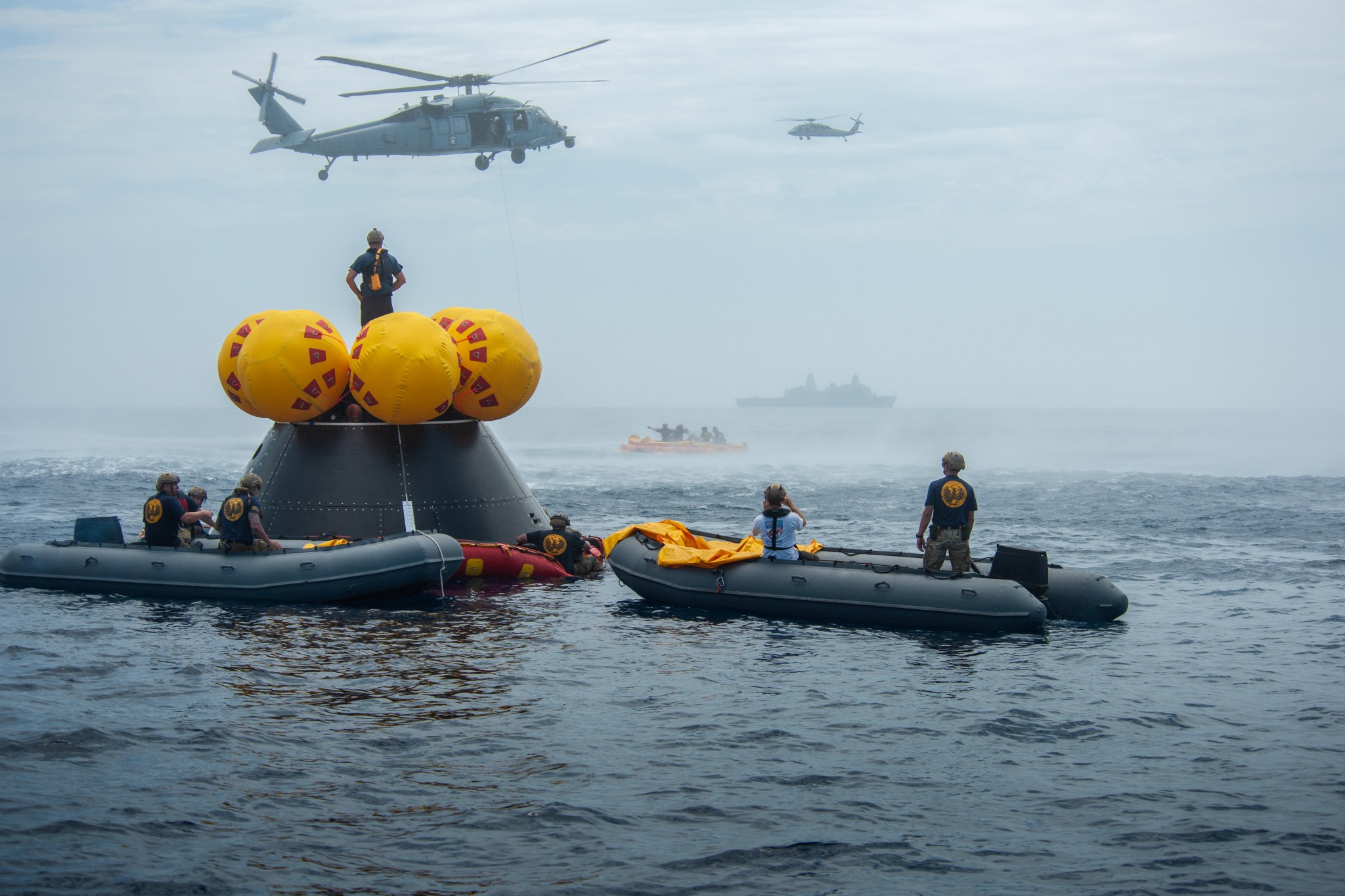
NASA astronaut and Artemis II pilot Victor Glover is assisted by U.S. Navy personnel as he exits a mockup of the Orion spacecraft in the Pacific Ocean during training Feb. 25, while his crewmates look on. The Artemis II crew and a team from NASA and the Department of Defense are spending several days at sea to test the procedures and tools that will be used to help the crew to safety when they splash down in the ocean at the end of their 10-day, 685,000-mile journey around the Moon next year as part of the first crewed mission under NASA’s Artemis campaign.
On the day of the crew’s return to Earth, a Navy ship with specially trained personnel will await splashdown and then approach the Orion capsule to help extract the four astronauts. An inflatable raft, called the front porch, will provide a place for them to rest when they exit the capsule before they are then individually hoisted by helicopters and flown to the waiting ship.
Artemis II, launching atop the SLS (Space Launch System) rocket from NASA’s Kennedy Space Center in Florida, will test the Orion spacecraft’s life support systems needed for future lunar missions.
NASA and the agency’s international partners are sending scientific investigations to the International Space Station on the 30th SpaceX commercial resupply services mission, including tests of technologies to monitor sea ice, automate 3D mapping, and create nanoparticle solar cells. The company’s Dragon cargo spacecraft is scheduled to launch from Cape Canaveral Space Force Station in Florida in early March.
Read more about some of the research making the journey to the orbiting laboratory:
Plants off the Planet
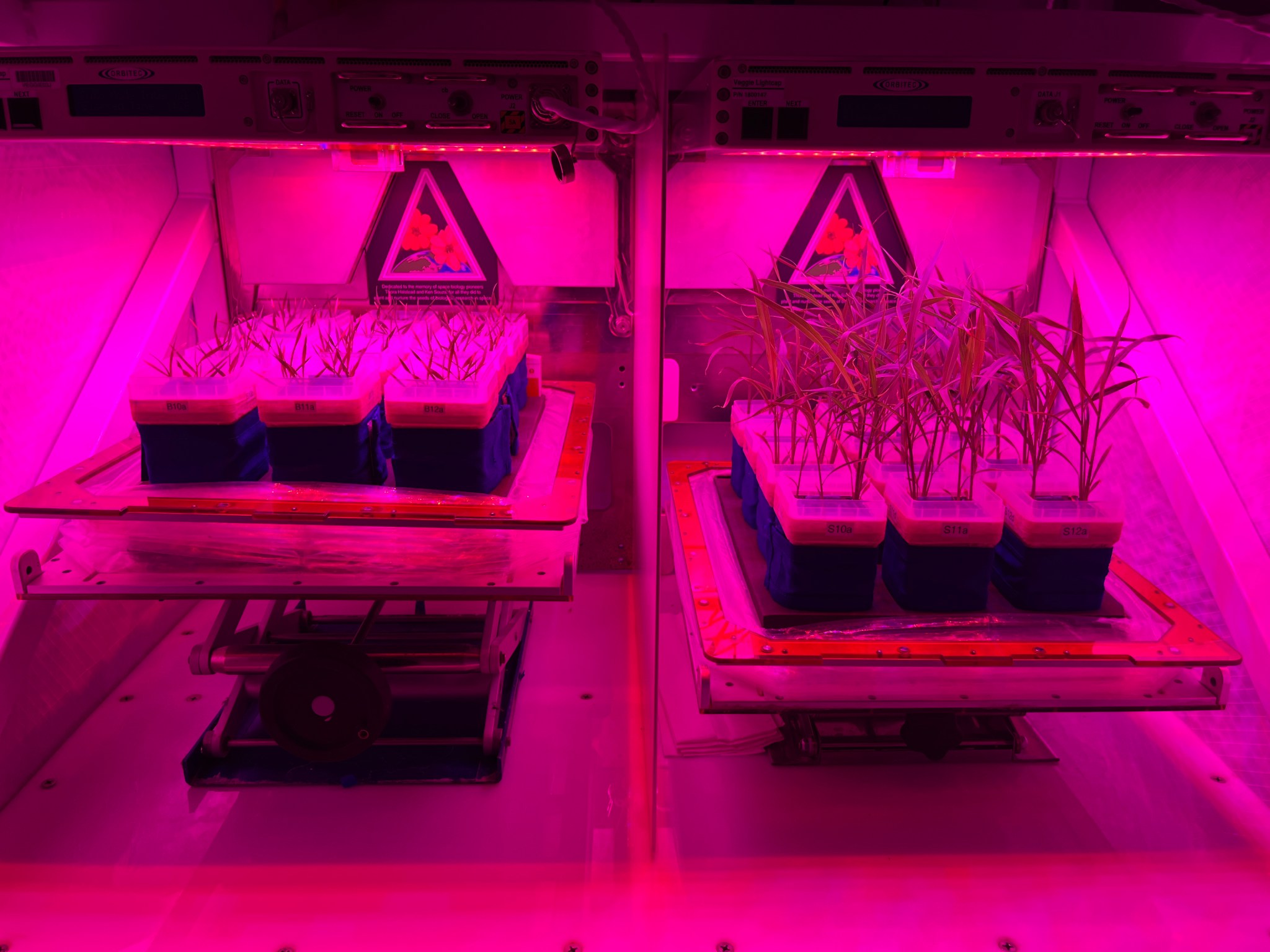
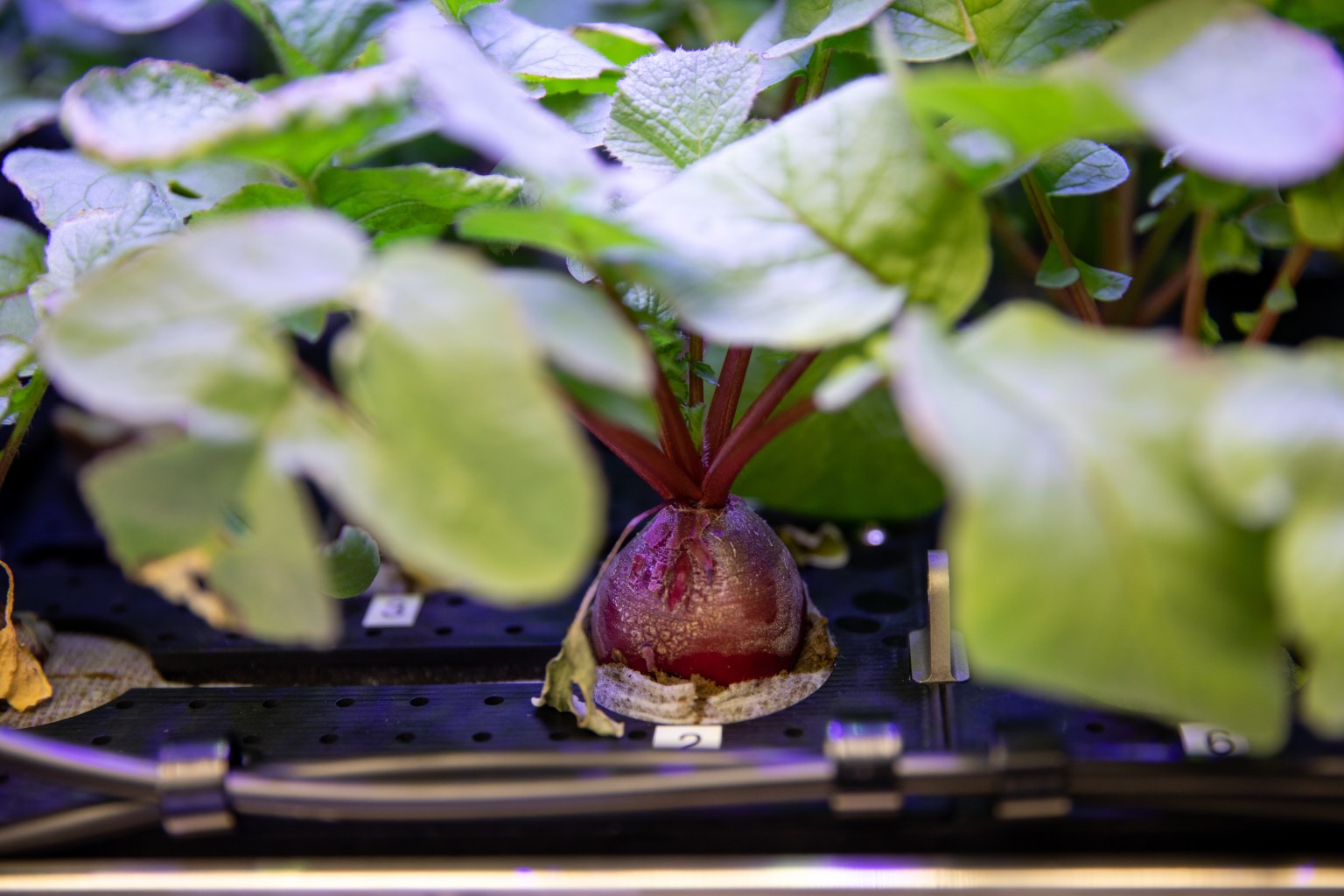
Plants can be used in regenerative life support systems, to provide food, and to contribute to the well-being of astronauts on future deep space exploration missions. C4 Photosynthesis in Space (APEX-09) examines how microgravity affects the mechanisms by which two types of grasses, known as C3 and C4, capture carbon dioxide from the atmosphere.
“Plants respond to stressful conditions based on their genetic makeup and the environment,” said Pubudu Handakumbura, principal investigator with the Pacific Northwest National Laboratory. “We aim to uncover the molecular changes involved in plants exposed to spaceflight stressors and develop an understanding of the mechanisms of photosynthesis in space.” Results could clarify plant responses to stressful environments and inform the design of bio-regenerative support systems on future missions, as well as systems for plant growth on Earth.
Seedlings germinating for the APEX-09 C4 Space investigation.
Pubudu Handakumbura
Sensing the Sea
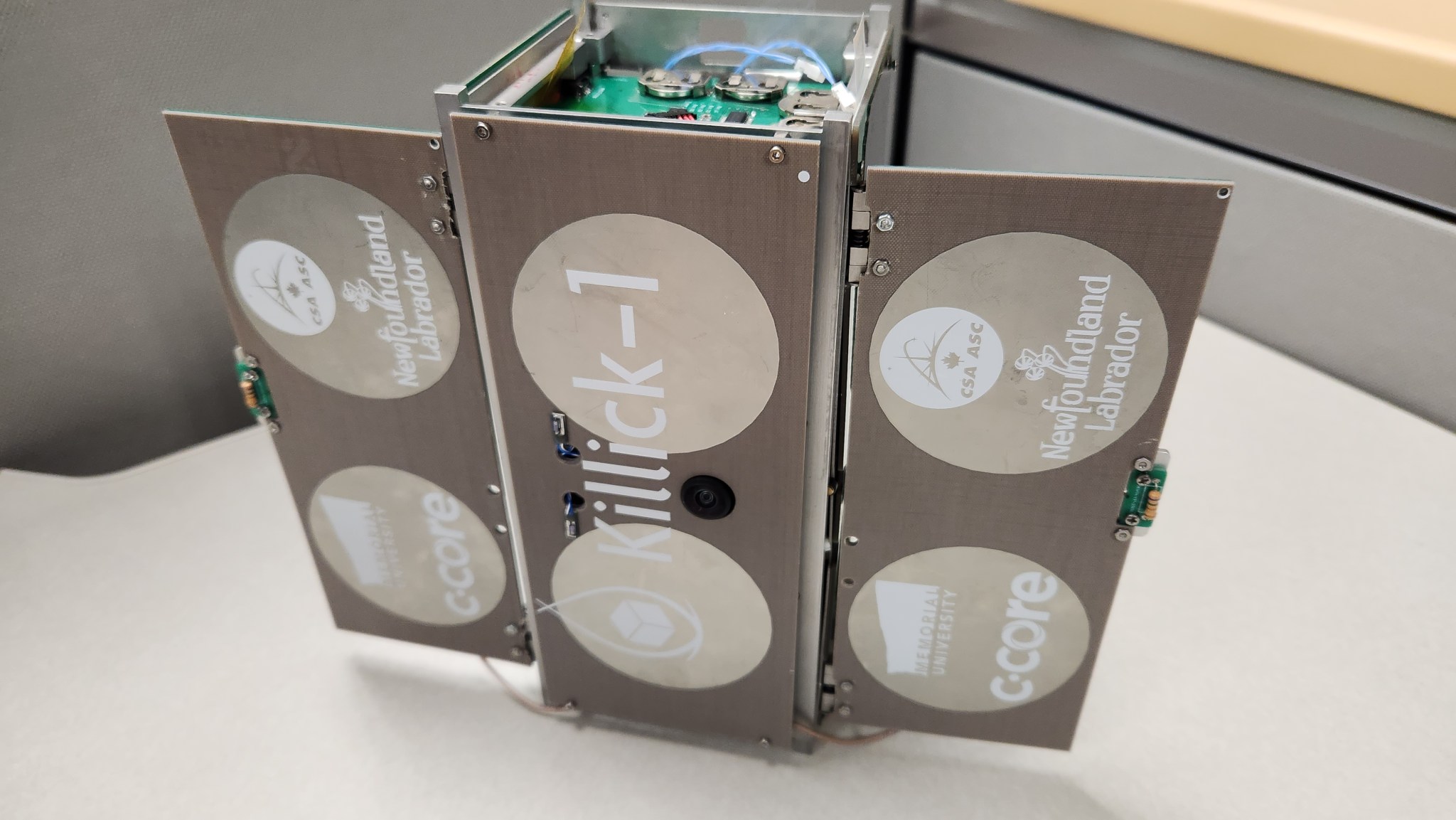
The ocean significantly affects the global climate. A technique called Global Navigation Satellite System reflectometry (GNSS-R), which receives satellite signals reflected from the surface of Earth, shows promise as a way to monitor ocean phenomena and improve climate models. Killick-1: A GNSS Reflectometry CubeSat for Measuring Sea Ice Thickness and Extent (Nanoracks KILLICK-1) tests using this technique to measure sea ice. The project supports development of space and science capabilities in Newfoundland and Labrador, Canada, by providing hands-on experience with space systems and Earth observation. More than 100 undergraduate and graduate engineering students participated in the project.
“The most exciting aspect of this project is that students have the opportunity to launch a mission into space,” said Desmond Power, a co-investigator with C-CORE of Canada. “It is also exciting to build a tiny satellite that does different things, including contributing to our knowledge of climate change.”
GNSS-R technology is low-cost, light, and energy efficient. Its potential applications on Earth include providing data for weather and climate models and improving the understanding of ocean phenomena such as surface winds and storm surge.
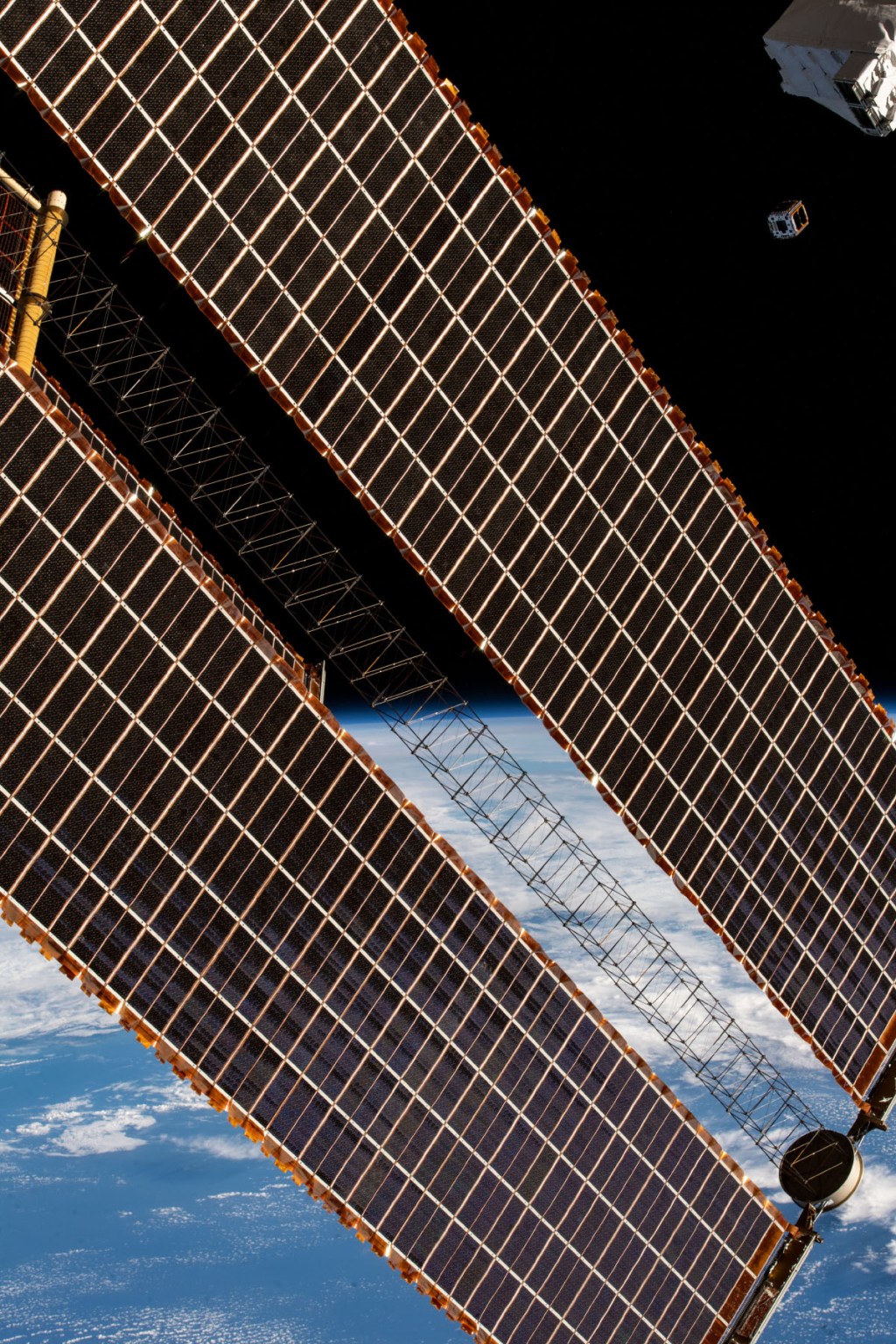
The KILLICK-1 CubeSat ready to pack for launch.
Memorial University, Canada
Automated Autonomous Assistance
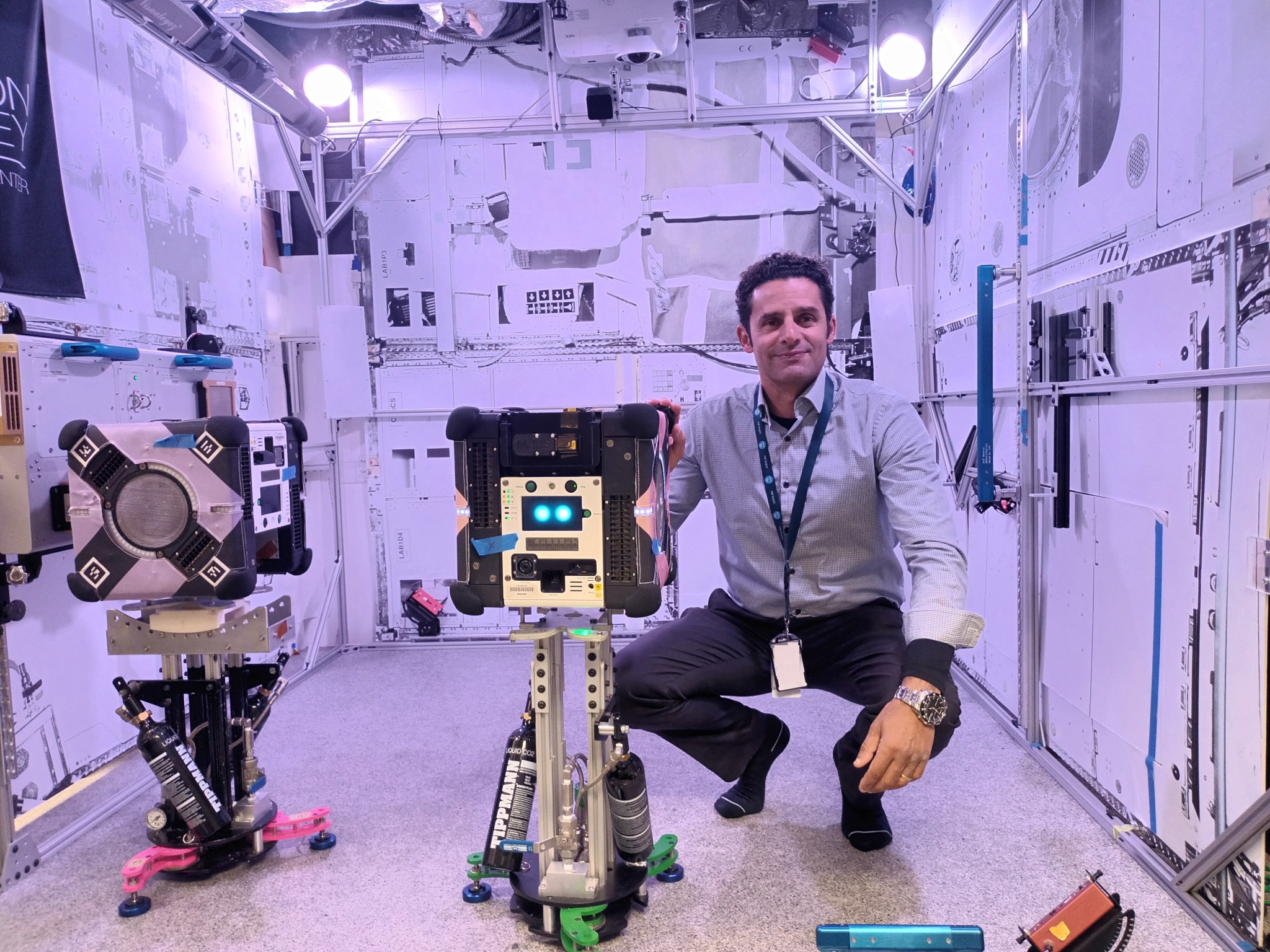
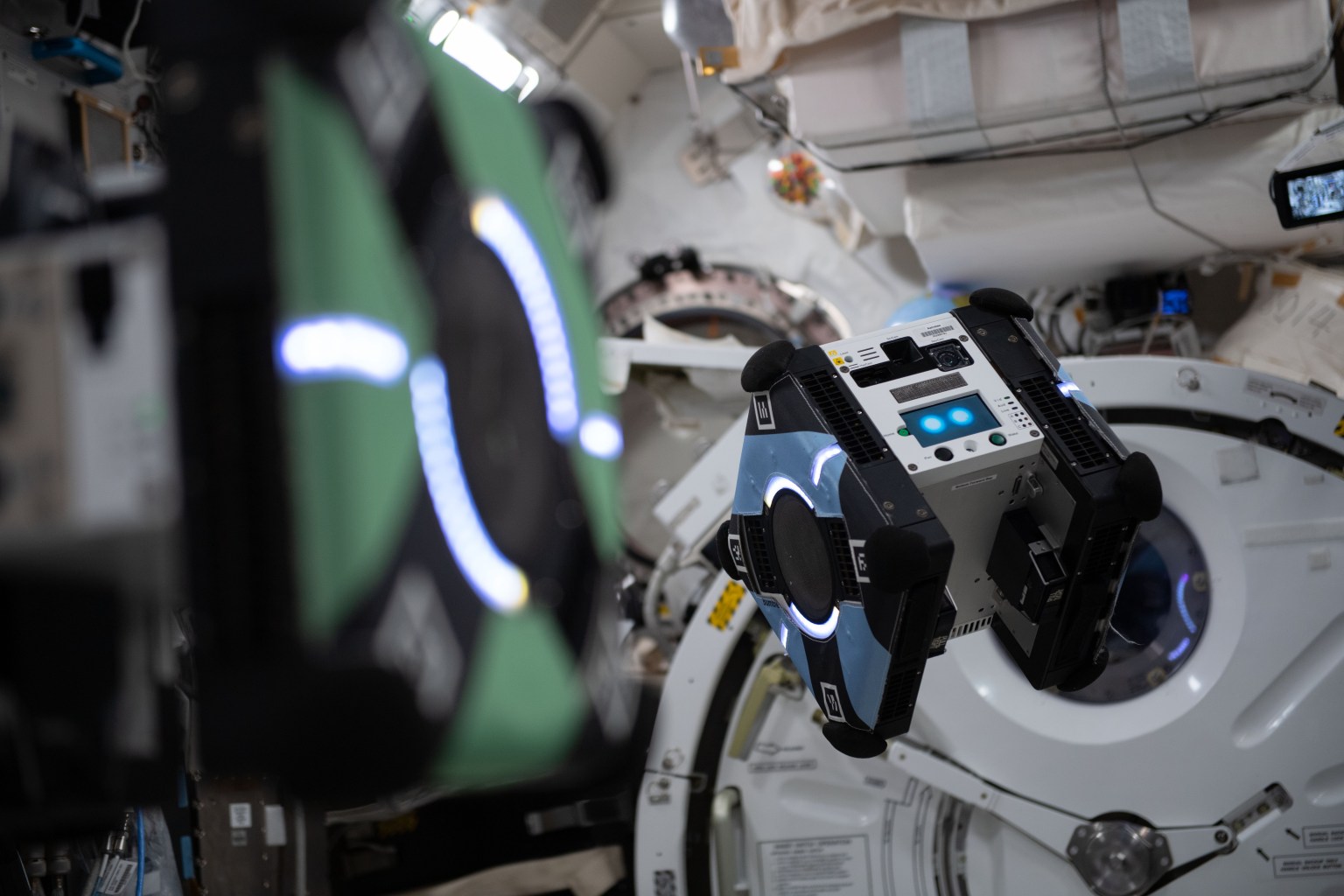
Multi-resolution Scanner (MRS) Payload for the Astrobee (Multi-Resolution Scanning) tests technology to automate 3D sensing, mapping, and situational awareness systems.
“Our MRS on an Astrobee free-flying robot will create 3D maps inside the space station,” said Marc Elmouttie, project lead with the Australian Commonwealth Scientific and Industrial Research Organization. “The technology combines multiple sensors, which compensates for weaknesses in any one of them and provides very high-resolution 3D data and more accurate trajectory data to understand how the robot moves around in space.”
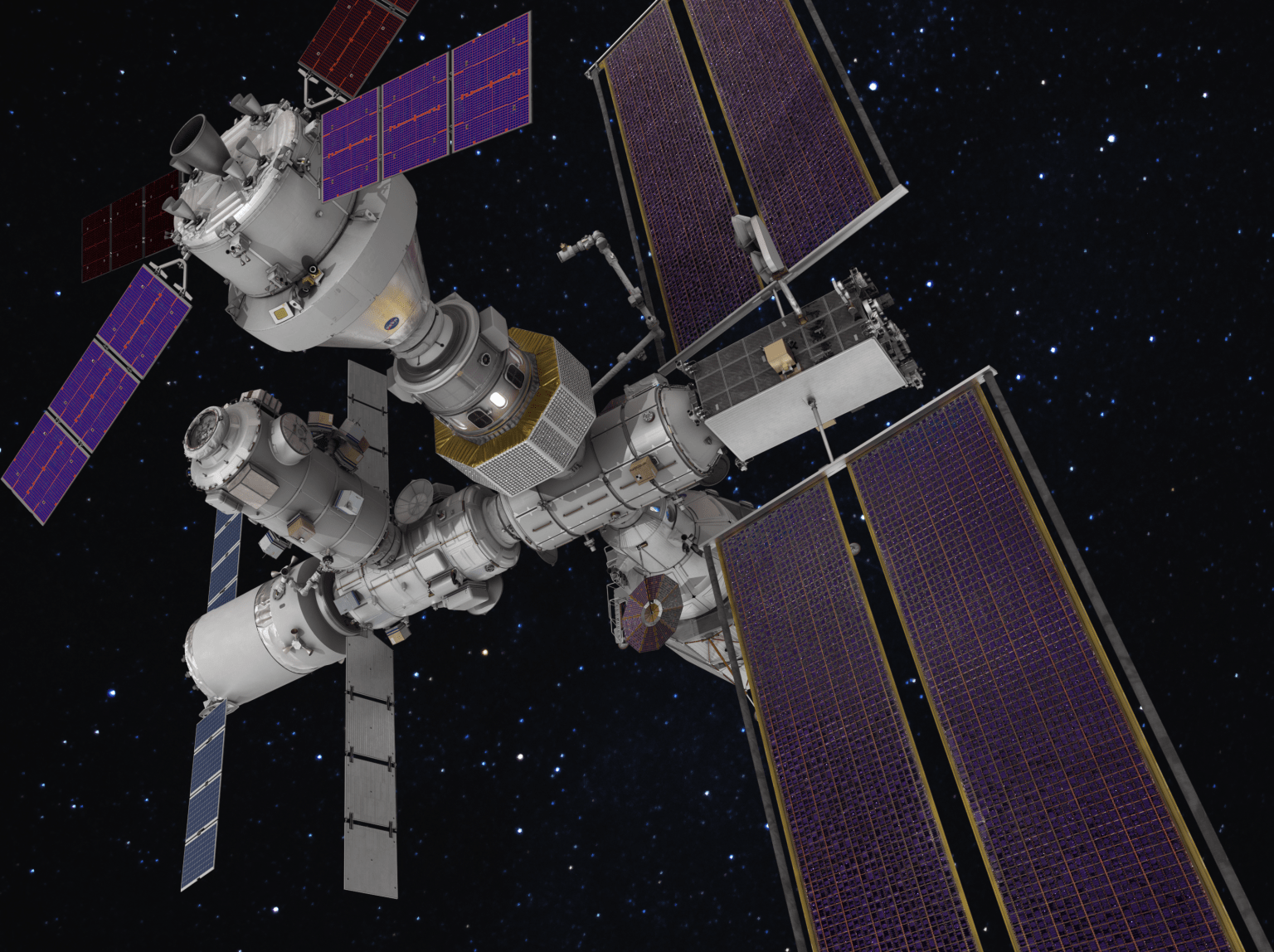
The technology could be used for autonomous operation of spacecraft with minimal or no human occupancy where robots must sense the environment and precisely maneuver, including the lunar Gateway space station. Other uses could be to inspect and maintain spacecraft and for autonomous vehicle operations on other celestial bodies. Results also support improvements in robotic technologies for harsh and dangerous environments on Earth.
Project Lead Marc Elmouttie with the MRS hardware housed in an Astrobee robot.
NASA
Placement of Particles
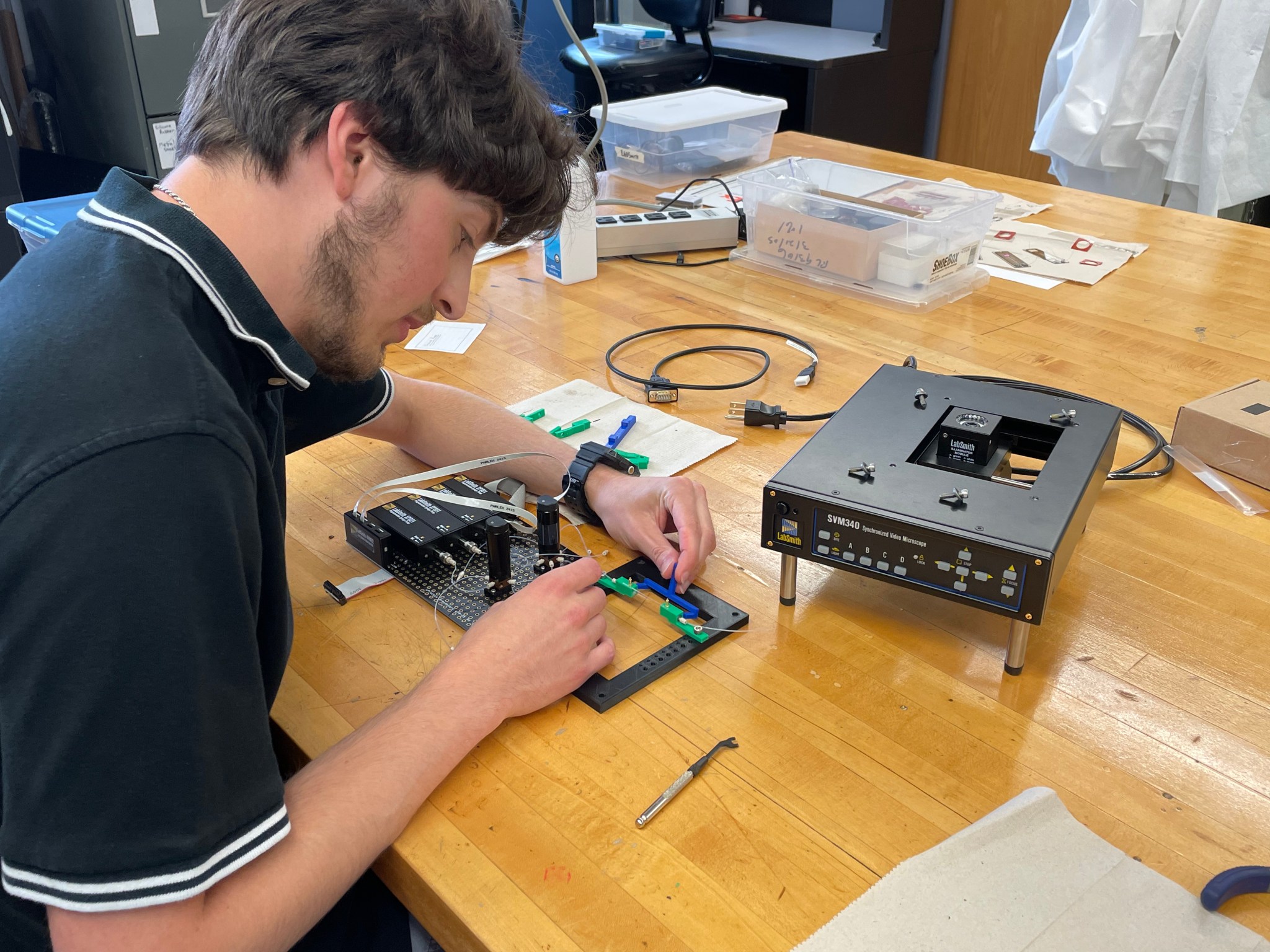
The Nano Particle Haloing Suspension investigation examines how nanoparticles and microparticles interact within an electrical field. A process called nanoparticle haloing uses charged nanoparticles to enable precise particle arrangements that improve the efficiency of quantum-dot synthesized solar cells, according to Stuart J. Williams, principal investigator with the University of Louisville Department of Mechanical Engineering.
Quantum dots are tiny spheres of semiconductor material with the potential to convert sunlight into energy much more efficiently. Conducting these processes in microgravity provides insight into the relationship between shape, charge, concentration, and interaction of particles.
The investigation is supported by NASA’s Established Program to Stimulate Competitive Research (EPSCoR), which partners with government, higher education, and industry on projects to improve a research infrastructure and research and development capacity and competitiveness.
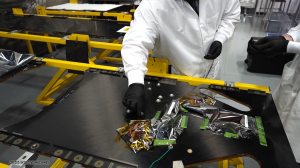
A capstone student assembles part of the Nano Particle Haloing Suspension hardware.
University of Louisville
Download high-resolution photos and videos of the research mentioned in this article.
Melissa Gaskill
International Space Station Program Research Office Johnson Space Center
Search this database of scientific experiments to learn more about those mentioned above.
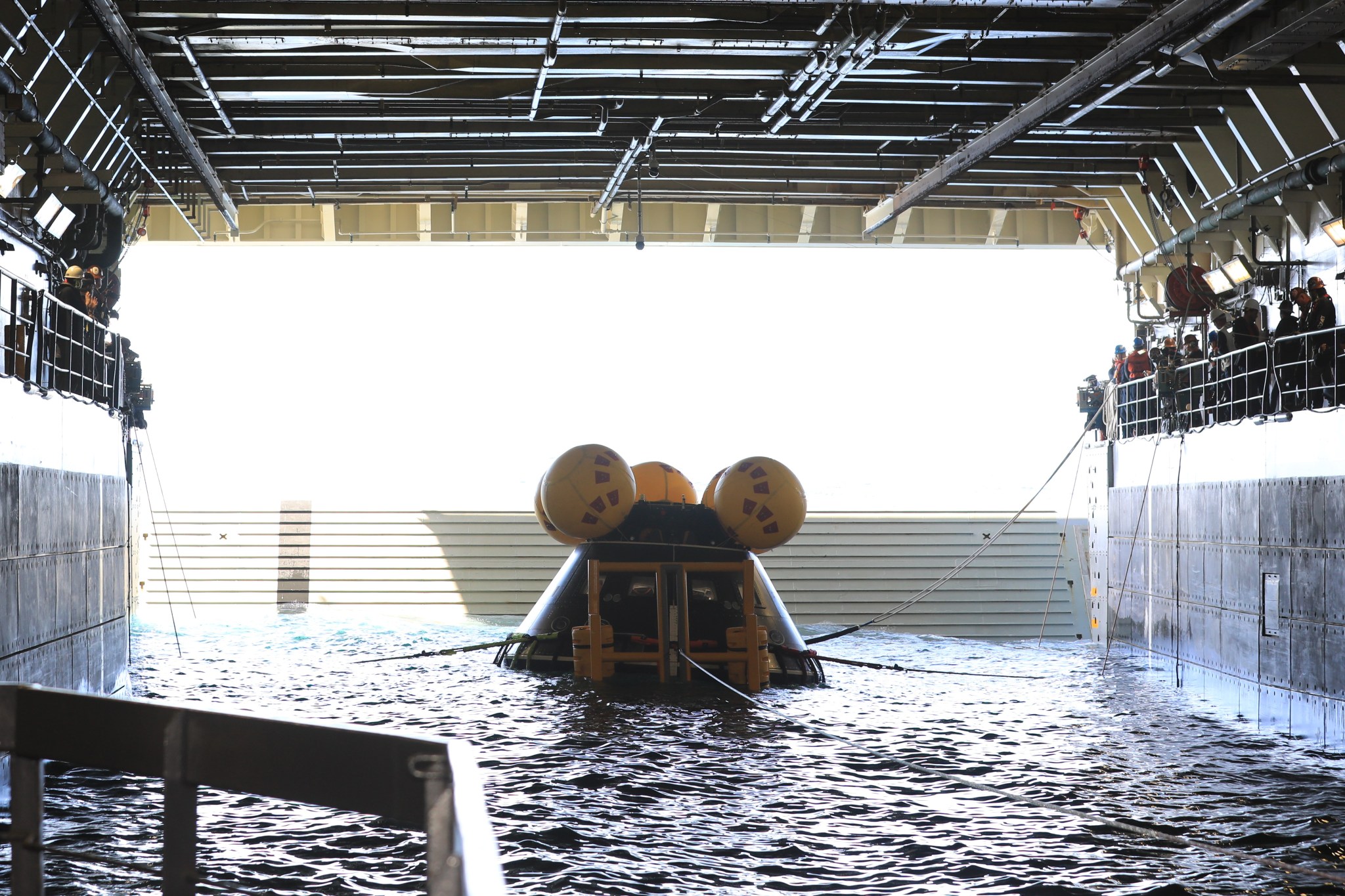
Members of NASA’s Exploration Ground System’s Landing and Recovery team work to secure the Crew Module Test Article and align it on its stand inside the ship’s well deck in this image from Feb. 22, 2024. Underway Recovery Test 11 is the eleventh in a series of Artemis recovery tests, and the first time NASA and its partners put their Artemis II recovery procedures to the test with the astronauts.
These tests demonstrate the procedures and hardware needed to retrieve NASA astronauts Reid Wiseman, Victor Glover, Christina Koch, and CSA (Canadian Space Agency) astronaut Jeremy Hansen after their approximately 10-day, 685,000-mile journey beyond the lunar far side and back.
Artemis II is the first crewed mission under NASA’s Artemis campaign and will test the agency’s Orion spacecraft life support systems needed for future lunar missions.
Preparations for Next Moonwalk Simulations Underway (and Underwater)
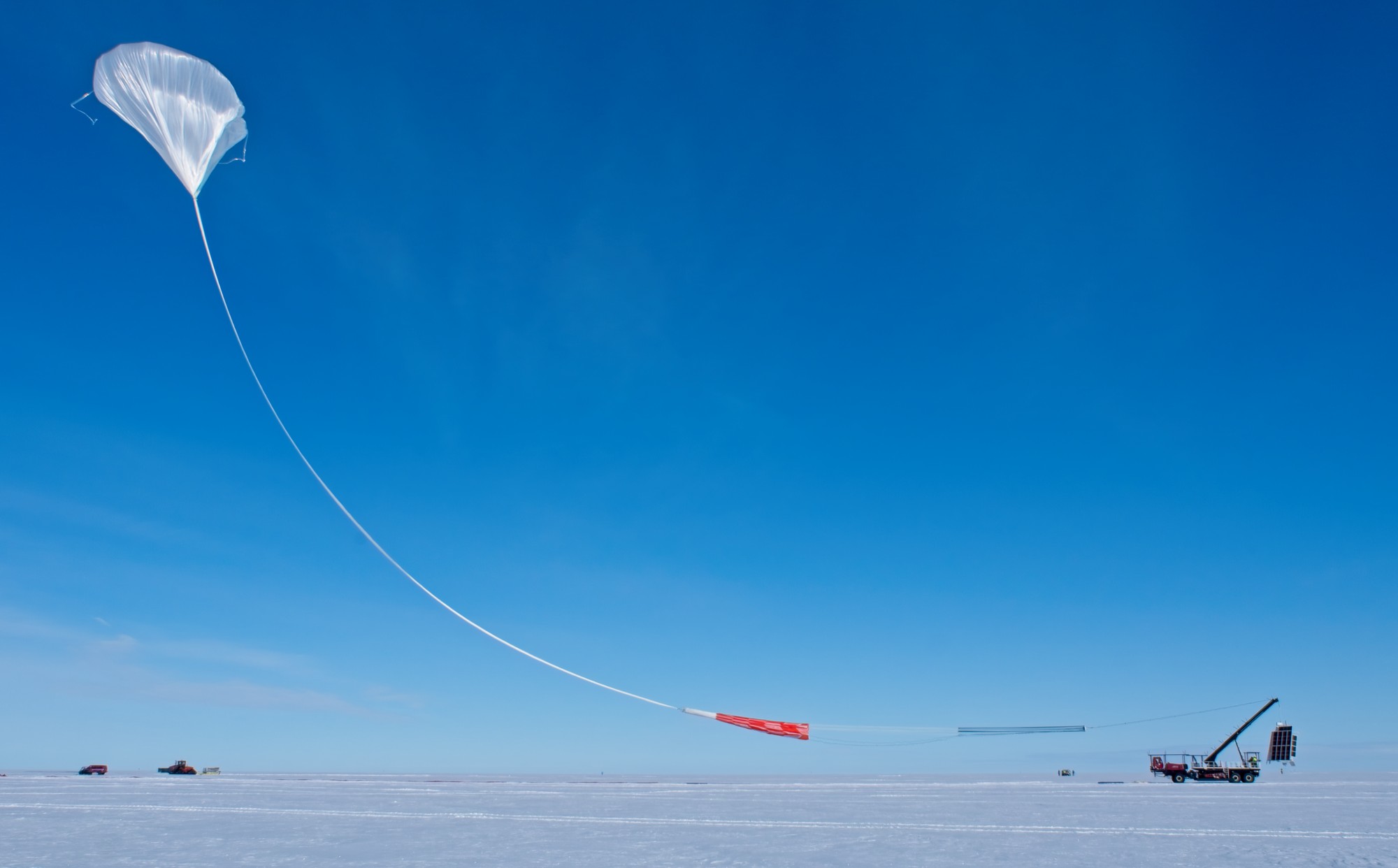
The GUSTO mission successfully launched on a scientific balloon from Antarctica Dec. 31, 7:30 p.m. local time (Dec. 31, 1:30 a.m. EST). GUSTO is flying on a 39 million cubic-foot zero-pressure scientific balloon. The balloon is used to fly missions for long periods of time during the Austral Summer over Antarctica. On Saturday, Feb. 24, 2024, GUSTO broke the record for longest flight of any NASA heavy-lift, long-duration scientific balloon mission.
NASA/Scott Battaion
Fifty-five days, one hour, and 34 minutes was the NASA record to beat, and the GUSTO (Galactic/Extragalactic ULDB Spectroscopic Terahertz Observatory) scientific balloon mission did just that Saturday, Feb. 24, while flying high above the icy surface of Antarctica. GUSTO is now the new record-holder for longest flight of any NASA heavy-lift, long-duration scientific balloon mission.
“The success of this balloon mission is a fantastic tribute to all the people that support the program,” said Andrew Hamilton, acting chief of NASA’s Balloon Program Office at the agency’s Wallops Flight Facility in Virginia. “From the operations team at Peraton, to our balloon manufacturer at Aerostar, to the National Science Foundation and their support staff in Antarctica, and to the Mission Management team with NASA, every one of them has been vital to the success of this mission which absolutely demonstrates the capability and value of Long Duration Ballooning to the scientific community.”
GUSTO was launched at 1:30 a.m. EST Dec. 31 from the Long Duration Balloon Camp near McMurdo Station, Antarctica. The balloon mission not only broke the flight record but continues its path circumnavigating the South Pole. The stadium-sized zero-pressure scientific balloon and observatory are currently reaching altitudes above 125,000 feet. “The health of the balloon and the stratospheric winds are both contributing to the success of the mission so far,” said Hamilton. “The balloon and balloon systems have been performing beautifully, and we’re seeing no degradation in the performance of the balloon. The winds in the stratosphere have been very favorable and have provided stable conditions for extended flight.”
GUSTO’s record-breaking flight claimed the NASA title from the Super-TIGER (Super Trans-Iron Galactic Element Recorder) balloon mission, which launched from Antarctica in December 2012.
GUSTO, an Astrophysics mission managed by NASA’s Explorers Program Office at the agency’s Goddard Space Flight Center in Greenbelt, Maryland, is led by principal investigator Christopher Walker from the University of Arizona with support from the Johns Hopkins University Applied Physics Laboratory.
“NASA’s Long Duration Balloon program provides researchers the ability to fly state-of-the art payloads at the very edge of space, affording them the opportunity to make groundbreaking observations of the cosmos more frequently and at a significantly lower cost than conventional orbital missions,” said Walker.
GUSTO is mapping a large part of the Milky Way galaxy, including the galactic center, and the nearby Large Magellanic Cloud. The telescope is equipped with sensitive detectors for carbon, oxygen, and nitrogen emission lines. Measuring these emission lines gives the GUSTO team insight into the full lifecycle of the interstellar medium, the cosmic material found between stars. GUSTO’s science observations are performed from Antarctica to allow for enough observation time aloft, access to astronomical objects, and solar power provided by the austral summer in the polar region.
The GUSTO science mission is scheduled to run just over 60 days, and even after the science mission is complete, the balloon will continue to fly and perform technology demonstration work. “After that, we plan to push the limits of the balloon and fly as long as the balloon is capable to really demonstrate the capabilities of Long Duration Ballooning,” said Hamilton.
NASA’s Wallops Flight Facility in Virginia manages the agency’s scientific balloon flight program with 10 to 15 flights each year from launch sites worldwide. Peraton, which operates NASA’s Columbia Scientific Balloon Facility (CSBF) in Texas, provides mission planning, engineering services, and field operations for NASA’s scientific balloon program. The CSBF team has launched more than 1,700 scientific balloons over some 40 years of operations. NASA’s balloons are fabricated by Aerostar. The NASA Scientific Balloon Program is funded by the NASA Headquarters Science Mission Directorate Astrophysics Division. NASA balloon launch operations from Antarctica receive logistical support from the National Science Foundation’s Office of Polar Programs, which leads U.S. research in Antarctica.
For more information on NASA’s Scientific Balloon Program, click here. Track the GUSTO mission in real-time on NASA’s Columbia Scientific Balloon Facility website.
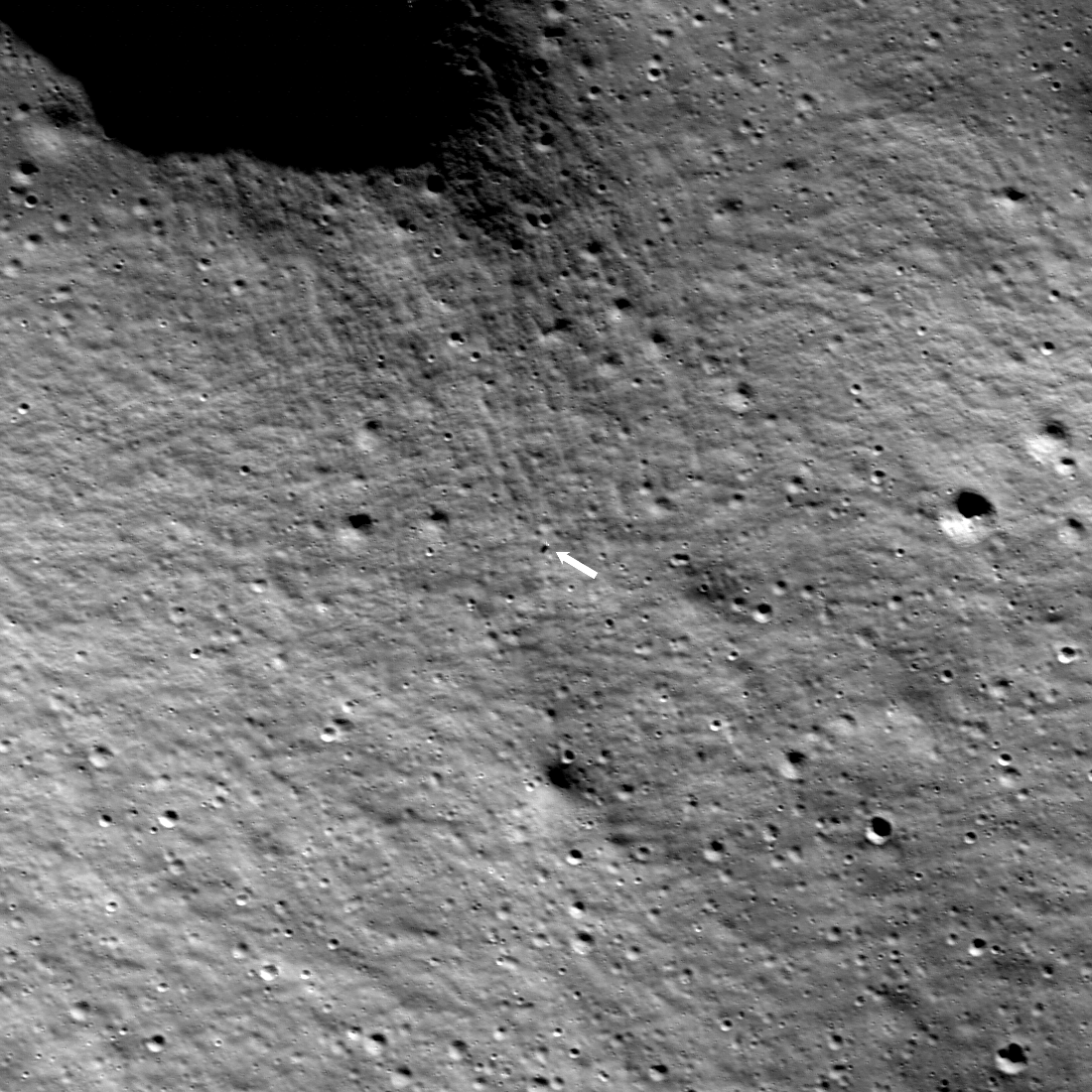
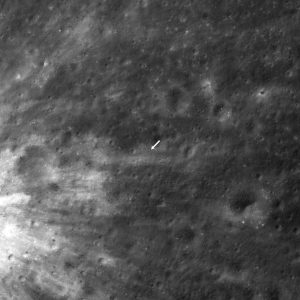
On Feb. 22, Intuitive Machines’ Nova-C lander, called Odysseus, completed a seven-day journey to lunar orbit and softly landed near crater Malapert A in the South Pole region of the Moon at 6:24 p.m. EST. On Feb. 24, NASA’s Lunar Reconnaissance Orbiter (LRO) spacecraft passed over the landing site at an altitude of about 56 miles (90 km) and photographed Odysseus.
NASA’s Lunar Reconnaissance Orbiter captured this image of the Intuitive Machines’ Nova-C lander, called Odysseus, on the Moon’s surface on Feb. 24, 2024, at 1:57 p.m. EST). Odysseus landed at 80.13 degrees south latitude, 1.44 degrees east longitude, at an elevation of 8,461 feet (2,579 meters). The image is 3,192 feet (973 meters) wide, and lunar north is up. (LROC NAC frame M1463440322L)
NASA/Goddard/Arizona State University
Odysseus came to rest at 80.13 degrees south latitude, 1.44 degrees east longitude, 8,461 feet (2,579 meters) elevation, within a degraded one-kilometer diameter crater where the local terrain is sloped at 12 degrees.
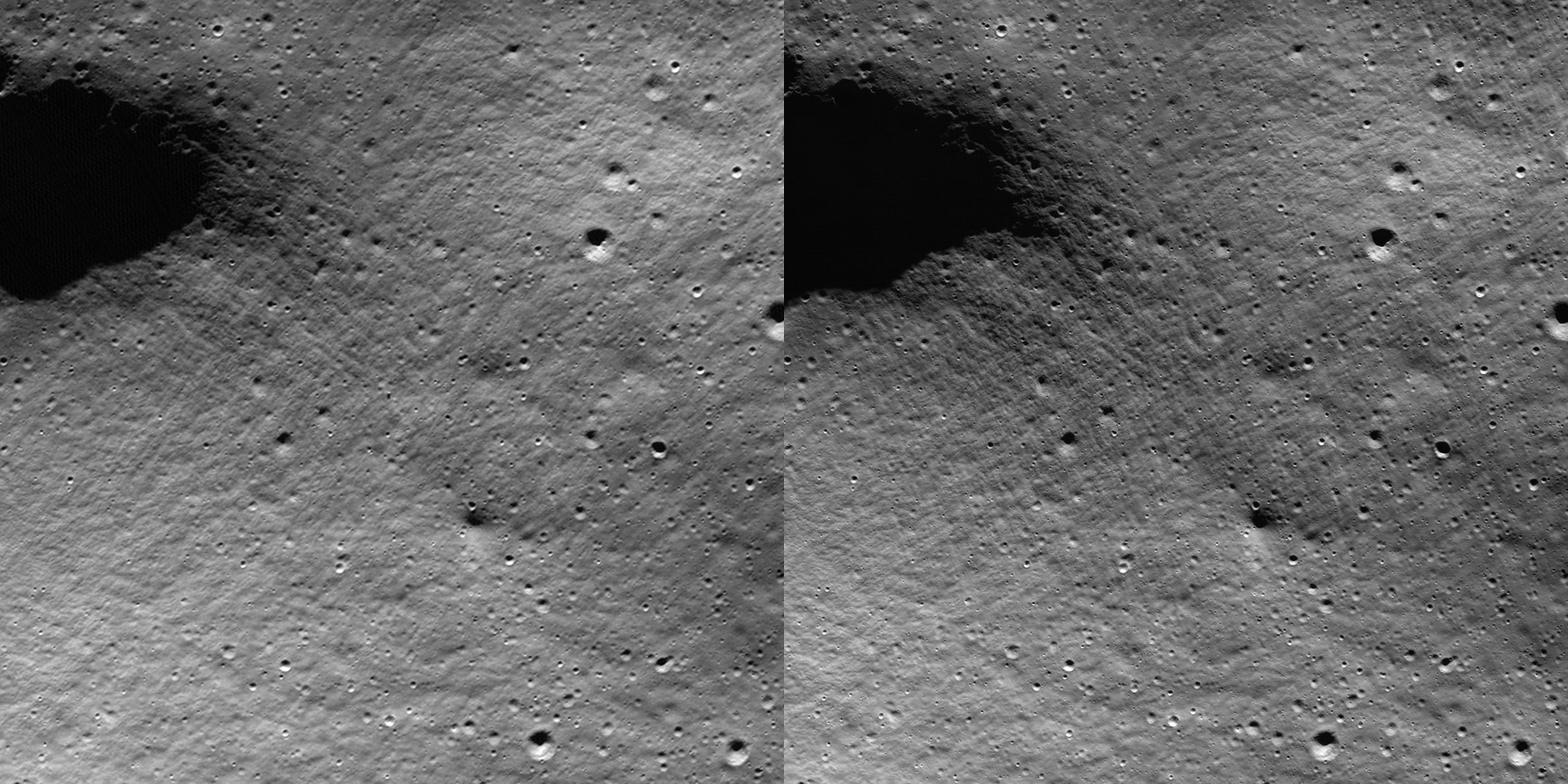
This image pair shows LRO views of the area surrounding the Odysseus site before (frame M172936310) and after (frame M1463440322L) its landing.
NASA/Goddard/Arizona State University
Odysseus marks the first successful soft landing of NASA’s CLPS (Commercial Lunar Payload Services) initiative and the first time that new NASA science instruments and technology demonstrations are operating on the Moon in more than 50 years.
This image is the same as the one above, but without the arrow. NASA’s Lunar Reconnaissance Orbiter captured this image of the Intuitive Machines’ Nova-C lander, called Odysseus, on the Moon’s surface on Feb. 24, 2024, at 12:57 pm CST). The image is 3,192 feet (973 meters) wide, and lunar north is up. (LROC NAC frame M1463440322L)
NASA/Goddard/Arizona State University
LRO is managed by NASA’s Goddard Space Flight Center in Greenbelt, Maryland, for the agency’s Science Mission Directorate at NASA Headquarters in Washington. Launched on June 18, 2009, LRO has collected a treasure trove of data with its seven powerful instruments, making an invaluable contribution to our knowledge about the Moon. Arizona State University manages and operates the Lunar Reconnaissance Orbiter Camera, LROC.
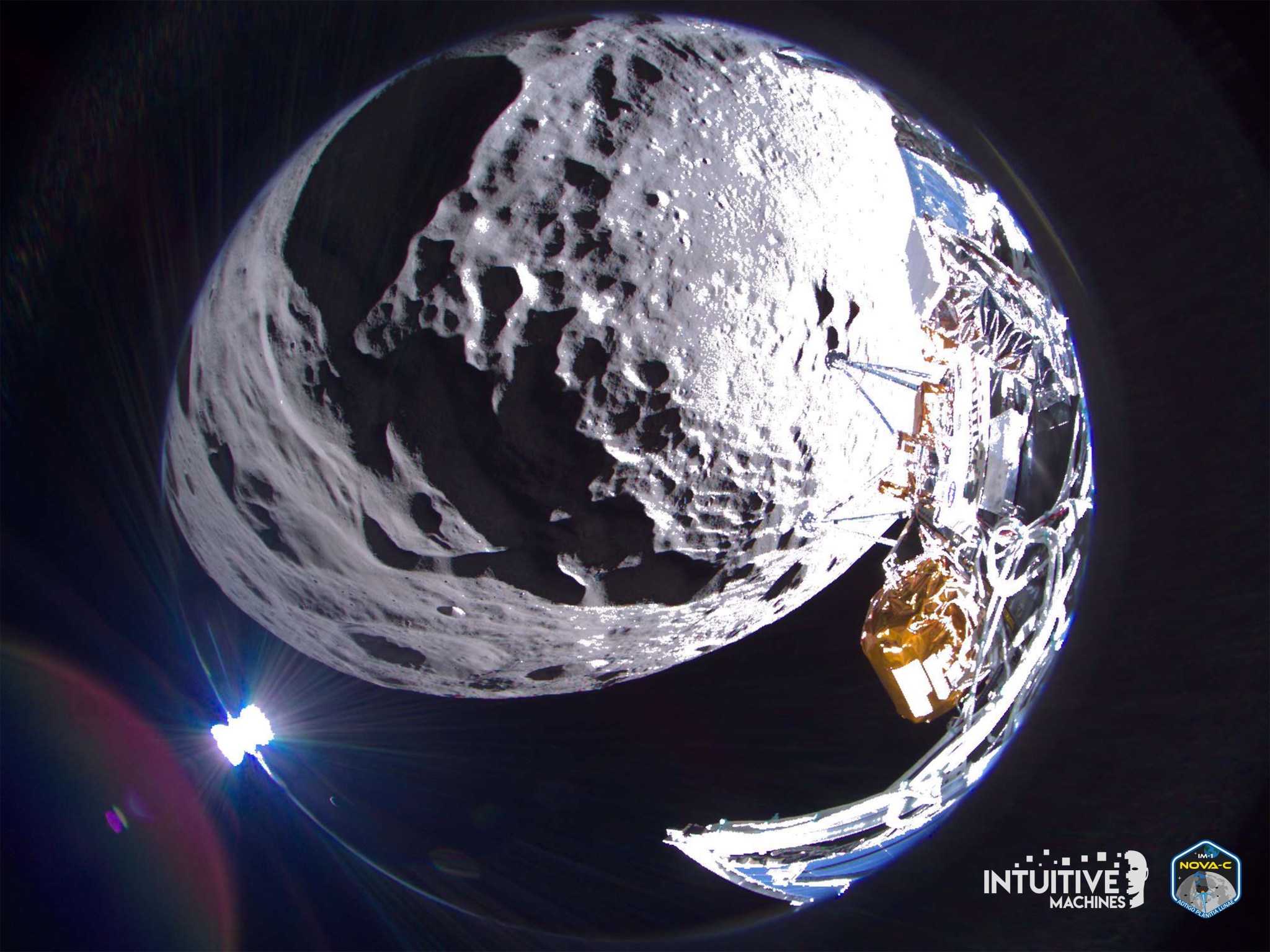
On Feb. 22, 2024, Intuitive Machines’ Odysseus lunar lander captures a wide field of view image of Schomberger crater on the Moon approximately 125 miles (200 km) uprange from the intended landing site, at approximately 6 miles (10 km) altitude.
Credit: Intuitive Machines
For the first time in more than 50 years, new NASA science instruments and technology demonstrations are operating on the Moon following the first successful delivery of the agency’s CLPS (Commercial Lunar Payload Services) initiative.
Intuitive Machines’ Nova-C lander, called Odysseus, completed a seven-day journey to lunar orbit and executed procedures to softly land near Malapert A in the South Pole region of the Moon at 5:24 p.m. CST on Feb. 22. The lander is healthy, collecting solar power, and transmitting data back to the company’s mission control in Houston. The mission marks the first commercial uncrewed landing on the Moon.
Carrying six NASA science research and technology demonstrations, among other customer payloads, all NASA science instruments completed transit checkouts en route to the Moon. A NASA precision landing technology demonstration also provided critical last-minute assistance to ensure a soft landing. As part of NASA’s Artemis campaign, the lunar delivery is in the region where NASA will send astronauts to search for water and other lunar resources later this decade.
“For the first time in more than half a century, America returned to the Moon. Congratulations to Intuitive Machines for placing the lunar lander Odysseus carrying NASA scientific instruments to a place no person or machine has gone before, the lunar South Pole,” said NASA Administrator Bill Nelson. “This feat from Intuitive Machines, SpaceX, and NASA demonstrates the promise of American leadership in space and the power of commercial partnerships under NASA’s CLPS initiative. Further, this success opens the door for new voyages under Artemis to send astronauts to the Moon, then onward to Mars.”
During the journey to the Moon, NASA instruments measured the quantity of cryogenic engine fuel as it has been used, and while descending toward the lunar surface, teams collected data on plume-surface interactions and tested precision landing technologies.
Odysseus’ surface operations are underway and expected to take place through Thursday, Feb. 29.
New lunar science, technology
NASA’s Navigation Doppler Lidar for Precise Velocity and Range Sensing (NDL) guidance system for descent and landing ultimately played a key role in aiding the successful landing. A few hours ahead of landing, Intuitive Machines encountered a sensor issue with their navigation system and leaned on NASA’s guidance system for an assist to precisely land. NASA’s instrument operates on the same principles of radar and uses pulses from a laser emitted through three optical telescopes. It measures speed, direction, and altitude with high precision during descent and touchdown.
“We are thrilled to have NASA on the Moon again, and proud of the agency’s contribution to the successful landing with our NDL technology. Congratulations for completing this first lunar delivery for NASA, paving the way for a bright future for our CLPS initiative,” said Nicky Fox. “Some of the NASA science instruments on this mission will bring us insight on lunar plume interactions and conduct radio astronomy. The valiant efforts and innovation demonstrated by Intuitive Machines is exemplary and we are excited for the upcoming lunar deliveries that will follow this first mission.”
Now that they are on the lunar surface, NASA instruments will focus on investigating lunar surface interactions and radio astronomy. The Odysseus lander also carries a retroreflector array that will contribute to a network of location markers on the Moon for communication and navigation for future autonomous navigation technologies.
Additional NASA hardware aboard the lander includes:
Lunar Node 1 Navigation Demonstrator: A small, CubeSat-sized experiment that will demonstrate autonomous navigation that could be used by future landers, surface infrastructure, and astronauts, digitally confirming their positions on the Moon relative to other spacecraft, ground stations, or rovers on the move.
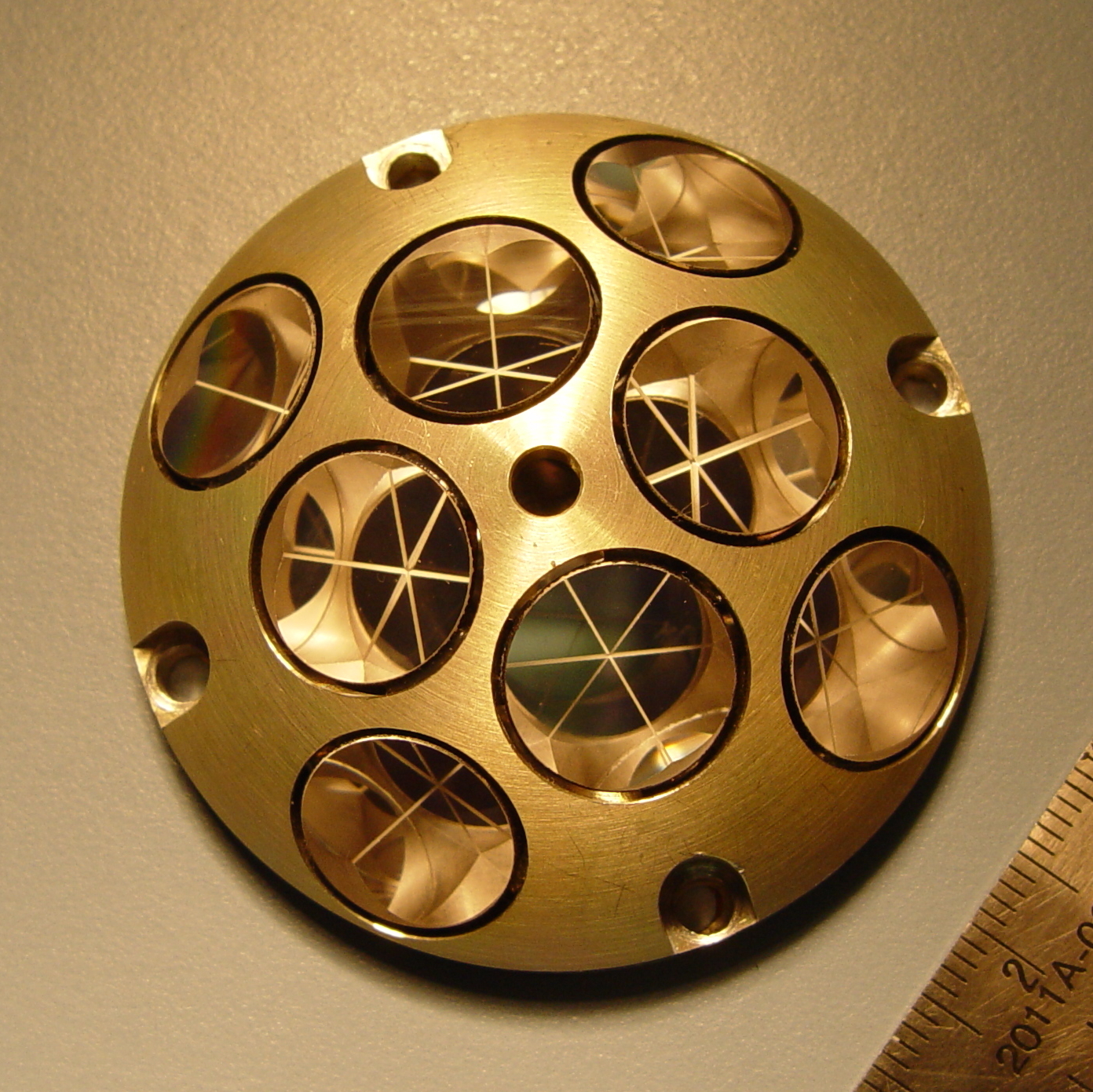
Laser Retroreflector Array: A collection of eight retroreflectors that enable precision laser ranging, which is a measurement of the distance between the orbiting or landing spacecraft to the reflector on the lander. The array is a passive optical instrument and will function as a permanent location marker on the Moon for decades to come.
Radio Frequency Mass Gauge: A technology demonstration that measures the amount of propellant in spacecraft tanks in a low-gravity space environment. Using sensor technology, the gauge will measure the amount of cryogenic propellant in Nova-C’s fuel and oxidizer tanks, providing data that could help predict fuel usage on future missions.
Radio-wave Observations at the Lunar Surface of the Photoelectron Sheath: The instrument will observe the Moon’s surface environment in radio frequencies, to determine how natural and human-generated activity near the surface interacts with and could interfere with science conducted there.
Stereo Cameras for Lunar Plume-Surface Studies: A suite of four tiny cameras to capture imagery showing how the Moon’s surface changes from interactions with the spacecraft’s engine plume during and after descent.
NASA is committed to supporting its U.S. commercial vendors as they navigate the challenges of sending science and technology to the surface of the Moon.
“In daring to confront one of humanity’s greatest challenges, Intuitive Machines created an entire lunar program that has ventured farther than any American mission to land on the Moon in over 50 years,” said Altemus. “This humbling moment reminds us that pursuing the extraordinary requires both boldness and resilience.”
Preparations for Next Moonwalk Simulations Underway (and Underwater)
White Paper, “Space Data Ethics: The Next Frontier in Responsible Leadership”
White Paper, “Space Data Ethics: The Next Frontier in Responsible Leadership,” prepared by the Climate and Societal Benefits Subcommittee. This is a position paper in support of a recommendation to develop the principles of space data ethics. Completed December 1, 2023.
White Paper, “Enhancing Agricultural Resilience, Enabling Scalable Sustainability, and Ensuring Food Security through Space-based Earth Observations,”
White Paper, “Enhancing Agricultural Resilience, Enabling Scalable Sustainability, and Ensuring Food Security through Space-based Earth Observations,” prepared by the Climate and Societal Benefits Subcommittee. This is a position paper supporting the recommendations of the Climate and Societal Benefits Subcommittee. It highlights agriculture as a use case to explore the applications and current challenges surrounding wide-scale utilization Earth Observation (EO). While EO holds promise for many applications, including the aforementioned, there are multiple challenges identified by this Users’ Advisory Group (UAG) subcommittee that must be addressed to fully realize EO’s potential to address these challenges and the impact of climate change. These include data quality, data accessibility, the need for additional information to contextualize EO insights, mission continuity/resilience, and institutional barriers that limit innovation. Completed December 1, 2023.
White Paper, “The Earth Information Action Lead: Strengthening Leadership to Enhance U.S. Earth Observation in Support of Climate and Societal Benefits”
White Paper, “The Earth Information Action Lead: Strengthening Leadership to Enhance U.S. Earth Observation in Support of Climate and Societal Benefits,” prepared by the Climate and Societal Benefits Subcommittee. This is a position paper in support of a recommendation establish an over-arching leadership role within the National Security Council to assess, prioritize, and guide the Nation’s multi-agency EO effort along with consideration of private sector capabilities for the purpose of accelerating and improving environmental information and action promoting greater resiliency. Completed January 29, 2024.
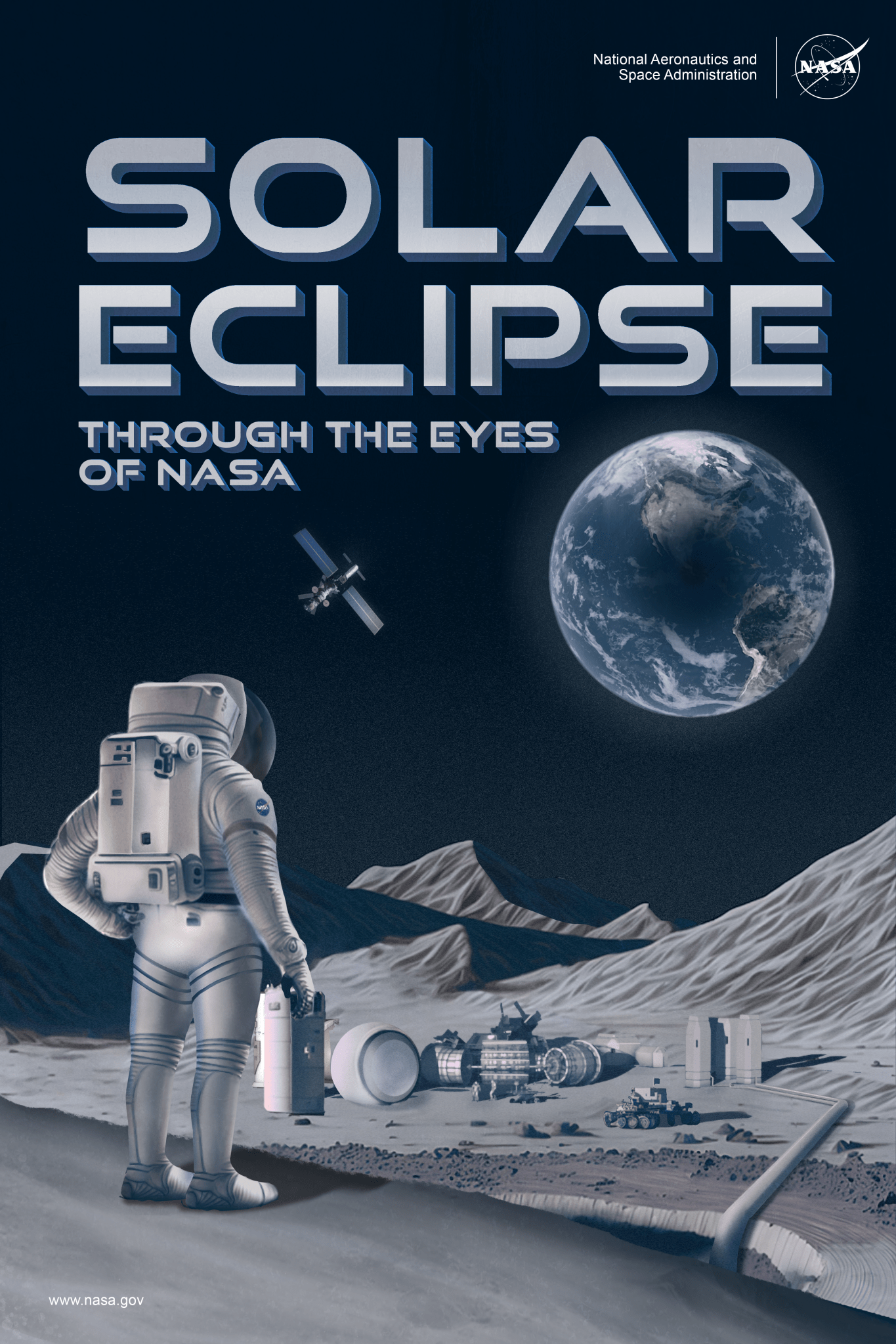
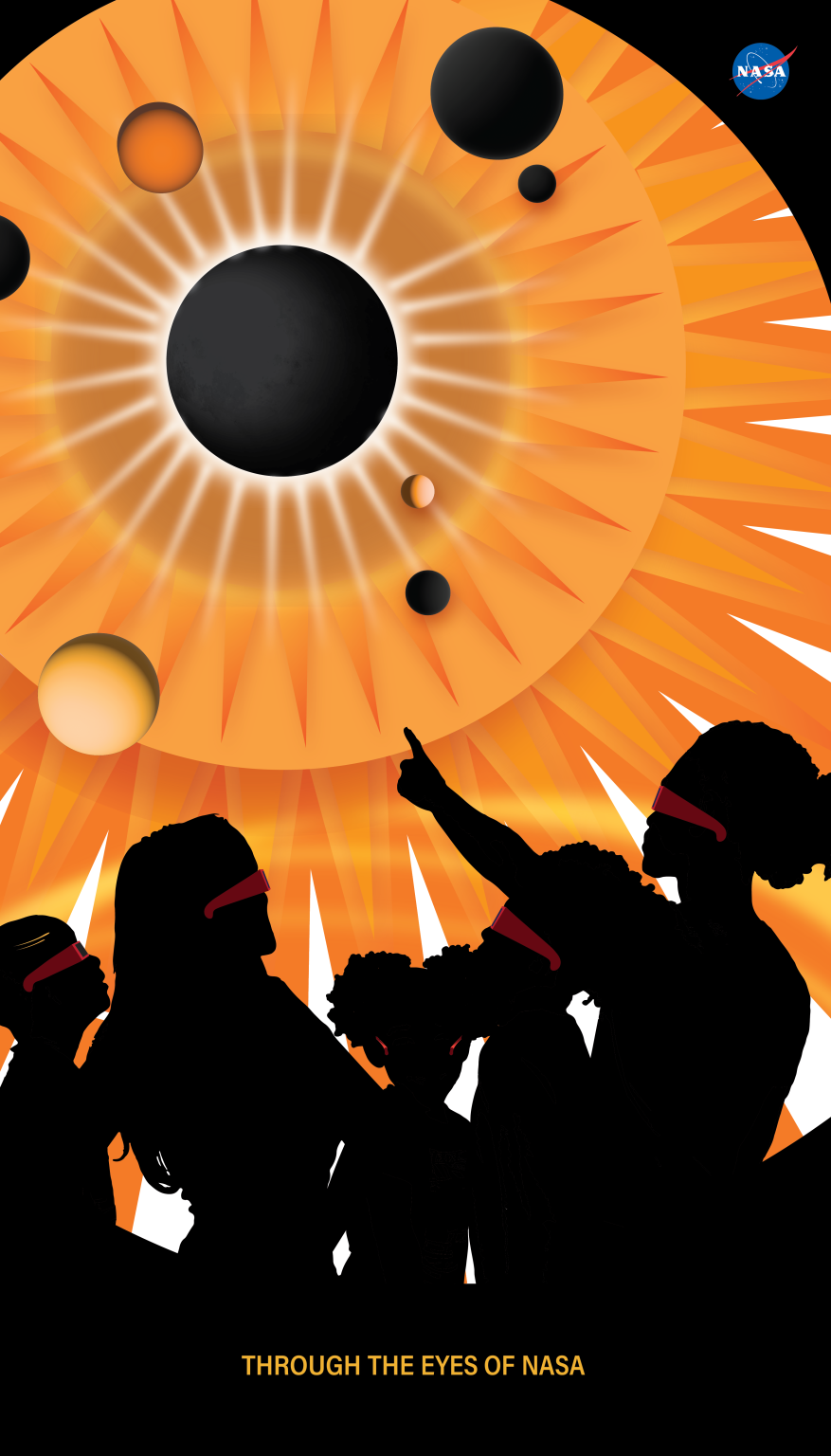
Meet the Creators, Part 4: Two New 2024 Total Eclipse Posters
Total solar eclipses reveal the Sun’s outer atmosphere – the corona – a white, wispy halo of solar material that flows out from around the Sun. This atmosphere is breathtaking as it glows in the sky for viewers on Earth, surrounding the dark disk of the Moon. In addition to revealing this normally hidden part of our Sun, the eclipse also darkens the sky, changes shadows, and cools the air. It can feel like living inside a piece of art.
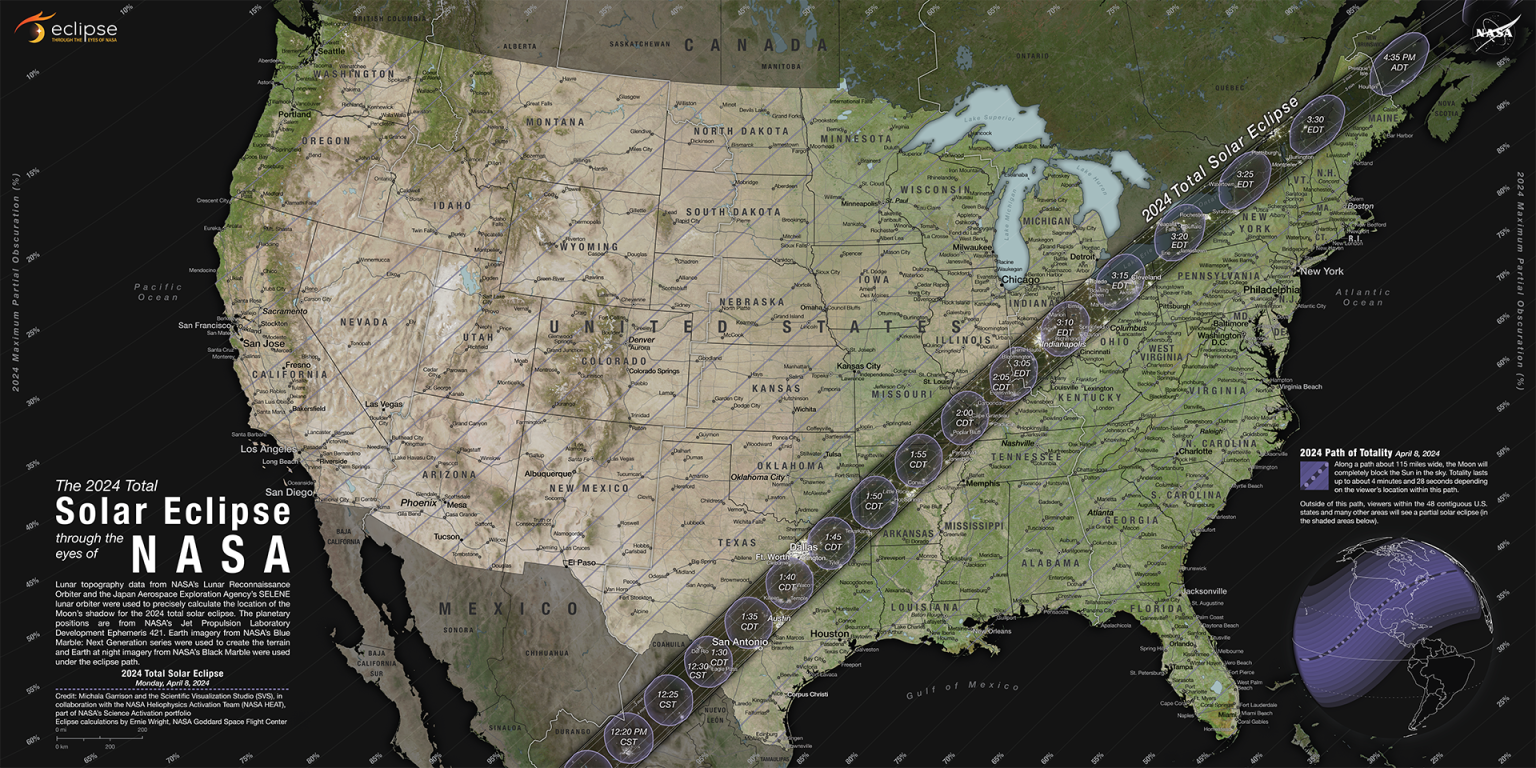
Artists have captured the magical appearance of eclipses for over a thousand years. For the upcoming total solar eclipse crossing North America on April 8, 2024, two artists have contributed new posters to NASA’s eclipse poster series.
Dongjae “Krystofer” Kim
Download the poster here.
NASA/Dongjae “Krystofer” Kim
Dongjae “Krystofer” Kim is a Senior Science Animator at the Conceptual Image Lab at NASA’s Goddard Space Flight Center. He received a Bachelor of Fine Arts in Design and Technology from Parsons School of Design and a Master of Business Administration and Master of Arts from the Design Leadership program at the Maryland Institute of Contemporary Art and the Johns Hopkins Carey Business School. He combines various art and design disciplines, including fine arts, graphic design, creative coding, animation, and design research to help tell NASA’s story.
“I was contemplating how the eclipse is an event that is beyond human scale physically and chronologically. It will look differently outside of my myopic view from this planet and it will occur after I am gone for many years to come. With this perspective, I thought of how future space explorations with permanent settlements on the Moon will view this event. While searching for scientific references, I remembered a video piece by our own NASA Goddard media team ‘An EPIC View of the Moon’s Shadow During the June 10 Solar Eclipse’ in 2021 and used it as a visual reference.”
What inspired you to become an artist?
“My inspiration came via Pixar and Ghibli animated films and shows I watched as a child. Despite being a little dyslexic Korean kid, I was welcomed into the world of each story. I found it magical that artists could seemingly create everything from nothing or something fantastical from mundane ideas and objects. And I loved that art enables you to communicate your own ideas as well as learn about others creating common ground.”
Want to explore this artwork more? An animated version of this poster is available to download.
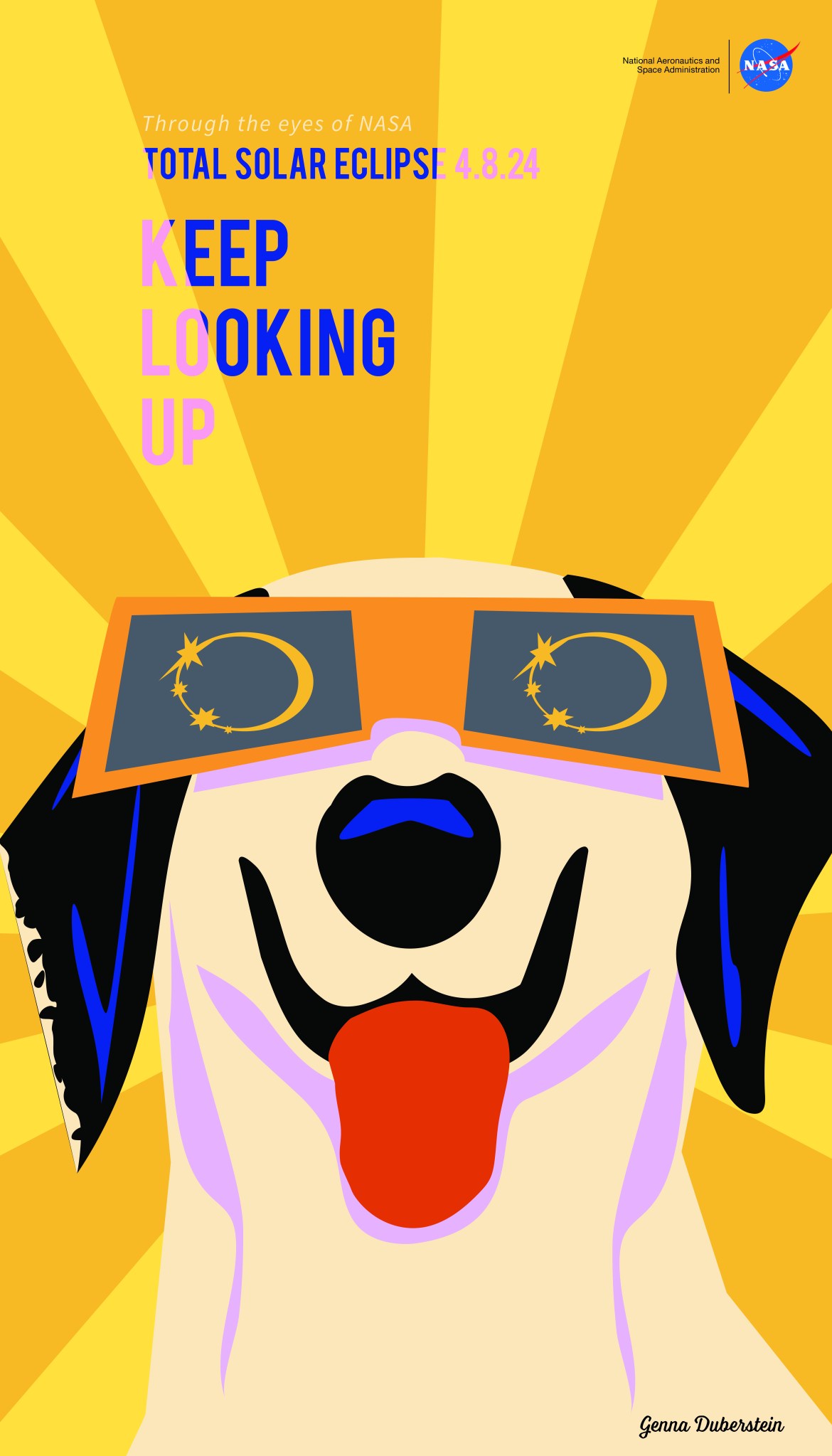
Genna Duberstein
Download the poster here.
NASA/Genna Duberstein
Genna Duberstein is an award-winning, Emmy-nominated multimedia producer and graphic designer who specializes in both making and marketing content. Her work has been shown internationally, aired on PBS, and has been featured in many outlets, including The New York Times, Vanity Fair, WIRED, The Atlantic, and National Geographic. She holds a Master of Fine Arts from American University and a Bachelor of Arts from The Ohio State University.
“During the 2017 total solar eclipse, my parents sent me a picture of themselves, smiling in eclipse glasses and sitting on their front stoop with their dog. It was such a goofy, happy picture, I wanted to capture that same spirit for the poster. I have a dog of my own now – a goofy, happy American foxhound mix – and he proved to be the perfect model for the total eclipse poster. There’s no denying an eclipse can be an awe-inspiring event, but it can be just plain fun too!”
What inspired you to become an artist?
“I can’t help it! I’ve always made things, and I’ve been very fortunate to have had support along the way. My parents enrolled me in my first art class at four, and they encouraged me to submit work to art contests all through elementary and high school. Portfolio-based scholarships and commissioned portrait work helped me pay for college. To this day, I’m incredibly lucky to have had a career where I can be creative, and I am thankful for all the people who have made it possible.”
Have an idea for how to put your own spin on this poster? This artwork is also available as a downloadable coloring sheet.
By Abbey Interrante NASA’s Goddard Space Flight Center, Greenbelt, Md.
Naval helicopters fly over a test version of NASA’s Orion spacecraft and personnel involved in training activities in the Pacific Ocean in July 2023, in preparation for Artemis II. Teams from NASA, including the Artemis II crew, and the Department of Defense are training this month off the coast of San Diego to prepare to recover the astronauts and Orion when they return to Earth.
Credits: NASA/Kenny Allen
Media are invited to speak with the four Artemis II astronauts on Wednesday, Feb. 28, at Naval Base San Diego in California. The crew will fly around the Moon next year as part of NASA’s Artemis campaign, marking the first astronauts to make the journey in more than 50 years.
NASA and the U.S. Department of Defense are conducting training with the crew in the Pacific Ocean to demonstrate the procedures and hardware needed to retrieve NASA astronauts Reid Wiseman, Victor Glover, Christina Koch, and CSA (Canadian Space Agency) astronaut Jeremy Hansen after their approximately 10-day, 685,000-mile journey beyond the lunar far side and back.
The flight is the first crewed mission under NASA’s Artemis campaign and will test the agency’s Orion spacecraft life support systems needed for future lunar missions.
Attendees will be able to view hardware associated with the training, including a test version of Orion aboard the USS San Diego, and speak with other personnel from the agency and the Defense Department who are responsible for bringing the crew and the capsule to safety after the mission.
Media interested in attending must RSVP by 4 p.m. PST, Monday, Feb. 26, to Naval Base San Diego Public Affairs at nbsd.pao@us.navy.mil or 619-556-7359. The exact time of the planned afternoon Feb. 28 event is subject to the conclusion of testing activities.
Under Artemis, NASA will establish the foundation for long-term scientific exploration at the Moon, land the first woman, first person of color, and its first international partner astronaut on the lunar surface, and prepare for human expeditions to Mars for the benefit of all.
Webb Finds Evidence for Neutron Star at Heart of Young Supernova Remnant
The James Webb Space Telescope has observed the best evidence yet for emission from a neutron star.
Credits: NASA, ESA, CSA, STScI, C. Fransson (Stockholm University), M. Matsuura (Cardiff University), M. J. Barlow (University College London), P. J. Kavanagh (Maynooth University), J. Larsson (KTH Royal Institute of Technology)
NASA’s James Webb Space Telescope has found the best evidence yet for emission from a neutron star at the site of a recently observed supernova. The supernova, known as SN 1987A, was a core-collapse supernova, meaning the compacted remains at its core formed either a neutron star or a black hole. Evidence for such a compact object has long been sought, and while indirect evidence for the presence of a neutron star has previously been found, this is the first time that the effects of high-energy emission from the probable young neutron star have been detected.
Supernovae – the explosive final death throes of some massive stars – blast out within hours, and the brightness of the explosion peaks within a few months. The remains of the exploding star will continue to evolve at a rapid rate over the following decades, offering a rare opportunity for astronomers to study a key astronomical process in real time.
Supernova 1987A
The supernova SN 1987A occurred 160,000 light-years from Earth in the Large Magellanic Cloud. It was first observed on Earth in February 1987, and its brightness peaked in May of that year. It was the first supernova that could be seen with the naked eye since Kepler’s Supernova was observed in 1604.
About two hours prior to the first visible-light observation of SN 1987A, three observatories around the world detected a burst of neutrinos lasting only a few seconds. The two different types of observations were linked to the same supernova event, and provided important evidence to inform the theory of how core-collapse supernovae take place. This theory included the expectation that this type of supernova would form a neutron star or a black hole. Astronomers have searched for evidence for one or the other of these compact objects at the center of the expanding remnant material ever since.
Indirect evidence for the presence of a neutron star at the center of the remnant has been found in the past few years, and observations of much older supernova remnants –such as the Crab Nebula – confirm that neutron stars are found in many supernova remnants. However, no direct evidence of a neutron star in the aftermath of SN 1987A (or any other such recent supernova explosion) had been observed, until now.
Image: Supernova 1987A
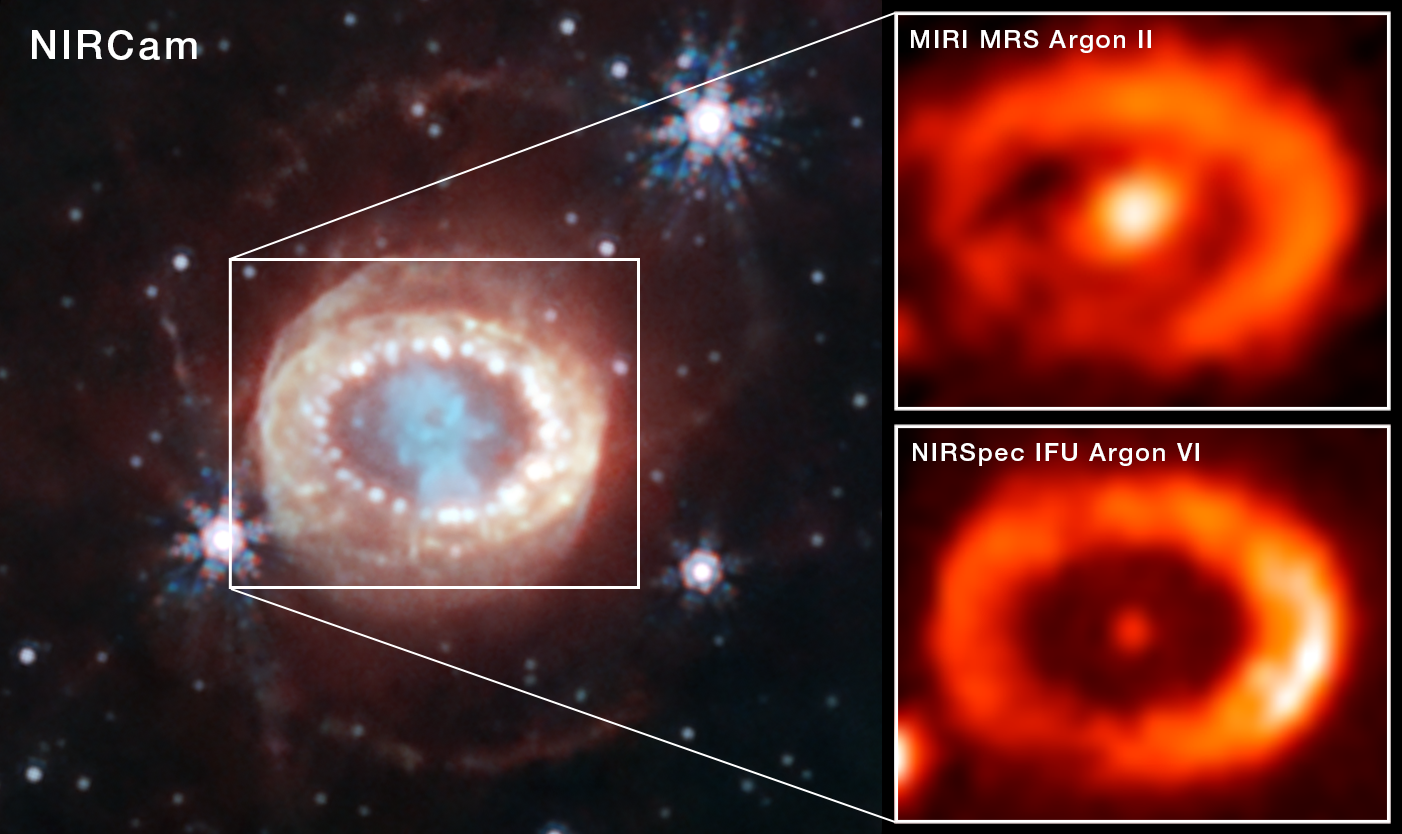
The James Webb Space Telescope has observed the best evidence yet for emission from a neutron star at the site of a well-known and recently-observed supernova known as SN 1987A. At left is a NIRCam (Near-Infrared Camera) image released in 2023. The image at top right shows light from singly ionized argon (Argon II) captured by the Medium Resolution Spectrograph (MRS) mode of MIRI (Mid-Infrared Instrument). The image at bottom right shows light from multiply ionized argon captured by the NIRSpec (Near-Infrared Spectrograph). Both instruments show a strong signal from the center of the supernova remnant. This indicated to the science team that there is a source of high-energy radiation there, most likely a neutron star.
NASA, ESA, CSA, STScI, C. Fransson (Stockholm University), M. Matsuura (Cardiff University), M. J. Barlow (University College London), P. J. Kavanagh (Maynooth University), J. Larsson (KTH Royal Institute of Technology)
Claes Fransson of Stockholm University, and the lead author on this study, explained: “From theoretical models of SN 1987A, the 10-second burst of neutrinos observed just before the supernova implied that a neutron star or black hole was formed in the explosion. But we have not observed any compelling signature of such a newborn object from any supernova explosion. With this observatory, we have now found direct evidence for emission triggered by the newborn compact object, most likely a neutron star.”
Webb’s Observations of SN 1987A
Webb began science observations in July 2022, and the Webb observations behind this work were taken on July 16, making the SN 1987A remnant one of the first objects observed by Webb. The team used the Medium Resolution Spectrograph (MRS) mode of Webb’s MIRI (Mid-Infrared Instrument), which members of the same team helped to develop. The MRS is a type of instrument known as an Integral Field Unit (IFU).
IFUs are able to image an object and take a spectrum of it at the same time. An IFU forms a spectrum at each pixel, allowing observers to see spectroscopic differences across the object. Analysis of the Doppler shift of each spectrum also permits the evaluation of the velocity at each position.
Spectral analysis of the results showed a strong signal due to ionized argon from the center of the ejected material that surrounds the original site of SN 1987A. Subsequent observations using Webb’s NIRSpec (Near-Infrared Spectrograph) IFU at shorter wavelengths found even more heavily ionized chemical elements, particularly five times ionized argon (meaning argon atoms that have lost five of their 18 electrons). Such ions require highly energetic photons to form, and those photons have to come from somewhere.
“To create these ions that we observed in the ejecta, it was clear that there had to be a source of high-energy radiation in the center of the SN 1987A remnant,” Fransson said. “In the paper we discuss different possibilities, finding that only a few scenarios are likely, and all of these involve a newly born neutron star.”
More observations are planned this year, with Webb and ground-based telescopes. The research team hopes ongoing study will provide more clarity about exactly what is happening in the heart of the SN 1987A remnant. These observations will hopefully stimulate the development of more detailed models, ultimately enabling astronomers to better understand not just SN 1987A, but all core-collapse supernovae.
These findings were published in the journal Science.
The James Webb Space Telescope is the world’s premier space science observatory. Webb is solving mysteries in our solar system, looking beyond to distant worlds around other stars, and probing the mysterious structures and origins of our universe and our place in it. Webb is an international program led by NASA with its partners, ESA (European Space Agency) and the Canadian Space Agency.
Downloads
Right click the images in this article to open a larger version in a new tab/window.