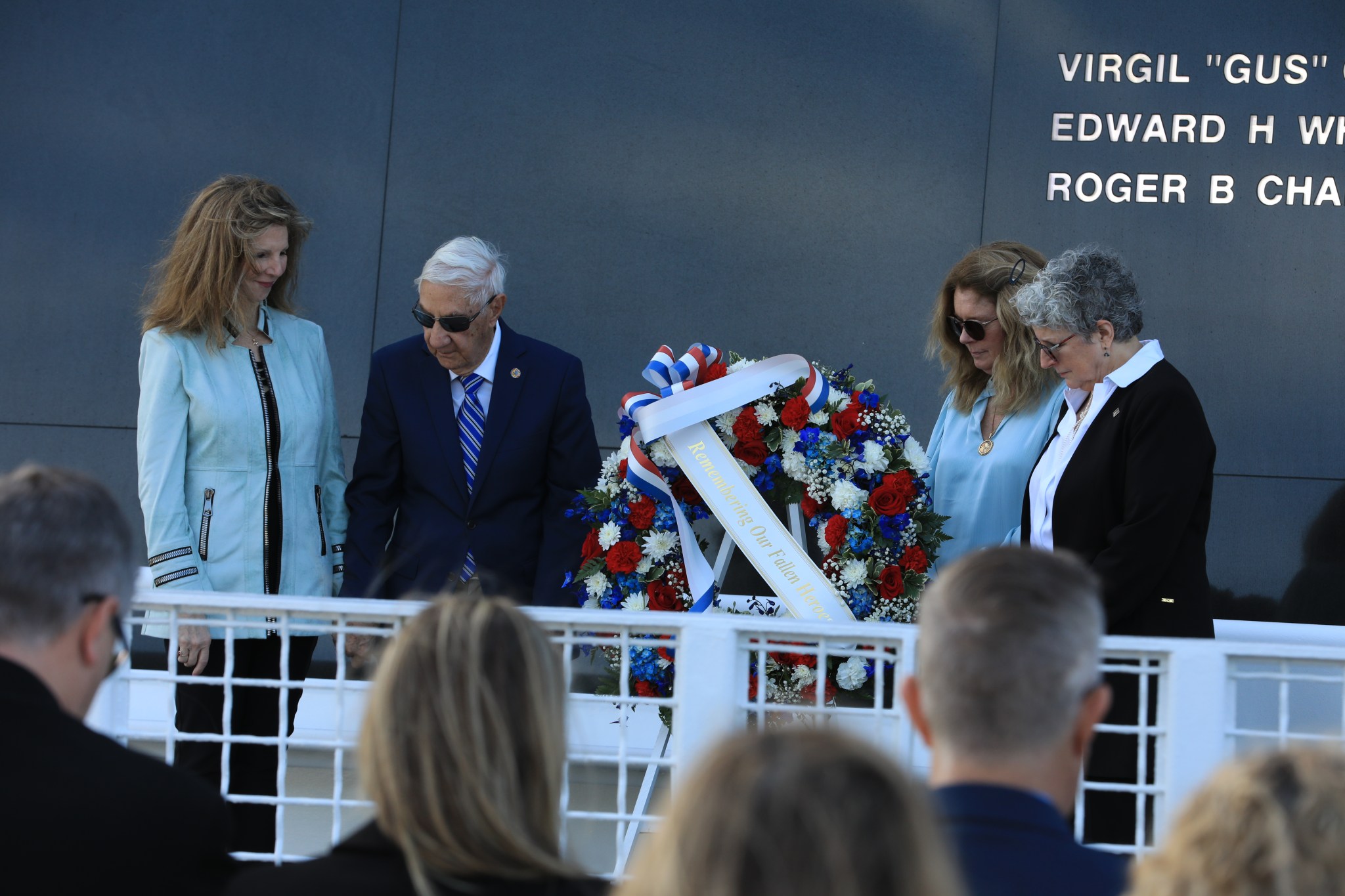
Family members of fallen astronauts Kathie Scobee Fulgham, Lowell Grissom, Sheryl Chaffee, and Karen Bassett Stevenson place a wreath at the Space Mirror Memorial at NASA’s Kennedy Space Center Visitor Complex in Florida on Thursday, Jan. 25, 2024, during the agency’s Day of Remembrance. The annual tradition pays tribute to fallen astronauts and astronaut candidates who lost their lives while furthering the cause of exploration and discovery, including the crews of Apollo 1, Challenger STS-51L, and Columbia STS-107.
Burt Summerfield, associate director, management, at NASA’s Kennedy Space Center in Florida, spoke during the annual Day of Remembrance to honor fallen astronauts and astronaut candidates. “Today is an important day for NASA and the nation to recognize the contribution and sacrifice made in pursuit of space exploration and discovery for all.” Summerfield said. “As we push forward to the Moon and continue our missions to the International Space Station, it’s vital that we always remember and implement the lessons from the past in our preparations.”
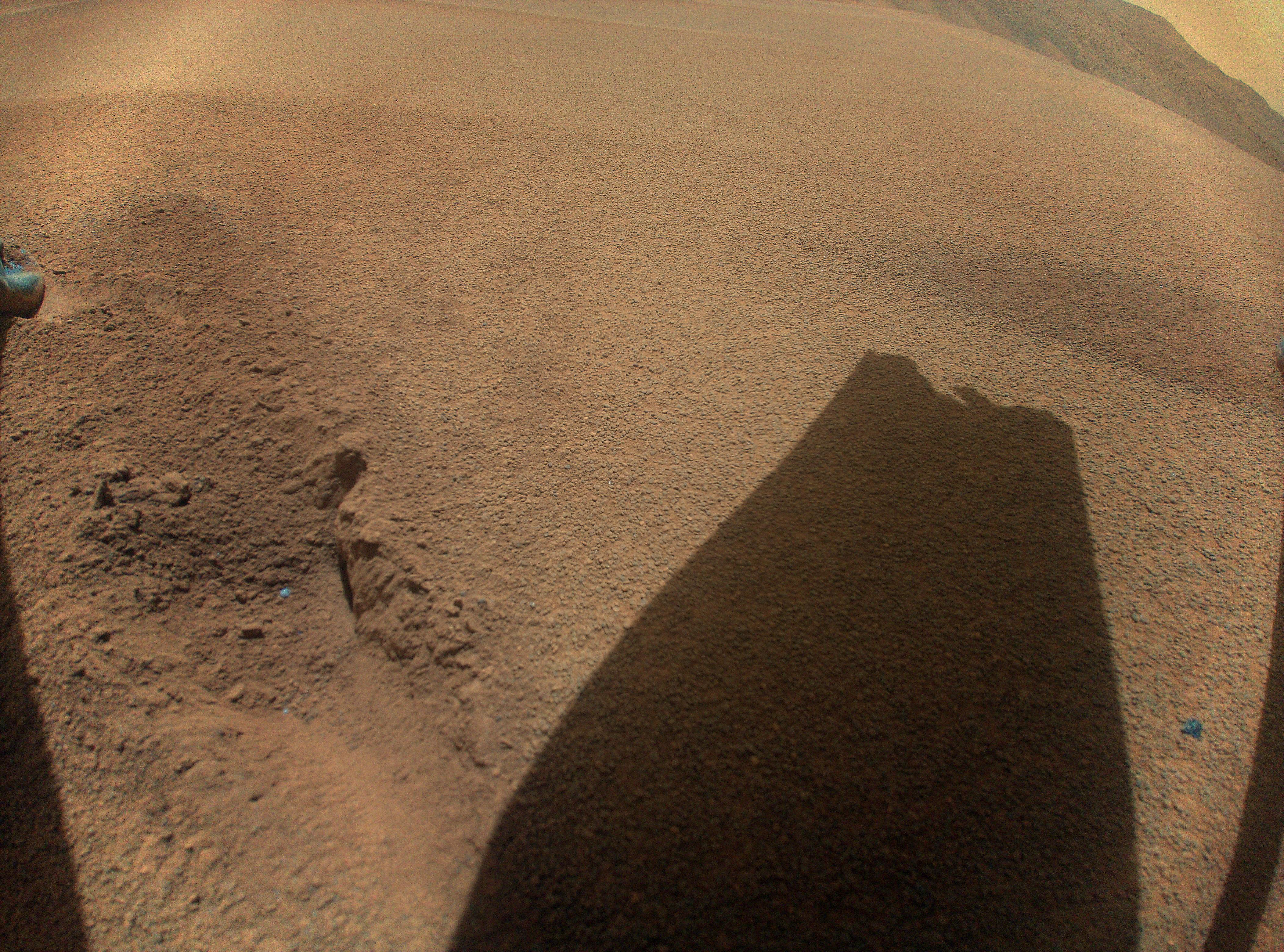
NASA’s history-making Ingenuity Mars Helicopter has ended its mission at the Red Planet after surpassing expectations and making dozens more flights than planned. While the helicopter remains upright and in communication with ground controllers, imagery of its Jan. 18 flight sent to Earth this week indicates one or more of its rotor blades sustained damage during landing, and it is no longer capable of flight.
Originally designed as a technology demonstration to perform up to five experimental test flights over 30 days, the first aircraft on another world operated from the Martian surface for almost three years, performed 72 flights, and flew more than 14 times farther than planned while logging more than two hours of total flight time.
“The historic journey of Ingenuity, the first aircraft on another planet, has come to end,” said NASA Administrator Bill Nelson. “That remarkable helicopter flew higher and farther than we ever imagined and helped NASA do what we do best – make the impossible, possible. Through missions like Ingenuity, NASA is paving the way for future flight in our solar system and smarter, safer human exploration to Mars and beyond.”
NASA to Discuss Ingenuity Mission in Media Call Today
In addition to video comments shared from Nelson about the mission’s conclusion, NASA will host a media teleconference at 5 p.m. EST today, Thursday, Jan. 25, to provide an update on Ingenuity Mars Helicopter.
Audio of the call will stream live on the agency’s website.
Participants in the call are expected to include:
Lori Glaze, director, Planetary Science Division, NASA’s Science Mission Directorate at the agency’s headquarters in Washington
Laurie Leshin, director, NASA’s Jet Propulsion Laboratory in Southern California
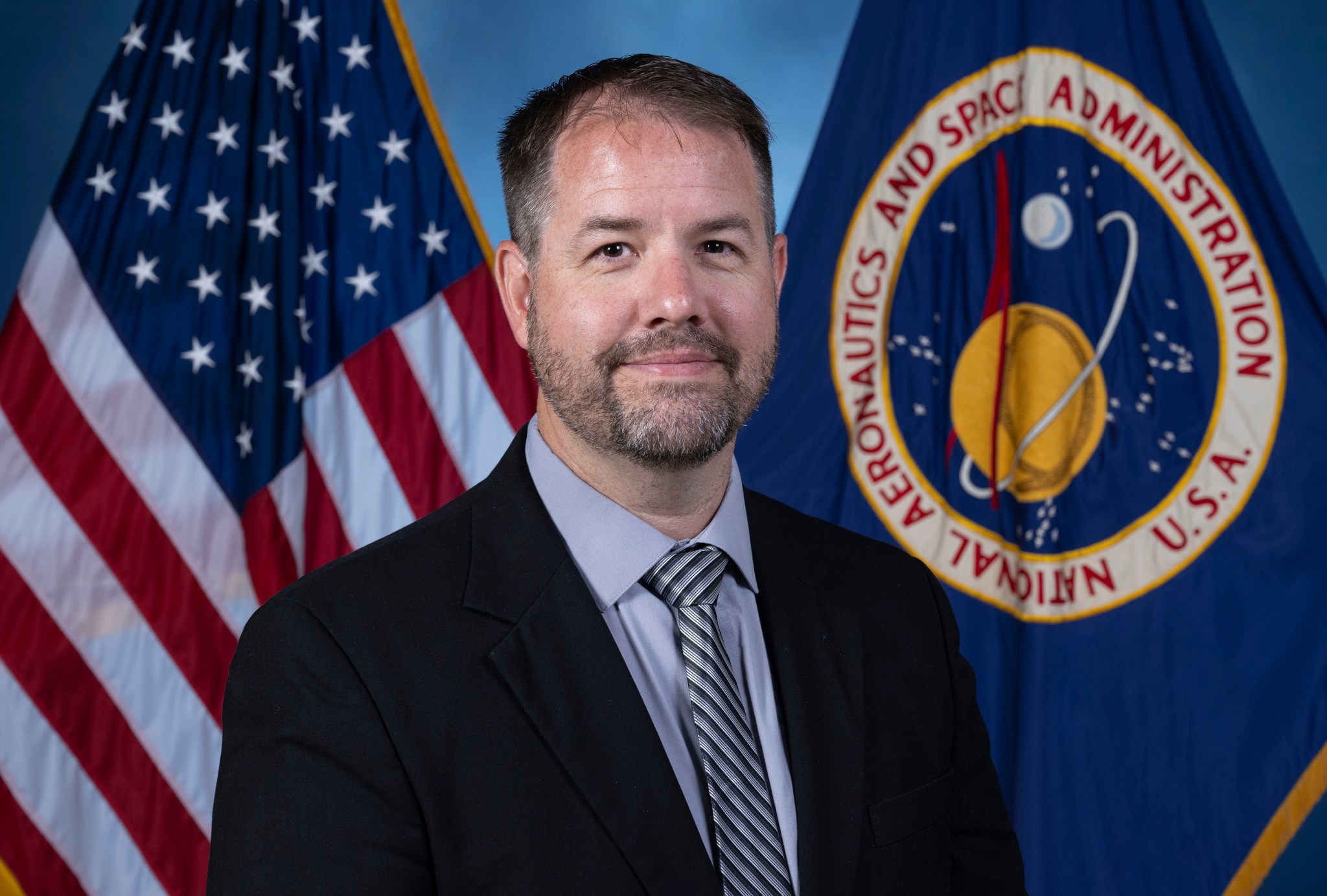
Teddy Tzanetos, Ingenuity project manager, NASA JPL
Media who wish to participate by phone can request dial-in information by emailing hq-media@mail.nasa.gov.
Ingenuity landed on Mars Feb. 18, 2021, attached to the belly of NASA’s Perseverance rover and first lifted off the Martian surface on April 19, proving that powered, controlled flight on Mars was possible. After notching another four flights, it embarked on a new mission as an operations demonstration, serving as an aerial scout for Perseverance scientists and rover drivers. In 2023, the helicopter executed two successful flight tests that further expanded the team’s knowledge of its aerodynamic limits.
“At NASA JPL, innovation is at the heart of what we do,” said Leshin. “Ingenuity is an exemplar of the way we push the boundaries of what’s possible every day. I’m incredibly proud of our team behind this historic technological achievement and eager to see what they’ll invent next.”
Ingenuity’s team planned for the helicopter to make a short vertical flight on Jan. 18 to determine its location after executing an emergency landing on its previous flight. Data shows that, as planned, the helicopter achieved a maximum altitude of 40 feet (12 meters) and hovered for 4.5 seconds before starting its descent at a velocity of 3.3 feet per second (1 meter per second).
However, about 3 feet (1 meter) above the surface, Ingenuity lost contact with the rover, which serves as a communications relay for the rotorcraft. The following day, communications were reestablished and more information about the flight was relayed to ground controllers at NASA JPL. Imagery revealing damage to the rotor blade arrived several days later. The cause of the communications dropout and the helicopter’s orientation at time of touchdown are still being investigated.
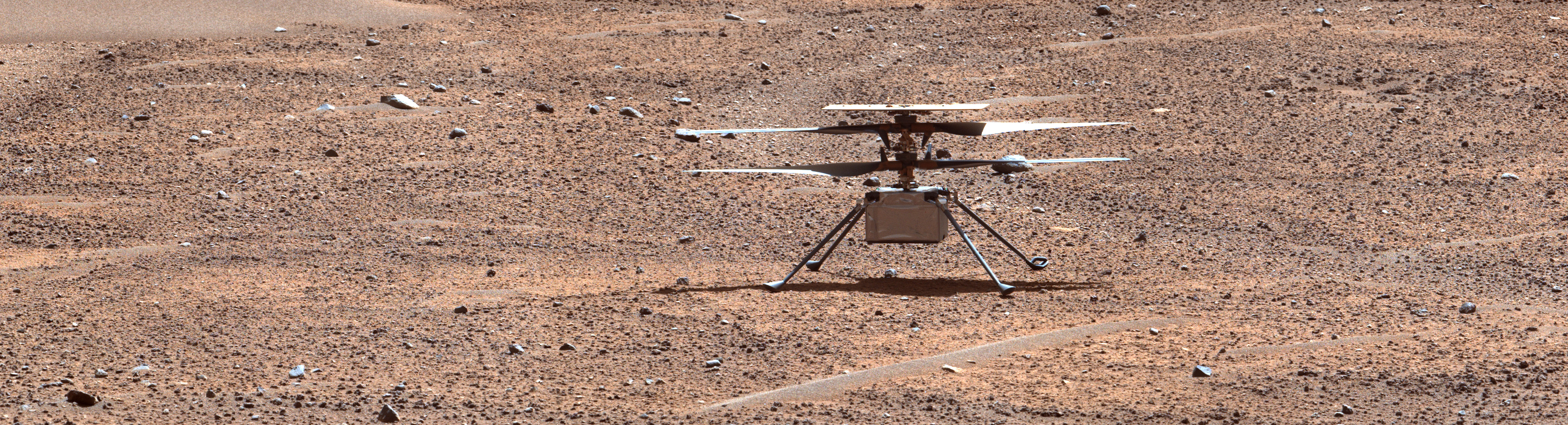
This enhanced color view of NASA’s Ingenuity Mars Helicopter was generated using data collected by the Mastcam-Z instrument aboard the agency’s Perseverance Mars rover on Aug. 2, 2023, the 871st Martian day, or sol, of the mission. The image was taken a day before the rotorcraft’s 54th flight.
After its 72nd flight on Jan. 18, 2024, NASA’s Ingenuity Mars Helicopter captured this color image showing the shadow of one of its rotor blades, which was damaged during touchdown.
NASA/JPL-Caltech
Triumphs, Challenges
Over an extended mission that lasted for almost 1,000 Martian days, more than 33 times longer than originally planned, Ingenuity was upgraded with the ability to autonomously choose landing sites in treacherous terrain, dealt with a dead sensor, cleaned itself after dust storms, operated from 48 different airfields, performed three emergency landings, and survived a frigid Martian winter.
Designed to operate in spring, Ingenuity was unable to power its heaters throughout the night during the coldest parts of winter, resulting in the flight computer periodically freezing and resetting. These power “brownouts” required the team to redesign Ingenuity’s winter operations in order to keep flying.
With flight operations now concluded, the Ingenuity team will perform final tests on helicopter systems and download the remaining imagery and data in Ingenuity’s onboard memory. The Perseverance rover is currently too far away to attempt to image the helicopter at its final airfield.
“It’s humbling Ingenuity not only carries onboard a swatch from the original Wright Flyer, but also this helicopter followed in its footsteps and proved flight is possible on another world,” said Ingenuity’s project manager, Teddy Tzanetos of NASA JPL. “The Mars helicopter would have never flown once, much less 72 times, if it were not for the passion and dedication of the Ingenuity and Perseverance teams. History’s first Mars helicopter will leave behind an indelible mark on the future of space exploration and will inspire fleets of aircraft on Mars – and other worlds – for decades to come.”
More About Ingenuity
The Ingenuity Mars Helicopter was built by NASA JPL, which also manages the project for NASA Headquarters. It is supported by NASA’s Science Mission Directorate. NASA’s Ames Research Center in California’s Silicon Valley and NASA’s Langley Research Center in Hampton, Virginia, provided significant flight performance analysis and technical assistance during Ingenuity’s development. AeroVironment Inc., Qualcomm, and SolAero also provided design assistance and major vehicle components. Lockheed Space designed and manufactured the Mars Helicopter Delivery System. At NASA Headquarters, Dave Lavery is the program executive for the Ingenuity Mars helicopter.
This new NASA Hubble Space Telescope image features a member of the galaxy group Arp 295.
NASA/ESA/J. Dalcanton (University of Washington)/R. Windhorst (Arizona State University)/Processing: Gladys Kober (NASA/Catholic University of America)
One of the galaxies from a galactic group known as Arp 295 is visible in this new NASA Hubble Space Telescope image, along with part of the faint 250,000-light-year-long bridge of stars and gas that stretches between two of the galaxies. The galaxies have passed close enough together that their mutual gravity created this cosmic streamer.
When galaxies pass close enough to gravitationally disrupt each other’s shape, they are known as interacting galaxies. This type of interaction happens over billions of years and repeated close passages can result in the merger of the two galaxies. Galactic mergers are thought to be common, and even our own Milky Way is expected to merge with the massive, neighboring Andromeda galaxy in about 4 billion years.
Arp 295 is made up of three spiral galaxies designated Arp 295a, Arp 295b, and Arp 295c. Arp 295a is the edge-on galaxy seen in the center of the image, and Arp 295c is the smaller and bluer face-on spiral to its right. Arp 295b is off the top left of this image and not visible here. Together, they are the largest of a loose grouping of galaxies located about 270 million light-years in the direction of the constellation Aquarius.
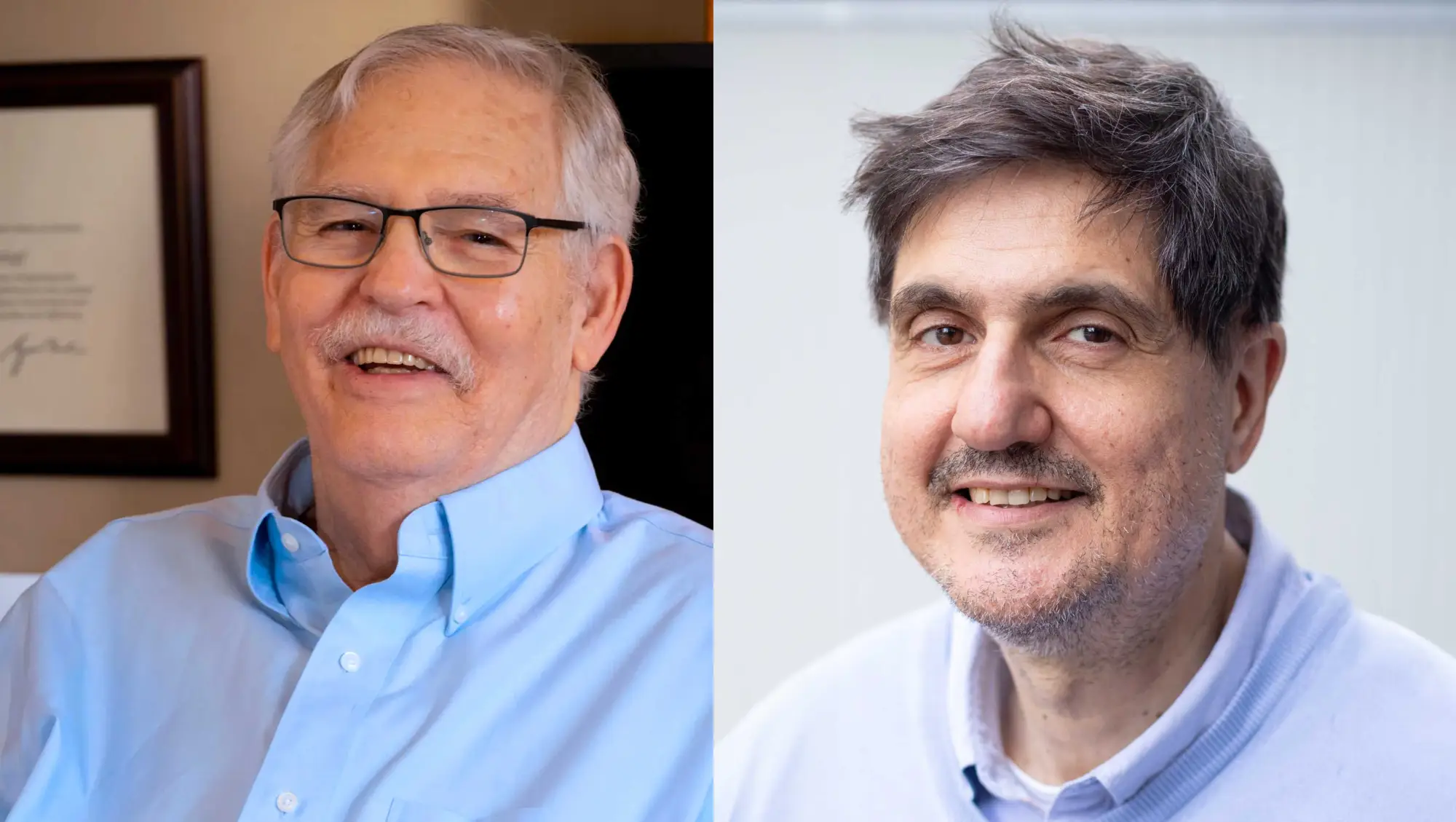
The High Energy Astrophysics Division of the American Astronomical Society (AAS) has awarded the 2024 Bruno Rossi Prize to retired NASA astrophysicist Martin Weisskopf, Italian Space Agency principal investigator Paolo Soffitta, and their team for development of IXPE, “whose novel measurements advance our understanding of particle acceleration and emission from astrophysical shocks, black holes and neutron stars,” according to the AAS announcement.
NASA’s Imaging X-ray Polarimetry Explorer mission, led by retired NASA astrophysicist Martin Weisskopf, left, and Italian Space Agency principal investigator Paolo Soffitta, has received the 2024 Rossi Prize in high-energy astronomy, awarded annually by the American Astronomical Society.
NASA/INAF
“IXPE is a realization of decades of work and belief in the importance of X-ray polarization measurements for X-ray astronomy. I am honored and excited to share this prize with Paolo Soffitta and the entire IXPE team,” said Weisskopf, who was IXPE’s principal investigator during its development. He retired from NASA in 2022.
“IXPE is the demonstration of how an idea pursued for more than 30 years has been transformed into a successful mission, thanks to the collaboration between the United States and Italy,” Soffitta said. “It’s incredible to receive this prize along with Martin Weisskopf and on behalf of so many people whose expertise and enthusiasm have made this breakthrough in astrophysics possible.”
Developed by NASA, the Italian Space Agency, and partners in a dozen countries, IXPE was launched to space on Dec. 9, 2021. Today, it orbits Earth some 340 miles up to observe X-ray emissions from powerful cosmic phenomena hundreds or thousands of light-years away. In 2023 alone, its subjects of study included blazars such as Markarian 501 and Markarian 421, supernova remnants including Tycho and SN 1006, and the supermassive black hole at the center of our own galaxy. Its success led NASA to formally extend the mission for an additional 20 months, through at least September 2025.
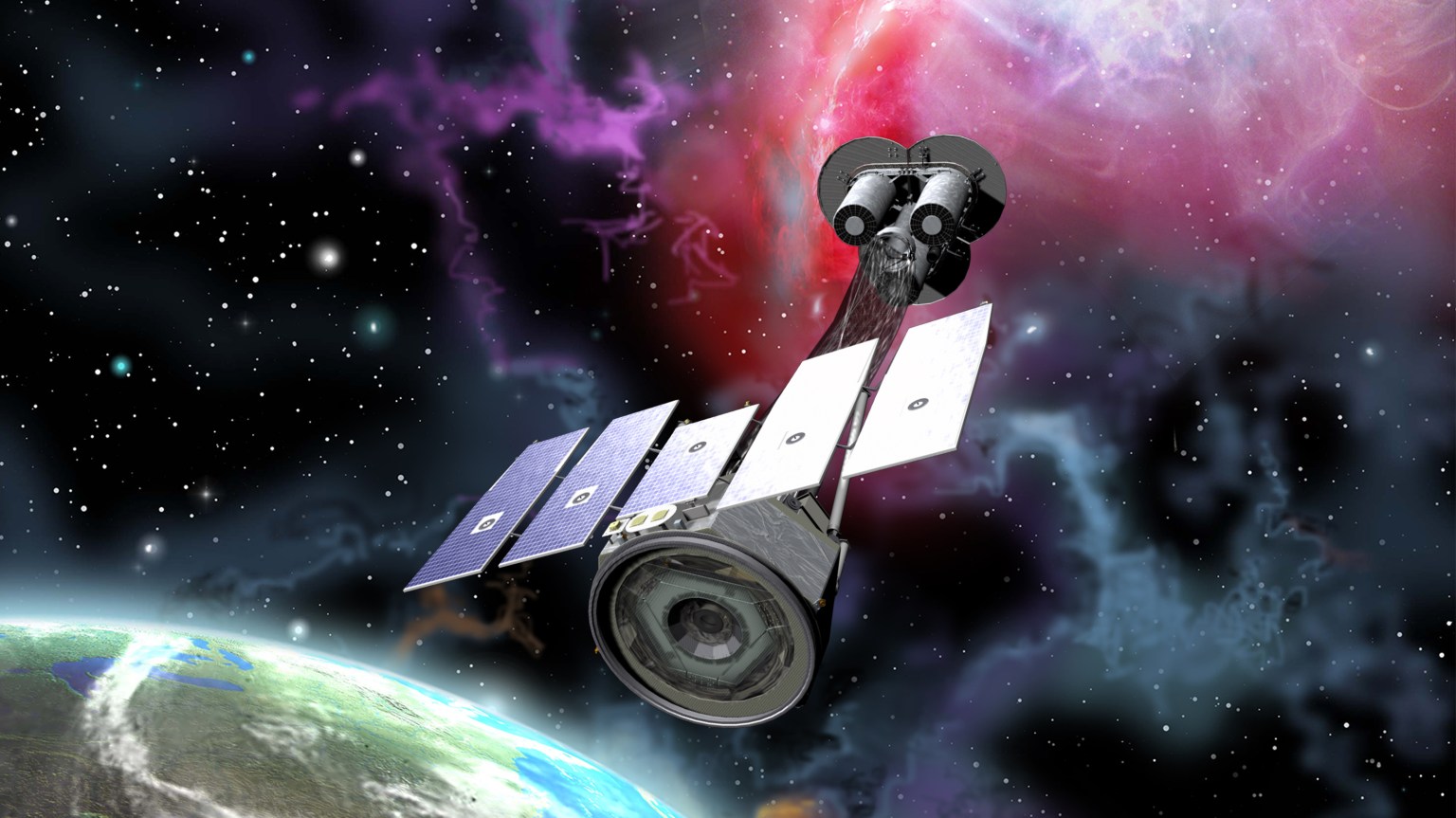
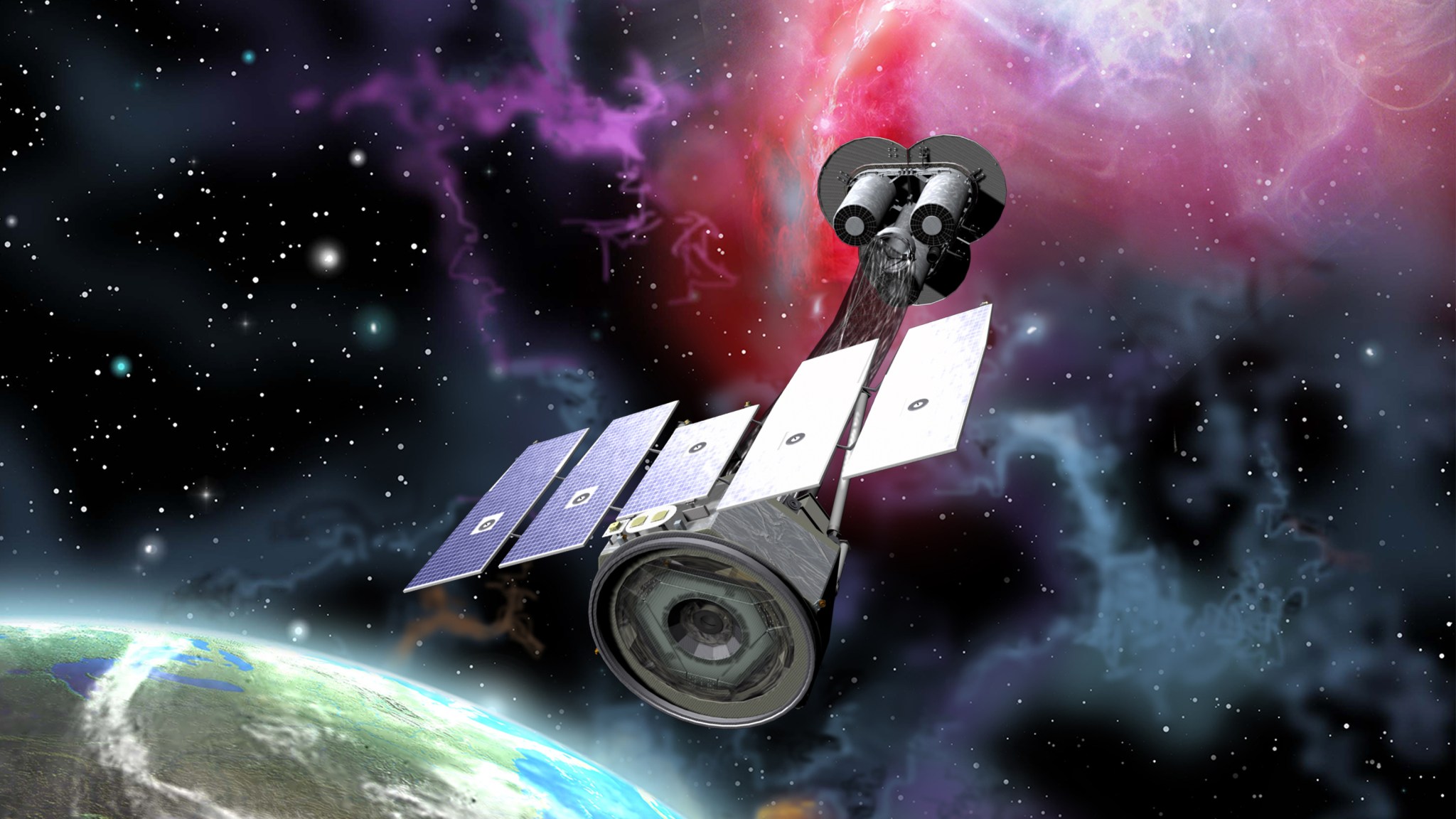
An artist’s illustration of the IXPE spacecraft in orbit, studying high-energy phenomena light-years from Earth.
NASA
“We at NASA are incredibly proud of Dr. Weisskopf and the IXPE team around the world,” said acting Marshall Center Director Joseph Pelfrey. “IXPE allows us to look at the universe through a vantage point never seen before. It’s particularly gratifying to continue Marshall’s long association with the Rossi Prize, which identifies singular breakthroughs and unprecedented innovation in high-energy astrophysics – a field in which our researchers excel.”
Weisskopf, together with Harvard astrophysicist Harvey Tananbaum, previously received the Rossi Prize in 2004 for their work to develop and fly NASA’s Chandra X-ray Observatory, which continues to study X-ray phenomena across the cosmos. Marshall researchers Gerald Fishman and Colleen Wilson-Hodge also were awarded the Rossi Prize in 1994 and 2018, respectively. Fishman was honored for his contributions to the Compton Gamma-ray Observatory’s BATSE (Burst and Transient Source Experiment) mission, Wilson-Hodge for her work with the Fermi GBM (Gamma-ray Burst Monitor) in August 2017, detecting gravitational and light waves from the spectacular smashup of two neutron stars in a distant galaxy.
The Rossi Prize is awarded annually for a significant recent contribution to high-energy astrophysics. The honor includes an engraved certificate and a $1,500 award.
Smith, an Aeyon/MTS employee, supports the Marshall Office of Communications.
National Mentoring Month: The Right Type of Mentorship with Erika Alvarez and Dave Reynolds
By Celine Smith
Erika Alvarez’s path to becoming a Systems Engineering & Integration manager at NASA Headquarters has impacted the way she mentors.
“What we do at NASA takes a village,” Alvarez said. “It may take one person to make something, but there could be 10 or 15 or 20 people who help them get there.”
Erika Alvarez, System Engineering and Integration manager at NASA Headquarters, and mentor to Dave Reynolds, a deputy program manager at NASA’s Marshall Space Flight Center.
NASA
Alvarez wants to be one of many guiding others to meet their goals, which is how she began mentoring Dave Reynolds, a deputy program manager at NASA’s Marshall Space Flight Center.
Alvarez and Reynolds don’t have a traditional mentorship. Both began in Marshall’s propulsion systems department in 2004. While Alvarez is younger than Reynolds, Alvarez is mentoring Reynolds.
Alvarez may not have decades more experience than Reynolds, but Alvarez joining the SES (Senior Executive Service) coincided with Reynolds wanting to transition to the SES. Their shared working experience and similar goal made a perfect fit for their mentorship.
Reynolds is currently being mentored by Alvarez in preparation for a Senior Executive Service position.
NASA
Hoping their experience can help others during National Mentoring Month, they discussed their insight about finding the right type of mentorship.
Question: What does mentorship mean to you?
Reynolds: Mentorship is an outside perspective that benefits me by providing a better solution. You can ask your mentor about your ideas to self-examine the path that you’re on. They know you and have your best interest in mind. Your decisions are not directly going to affect them, so they can offer candid advice.
Alvarez: For me, mentorship is worth the time investment because we can get stuck in our day-to-day routine. It’s a refreshing time during the week to sit down with someone knowing what they’re experiencing and helping them, so they don’t have to navigate certain challenges on their own. I have templates, articles, rubrics, books, and other perspectives I gained through my first year in SES. Now I can offer those resources. It’s something that I want to pass on to somebody else because it takes a village to do this. Mentoring is very energizing and fruitful. It reminds me that I love NASA and it’s a great place to work. I hope that I can provide that feeling and energy to someone else and it just keeps going.
Question: What impact has mentorship had on you and your career?
Alvarez: With Dave and I starting from the same department, we had some of the same mentors early on. Mentors give you confidence to move to the next role when you’re down in the details, doing the work, and years into a position. I would also say I was fortunate enough to have a great mentor that was outside of my department. The most important trait she gave to me was resiliency. There are many times when you go for something and are unsuccessful. Having somebody that believes in you during those times is huge.
Reynolds: My first formal mentor was assigned to me while I was in the Mid-Level Leadership Program and she was in SES at NASA’s Glenn Research Center. She encouraged me to get out of engineering, because she believed I was ready for a leadership role. Without her, I wouldn’t have transitioned as quickly as I did. My current mentorship is also kicking me to the next level and informing me of all the options I need to consider. Having a mentor that has known you for a long time, like Alvarez, is beneficial. You can trust their guidance more because they’ve seen you fail, and they still believe in your success.
Question: What was the initial goal and how has that impacted the type of mentoring relationship you built?
Reynolds: The initial goal was Alvarez prepping me to become SES qualified and she’s helped me at every step. Alvarez encouraged me to apply for the ASPIRE program. Programs and tools like that are exactly what I need to know about. She’s provided a lot of information that I didn’t know I would need to consider.
A young Alvarez, third from left, and Reynolds, far right, smile for a photo taken while they were both working in the propulsion systems department at Marshall.
NASA
Alvarez: I mentor a lot of people at different levels. Reynolds is a unique mentee because he is seeking out a big goal. Other mentees coming to me are in different stages, or they’re in a similar field and want to discuss the type of work I do. His goal is personal. I don’t want Reynolds to feel unprepared. I want him to go into his interview and any future roles with confidence and his best foot forward. I want Dave’s future peers to know he’s ready to lead. If Dave is successful in achieving his goal, I want to help him through that transition during the first year of his new role as well, especially with the person who last had the position being gone. I have executive mentors who are the only people I can discuss certain topics with. A part of the goal is Reynolds’ long-term success, which is why it’s important for him to have access to that network of people. If Reynolds needs help with something I’m not well-versed in, I can get him in contact with someone who is.
Question: How do you think the dynamic between mentor and mentee may differ in a formal mentoring relationship compared to an informal, casual mentoringencounter?
Reynolds: Formal mentoring relationships are more deliberate. We have a goal that we set. We’re not just having lunch, we set a scheduled time where we each have ideas we bring to discuss. Formal encounters are more structured. With informal mentorships you can also have casual lunches where good advice is thrown back and forth, but I have noticed if you’re more deliberate, you’ll get concrete progress.
Alvarez: Dave having a specific objective made the mentorship formal. The structure provided time for me to gather materials I found helpful in preparation for SES. With a hands-on approach, I could help Reynolds during his time in the ASPIRE program. We methodically planned how to reach each goal and in turn the objective. As we’re doing the work, we’re checking in consistently. Informal mentorships are hard. There’s no set amount of time spent together, and its disorganization makes it easier to lose momentum toward the objective. Informal mentorships also make it harder to feel a sense of accomplishment because progress is harder to assess.
Question: What advice do you have for someone else considering finding or being a mentor?
Alvarez: Think outside the box. Some people come in with an unconscious bias of what a mentor is. Mentees can become overly concerned with a mentor’s background. Not knowing their background is a good thing. Remain open minded about what someone else can offer you. You’re always going to get some good nuggets out of a mentorship. If someone suggests a mentor to you, take it. They might see something that neither of you do that would make a great pairing. I also recommend that some people choose mentors with a different career path like Dave and me. We shared the same foundation but then we went off in two different branches. Getting to combine those different insights is amazing because it makes us stronger.
Reynolds: As a mentee, check that you have humility. It’d be easy for me to dismiss Alvarez as a mentor because of our similarities. I recognize, she’s had a completely different life and is therefore capable of giving me an outside perspective. She’s also wicked smart, and I listen to wicked smart people. I’ve heard people reject advice from others because they are on the same tier or below career wise. That’s not a good approach. Ask yourself who can help with growth as opposed to finding somebody that that will help you up the ladder.
Editor’s note: This is the second in a Marshall Star series during National Mentoring Month in January. Marshall team members can learn more about the benefits of mentoring on Inside Marshall.
Smith, a Media Fusion employee, supports the Marshall Office of Communications.
Larry Leopard Named Acting Director of Marshall’s Engineering Directorate
Larry Leopard has been named acting director of NASA Marshall Space Flight Center’s Engineering Directorate upon the retirement of Don Holder this month. He will fill the role until a permanent director is named as well as continuing his duties as Marshall’s associate director, technical.
Larry Leopard, Marshall’s associate director, technical, has been named acting director of NASA Marshall Space Flight Center’s Engineering Directorate.
NASA
As Marshall’s associate director, technical, Leopard provides expert advice in all facets of the center’s responsibilities by conducting special studies; provides authoritative advice and assistance in policy review; manages and reports on centerwide and directorate metrics; and develops benchmark strategies. He was appointed to the position in December 2020. Leopard previously served as director of the Engineering Directorate from 2018 to 2020.
Lisa Bates will remain as deputy director of Marshall’s Engineering Directorate.
NASA
Lisa Bates will remain as deputy director and will be responsible for the day-to-day management of the Engineering Directorate.
Whether he’s advising student robotic competitions or managing production of a powerful, new Moon rocket stage, Erick Holsonback meets technical challenges with enthusiasm.
Holsonback, a Jacobs Technology employee, is subsystem manager for production and launch operations of the exploration upper stage (EUS) for NASA’s SLS (Space Launch System) rocket. SLS is NASA’s super heavy lift rocket that will launch the agency’s Artemis campaign to the Moon. The exploration upper stage is one of two upgrades to the SLS rocket as it evolves to the Block 1B variant for missions beginning with Artemis IV. Along with the rocket’s new universal stage adapter, the SLS rocket in its Block 1B configuration will be able to send 40% more payload to the Moon in a single launch.
Eric Holsonback, a Jacobs Technology employee, is subsystem manager for production and launch operations of the exploration upper stage for NASA’s SLS (Space Launch System) rocket.
NASA/Michael DeMocker
Holsonback’s job stretches from setting up production for the future upper stage at NASA’s Michoud Assembly Facility, where it’s built, to preparing it for launch from the agency’s Kennedy Space Center.
“It’s exciting to be part of a capability that will send more crew and cargo to the Moon in a single launch than any other current rocket,” Holsonback said. “That’s going to make operations in the challenging space environment a lot simpler.”
Growing up in North Georgia, Holsonback remembers wanting to be an astronaut and turning street cars into hot rods. He figured he’d wind up in the auto industry, until Pratt & Whitney offered him a job working on space shuttle main engine turbomachinery straight out of college in 1997. He briefly left the space business but jumped at a chance to get back in with the SLS Program in 2016 at NASA’s Marshall Space Flight Center.
“I wanted to come back and do rockets,” he recalled. “It gets in your blood. You’re part of something bigger that just yourself. Through Artemis, we are truly impacting the space program at its foundational level of how we are getting back to the Moon and to Mars.”
Holsonback’s enthusiasm for space challenges doesn’t end at the office door. In his free time, Holsonback has mentored and coached his two daughters’ technology challenge competitions. While the challenge is foremost a robotics contest, Holsonback is proud of the lessons in problem solving, technology, and project management he’s helped impart to the team along the way – which he likens to his NASA job.
You could say Erick Holsonback is working on the future personally as well as professionally, but it’s hard to beat working on a Moon rocket.
“I’ve had some great opportunities with NASA, but my current role is pretty amazing – getting to be part of building and launching,” he reflected. “I get to play a little part in the overall foundation work that is going to be part of the history of our country for years to come.”
NASA is working to land the first woman and first person of color on the Moon under Artemis. SLS is part of NASA’s backbone for deep space exploration, along with the Orion spacecraft, advanced spacesuits and rovers, the Gateway in orbit around the Moon, and commercial human landing systems. SLS is the only rocket that can send Orion, astronauts, and supplies to the Moon in a single launch.
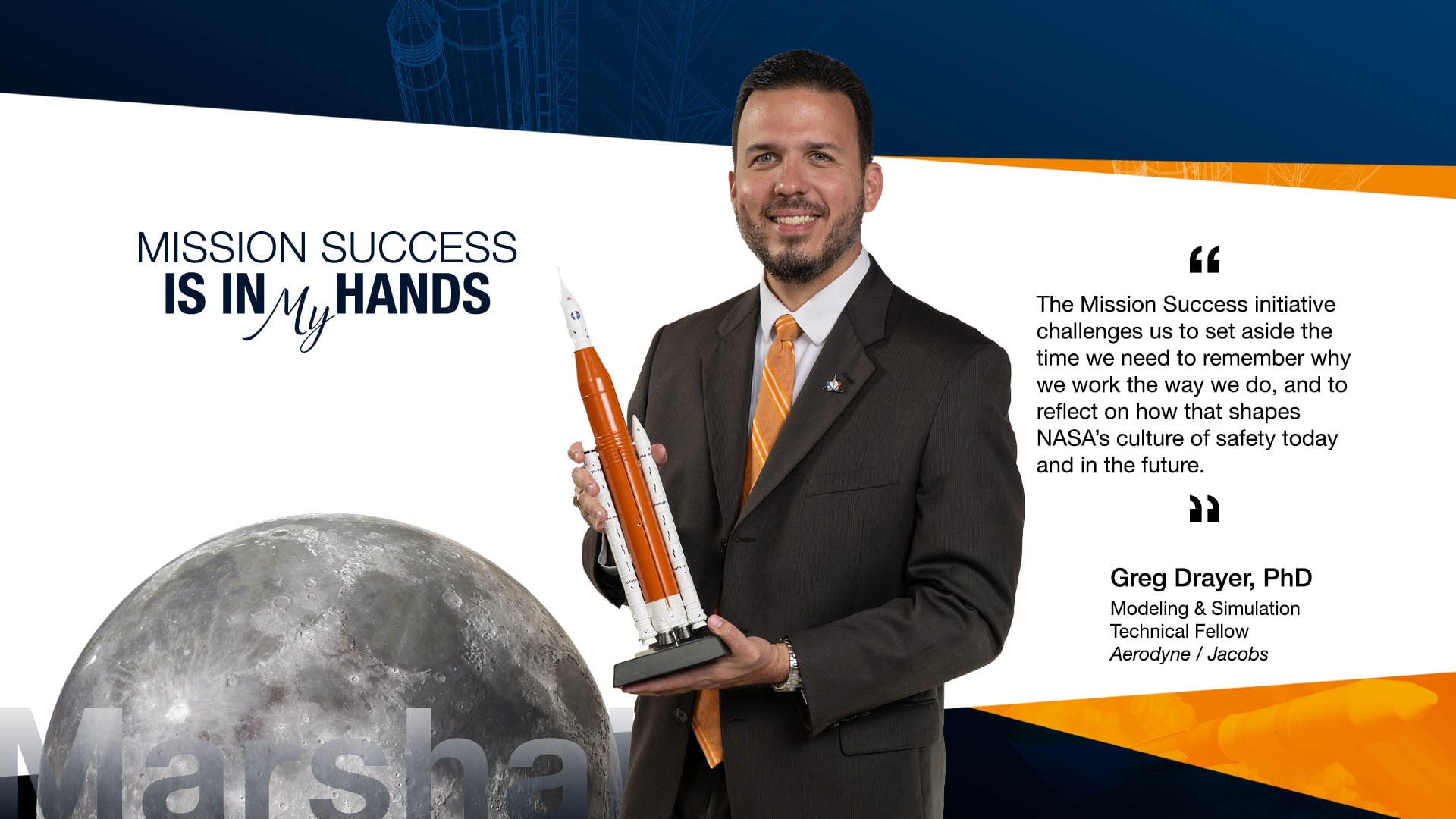
Mission Success is in Our Hands is a safety initiative collaboration between NASA’s Marshall Space Flight Center and Jacobs. As part of the initiative, eight Marshall team members are featured in new testimonial banners placed around the center. This is the third in a Marshall Star series profiling team members featured in the testimonial banners.
Greg Drayer is the JSEG (Jacobs Space Exploration Group) team lead for EV74, the Systems Analysis Branch, working at NASA’s Marshall Space Flight Center. He is also the JSEG Tech Fellow for Modeling and Simulation.
Greg Drayer is the JSEG (Jacobs Space Exploration Group) team lead for EV74, the Systems Analysis Branch, working at NASA’s Marshall Space Flight Center.
NASA/Charles Beason
He previously was a Modeling and Simulation integration systems engineer, representing NASA’s SLS (Space Launch System) Program to the Data Integration Integrated Task Team and supporting the certification of Design Math Models. He started working at Marshall in 2020. A native of Caracas, Venezuela, Drayer is a graduate of both Universidad Simon Bolivar, where he earned a bachelor’s degree in electrical engineering and magister in systems engineering, and the Georgia Institute of Technology, where he earned his doctorate with the School of Electrical and Computer Engineering. He was sponsored by the U.S. Department of State International Fulbright Science and Technology Program.
Question: What are some of your key responsibilities?
Drayer: I am responsible for the proactive management of the EV74 Branch JSEG Task Order and Systems Evaluation personnel to ensure the safe and effective accomplishment of Marshall requirements by providing engineering, scientific, and technical support to various NASA programs. My team is a high-performing group of three different sub-teams executing challenging tasks for Marshall’s Systems Engineering and Integration Division (EV70) in support of SLS, HLS (Human Landing System), and MAV (Mars Ascent Vehicle) programs, providing unique expertise in the following domains:
Program compliance with the NASA Standard for Models and Simulations, NASA-STD-7009.
Vehicle mass properties and weight management.
SLS photogrammetric imaging and analysis.
Data integration tools, systems, and processes.
Adoption of model-based systems engineering methodologies.
Question: How does your work support the safety and success of NASA and Marshall missions?
Drayer: The goal of our Modeling and Simulation Sub-Team at NASA is to help reduce the risks associated with models and simulations-influenced decisions by properly conveying the credibility of results to those making critical decisions in support of program compliance with NASA-STD-7009, Standard for Models and Simulations. We ensure the NASA’s commitment to excellence in satisfying the requirements of NASA-STD-7009, an outcome resulting from the Columbia Accident Investigation Board Report.
Question: What does the Mission Success is in Our Hands initiative mean to you?
Drayer: Working in support of NASA-STD-7009, this initiative hits close to home as another reminder of why we do our work the way we are required. Beyond any statistics, to me this campaign is a reminder and a challenge to ensure that we ‘Know what we build. Test what we build. Test what we fly. Test like we fly.’ We should continue learning from our past to make sure that it does not repeat in the future. This initiative helps us dedicate the time to remember why we do things the way we do them, and how we arrived at today’s NASA culture.
Question: Do you have a story or personal experience you can share that might help others understand the significance of mission assurance or flight safety?
Drayer: Coming back from COVID-19 has been a great challenge to overcome. Incredibly, we all have found some strange comfort zones from which we are now needing to come back to collaborate better. I know how much some of us value our ability to telework at times. However, I would like us all to also understand how some in-person conversations can save us many if not several hours of unending electronic communications. I would like all of us to demonstrate to ourselves why we truly need to be present in our meetings and engage as best as we can to reap the fruit of those interactions. Let us lead by example and ‘preach’ about it along the way with our actions, to the benefit of the NASA culture in a post-COVID era. As an agency, this can greatly impact our ability to ensure mission success and flight safety.
Question: How can we work together better to achieve mission success?
Drayer: We go all the way to the Moon in search of discoveries, science, and developing new technologies. And even beyond all these, we go to the Moon to find ourselves personally and each other. That journey has begun already with each weekday and at times weekends that we dedicate to work with the mission in mind, working hard to meet and exceed the expectations of our customers and our stakeholders, most important of which are our astronauts and their families.
Smith, a Media Fusion employee and the Marshall Star editor, supports the Marshall Office of Communications.
NASA Continues Artemis Moon Rocket Engine Tests with First Hot Fire of 2024
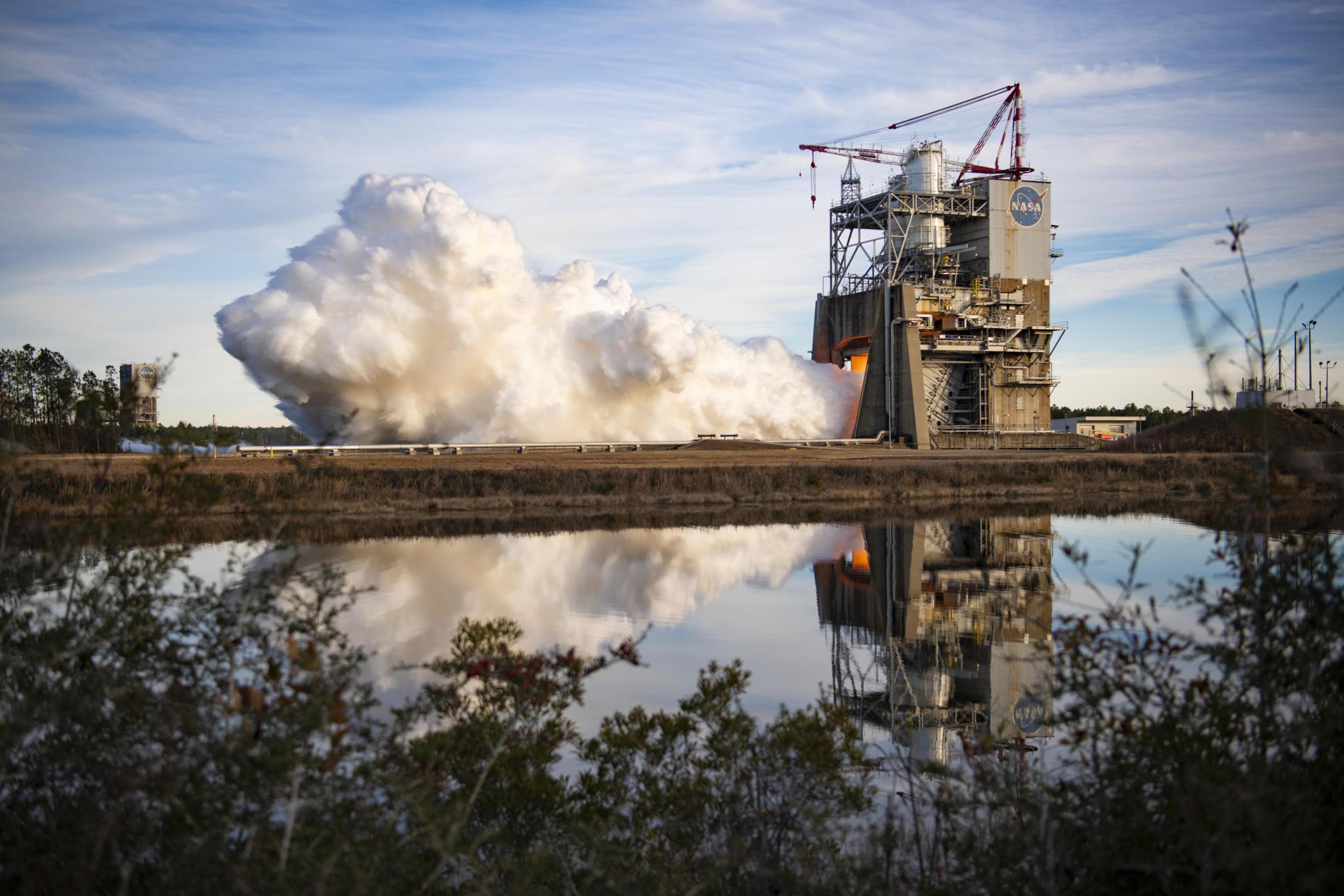
NASA continued a critical test series for future flights of NASA’s SLS (Space Launch System) rocket in support of the Artemis campaign Jan. 17 with a full-duration hot fire of the RS-25 engine on the Fred Haise Test Stand at NASA’s Stennis Space Center.
Data collected from the test series will be used to certify production of new RS-25 engines by lead contractor Aerojet Rocketdyne, an L3Harris Technologies company, to help power the SLS rocket on future Artemis missions to the Moon and beyond, beginning with Artemis V. NASA’s Marshall Space Flight Center manages the SLS Program.
NASA completed a full-duration, 500-second hot fire of an RS-25 certification engine Jan. 17, continuing a critical test series to support future SLS (Space Launch System) missions to the Moon and beyond as NASA explores the secrets of the universe for the benefit of all.
NASA/Danny Nowlin
Teams are evaluating the performance of several new engine components, including a nozzle, hydraulic actuators, flex ducts, and turbopumps. The current series is the second and final series to certify production of the upgraded engines. NASA completed an initial 12-test certification series with the upgraded components in June 2023.
During the Jan. 17 test, operators followed a “test like you fly” approach, firing the engine for the same amount of time – almost eight-and-a-half minutes (500 seconds) – needed to launch SLS and at power levels ranging between 80% to 113%.
The Jan. 17 test comes three months after the current series began in October. During three tests last fall, operators fired the engine for durations from 500 to 650 seconds. The longest planned test of the series occurred on Nov. 29 when crews gimbaled, or steered, the engine during an almost 11-minute (650 seconds) hot fire. The gimbaling technique is used to control and stabilize SLS as it reaches orbit.
Each SLS flight is powered by four RS-25 engines, firing simultaneously during launch and ascent to generate over 2 million pounds of thrust.
The first four Artemis missions with SLS are using modified space shuttle main engines that can power up to 109% of their rated level. The newly produced RS-25 engines will power up to the 111% level to provide additional thrust. Testing to the 113% power level provides an added margin of operational safety.
With the completion of the test campaign in 2024, all systems are expected to be “go” for production of 24 new RS-25 engines for missions beginning with Artemis V.
Through Artemis, NASA will establish a long-term presence at the Moon for scientific exploration with commercial and international partners, learn how to live and work away from home, and prepare for future human exploration of Mars.
Station Crew Assists Ax-3 on Advanced Space Research
The Expedition 70 crew spent Jan. 23 on a host of research activities and spacesuit maintenance while assisting their Axiom Mission 3 (Ax-3) guests on the International Space Station. The four Ax-3 crew members had their hands full as they explored cancer research, space botany, and robotics for Earth and space benefits.
The Ax-3 crew arrived Jan. 20. Astronauts Andreas Mogensen, Loral O’Hara, and Satoshi Furukawa dedicated part of their schedule to the Ax-3 mission. The trio helped the four private astronauts get up to speed with life on orbit as well as conduct advanced microgravity science.
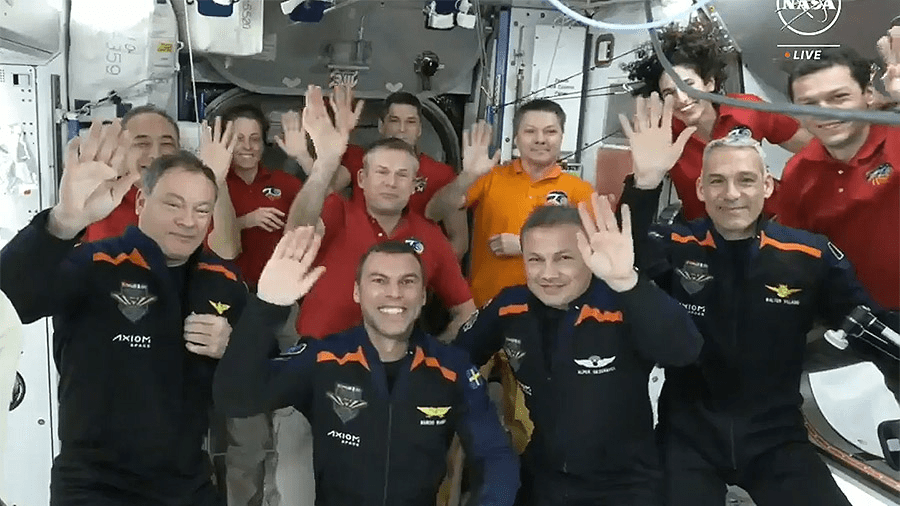
The four Axiom Mission 3 astronauts, front row, and the seven Expedition 70 crew members wave to the camera following a crew greeting ceremony on the International Space Station on Jan. 20.
NASA TV
Mogensen from ESA (European Space Agency) spent a couple of hours ensuring the Ax-3 crewmates are familiarized with systems throughout the orbital lab. O’Hara from NASA set up the LSG (Life Science Glovebox) for an Ax-3 space botany investigation while Furukawa from JAXA (Japan Aerospace Exploration) activated a microscope to look at cell samples for an Ax-3 cancer study.
Ax-3 Commander Michael López-Alegría and Mission Specialist Alper Gezeravcı worked in the Kibo laboratory module’s LSG and tested the genetic editing of space-grown plants. Results may enable genetic modifications allowing plants to adapt to weightlessness and promote crew health. Ax-3 Pilot Walter Villadei peered at cell samples inside the Kermit microscope to learn how to predict and prevent cancer both on Earth and in space.
Ax-3 Mission Specialist Marcus Wandt tested the ability to remotely control robots on Earth from the space station. Working in the Columbus laboratory module, Wandt used a laptop computer to command a team of Earth-bound robots simulating a robotic exploration mission on another planet controlled from a spacecraft.
Mogensen would go on to organize food packs, charge virtual reality hardware for a mental health study, then videotape a space physics demonstration for junior high school students. Furukawa serviced science freezers and combustion research gear before cleaning vents inside the Unity module. Furukawa wrapped up his day with eye checks with NASA Flight Engineer Jasmin Moghbeli. O’Hara operated the medical imaging gear examining the optic nerve, retina, and cornea of both astronauts. Moghbeli earlier installed and tested a camera and lights on a spacesuit helmet.
The orbiting lab’s three cosmonauts from Roscosmos focused on operations in their segment. Veteran Flight Engineer Oleg Kononenko spent his day inspecting the Zvezda service module and servicing communication and computer systems in the Nauka science module. Flight Engineer Nikolai Chub photographed the condition of Zvezda’s windows then studied how microgravity conditions such as magnetic and electrical fields affect fluid physics. Flight Engineer Konstantin Borisov deactivated Earth observation gear, downloaded vibration data the station experiences while orbiting Earth, then worked on orbital plumbing duties.
The Payload Operations Integration Center at NASA’s Marshall Space Flight Center operates, plans, and coordinates the science experiments onboard the space station 365 days a year, 24 hours a day.
Learn more about station activities by following the space station blog.
NASA’S OSIRIS-REx Curation Team Reveals Remaining Asteroid Sample
The astromaterials curation team at NASA’s Johnson Space Center has completed the disassembly of the OSIRIS-REx sampler head to reveal the remainder of the asteroid Bennu sample inside. On Jan. 10, they successfully removed two stubborn fasteners that had prevented the final steps of opening the TAGSAM (Touch-and-Go-Sample-Acquisition-Mechanism) head.
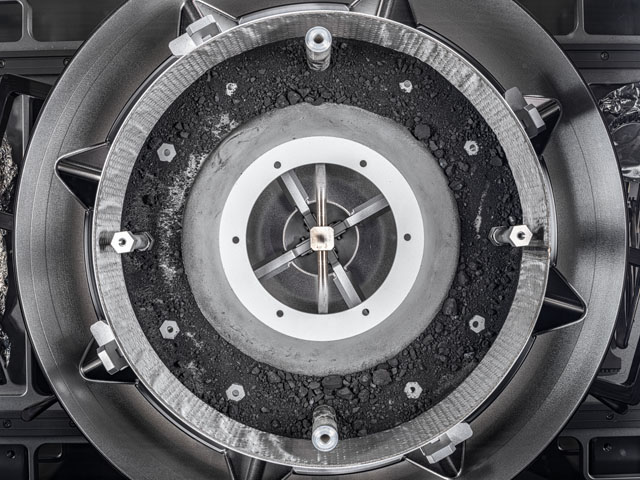
A top-down view of the OSIRIS-REx Touch-and-Go-Sample-Acquisition-Mechanism head with the lid removed, revealing the remainder of the asteroid sample inside.
NASA/Erika Blumenfeld & Joseph Aebersold
Erika Blumenfeld, creative lead for AIVA (Advanced Imaging and Visualization of Astromaterials) and Joe Aebersold, AIVA project lead, captured a photograph of the open TAGSAM head including the asteroid material inside using manual high-resolution precision photography and a semi-automated focus stacking procedure. The result is an image that shows extreme detail of the sample.
Next, the curation team will remove the round metal collar and prepare the glovebox to transfer the remaining sample from the TAGSAM head into pie-wedge sample trays.
These trays will be photographed before the sample is weighed, packaged, and stored at Johnson, home to the most extensive collection of astromaterials in the world. The remaining sample material includes dust and rocks up to about 0.4 inch in size. The final mass of the sample will be determined in the coming weeks. The curation team members had already collected 2.48 ounces of asteroid material from the sample hardware before the lid was removed, surpassing the agency’s goal of bringing at least 2.12 ounces to Earth.
The curation team will release a catalog of all the Bennu samples later this year, which will allow scientists and institutions around the world to submit requests for research or display.
OSIRIS-REx is the third mission in NASA’s New Frontiers Program, managed by the agency’s Marshall Space Flight Center.
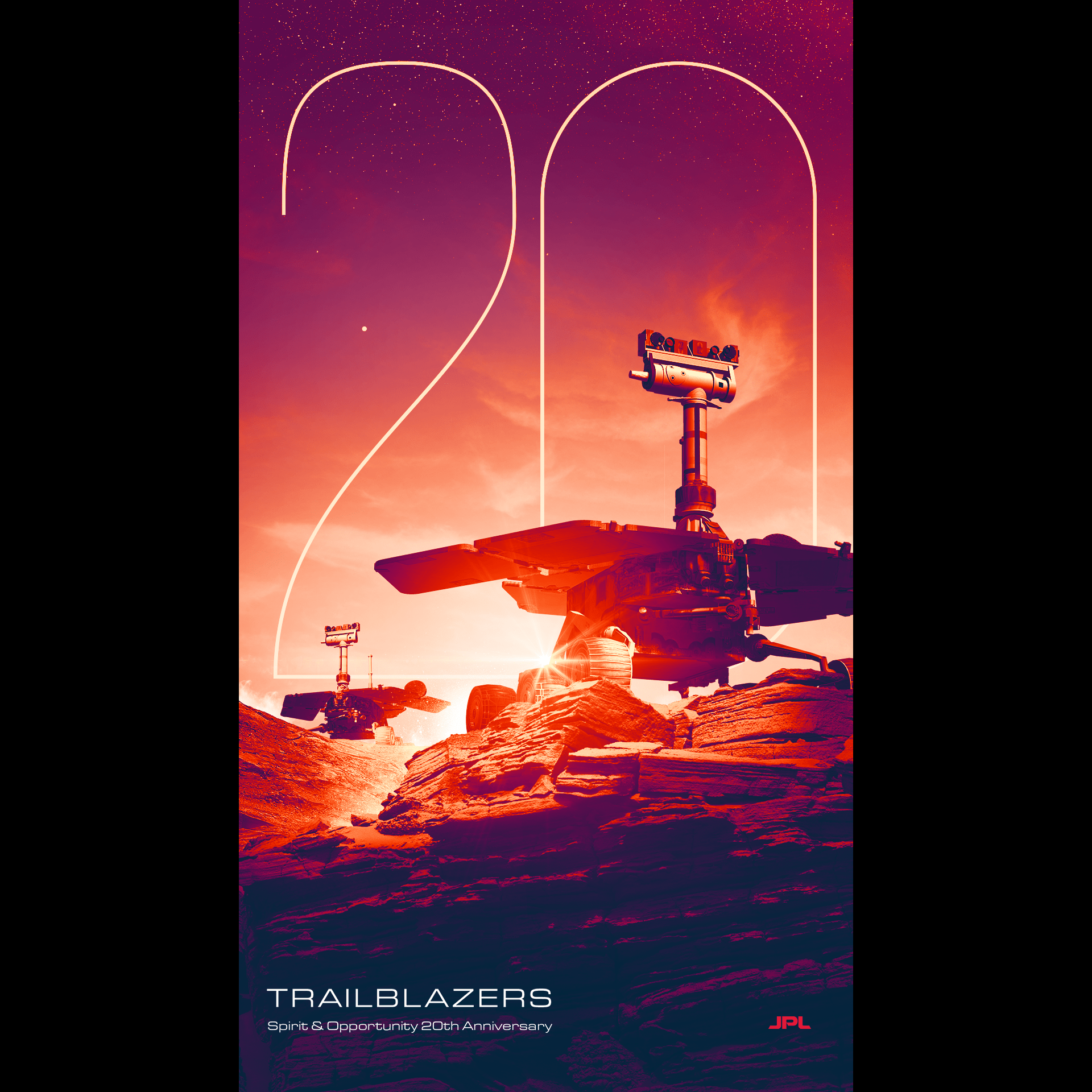
The rovers landed in January 2004, on opposite sides of the planet in locales that scientists suspected had been affected by liquid water in the past. Their main scientific objective was to search for a range of rocks and soil types and then look for clues for past water activity on Mars—and what they found rewrote textbooks.
In addition to proving that water once existed on Mars, the rovers also far exceeded their initial planned lifetimes. Spirit operated for 6 years, 2 months, and 19 days, more than 25 times its original intended lifetime, and Opportunity operated for almost 15 years, setting several records.
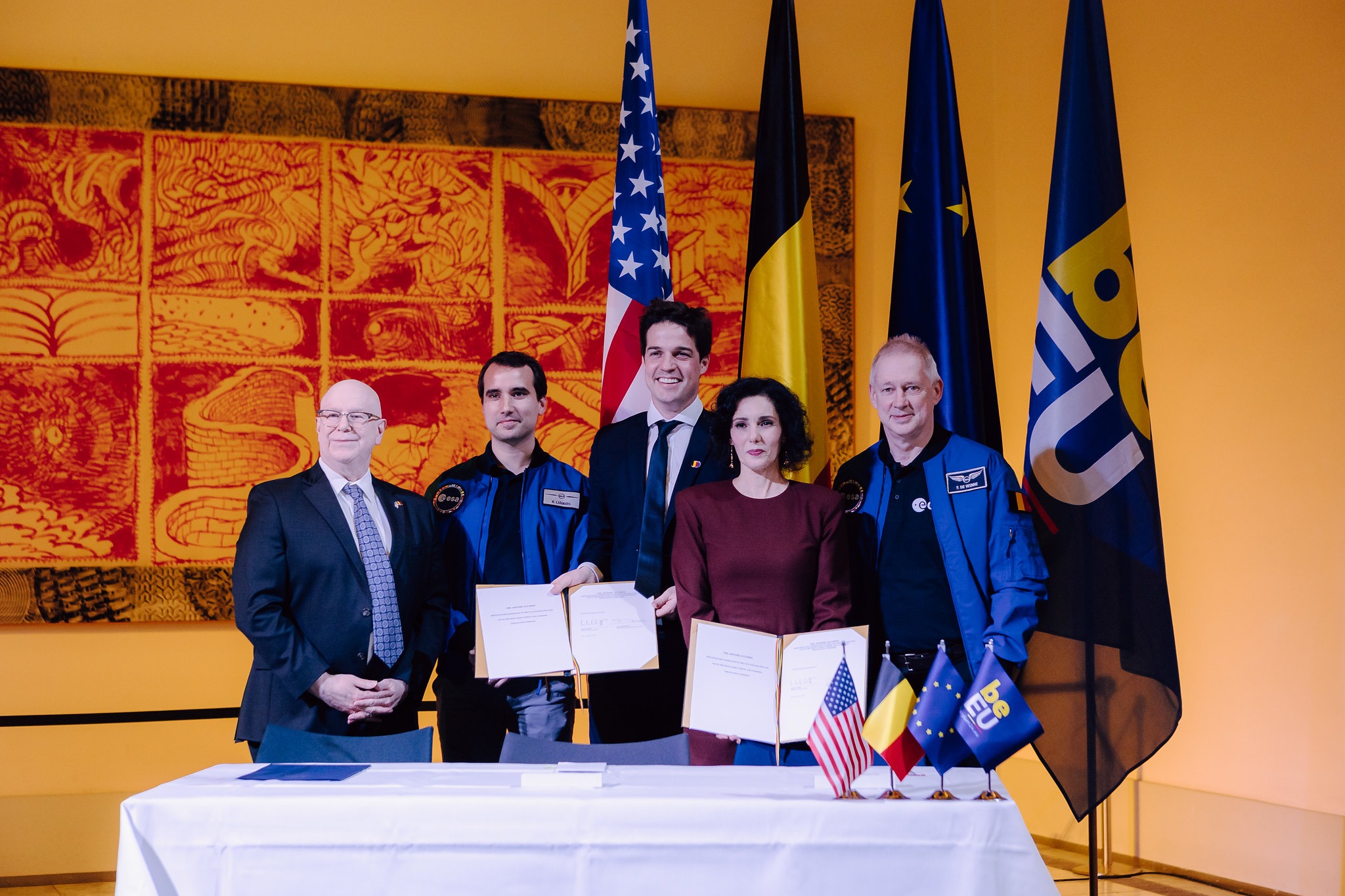
From left to right: Tim Richardson, chargé d’affaires, U.S. Embassy Belgium, Raphaël Liégeois, Belgian astronaut, Thomas Dermine, Belgian secretary of state for science policy, Hadja Lahbib, Belgian minister of foreign affairs, and Frank De Winne, Belgian astronaut, during the Artemis Accords signing ceremony in Brussels.
Credits: Nathan De Fortunato
During a ceremony at the Museum of Fine Arts in Brussels on Tuesday, Belgium became the 34th country to sign the Artemis Accords. The accords establish a practical set of principles to guide space exploration cooperation among nations, including those participating in NASA’s Artemis campaign.
“Congratulations to Belgium on becoming the newest member of the Artemis Accords family,” said NASA Administrator Bill Nelson. “It’s clear that countries around the world understand the opportunity that space presents. As the 34th signatory of the Artemis Accords, Belgium is showing great leadership in committing to responsible exploration in the 21st century.”
Hadja Lahbib, minister of foreign affairs, European affairs and foreign trade, and the federal cultural institutions, and Thomas Dermine, state secretary for economic recovery and strategic investments, in charge of science policy, signed on behalf of Belgium.
“Joining the Artemis Accords reflects our logic of cooperation and enables Belgium to join the working group of states that have already signed,” said Dermine.
“Belgium always has its feet on the ground and its head in the stars,” said Lahbib. “Our country is one of the world leaders in space exploration. The signing of the Artemis Accords shows our ongoing commitment to sustainable and responsible space, and will strengthen ties with international partners. It will also open new economic opportunities for our companies, which have world-renowned expertise in the space sector.”
NASA, in coordination with the U.S. Department of State, established the Artemis Accords in 2020 together with seven other original signatories. Since then, the Accords signatories have held focused discussions on how best to implement the Artemis Accords principles.
The Artemis Accords reinforce and implement key obligations in the 1967 Outer Space Treaty. They also strengthen the commitment by the United States and signatory nations to the Registration Convention, the Rescue and Return Agreement, as well as best practices and norms of responsible behavior NASA and its partners have supported, including the public release of scientific data.
More countries are expected to sign the accords in the months and years ahead, which is important to advancing safe, peaceful, and prosperous activities in space. Learn more about the Artemis Accords at:
Whether he’s advising student robotic competitions or managing production of a powerful, new Moon rocket stage, Erick Holsonback meets technical challenges with enthusiasm.
Holsonback, a Jacobs Technology employee, is subsystem manager for production and launch operations of the exploration upper stage (EUS) for NASA’s SLS (Space Launch System) rocket. SLS is NASA’s super heavy lift rocket that will launch the agency’s Artemis campaign to the Moon. The exploration upper stage is one of two upgrades to the SLS rocket as it evolves to the Block 1B variant for missions beginning with Artemis IV. Along with the rocket’s new universal stage adapter, the SLS rocket in its Block 1B configuration will be able to send 40% more payload to the Moon in a single launch.
Holsonback’s job stretches from setting up production for the future upper stage at NASA’s Michoud Assembly Facility in New Orleans, where it’s built, to preparing it for launch from the agency’s Kennedy Space Center in Florida.
“It’s exciting to be part of a capability that will send more crew and cargo to the Moon in a single launch than any other current rocket,” Holsonback said. “That’s going to make operations in the challenging space environment a lot simpler.”
Growing up in North Georgia, Holsonback remembers wanting to be an astronaut and turning street cars into hot rods. He figured he’d wind up in the auto industry, until Pratt & Whitney offered him a job working on space shuttle main engine turbomachinery straight out of college in 1997. He briefly left the space business but jumped at a chance to get back in with the SLS Program in 2016 at NASA’s Marshall Space Flight Center in Huntsville, Alabama.
“I wanted to come back and do rockets,” he recalled. “It gets in your blood. You’re part of something bigger that just yourself. Through Artemis, we are truly impacting the space program at its foundational level of how we are getting back to the Moon and to Mars.”
Holsonback’s enthusiasm for space challenges doesn’t end at the office door. In his free time, Holsonback has mentored and coached his two daughters’ technology challenge competitions. While the challenge is foremost a robotics contest, Holsonback is proud of the lessons in problem solving, technology, and project management he’s helped impart to the team along the way – which he likens to his NASA job.
You could say Erick Holsonback is working on the future personally as well as professionally, but it’s hard to beat working on a Moon rocket.
“I’ve had some great opportunities with NASA, but my current role is pretty amazing – getting to be part of building and launching,” he reflected. “I get to play a little part in the overall foundation work that is going to be part of the history of our country for years to come.”
NASA is working to land the first woman and first person of color on the Moon under Artemis. SLS is part of NASA’s backbone for deep space exploration, along with the Orion spacecraft, advanced spacesuits and rovers, the Gateway in orbit around the Moon, and commercial human landing systems. SLS is the only rocket that can send Orion, astronauts, and supplies to the Moon in a single launch.
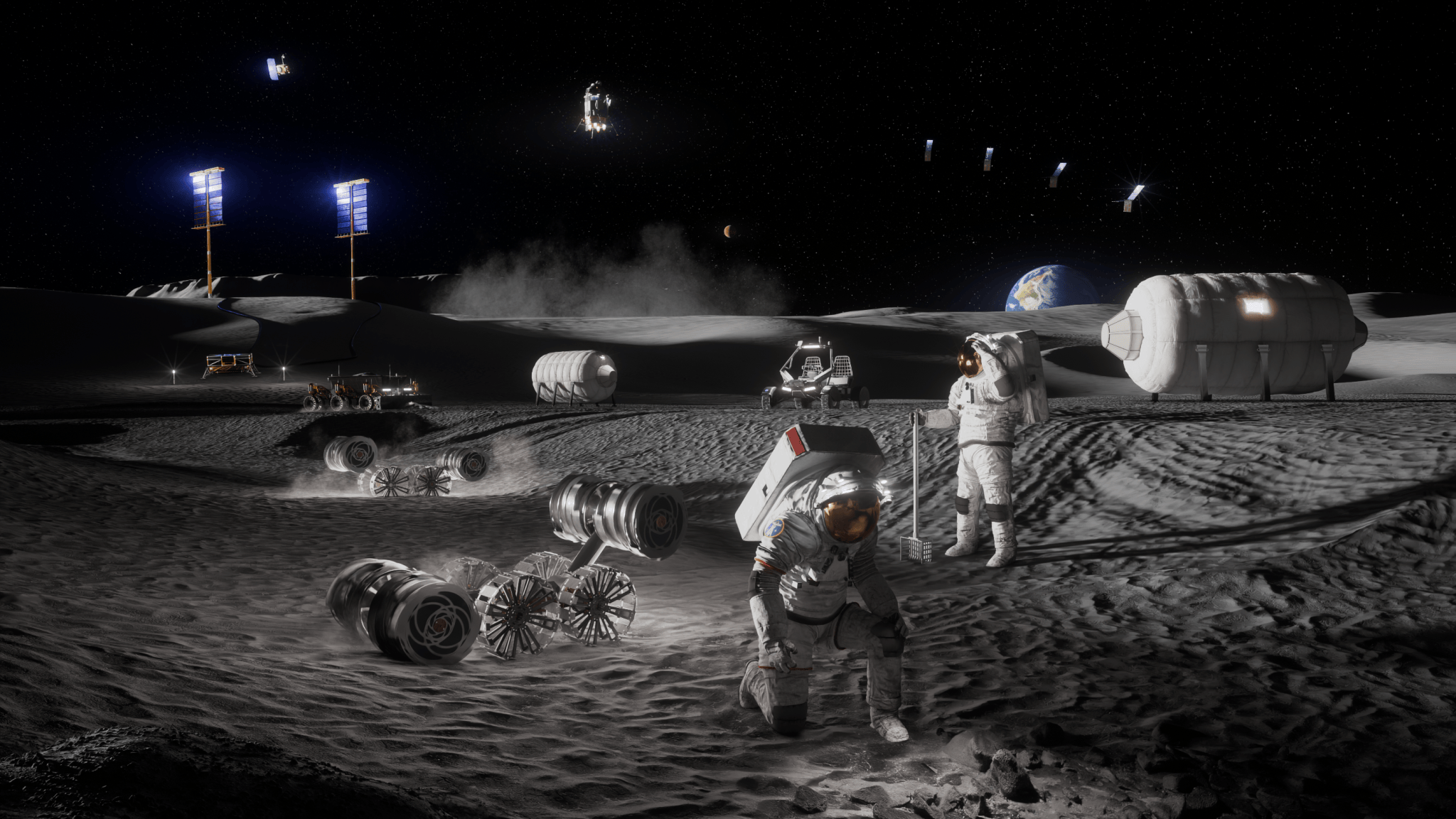
Preparations for Next Moonwalk Simulations Underway (and Underwater)
DC-8 lifts off from Air Force Plant 42 in Palmdale, Calif.
NASA/Carla Thomas
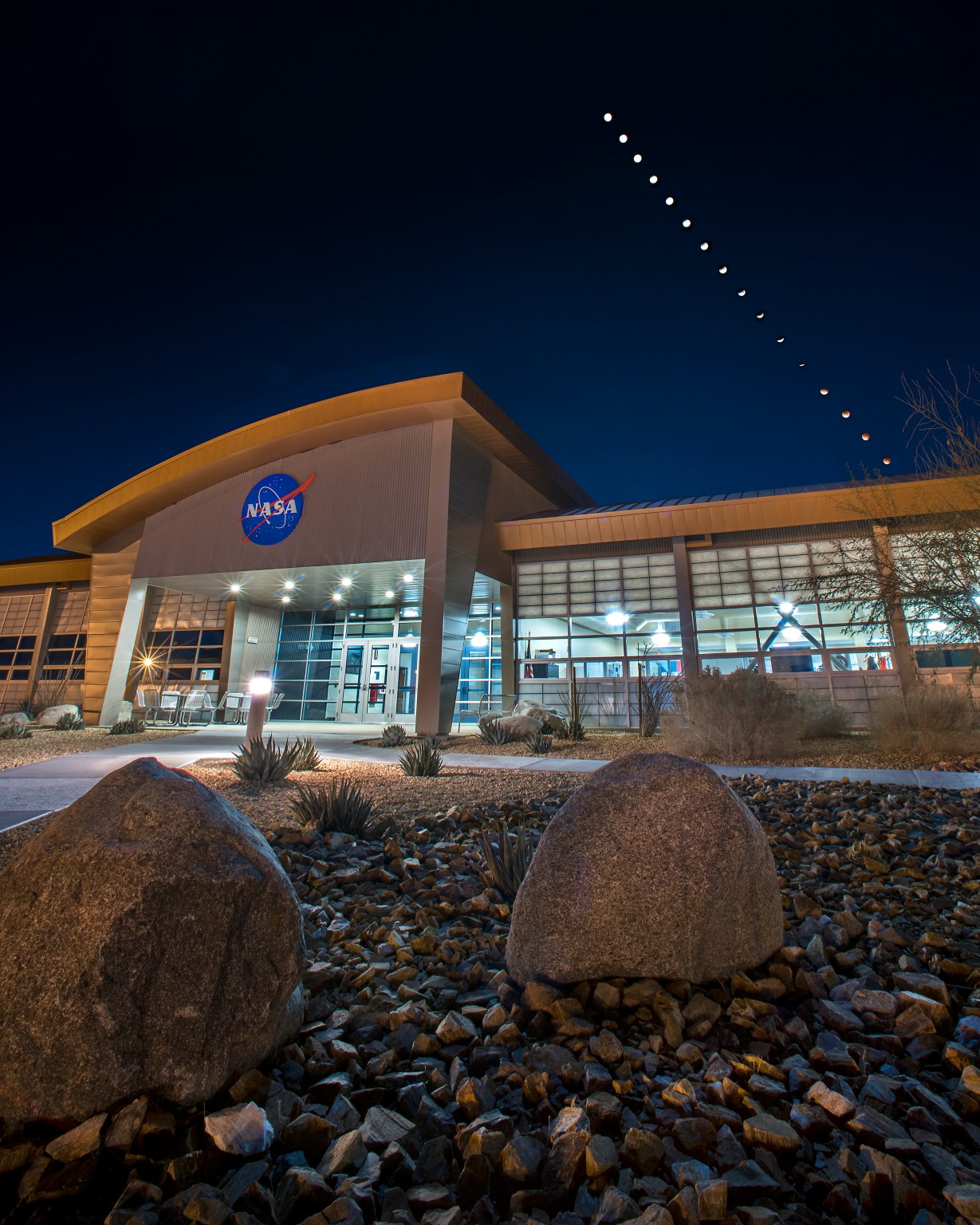
What: NASA Armstrong Flight Research Center’s DC-8 aircraft will fly over Central Valley and surroundings areas as part of an air quality field study. Residents in the areas below will see and hear the aircraft as it flies to achieve these measurements.
Where: Central Valley, CA and surrounding areas
When: Tuesday, January 23, 2024 at mid-morning to early afternoon
Additional details: All flyovers are conducted at a safe altitude without harm to public, wildlife, or infrastructure. Jet aircraft are loud and those with sensitivity to loud noises should be aware of the flyover window.