Two NASA astronauts are scheduled to venture outside the International Space Station for a pair of six-and-a-half-hour spacewalks May 16 and 30.
from NASA Breaking News https://ift.tt/2KxQRLE
via IFTTT

Thursday, 3 May 2018

Wednesday, 2 May 2018
Demonstration Proves Nuclear Fission System Can Provide Space Exploration Power
NASA and the Department of Energy’s National Nuclear Security Administration (NNSA) have successfully demonstrated a new nuclear reactor power system that could enable long-duration crewed missions to the Moon, Mars and destinations beyond.
from NASA Breaking News https://ift.tt/2FA64rZ
via IFTTT
from NASA Breaking News https://ift.tt/2FA64rZ
via IFTTT
Tuesday, 1 May 2018
Vice President Pence Visits JPL, Previews NASA's Next Mars Mission Launch

A week before NASA launches its next mission to Mars, Vice President Mike Pence toured on Saturday, April 28, the birthplace of numerous past, present and future space missions at the agency's Jet Propulsion Laboratory in Pasadena, California.
The afternoon visit by the Vice President, his wife, Karen, and daughter Charlotte, included a stop in JPL's Mission Control, where engineers will communicate with NASA's Interior Exploration using Seismic Investigations, Geodesy and Heat Transport (InSight). The Mars lander is scheduled to launch Saturday, May 5, from Vandenberg Air Force Base in California. InSight will be the first interplanetary mission ever to launch from the West Coast, and is the first-ever mission to study the interior of Mars.
The Mission Control building, a National Historic Landmark, has served as a hub for communications with countless spacecraft since 1964, including some of NASA's Apollo Moon missions, the twin Voyager spacecraft at the edge of our solar system, and the Cassini mission to Saturn. From here, Charlotte Pence had an opportunity to send commands giving the Mars Curiosity rover a day's worth of science activities. The signal took about seven minutes to travel the 80 million miles to reach Curiosity, which has been roaming the Red Planet for almost six years.
"We were honored to show the Vice President, who has a strong commitment to space exploration, some of our special sites and space missions," said JPL Director Michael Watkins. "With JPL's rich history, which includes designing and building America's first satellite for launch in 1958, and with our cutting-edge scientific capabilities, we stand ready to advance exploration as we move forward into our revitalized space age."
The tour included a stop at the JPL Mars Yard, an outdoor test facility that simulates the Martian landscape. There, the Pence family tried their hands at maneuvering a test Mars rover. They also visited the Spacecraft Assembly Facility, where the Mars 2020 mission hardware is being assembled. Mars 2020 will search for signs of habitability in Mars' ancient past and signs of past microbial life.
The Vice President, who chairs the National Space Council, was accompanied on the tour by Watkins, JPL Deputy Director Larry James, Mars Exploration Program Director Fuk Li, Caltech President Thomas Rosenbaum, National Space Council Executive Secretary Scott Pace, and Jim Ellis, chair of the NASA Space Council Users Advisory Group. Caltech manages JPL for NASA.
Video and still images of the visit are available at:
and
For more information about NASA's Mars program, visit:
News Media Contact
Veronica McGregor / Jane Platt
Jet Propulsion Laboratory, Pasadena, Calif.
818-354-9452 / 354-0880
veronica.c.mcgregor@jpl.nasa.gov / jane.platt@jpl.nasa.gov
2018-086
from News and Features https://ift.tt/2JGHGay
via IFTTT
Monday, 30 April 2018
Twin Spacecraft to Weigh in on Earth's Changing Water

A pair of new spacecraft that will observe our planet's ever-changing water cycle, ice sheets and crust is in final preparations for a California launch no earlier than Saturday, May 19. The Gravity Recovery and Climate Experiment Follow-On (GRACE-FO) mission, a partnership between NASA and the German Research Centre for Geosciences (GFZ), will take over where the first GRACE mission left off when it completed its 15-year mission in 2017.
GRACE-FO will continue monitoring monthly changes in the distribution of mass within and among Earth's atmosphere, oceans, land and ice sheets, as well as within the solid Earth itself. These data will provide unique insights into Earth's changing climate, Earth system processes and even the impacts of some human activities, and will have far-reaching benefits to society, such as improving water resource management.
GRACE-Follow On (GRACE-FO) is a satellite mission scheduled for launch in May 2018. GRACE-FO will continue the work of the GRACE satellite mission tracking Earth's water movement around the globe. These discoveries provide a unique view of Earth's climate and have far-reaching benefits to society and the world's population.
"Water is critical to every aspect of life on Earth -- for health, for agriculture, for maintaining our way of living," said Michael Watkins, GRACE-FO science lead and director of NASA's Jet Propulsion Laboratory in Pasadena, California. "You can't manage it well until you can measure it. GRACE-FO provides a unique way to measure water in many of its phases, allowing us to manage water resources more effectively."
Like GRACE, GRACE-FO will use an innovative technique to observe something that can't be seen directly from space. It uses the weight of water to measure its movement -- even water hidden far below Earth's surface. GRACE-FO will do this by very precisely measuring the changes in the shape of Earth's gravity field caused by the movement of massive amounts of water, ice and solid Earth.
"When water is underground, it's impossible to directly observe from space. There's no picture you can take or radar you can bounce off the surface to measure changes in that deep water," said Watkins. "But it has mass, and GRACE-FO is almost the only way we have of observing it on large scales. Similarly, tracking changes in the total mass of the polar ice sheets is also very difficult, but GRACE-FO essentially puts a 'scale' under them to track their changes over time."
A Legacy of Discoveries
GRACE-FO will extend the GRACE data record an additional five years and expand its legacy of scientific achievements. GRACE chronicled the ongoing loss of mass from the Greenland and Antarctic ice sheets and mountain glaciers. That wealth of data shed light on the key processes, short-term variability and long-term trends that impact sea level rise, helping to improve sea level projections. The estimates of total water storage on land derived from GRACE data, from groundwater changes in deep aquifers to changes in soil moisture and surface water, are giving water managers new tools to measure the impact of droughts and monitor and forecast floods.
GRACE data also have been used to infer changes in deep ocean currents, a driving force in Earth's climate. Its atmospheric temperature profile data, derived from measurements of how signals from the constellation of GPS satellites were bent as they traveled through the atmosphere and received by antennas on the GRACE satellites, have contributed to U.S. and European weather forecast products. GRACE data have even been used to measure changes within the solid Earth itself, including the response of Earth's crust to the retreat of glaciers since the last Ice Age, and the impact of large earthquakes.
According to Frank Webb, GRACE-FO project scientist at JPL, the new mission will provide invaluable observations of long-term climate-related mass changes.
"The only way to know for sure whether observed multi-year trends represent long-term changes in mass balance is to extend the length of the observations," Webb said.
An Orbiting Cat and Mouse
Like its predecessors, the two identical GRACE-FO satellites will function as a single instrument. The satellites orbit Earth about 137 miles (220 kilometers) apart, at an initial altitude of about 305 miles (490 kilometers). Each satellite continually sends microwave signals to the other to accurately measure changes in the distance between them. As they fly over a massive Earth feature, such as a mountain range or underground aquifer, the gravitational pull of that feature tugs on the satellites, changing the distance separating them. By tracking changes in their separation distance with incredible accuracy -- to less than the thickness of a human hair -- the satellites are able to map these regional gravity changes.
A GPS receiver is used to track each spacecraft's position relative to Earth's surface, and onboard accelerometers record non-gravitational forces on the spacecraft, such as atmospheric drag and solar radiation. These data are combined to produce monthly maps of the regional changes in global gravity and corresponding near-surface mass variations, which primarily reflect changes in the distribution of water mass in Earth's atmosphere, oceans, land and ice sheets.
In addition, GRACE-FO will test an experimental Laser Ranging Interferometer, an instrument that could increase the precision of measurements between the two spacecraft by a factor of 10 or more, for future missions similar to GRACE. The interferometer, developed by a German/American instrument team, will be the first in-space demonstration of laser interferometry between satellites.
"The Laser Ranging Interferometer is an excellent example of a great partnership," said Frank Flechtner, GFZ's GRACE-FO project manager. "I'm looking forward to analyzing these innovative inter-satellite ranging data and their impact on gravity field modeling."
GRACE-FO will be launched into orbit with five Iridium NEXT communications satellites on a commercially procured SpaceX Falcon 9 rocket from Vandenberg Air Force Base in California. This unique "rideshare" launch will first deploy GRACE-FO, then the Falcon 9 second stage will continue to a higher orbit to deploy the Iridium satellites.
GRACE-FO continues a successful partnership between NASA and Germany's GFZ, with participation by the German Aerospace Center (DLR). JPL manages the mission for NASA's Science Mission Directorate in Washington.
For more information on GRACE-FO, visit:
A media reel is available at:
News Media Contact
Alan Buis
Jet Propulsion Laboratory, Pasadena, Calif.
818-354-0474
Alan.Buis@jpl.nasa.gov
Steve Cole
NASA Headquarters, Washington
202-358-0918
Stephen.e.cole@nasa.gov
2018-085
from News and Features https://ift.tt/2vZlyWF
via IFTTT
Twin Spacecraft to Weigh in on Earth's Changing Water
A pair of new spacecraft that will observe our planet’s ever-changing water cycle, ice sheets, and crust is in final preparations for a California launch no earlier than Saturday, May 19.
from NASA Breaking News https://ift.tt/2jj0v8j
via IFTTT
from NASA Breaking News https://ift.tt/2jj0v8j
via IFTTT
Saturday, 28 April 2018
NASA Sets Sights on May 5 Launch of InSight to Mars

NASA's next mission to Mars, Interior Exploration using Seismic Investigations, Geodesy and Heat Transport (InSight), is scheduled to launch Saturday, May 5, on a first-ever mission to study the heart of the Red Planet. Coverage of prelaunch and launch activities begins Thursday, May 3, on NASA Television and the agency's website.
InSight, the first planetary mission to take off from the West Coast, is targeted to launch at 4:05 a.m. PDT (7:05 a.m. EDT) from Space Launch Complex-3 at Vandenberg Air Force Base in California aboard a United Launch Alliance (ULA) Atlas V rocket.
Launching on the same rocket is a separate NASA technology experiment known as Mars Cube One (MarCO). MarCO consists of two mini-spacecraft and will be the first test of CubeSat technology in deep space. They are designed to test new communications and navigation capabilities for future missions and may aid InSight communications.
NASA TV and online mission coverage is as follows (all times Pacific):
Thursday, May 3
1 p.m. - Prelaunch Briefing
- Thomas Zurbuchen, associate administrator for the Science Mission Directorate at NASA Headquarters, Washington
- Bruce Banerdt, InSight principal investigator at NASA's Jet Propulsion Laboratory, Pasadena, California
- Tom Hoffman, InSight project manager at JPL
- Annick Sylvestre-Baron, deputy project manager for InSight seismometer investigation at France's space agency, the Centre National d'Études Spatiales, Paris
- Philippe Lognonné - InSight seismometer investigation lead at the Institut de Physique du Globe de Paris, France
- Tilman Spohn, investigation lead at the German Aerospace Center (DLR) for the Heat Flow and Physical Properties Probe (HP3), an instrument on InSight, Berlin
- Andrew Klesh, MarCO chief engineer at JPL
- Anne Marinan, MarCO systems engineer at JPL
- Stu Spath, InSight program manager at Lockheed Martin Space, Denver
- Tim Dunn, launch director with NASA's Launch Services Program at Kennedy Space Center, Florida
- Scott Messer, ULA program manager for NASA launches, Centennial, Colorado
- Col. Michael Hough, commander of the 30th Space Wing at Vandenberg Air Force Base, Central California
- 1st Lt. Kristina Williams, weather officer for the 30th Space Wing
Saturday, May 5 (all times Pacific)
3:30 a.m. - Launch coverage begins.
4:05 a.m. - Launch time
Prelaunch Briefing Participation
Media and the public also may ask questions during the event on social media using #askNASA.
Public Launch Viewing
There are two official launch viewing sites for the public in Lompoc, California. For information on these sites, visit:
https://mars.nasa.gov/insight/mission/timeline/launch/watch-in-person/
InSight will be the first mission to peer deep beneath the Martian surface, studying the planet's interior by measuring its heat output and listening for marsquakes, which are seismic events similar to earthquakes on Earth. It will use the seismic waves generated by marsquakes to develop a map of the planet's deep interior. The resulting insight into Mars' formation will help us better understand how other rocky planets, including Earth, were and are created.
JPL manages the InSight mission for the agency's Science Mission Directorate in Washington. InSight is part of NASA's Discovery Program, managed by the agency's Marshall Space Flight Center in Huntsville, Alabama. The spacecraft, including cruise stage and lander, was built and tested by Lockheed Martin Space in Denver.
Several European partners, including France's space agency, the Centre National d'Étude Spatiales, and Germany's DLR, are supporting the mission.
ULA, of Centennial, Colorado, is providing the Atlas V launch service. The Launch Services Program at NASA's Kennedy Space Center in Florida is responsible for launch management.
The prelaunch briefing and launch commentary will be streamed on NASA TV and at
It will also be streamed live and archived at
https://youtube.com/nasajpl/live
Join the conversation on social media by following InSight at:
https://twitter.com/NASAInSight
or
https://www.facebook.com/NASAInSight/
News Media Contact
DC Agle / Andrew Good
Jet Propulsion Laboratory, Pasadena, Calif.
818-393-9011 / 818-393-2433
agle@jpl.nasa.gov / andrew.c.good@jpl.nasa.gov
Dwayne Brown / JoAnna Wendel
NASA Headquarters, Washington
202-358-1726 / 202-358-1003
dwayne.c.brown@nasa.gov / joanna.r.wendel@nasa.gov
Tori McLendon
NASA Kennedy Space Center, Fla.
321-867-2468
tori.n.mclendon@nasa.gov
2nd Lt. Amy Rasmussen
30th Space Wing, Vandenberg Air Force Base, Calif.
805-606-4017
amy.rasmussen@us.af.mil
2018-084b
from News and Features https://ift.tt/2jasW8u
via IFTTT
Results of Heat Shield Testing

NASA Mars 2020 Mission Status Report
A post-test inspection of the composite structure for a heat shield to be used on the Mars 2020 mission revealed that a fracture occurred during structural testing. The mission team is working to build a replacement heat shield structure. The situation will not affect the mission's launch readiness date of July 17, 2020.
Project management at NASA's Jet Propulsion Laboratory in Pasadena, California, is working with contractor Lockheed Martin Space, Denver, to understand the cause of the fracture and determine whether any design changes need to be incorporated into a replacement.
The fracture, which occurred near the shield's outer edge and spans the circumference of the component, was discovered on April 12, after the shield completed a week-long test at the Lockheed Martin Space facility. The test was designed to subject the heat shield to forces up to 20 percent greater than those expected during entry into the Martian atmosphere. While the fracture was unexpected, it represents why spaceflight hardware is tested in advance so that design changes or fixes can be implemented prior to launch.
The heat shield is part of the thermal protection system and aeroshell designed to encapsulate and protect the Mars 2020 rover and landing system from the intense heat generated during descent into the Martian atmosphere. The structure was originally tested in 2008 and wasone of two heat shields manufactured in support of the Mars Science Laboratory mission, which successfully landed the Curiosity rover on Mars in August 2012.
The current heat shield will be repaired in order to support the prelaunch spacecraft testing while a new heat shield structure is readied for flight over the next year. Once the new structure is complete and tested, the thermal protection tiles will then be installed for flight, and the heatshield and other components of the aeroshell will be delivered to NASA's Kennedy Space Center in Florida for final spacecraft processing prior to launch.
The Mars 2020 Project at JPL manages the Mars 2020 spacecraft development for the Science Mission Directorate at NASA Headquarters in Washington.
News Media Contact
DC Agle
Jet Propulsion Laboratory, Pasadena, Calif.
818-393-9011
agle@jpl.nasa.gov
2018-083
from News and Features https://ift.tt/2HB6XlC
via IFTTT
NASA Sets Sights on May 5 Launch of InSight Mars Mission
NASA’s next mission to Mars, Interior Exploration using Seismic Investigations, Geodesy and Heat Transport (InSight), is scheduled to launch Saturday, May 5, on a first-ever mission to study the heart of Mars. Coverage of prelaunch and launch activities begins Thursday, May 3, on NASA Television and the agency’s website.
from NASA Breaking News https://ift.tt/2HzYIdy
via IFTTT
from NASA Breaking News https://ift.tt/2HzYIdy
via IFTTT
Friday, 27 April 2018
Montana, Vermont Students to Speak with NASA Astronauts on Space Station
Students from Montana and Vermont will talk with astronauts on the International Space Station next week as part of NASA’s Year of Education on Station.
from NASA Breaking News https://ift.tt/2KmwjWq
via IFTTT
from NASA Breaking News https://ift.tt/2KmwjWq
via IFTTT
Before the Flood Arrives

New NASA Study May Improve Future River-Observing Satellites
River floods are one of the most common and devastating of Earth's natural disasters. In the past decade, deluges from rivers have killed thousands of people every year around the world and caused losses on the order of tens of billions of U.S. dollars annually. Climate change, which is projected to increase precipitation in certain areas of the planet, might make river floods in these places more frequent and severe in the coming decades.
Now, a new study led by researchers at NASA's Jet Propulsion Laboratory in Pasadena, California, analyzes what it would take for river-observing satellitesto become an even more useful tool to mitigate flood damage and improve reservoir management globally in near real-time.
"Early flood warning systems traditionally depend on gauge networks that detect floods farther up the river, but gauge data are becoming more and more scarce," said George Allen, lead author of the new research and a hydrologist at JPL. "Our study shows that there's room for satellites to help fill in the gap. But for satellites to inform real-time flood mitigation, they have to provide data to water managers within a sufficiently short lag time."
River floods occur when a channel fills with water beyond the capacity of its banks, normally due to heavy rainfall. The flood travels along the course of the river as a wave, moving downstream faster than the water itself. Several satellite missions have been able to detect floods as sudden changes in the height or width of river waters. Once a flood is observed, it is relatively easy to predict accurately how it will move down the river. This information is extremely useful in early flood warning systems and other real-time river management applications.
To study the speed at which floods propagate through the planet's rivers, Allen and his colleagues ran a simple numerical model of flow waves that used information such as the width, slope, depth and roughness -- the amount of friction water experiences when traveling along a river -- of rivers worldwide. After analyzing wave speeds through 11 million miles (17.7 million kilometers) of rivers around the planet, the researchers found that flood waves traveling at their maximum speed take a median time of three days to reach the next downstream dam, four days to arrive to the next downstream city and six days to exit the river system entirely.
The team compared their model's results with discharge records from more than 20,000 U.S. Geological Survey gauge stations along around 40,000 miles (64,400 kilometers) of varied river systems in the United States. They found that the model estimated faster wave speeds than the gauge data showed.
"That was expected, based on the fact that we're modeling waves moving at maximum speeds, whereas the gauge data are looking at all types of wave speeds: low speeds, high speeds, everything in between," Allen said. "In this way, our study estimates a worst-case-scenario of how fast floods can move down rivers."
The scientists then used their wave speed findings to calculate data latency -- how quickly satellite data should be downloaded, processed and made available to the public to be useful for flood early warning systems and other real-time flood mitigation strategies, as well as reservoir management. In particular, they focused on future data from NASA's upcoming Surface Water and Ocean Topography (SWOT) mission. SWOT, scheduled to launch in 2021, is specifically designed to observe rivers. That's because it has a repeat orbit of 21 days and will be able to detect flood waves, particularly in higher-latitude large rivers. The researchers found that making SWOT data available within days after being acquired by the spacecraft could be useful for real-time flood mitigation. Compared to past or current satellites providing river and flood information, SWOT will provide never-before-seen maps of river height, allowing for more reliable prediction of flood timing and magnitude.
If the data were to be processed in two days or less, Allen's team calculated, it would be ready for emergency managers before at least two-thirds of observed waves reached the next downstream city. For dams, the quick turnaround of satellite measurements would give advance notice to downstream reservoirs in at least half of the cases when SWOT detects a flood wave.
"There is a trade-off between data latency and data quality," said Cédric David of JPL, who directed the new study and is a member of SWOT's science team. "So, do we want to wait to get the best data possible, or do we want to get a rough version of what's going on now, so we can provide actionable information? As we prepare for new satellite missions like SWOT, that's when we start asking these types of questions."
Satellite data that could inform flood early warning systems would be particularly useful for developing nations, where either there are insufficient river gauges or countries do not share gauge data with their downstream neighbors, Allen said.
Results of the study are published in the journal Geophysical Research Letters.
For more information on SWOT, visit:
News Media Contact
Alan Buis
Jet Propulsion Laboratory, Pasadena, Calif.
818-354-0474
Alan.buis@jpl.nasa.gov
Written by Maria-José Viñas
NASA's Earth Science News Team
2018-082
from News and Features https://ift.tt/2r14jyE
via IFTTT
Wednesday, 25 April 2018
NASA to Hold Briefing on Next Earth-Observing Mission

NASA will host a media briefing at 10 a.m. PDT (1 p.m. EDT) Monday, April 30, to discuss the upcoming launch of a mission that will provide unique insights into our planet's changing climate and Earth system processes, and have far-reaching benefits to society, such as improving water resource management.
The briefing will be held at NASA Headquarters at 300 E St. SW in Washington, and air live on NASA Television and the agency's website. It will also be streamed live and archived at https://youtube.com/nasajpl/live.
The Gravity Recovery and Climate Experiment Follow-On (GRACE-FO) missionwill measure and monitor monthly changes in how mass is redistributed within and among Earth's atmosphere, oceans, land and ice sheets, as well as within Earth itself. NASA's Jet Propulsion Laboratory in Pasadena, California, manages the mission for NASA's Science Mission Directorate in Washington.
The briefing participants are:
- David Jarrett, GRACE-FO program executive in the Earth Science Division at NASA Headquarters, Washington
- Michael Watkins, GRACE-FO science lead and director of NASA's Jet Propulsion Laboratory, Pasadena, California
- Frank Webb, GRACE-FO project scientist at JPL
- Phil Morton, NASA GRACE-FO project manager at JPL
- Frank Flechtner, GRACE-FO project manager for the German Research Centre for Geosciences (GFZ), in Potsdam, Germany
Media and the public may ask questions during the briefing on Twitter using the hashtag #askNASA.
GRACE-FO is scheduled to launch May 19 from Vandenberg Air Force Base in California as a "rideshare" on a SpaceX Falcon 9 rocket carrying five Iridium communications satellites. GRACE-FO is a partnership between NASA and GFZ.
For more information about the mission, visit:
News Media Contact
Alan Buis
Jet Propulsion Laboratory, Pasadena, Calif.
818-354-0474
Alan.buis@jpl.nasa.gov
Steve Cole
NASA Headquarters, Washington
202-358-0918
stephen.e.cole@nasa.gov
2018-081
from News and Features https://ift.tt/2HvPwmr
via IFTTT
Subscribe to:
Posts (Atom)
NASA Announces $1 Million to Students for Moon Base Challenge
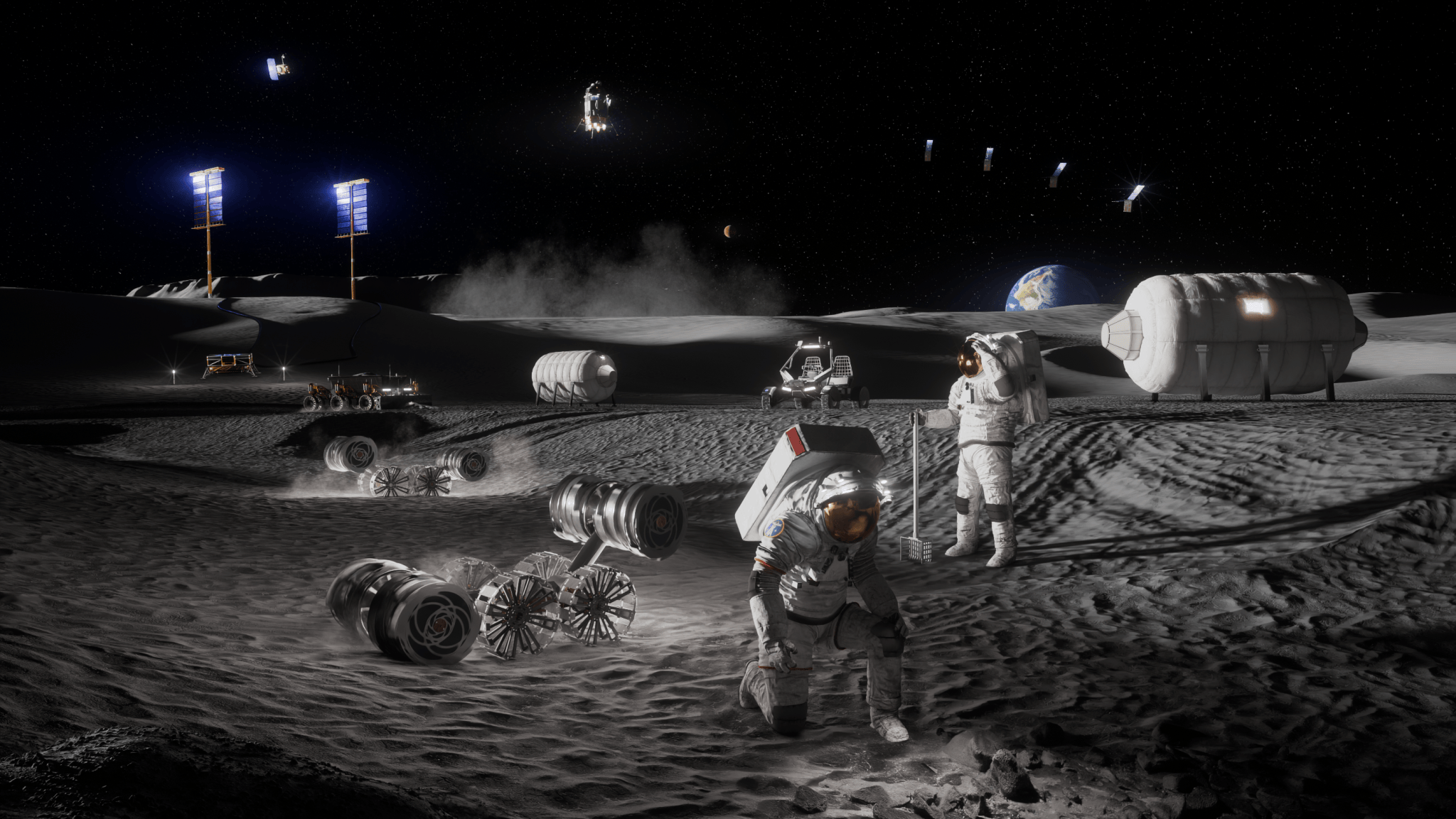
Artist’s concept depicting astronauts, habitats, rovers, power systems, and cargo operations supporting sustained human activities at the Mo...
-
NASA has exercised the second option of its Information Technology and Multimedia Services (ITAMS) contract with DB Consulting Group, Inc., ...
-
Science Earth Observatory A Subtle Return of La Niña Earth Earth Observatory Image of the Day EO Explorer All Topics ...
