We're delighted to announce a special issue of the "Communicating Astronomy with the Public" journal, which provides exclusive behind-the-scenes insights into the outreach surrounding the Rosetta Mission. Including articles written by ESA's communication team behind the competitions, cartoons, and social media campaigns, and reviews from external journalists and documentary film-makers following this iconic mission. The table of contents is listed below. Read the full journal, free online here. Explained in 60 Seconds: Why Visit a Comet? (Emily Baldwin) The Strategy and Implementation of the Rosetta Communication Campaign (Markus Bauer, Mark McCaughrean, Jocelyne Landeau-Constantin) How a Cartoon Series Helped the Public Care about Rosetta and Philae (Claudia Mignone, Emily Baldwin, Karen S. O’Flaherty, Anne-Mareike Homfeld, Markus Bauer, Mark McCaughrean, Sebastian Marcu, Carlo Palazzari) Behind the Scenes of the Discovery Channel’s Rosetta Mission Documentary Special (Shelley Ayres) Ambition: A Risky Adventure in Science Communication (Mark McCaughrean) “Hello, World!” Harnessing Social Media for the Rosetta Mission (Emily Baldwin, Claudia Mignone, Daniel Scuka, Anne-Mareike Homfeld, Karin Ranero Celius, Erica Rolfe, Maria Bennett, Andreas Schepers, Karen S. O’Flaherty, Markus Bauer, Mark McCaughrean) Using Competitions to Engage the Public: Lessons Learnt from Rosetta (Karen S. O’Flaherty, Emily Baldwin, Claudia Mignone, Anne-Mareike Homfeld, Daniel Scuka, Andreas Schepers, Manuela Braun, Fulvia Croci, Livia Giacomini, Nathalie Journo, Markus Bauer, Mark McCaughrean) Live Blogging Science News: The Rosetta Mission (Stuart Clark) An Historic Encounter: Reviewing the Outreach around ESA’s Rosetta Mission (Dirk Lorenzen)
from Rosetta – ESA's comet chaser http://ift.tt/1MD9cpn
via IFTTT

Thursday, 31 March 2016

NASA’s Spitzer Maps Climate Patterns on a Super-Earth
Observations from NASA's Spitzer Space Telescope have led to the first temperature map of a super-Earth planet -- a rocky planet nearly two times as big as ours. The map reveals extreme temperature swings from one side of the planet to the other, and hints that a possible reason for this is the presence of lava flows.
from NASA Breaking News http://ift.tt/1MBW1VT
via IFTTT
from NASA Breaking News http://ift.tt/1MBW1VT
via IFTTT
Wednesday, 30 March 2016
NASA's 'Spaceport of the Future' Reaches Another Milestone
NASA has completed a major milestone on its journey to Mars and is ready to begin another phase of work on its spaceport of the future, where the next generation of astronauts will launch to Mars and other deep-space destinations.
from NASA Breaking News http://ift.tt/1MQVbz6
via IFTTT
from NASA Breaking News http://ift.tt/1MQVbz6
via IFTTT
NASA’s ‘Spaceport of the Future’ Reaches Another Milestone
NASA has completed a major milestone on its journey to Mars and is ready to begin another phase of work on its spaceport of the future, where the next generation of astronauts will launch to Mars and other deep-space destinations.
from NASA Breaking News http://ift.tt/1RxwD0j
via IFTTT
from NASA Breaking News http://ift.tt/1RxwD0j
via IFTTT
NASA Awards Contract for Atmospheric Science Research
NASA has awarded a contract to Science Systems and Applications, Inc. of Lanham, Maryland, to conduct atmospheric sciences support services for the Science Directorate at NASA’s Langley Research Center in Hampton, Virginia, as well as for the broader Earth science community.
from NASA Breaking News http://ift.tt/1V20iDf
via IFTTT
from NASA Breaking News http://ift.tt/1V20iDf
via IFTTT
Tuesday, 29 March 2016
NASA Selects Instrument Team to Build Next-Gen Planet Hunter
NASA has selected a team to build a new, cutting-edge instrument that will detect planets outside our solar system by measuring the miniscule “wobbling” of stars. The instrument will be the centerpiece of a new partnership with the National Science Foundation called the NASA-NSF Exoplanet Observational Research program.
from NASA Breaking News http://ift.tt/22YpgX5
via IFTTT
from NASA Breaking News http://ift.tt/22YpgX5
via IFTTT
NASA Awards Information Technology Services Contract
NASA has awarded an Information Technology Services (ITS) contract to SaiTech, Inc. of Bethesda, Maryland, for provision of a wide range of IT services to be performed at the agency’s Stennis Space Center near Bay St. Louis, Mississippi.
from NASA Breaking News http://ift.tt/1VQlo8x
via IFTTT
from NASA Breaking News http://ift.tt/1VQlo8x
via IFTTT
Friday, 25 March 2016
Media Invited to See NASA's Green Propulsion Spacecraft
Media are invited to see a NASA spacecraft that is safer on the ground and more efficient in space during a tour March 31 at Ball Aerospace & Technologies Corp. in Boulder, Colorado, showcasing NASA's Green Propulsion Infusion Mission (GPIM).
from NASA Breaking News http://ift.tt/1MoaCUE
via IFTTT
from NASA Breaking News http://ift.tt/1MoaCUE
via IFTTT
Russian Space Station Cargo Ship Launch, Docking to Air on NASA TV
NASA Television will provide live coverage of the launch and docking of an unpiloted Russian cargo spacecraft, Progress 63P, to resupply the International Space Station.
from NASA Breaking News http://ift.tt/22yrRKl
via IFTTT
from NASA Breaking News http://ift.tt/22yrRKl
via IFTTT
Thursday, 24 March 2016
NASA Highlights Array of Experiments Launching on Next SpaceX Cargo Mission
NASA will host a media teleconference at 1 p.m. EDT Monday, March 28, to discuss cutting edge science investigations launching aboard the upcoming SpaceX commercial resupply flight to the International Space Station.
from NASA Breaking News http://ift.tt/1S8JXYH
via IFTTT
from NASA Breaking News http://ift.tt/1S8JXYH
via IFTTT
CometWatch 19 March
This week’s CometWatch entry from Rosetta’s NAVCAM was taken on 19 March from a distance of just 12 km. It captures a beautiful oblique view across the plains of Imhotep, taking in the cluster of boulders to the right of the image that includes 25m high Cheops. The rugged, fractured terrain and debris slopes in the background, where Imhotep meets Khepry, makes for a spectacular horizon. This region can also be seen, albeit from a much different orientation but which shows the wider context of the region, in the OSIRIS wide-angle camera image below captured on 16 March. Following the brief encounter at these close distances, Rosetta is now heading out on an anti-sunward excursion to around 1000 km to investigate the comet’s wider coma, tail and plasma environment. Today, 24 March, Rosetta is already over 200 km away from the comet. The current plan is for Rosetta to make a 30 km zero phase flyby around 9 April, before entering back into closer bound orbits by 21 April. Follow the spacecraft’s trajectory in the coming weeks with the Rosetta NOW tool. The original 1024 x 1024 pixel NAVCAM image is provided below:
from Rosetta – ESA's comet chaser http://ift.tt/22HXcXG
via IFTTT
from Rosetta – ESA's comet chaser http://ift.tt/22HXcXG
via IFTTT
Subscribe to:
Posts (Atom)
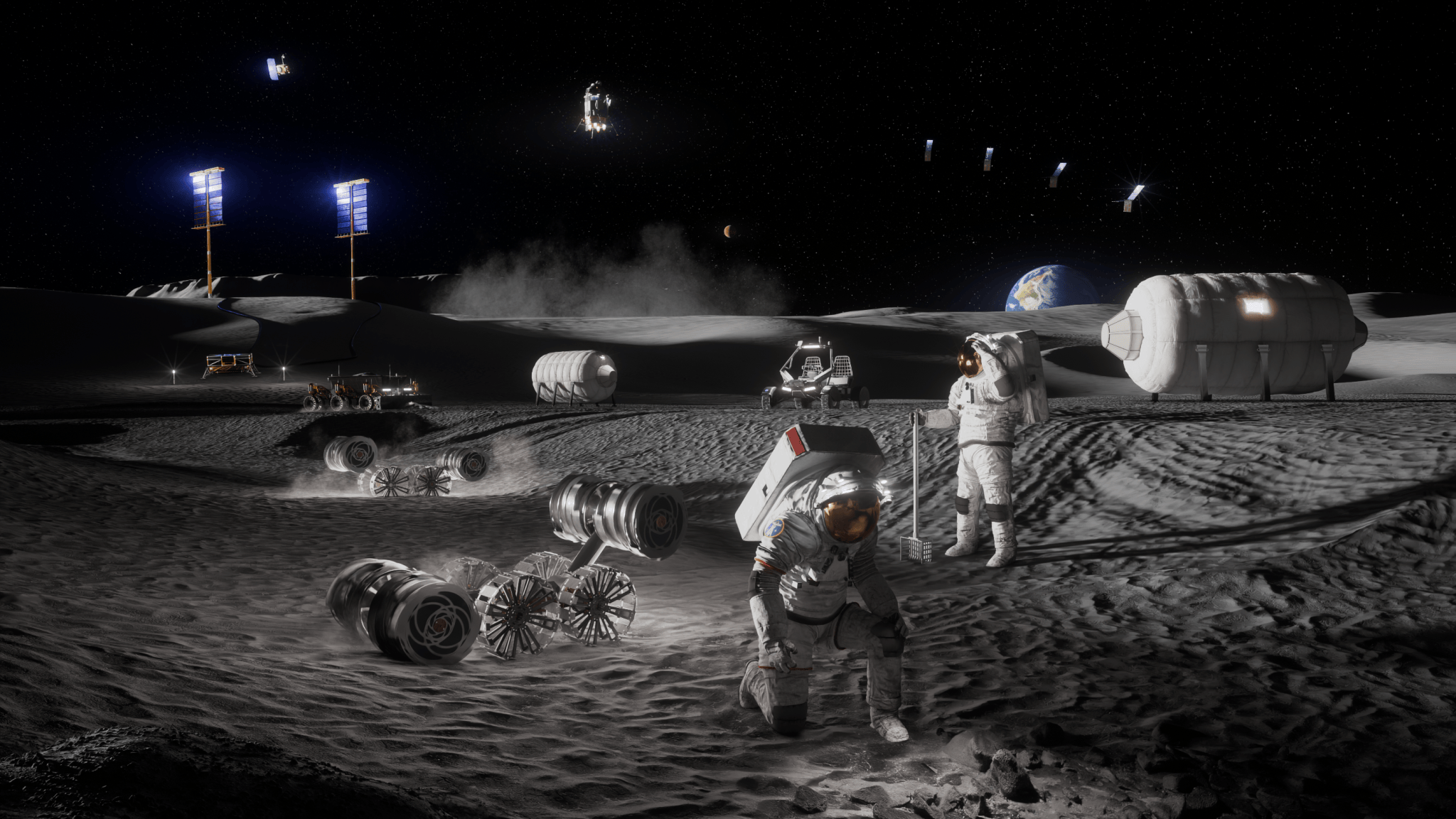
NASA Announces $1 Million to Students for Moon Base Challenge
Artist’s concept depicting astronauts, habitats, rovers, power systems, and cargo operations supporting sustained human activities at the Mo...
-
NASA has exercised the second option of its Information Technology and Multimedia Services (ITAMS) contract with DB Consulting Group, Inc., ...
-
Science Earth Observatory A Subtle Return of La Niña Earth Earth Observatory Image of the Day EO Explorer All Topics ...
