NASA has opened media accreditation for the next launch of a commercial resupply mission to the International Space Station. The launch of Orbital ATK’s Cygnus spacecraft is scheduled for Thursday, March 10, during a 30-minute window that opens at approximately 3 a.m. EST.
from NASA Breaking News http://ift.tt/1P2M9Qv
via IFTTT

Saturday, 30 January 2016

Friday, 29 January 2016
NASA Television to Air Russian Spacewalk
NASA Television will broadcast live coverage of a 5.5-hour spacewalk by two Russian cosmonauts aboard the International Space Station beginning at 7:30 a.m. EST Wednesday, Feb. 3.
from NASA Breaking News http://ift.tt/23y2nea
via IFTTT
from NASA Breaking News http://ift.tt/23y2nea
via IFTTT
CometWatch – January Part 2
In this new NAVCAM view, taken 21 January, Comet 67P/Churyumov-Gerasimenko’s small lobe and its distinctive Hatmehit depression face directly towards Rosetta. The Bastet region on the small lobe faces directly up in this orientation, with Ma’at immediately to the left and Wosret to the right. In the background, on the large lobe, a swath of smoother terrain – defining Aker, with Khepry beyond – lies between the more rugged terrain of Babi (left) and Anhur (right). Parts of these southern hemisphere regions (to the right in the NAVCAM image) were also seen in spectacularly detailed images captured by Rosetta’s OSIRIS narrow-angle camera this week. For example, the image below was taken on 27 January as part of an extensive surface mapping campaign. The complete sequence is aiming for a large coverage of the southern hemisphere to be used for 3D shape reconstruction and composition maps. The relatively flat Aker surface can be identified to the right in this image, with Khepry to the top and Anhur towards the foreground. Sobek (centre) marks the transition towards the small lobe (left) where distinctive fracture patterns are clearly seen in Wosret (far left). As we learned in the original OSIRIS release yesterday, the image also features two regions not previously mentioned before: Neith and Bes. The details of the regions and the locations of the boundaries are still under study (and precisely why images like this are essential), but broadly speaking, Neith lies between Wosret and Sobek on the small lobe, and Bes lies to the right of Anhur and extends into the foreground of this particular image. The OSIRIS team also released a striking new view focusing on the Khonsu region this week, at the boundary with Atum and Anubis (above). A variety of fracture-like features and layers are clearly visible. For example, […]
from Rosetta – ESA's comet chaser http://ift.tt/1Pn6L9O
via IFTTT
from Rosetta – ESA's comet chaser http://ift.tt/1Pn6L9O
via IFTTT
NASA to Announce Science, Technology Missions for First Flight of Space Launch System
NASA Television will air the announcement of the selection of a fleet of small satellites to launch on the inaugural flight of the agency’s Space Launch System (SLS). The event is at 11 a.m. EST (10 a.m. CST) Tuesday, Feb. 2, from NASA’s Marshall Space Flight Center in Huntsville, Alabama.
from NASA Breaking News http://ift.tt/1PIsFGk
via IFTTT
from NASA Breaking News http://ift.tt/1PIsFGk
via IFTTT
Thursday, 28 January 2016
NAVCAM archive update
796 NAVCAM images were just added to the Archive Image Browser. They cover the period 26 August to 20 October 2015, which includes beautiful post-perihelion images, and the comet from afar during Rosetta's far excursion. The latest images can be found in the folders labelled MTP020 and MTP021.
from Rosetta – ESA's comet chaser http://ift.tt/1SMa4K3
via IFTTT
from Rosetta – ESA's comet chaser http://ift.tt/1SMa4K3
via IFTTT
UPDATE: NASA Remembers Its Fallen Heroes, 30th Anniversary of Challenger Accident
NASA will pay will tribute to the crews of Apollo 1 and space shuttles Challenger and Columbia, as well as other NASA colleagues, during the agency's Day of Remembrance on Thursday, Jan. 28, the 30th anniversary of the Challenger accident. NASA's Day of Remembrance honors members of the NASA family who lost their lives while furthering the cause of
from NASA Breaking News http://ift.tt/205P85b
via IFTTT
from NASA Breaking News http://ift.tt/205P85b
via IFTTT
Wednesday, 27 January 2016
Twin tails
Amateur and professional astronomers alike have been monitoring changes in Comet 67P/Churyumov-Gerasimenko’s tail, which, since December, has been exhibiting two prominent structures. “Current indications from the data we’re collecting of Comet 67P/C-G is that both features are dust structures,” says professional astronomer Alan Fitzsimmons, who has recently spent time observing the comet with the Isaac Newton Telescope in La Palma. Multiple tail structures are not uncommon in comets, and indeed have been observed during previous apparitions of Comet 67P/C-G. The two portions of the tail are attributed to different populations of dust grains swept away from the comet’s nucleus by the radiation pressure of the Sun over the course of its 6.5 year orbit around the Sun. In the image above, taken with the 2.5m Isaac Newton Telescope on La Palma, the upper ‘streamer’ is precisely aligned along the projected orbit of the comet, implying it is made of large and/or old dust grains moving slowly along the orbit of comet. This part is called a comet dust trail because it is formed from the particles trailing along the path of a comet. This dust trail of Comet 67P/C-G has been seen several times before by both ground-based telescopes and space-based infrared observatories. The lower portion of the dust tail exhibits a thin central core and resembles a feature called a neckline structure. This is formed from dust grains released on the “opposite side” of the orbit from the time of the observation, and all lining up as seen from Earth. This has also been seen before in previous returns of Comet 67P/C-G. “We need to do more calculations and modelling, but if our interpretation is correct, then the dust grains forming the neckline in December 2015 were ejected from the comet nucleus around March last year, prior to perihelion,” […]
from Rosetta – ESA's comet chaser http://ift.tt/1KEEJ4a
via IFTTT
from Rosetta – ESA's comet chaser http://ift.tt/1KEEJ4a
via IFTTT
Monday, 25 January 2016
Space science image of the week: Exploring Imhotep
A recent OSIRIS image is featured as our ESA Space Science Image of the Week; the caption is mirrored below: This beautiful landscape feels within arm’s reach in this stunning view across the Imhotep region on Comet 67P/Churyumov–Gerasimenko. The view was captured by Rosetta’s OSIRIS narrow-angle camera on 17 January 2016, from a distance of 86.8 km. Measuring 3.2 km across, it captures one of the most geologically diverse areas of the comet. Imhotep is perhaps most easily identified by the broad smooth area that occupies the centre-right portion of this view. This smooth dusty terrain, which covers about 0.8 sq km, is etched with curvilinear features stretching hundreds of metres and which have been found to change in appearance over time. Many large boulders are also seen scattered within the smooth terrain, including the boulder Cheops in the foreground. Smaller but more numerous boulders are associated with exposed cliff faces and are most likely the product of erosion. In some debris falls, detailed analysis has revealed the presence of water ice. Particularly eye-catching is the distinctive layered and fractured material to the left of centre in the background. Similar patterns are also seen in the exposed cliff-like faces towards the right of the scene too, where Imhotep transitions into the Khepry region. Layers like this are seen in various locations on the comet and scientists are trying to understand how they might be related to the comet’s formation and/or evolution. Just in front of the prominent left-hand stack of layers a number of small round features can be found. They have a well-defined rim with a smooth interior and appear slightly raised from the surrounding material. One explanation for their appearance is that they are ancient sites of active regions covered by dust and are now being revealed by varying erosion of the overlying layers. Further in the foreground […]
from Rosetta – ESA's comet chaser http://ift.tt/1nJlzVE
via IFTTT
from Rosetta – ESA's comet chaser http://ift.tt/1nJlzVE
via IFTTT
Saturday, 23 January 2016
Voyager Mission Celebrates 30 Years Since Uranus
Looking back at the first and only encounter with this mysterious planet (so far).

from News and Features - NASA's Jet Propulsion Laboratory http://ift.tt/1PbxUw8
via IFTTT
Friday, 22 January 2016
NASA Remembers Its Fallen Heroes, 30th Anniversary of Challenger Accident
NASA will pay will tribute to the crews of Apollo 1 and space shuttles Challenger and Columbia, as well as other NASA colleagues, during the agency's Day of Remembrance on Thursday, Jan. 28, the 30th anniversary of the Challenger accident. NASA's Day of Remembrance honors members of the NASA family who lost their lives while furthering the cause of
from NASA Breaking News http://ift.tt/23jt46j
via IFTTT
from NASA Breaking News http://ift.tt/23jt46j
via IFTTT
CometWatch 17 January
Today's CometWatch features a NAVCAM image taken on 17 January 2016, when Rosetta was 83.4 km from the comet nucleus. The scale is 7.1 m/pixel and the image measures 7.3 km across. The image shows 67P/C-G with the large lobe on the left and the small one on the right, in a similar orientation to that of CometWatch 16 August 2015. In that image, taken only three days after perihelion, the comet's spectacular activity dominated the view, while today's image reveals more of the diversity of terrains that are found on the surface. In the upper part, we see a rough portion of the Khepry region (on the left) and a seemingly smoother portion of Aker (on the right). These two areas were often portrayed in CometWatch entries from April and May 2015, for example in this image from 21 May. Towards the left edge of the nucleus, this view reveals the narrow and elongated Aten. At the centre of the large lobe is the Babi region, bridging to the dust covered terrains of Ash on the lower left and to Seth, which is almost entirely cast in shadow, on the lower right. This image also beautifully portrays the string of boulders on the smooth Hapi region, on the 'neck' of the comet, leading towards the more rugged Sobek towards the top right. On the small lobe, we see the rough Bastet region (top) neighbouring smoother portions of Ma'at (bottom). To the right, the large circular depression of Hatmehit is depicted in a striking contrast of bright and shadowed areas that reveal many boulders lying in this region. You can use the interactive comet viewer tool to explore the various regions of the surface of 67P/C-G. The original 1024 x 1024 image is provided below.
from Rosetta – ESA's comet chaser http://ift.tt/1ZHl6z4
via IFTTT
from Rosetta – ESA's comet chaser http://ift.tt/1ZHl6z4
via IFTTT
Subscribe to:
Posts (Atom)
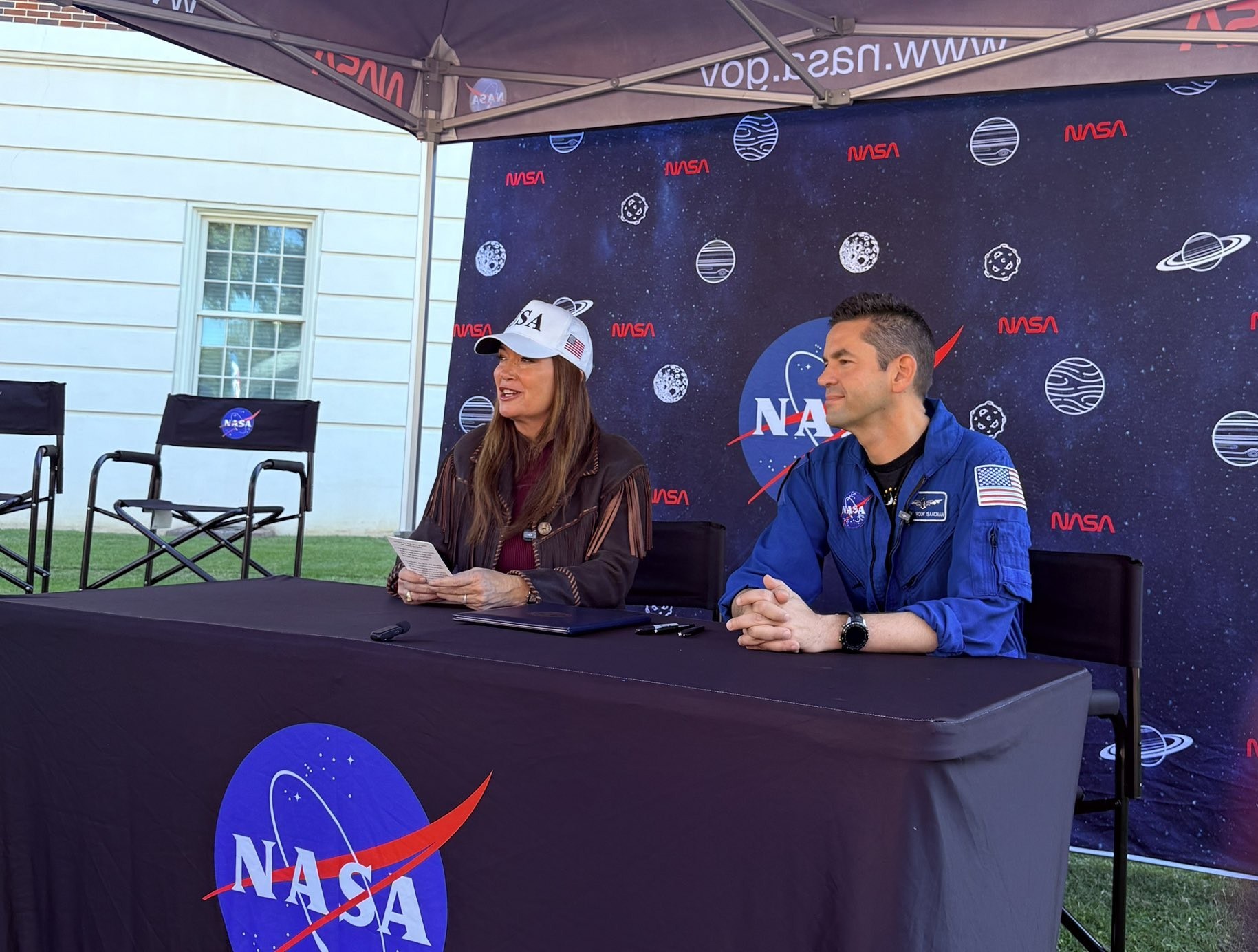
NASA, USDA Sign Agreement Advancing Earth Science, Agriculture
U.S. Secretary of Agriculture Brooke Rollins, left, and NASA Administrator Jared Isaacman signed a Memorandum of Understanding advancing agr...
-
NASA has exercised the second option of its Information Technology and Multimedia Services (ITAMS) contract with DB Consulting Group, Inc., ...
-
Science Earth Observatory A Subtle Return of La Niña Earth Earth Observatory Image of the Day EO Explorer All Topics ...
