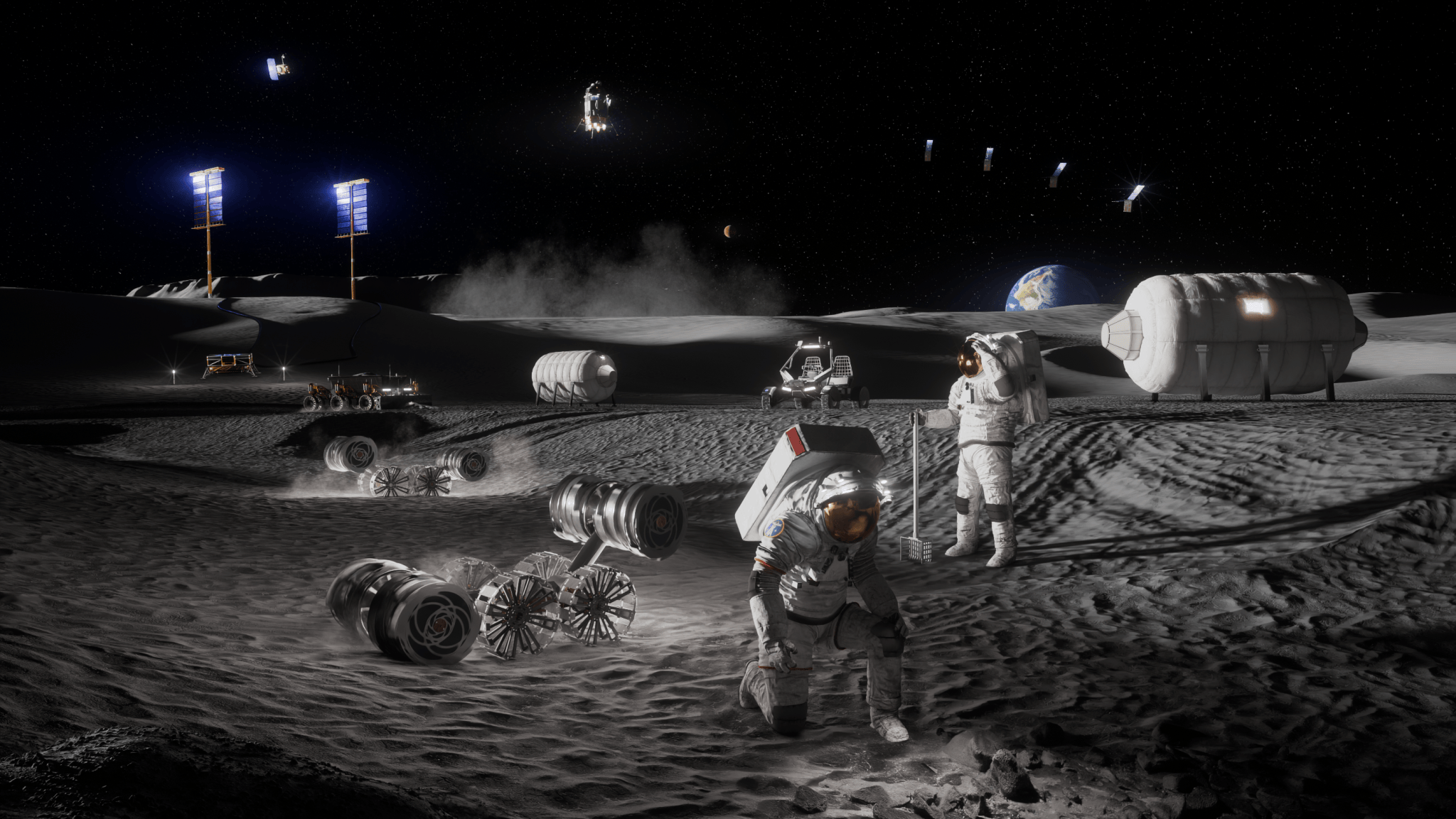
Preparations for Next Moonwalk Simulations Underway (and Underwater)
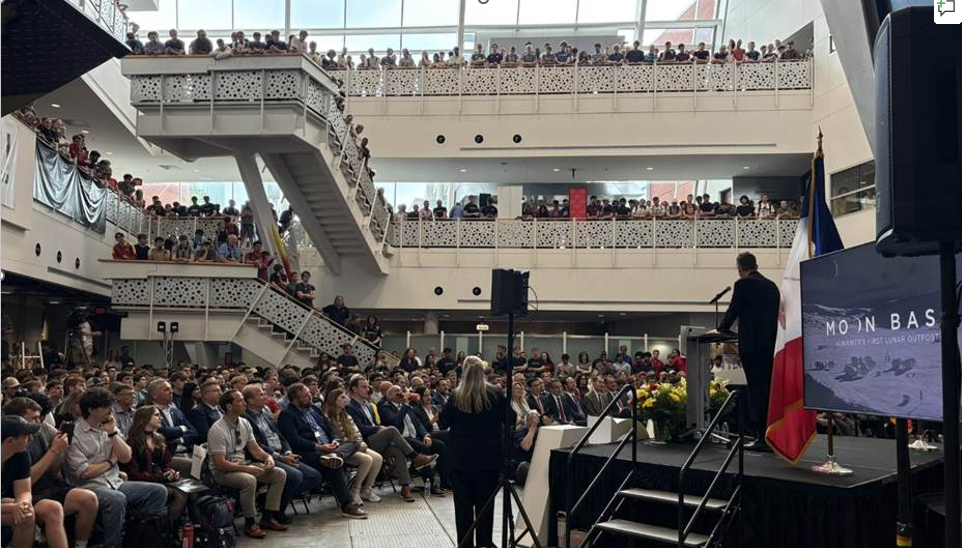
NASA Administrator Jared Isaacman addresses a standing-room-only crowd during an Inspiration Tour stop at Iowa State University.
Credit: NASA
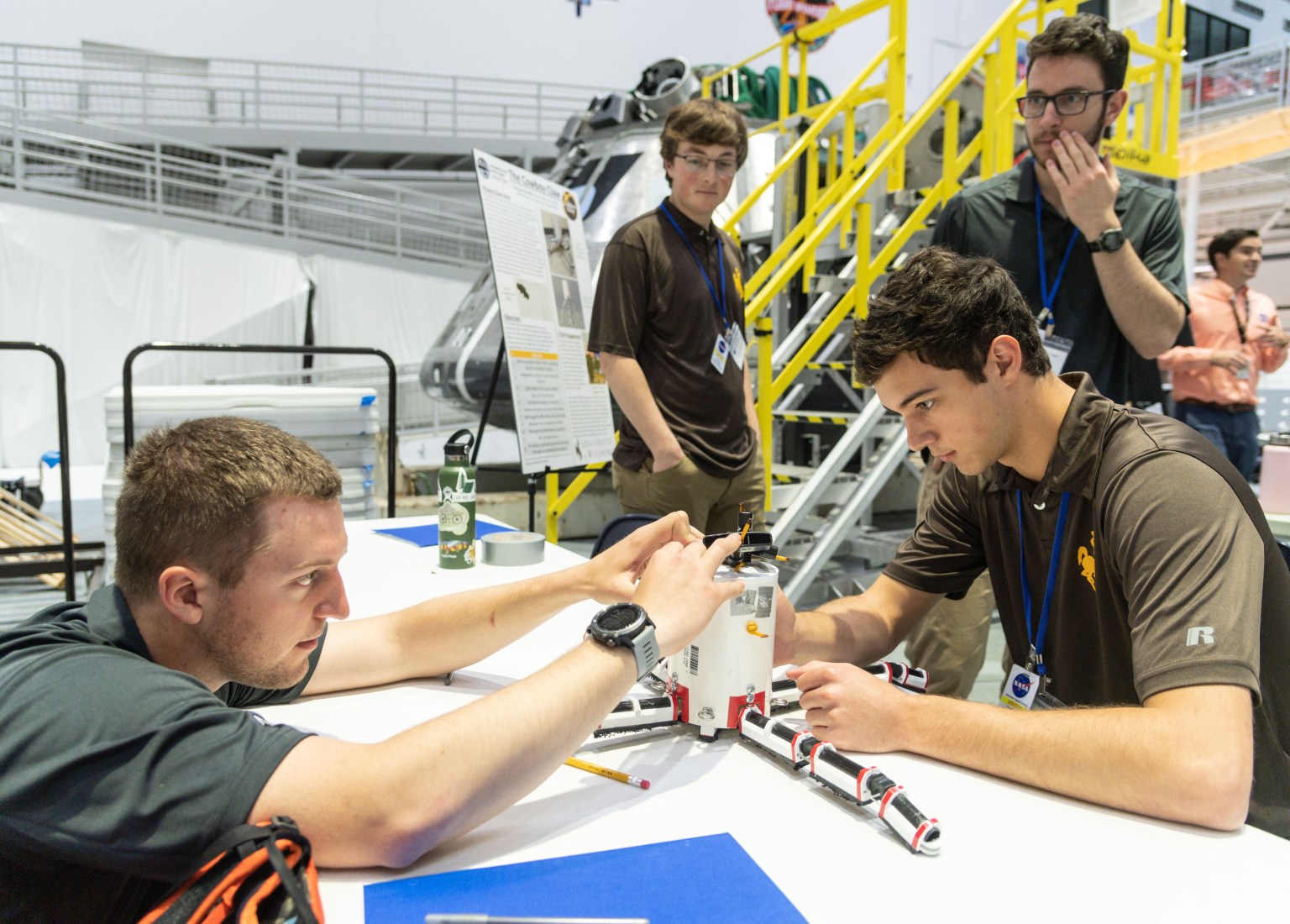
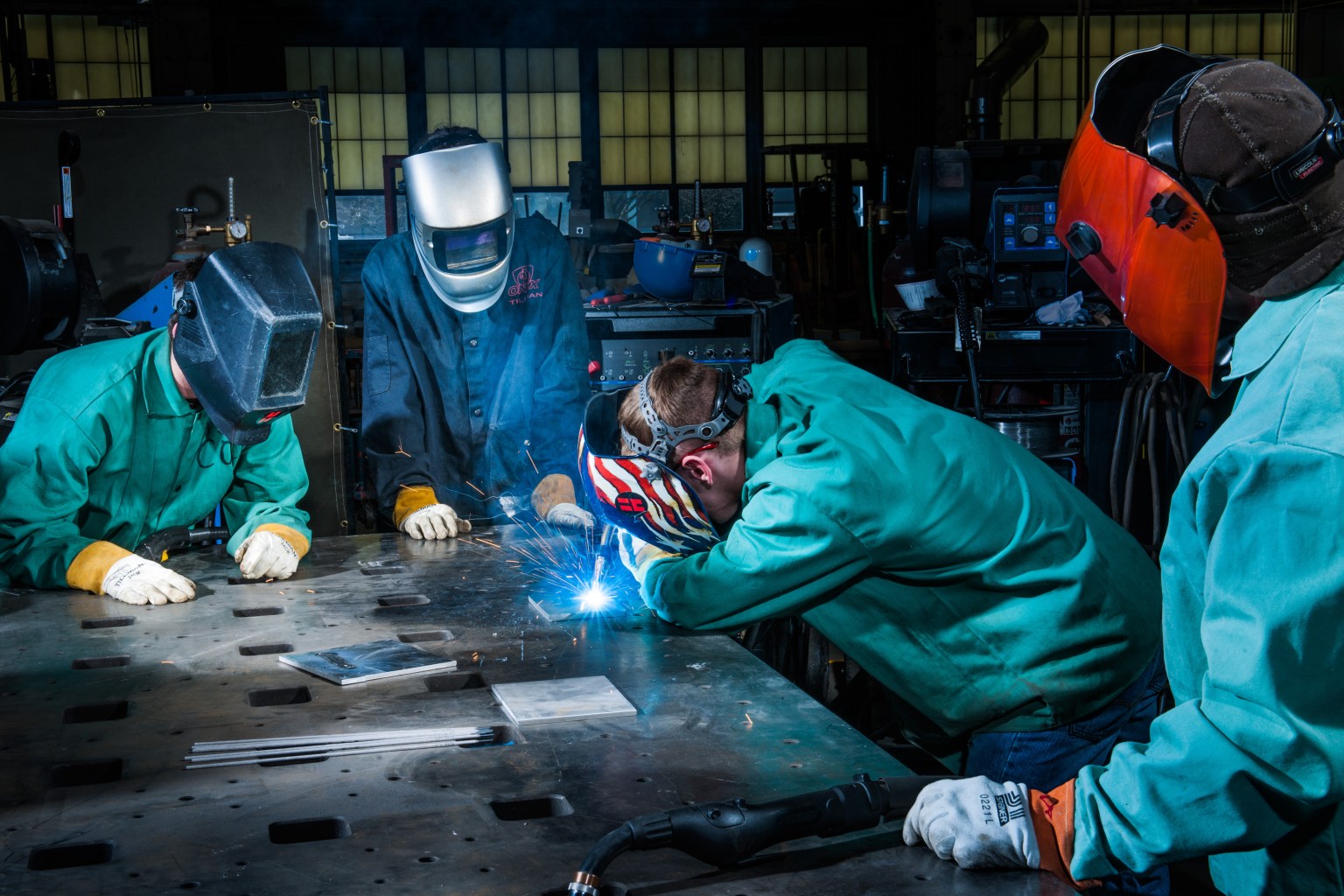
NASA’s Inspiration Tour spread the excitement of space exploration and aeronautical innovation by connecting the public, industry, and academia with the people, technologies, and organizations that drive American leadership in space. At nearly every stop across the country, NASA Space Grant has brought students into the heart of the action.
In Iowa, NASA Administrator Jared Isaacman toured the Make to Innovate program lab at Iowa State University. Students from the Iowa Space Grant Consortium’s Mission Moon program, along with consortium-funded student organizations including Cardinal Space Mining, CySat, and CyLaunch, shared research findings and demonstrated the institution’s strong connection to NASA via agency-funded projects. During a well-attended town hall event NASA experts briefed students on the agency’s Moon Base efforts and how their work can contribute to future exploration.
“We’re grateful for the opportunity to welcome NASA leadership to Iowa State,” said Sara Nelson Iowa Space Grant director. “The excitement among students was incredible, and the visit highlighted how the research and innovation happening in Iowa can help advance Artemis and NASA’s future exploration efforts.”
At the University of Arizona, the NASA administrator saw firsthand the space research and engineering capabilities that are enabled by the Arizona Space Grant Consortium. From satellite communications testing to complex optics for peering into deep space to student-built high-altitude balloon payloads and even small satellites, students at the University of Arizona have a long history of contributing to NASA missions and making aerospace career connections. This tour stop also included a Q&A session where the NASA administrator answered questions from local high school and college students.
“It was incredible to present the high-altitude ballooning research we do in SEDS (Students for the Exploration and Development of Space) to Jared Isaacman and those at NASA,” said Ella Miller, a junior studying mechanical engineering at the University of Arizona. “Arizona Space Grant has allowed me to get hands-on experience through an entire mission design process every semester, helping me pursue a career in space research and secure internships in this field.”
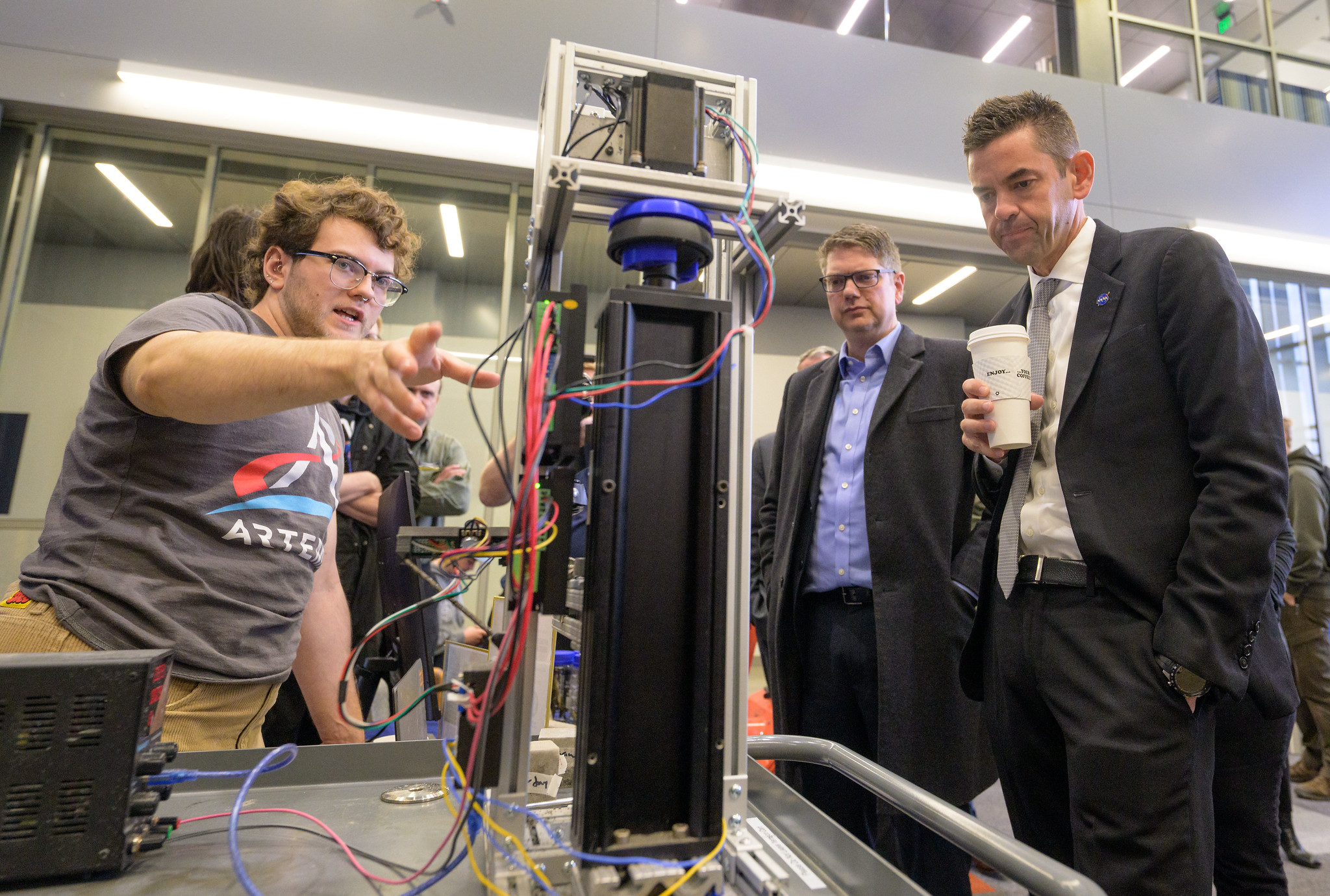
Space Grant students from the University of Alaska Fairbanks shared their research with NASA Administrator Jared Isaacman during a Science Fair event in conjunction with the agency’s Inspiration Tour stop.
Credit: NASA/Bill Ingalls
At the University of Alaska in Fairbanks, the Administrator toured two Geophysical Institute facilities: Poker Flat Research Range, the university’s scientific rocket launching facility, and the Alaska Satellite Facility. During an Alaska Space Grant science fair, students shared research in hibernation biology and showcased CubeSat technology advancements. Students were also able to learn about the agency’s Moon Base program and ask questions about opportunities available to the next generation of innovators and explorers.
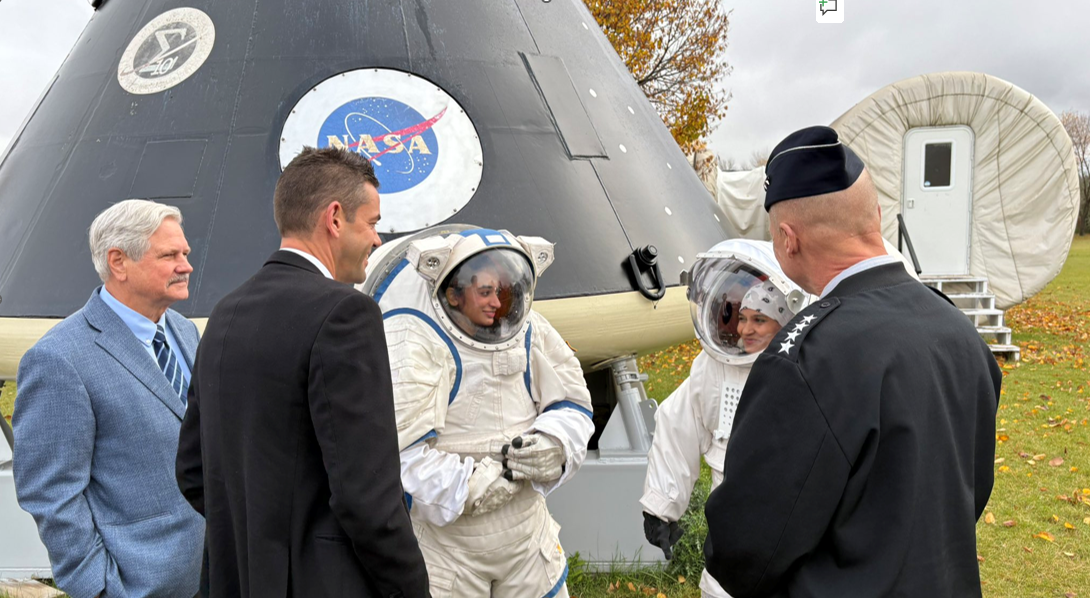
In North Dakota, the Inspiration Tour focused on future exploration capabilities. Space Grant-funded research at the University of North Dakota is helping to shape the future of exploration across STEM fields. Student fellows and NASA interns shared their projects on supercell mergers using satellite imagery, geomagnetic conditions of aurora borealis, and in-situ resource utilization, to name a few. North Dakota Space Grant STEM ambassador students also shared robotics and drone activities as part of “Mission Moon”, which centers Artemis initiatives in statewide collaborations with educators and other North Dakota colleges and universities.
“Getting to speak with the NASA Administrator was an amazing opportunity!” said research fellow and STEM ambassador Malissa Reinhardt. “He genuinely cared about what we students had to say and the research we’re working on, which makes all the hard work we put into our research and North Dakota Space Grant Consortium so rewarding.”
Students at the University of North Dakota’s spacesuit lab demonstrated design advancements for lunar surface spacesuits for NASA Administrator Jared Isaacman during a tour of their lab during the agency’s Inspiration Tour stop
Credit: NASA
NASA’s Inspiration Tour will culminate in MAX POWER, a public showcase of air and space innovation on Nov. 7 and 8, highlighting the agency’s commitment to preparing the next generation of innovators and explorers for humanity’s next giant leap. As NASA enters a Golden Age of innovation and exploration, the national network of Space Grant consortia is expanding opportunities for students to lead the way in an aerospace workforce that is evolving and growing. At learning institutions from coast to coast, today’s Space Grant students are launching America’s future in space.
To find ways to engage with NASA’s exciting missions, broad range of careers, and unique learning opportunities, visit:
This is an image from NASA’s Hubble Space Telescope of NGC 4449, one of the dwarf galaxies in the Galaxies Losing Oxygen via Winds (GLOW) study. Researchers found that dwarf galaxies can hold onto only a small fraction of the oxygen made by their stars.
NASA, ESA, Hubble Heritage–ESA/Hubble Collaboration, Alessandra Aloisi (STScI, ESA)
This photo released on Nov. 2, 2026, showcases NGC 4449, a dwarf irregular. Researchers using NASA’s Hubble Space Telescope studied 37 nearby dwarf galaxies — small galaxies containing a few thousand to hundreds of millions of stars — including NGC 4449 and found that much of the oxygen they expected to see is missing.
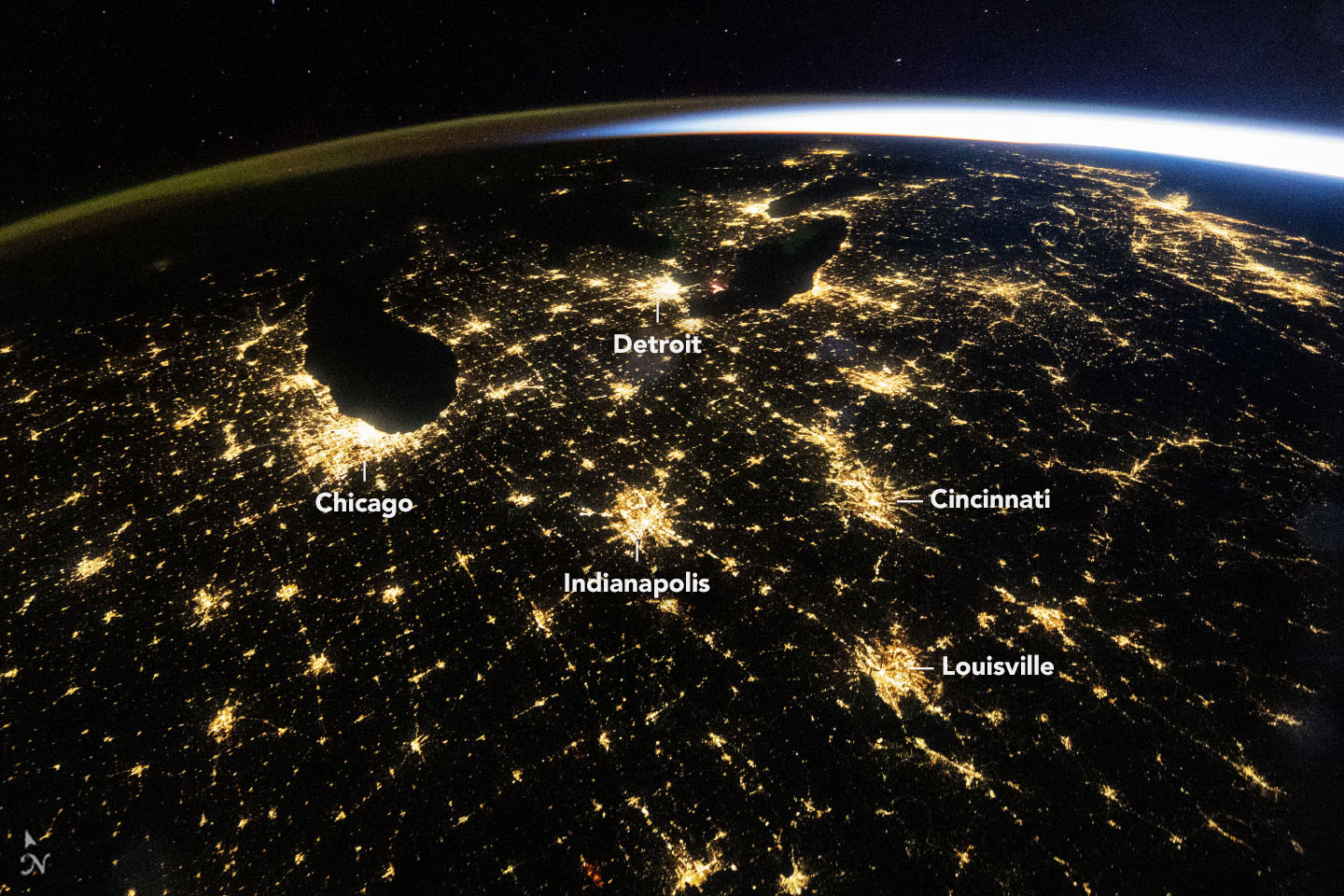
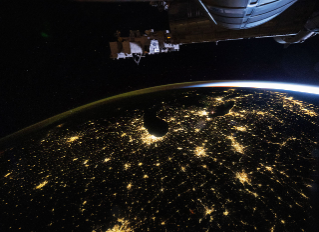
The predawn hours brought clear skies over much of the eastern United States on October 18, 2026. An astronaut aboard the International Space Station seized the opportunity to capture this wide-angle photo at 4:54 a.m. Central Daylight Time (09:54 Universal Time), with illuminated cities large and small arrayed across the darkened landscape.
The U.S. Midwest’s largest metropolitan areas, such as Chicago, Illinois, and Detroit, Michigan, stand out as some of the brightest features. Mid-sized cities—including Indianapolis, Indiana; Cincinnati, Ohio; and Louisville, Kentucky—and their interconnections along state and interstate highways also shine brightly.
Above the web of nighttime lights and Earth’s lower atmosphere, a diffuse layer of green and orange is visible along the horizon to the left. This band of light is airglow, produced when sunlight strikes atoms and molecules in the upper atmosphere and causes them to eject photons. To the right, light from the Sun arcs across the horizon; sunrise was about an hour away on the East Coast and about two hours away in Chicago.
Astronaut photos and other remote sensing observations of nighttime lights are scientifically valuable for tracking changes in the built environment. For example, Chicago’s lightscape appears a homogeneous pale yellow in the wide view above. But in detailed photos, like the one below, a range of colors stemming from different types of lighting is discernible. Using NASA’s extensive Gateway to Astronaut Photography of Earth archive, researchers have developed a method for distinguishing lighting types within the pixels of nighttime photos. Systematically quantifying urban lights’ brightness, color, and extent can provide insight into how cities grow and evolve.
March 1, 2024
Satellite sensors also observe changes to lighting. In particular, NASA’s Black Marble nighttime lights product suite uses satellite observations to produce science-quality records of nighttime lights across the globe at daily, monthly, and yearly time scales. In the eastern U.S., scientists have used these data to track everything from power outages and restoration following major storms to lighting changes associated with new infrastructure to transitions to LED lighting from older forms.
Astronaut photograph ISS075-E-226709 was acquired on October 18, 2026, with a Nikon Z9 digital camera using a focal length of 14 millimeters, and photograph ISS070-E-105097 was acquired on March 1, 2024, with a Nikon D5 digital camera using a focal length of 400 millimeters. They are provided by the ISS Crew Earth Observations Facility and the Earth Science and Remote Sensing Unit at NASA Johnson Space Center. The images were taken by members of the Expedition 75andExpedition 70 crews, respectively. The images have been cropped and enhanced to improve contrast, and lens artifacts have been removed. The International Space Station Program supports the laboratory as part of the ISS National Lab to help astronauts take pictures of Earth that will be of the greatest value to scientists and the public, and to make those images freely available on the internet. Additional images taken by astronauts and cosmonauts can be viewed at the NASA/JSC Gateway to Astronaut Photography of Earth. Story by Lindsey Doermann.
Happy 65 Years: NASA’s Johnson Space Center Then and Now
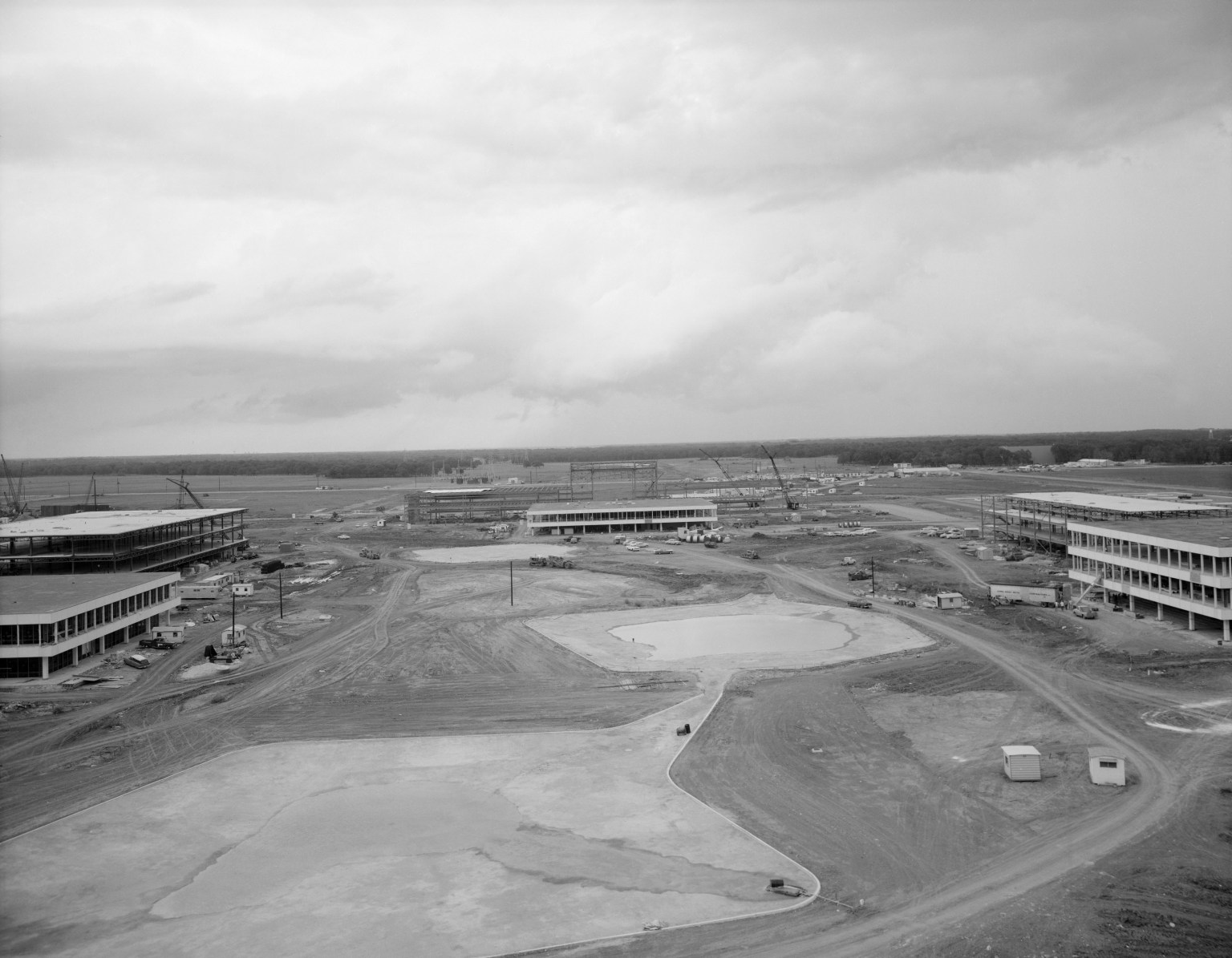
View of the Manned Spacecraft Center during construction in 1963.
Sixty-five years ago, a bold vision took root in Houston: a NASA center dedicated to human spaceflight. Since its founding, NASA’s Johnson Space Center has helped lead the nation’s human spaceflight program, supporting missions from Project Mercury through Artemis.
Today, Johnson serves as NASA’s Center of Excellence for Human Spaceflight, and its workforce is helping to usher in a Golden Age of innovation and discovery. Johnson is home to America’s astronaut corps, the Mission Control Center, and the teams behind some of humanity’s greatest achievements in space. As NASA’s human spaceflight programs evolve, Johnson remains at the forefront of these efforts.
Houston is home to NASA’s Low Earth Orbit Program, comprising International Space Station operations and commercial partnerships and destinations in low Earth orbit. For missions beyond low Earth orbit, Johnson houses the Moon Base Program and Orion Program, while NASA’s Human Health and Performance Directorate and Human Research Program work to protect crew health and performance as missions extend farther from Earth.
On May 25, 1961, the center’s story began when President John F. Kennedy gave a speech before a joint session of Congress, committing the nation to achieve the goal of landing a man on the Moon and returning him safely to Earth before the end of the decade.
NASA’s Space Task Group, in charge of America’s human spaceflight program, was already working on Project Mercury to put astronauts into Earth orbit, but with the additional task of a human lunar landing, it soon outgrew its facilities at NASA’s Langley Research Center in Hampton, Virginia. The agency decided it needed a dedicated field center for human spaceflight and on Sept. 19, 1961, after evaluating multiple sites around the country, NASA announced that the new Manned Spacecraft Center would be built near Houston, Texas. The agency established the center on Nov. 1, 1961, and construction began in 1962. In 1973, it officially became NASA’s Lyndon B. Johnson Space Center in honor of President Johnson for his ardent support of America’s space program from its foundation.
Manned Spacecraft Center to Johnson Space Center
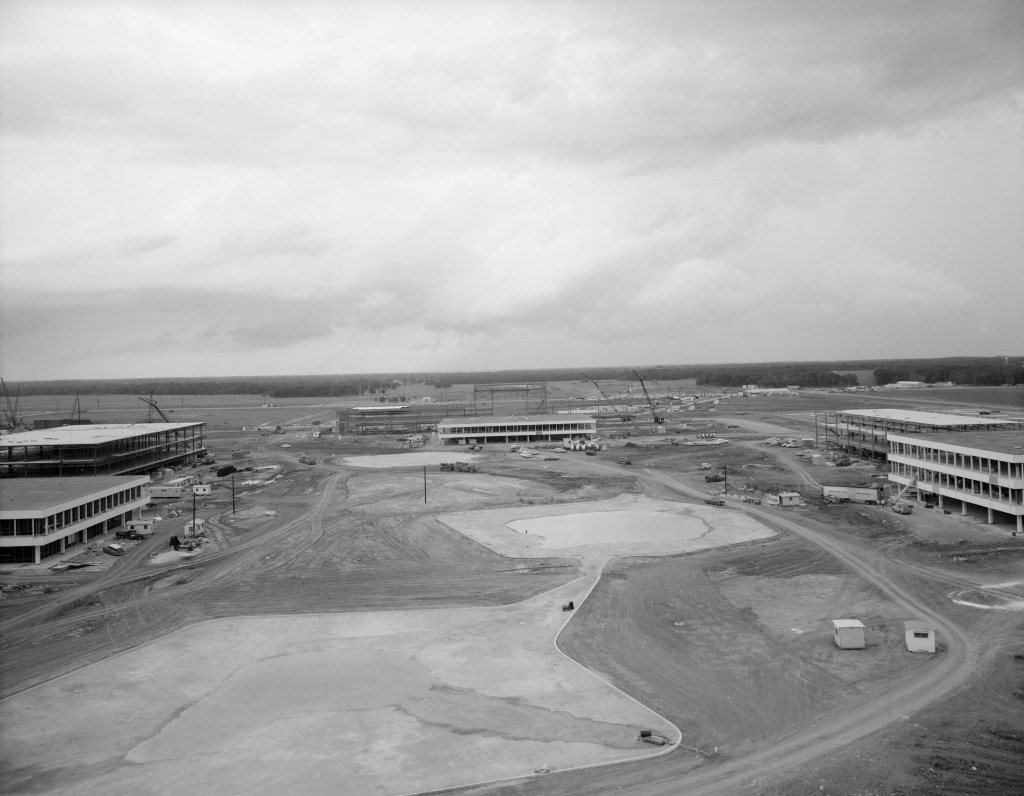
The Manned Spacecraft Center officially opened on Nov. 1, 1961, and while construction continued on the Clear Lake site, employees worked in 13 leased buildings in southeast Houston. The design phase took six months and construction of the first buildings took 18 months, with the first employees moving onto the new site in late 1963.
Over the decades, the number of buildings grew, and continues to grow, to meet the demands of new spaceflight programs.
View of the Manned Spacecraft Center during construction in 1963.
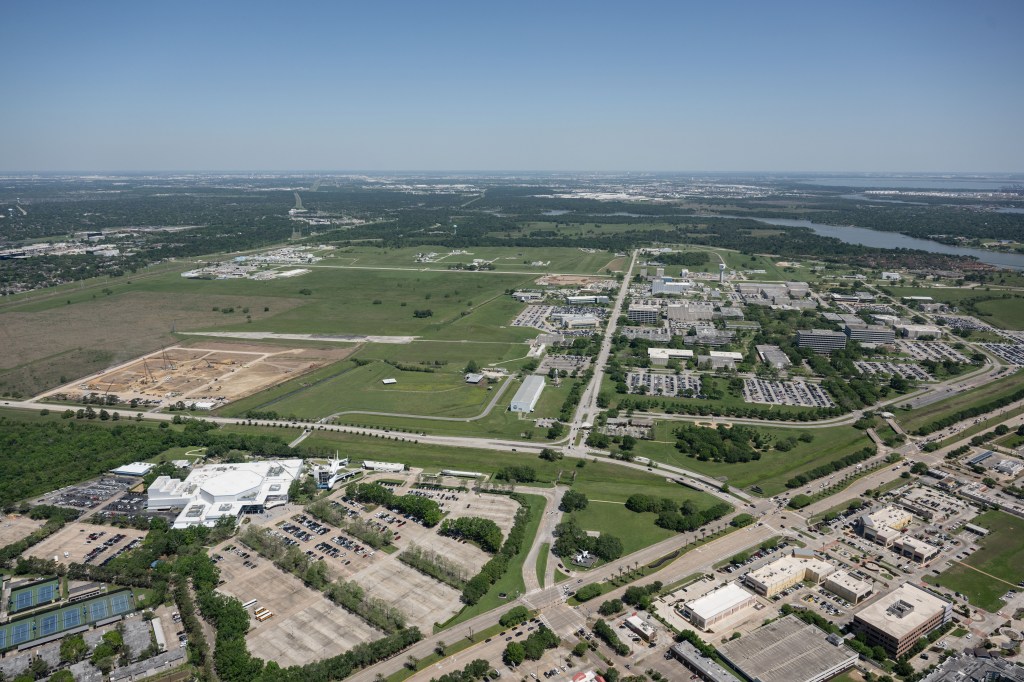
Aerial view of NASA’s Johnson Space Center and Space Center Houston in 2025.
NASA/James Blair
Project Management Building
Construction of the nine-story Project Management Building began on Dec. 5, 1962, and concluded on March 15, 1964. Robert Gilruth, the center’s first director, moved into his office on March 5, 1964, on the top floor of the edifice then known as Building 2. The building swapped numbers with the Public Affairs Building, originally known as Building 1, on June 30, 1974.
The main administration building, called Building 2 until 1974, during President Richard Nixon’s visit in 1974.
Employees pose for a group photo in front of Building 1 in 2024.
NASA/Robert Markowitz
Photo taken in 1964 from the main administration building toward the city of Nassau Bay.
The same view from roughly the same vantage point in 2026, showing the mature oak trees and the extensive development outside the center’s gates.
Neutral buoyancy spacewalk training
The use of neutral buoyancy for spacewalk training began with the Gemini XII mission in 1966. In 1967, workers installed an above-ground circular pool called the Water Immersion Facility for astronaut training that supported Apollo and pre-Shuttle spacewalk training.. To accommodate the larger size of the space shuttle payload bay, spacewalk training moved to the Weightless Environment Training Facility iin 1980. Astronauts used it for nearly all shuttle spacewalk training until 1997, when the Neutral Buoyancy Laboratory in the Sonny Carter Training Center entered operations for both shuttle and space station training, as well as testing future space suits and lunar surface activities.
Astronaut candidate Anna L. Fisher trains at the Water Immersion Facility in Houston in 1979.
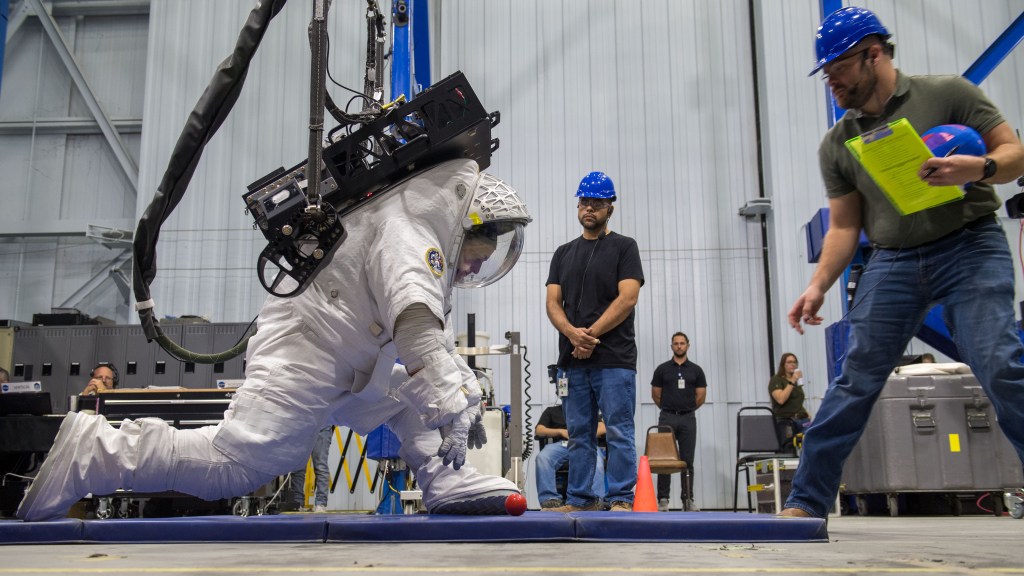
Exploration geologists and Artemis science officers Trevor Graff, left, and Angela Garcia carry out a lunar training development run at NASA’s Neutral Buoyancy Laboratory (NBL) in Houston. This testing run marked the first time in the Artemis program that two geologists were suited up simultaneously for lunar geology training in the NBL.
Lunar Receiving Laboratory (Building 37)
To prevent any back contamination from any possible lunar microorganisms, NASA designed the Lunar Receiving Laboratory in Building 37. Construction began in August 1966, with the first employees moving into their offices in June 1967. The astronauts from Apollo 11, 12, and 14 completed their three-week postflight quarantine in the lab, and scientists in the various laboratories studied the lunar samples all the Apollo missions returned.
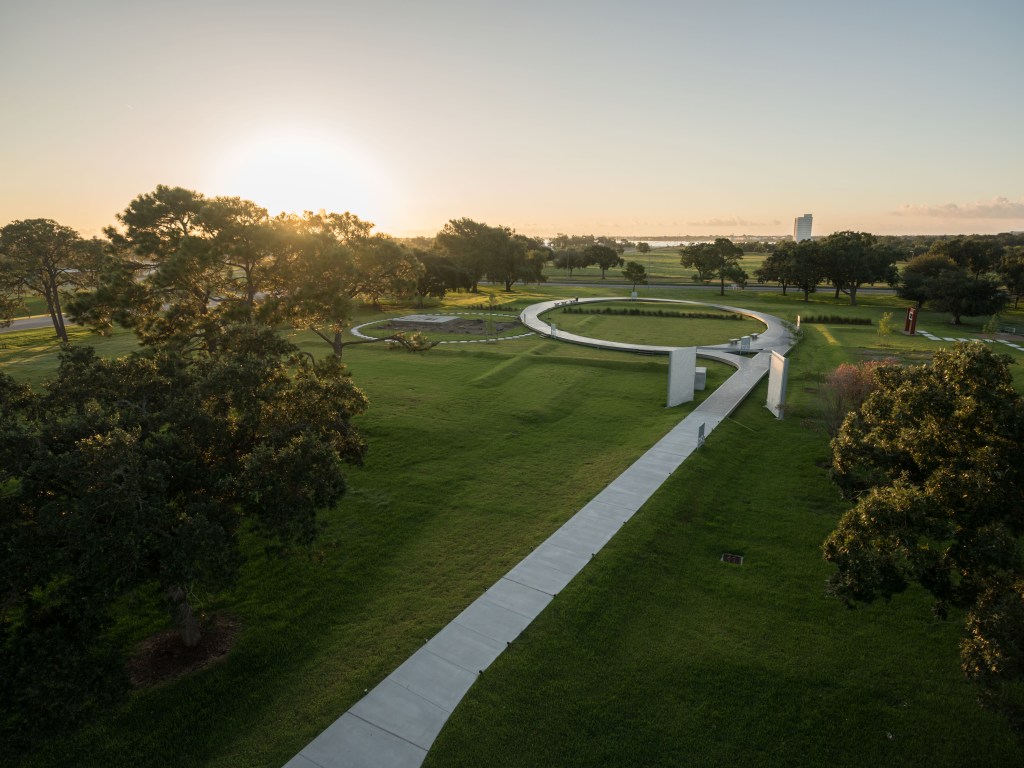
Following the Apollo program, Life Sciences division and laboratories moved into the building until they relocated in 2017. Following demolition of Building 37, the Lunar Receiving Park, dedicated in 2026, honors the history of the laboratory.
Building 37 that housed the Lunar Receiving Laboratory in May 1969, two months before the first Moon landing.
Aerial view of the Lunar Receiving Park built on the site of Building 37 in 2026.
NASA/Robert Markowitz
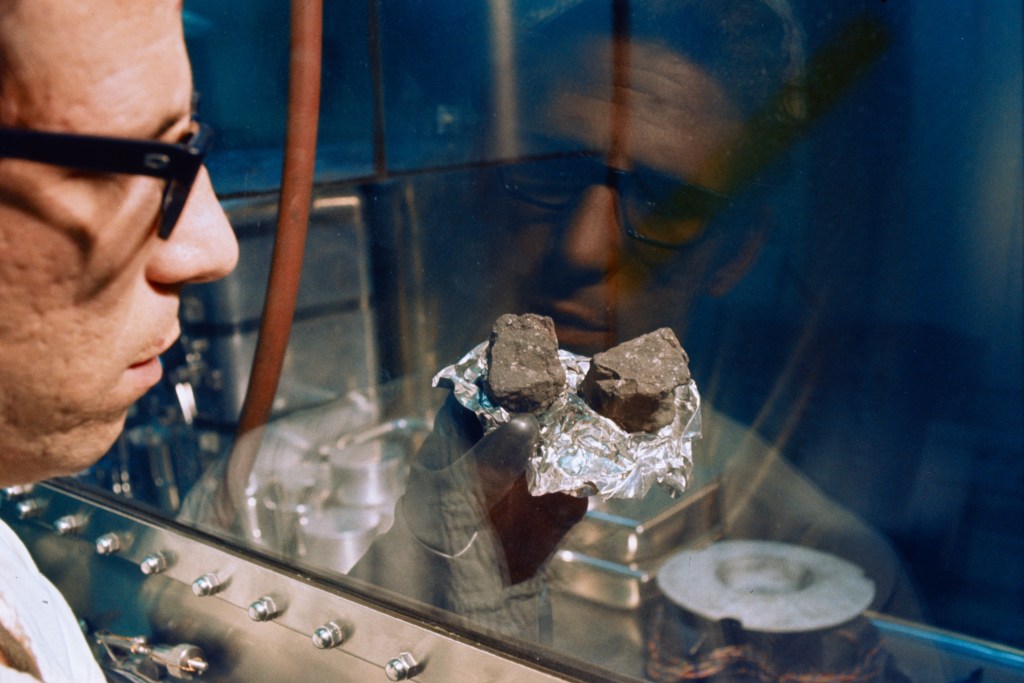
A scientist views an Apollo 11 Moon rock at the Lunar Receiving Laboratory in 1969.
Spacecraft mockup training facilities (Building 9)
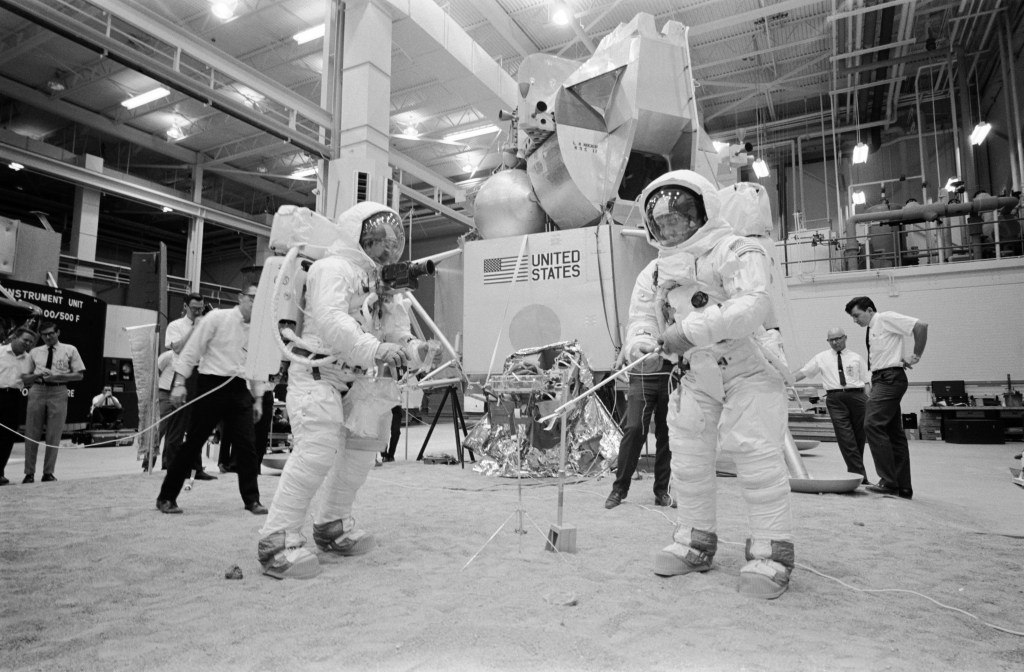
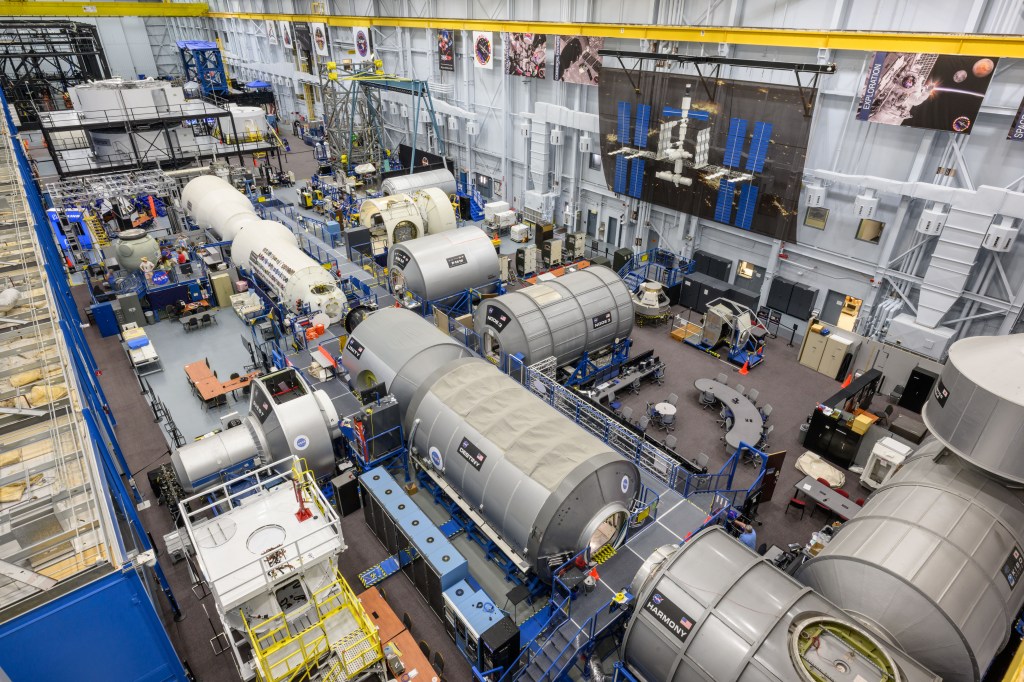
Construction of Building 9 began in December 1965 and finished in March 1967. The building initially housed the Technical Services Facility. In April 1969, workers converted a portion of the building to include a mock lunar surface scene, complete with a mockup of a Lunar Module, used by Apollo 11 astronauts. To support the space shuttle program, workers completed an addition that housed the Mockup and Integration Laboratory in September 1974. Astronauts for all 135 shuttle missions used the mockups for training. An extension on the northwest side of thebuilding begun in 1986 and completed in 1988. It received mockups of Space Station Freedom and later of the International Space Station, and the building was renamed the Space Vehicle Mockup Facility. Today, the facility also houses training mockups of NASA’s Orion spacecraft, commercial mockups, and the Active Response Gravity Offload System, known as ARGOS.
Apollo 11 astronauts Neil Armstrong, left, and Edwin “Buzz” Aldrin train for their lunar spacewalk in Building 9 in April 1969.
The Space Vehicle Mockup Facility in Building 9 in 2026
NASA/Robert Markowitz
Apollo 13 astronaut Fred Haise trains for his lunar spacewalk in Building 29 using the six-degrees of freedom simulator in January 1970.
In the Space Vehicle Mockup Facility in Building 9 in 2026, NASA astronaut Nicole Mann evaluates a new spacesuit design using the Active Response Gravity Offload System, or ARGOS.
NASA/David DeHoyos
Mission Simulation and Training Facility (Building 5)
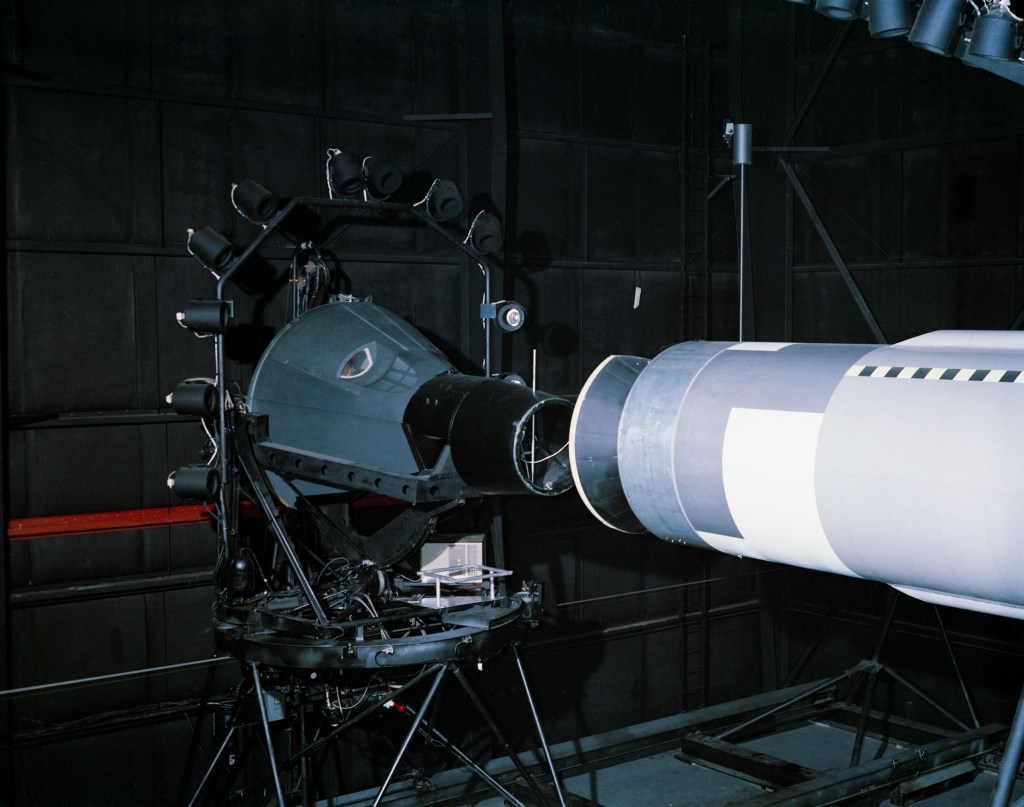
Construction of Building 5, the Mission Simulation and Training Facility completed inApril 1965 and began supporting missions beginning with Gemini IV in June 1965. The building originally contained the Gemini spacecraft simulator and a Gemini translation and docking simulator. Apollo program simulators, including a command module and lunar module simulator, began arriving in December 1965. From 1967 and 1978, astronauts used the Water Immersion Facility for spacewalk training. In the early 1970s, the building also housed full-scale, high-fidelity trainers and simulators of Skylab’s components, which all nine Skylab astronauts used for mission training. In the late 1970s, the facility underwent major renovations to support the space shuttle program, with the addition of fixed base and motion base simulators. The Space Station Training Facility addition, completed in 1991, supported first Space Station Freedom and now International Space Station crew training, and also contains Orion and Starliner simulators.
The Gemini Translation and Docking Simulator in Building 5 in March 1965 used for astronauts to train on docking with Agena target vehicles.
NASA astronauts Stephanie Wilson, left, Jonny Kim, and Randy Bresnik inspect the Orion spacecraft simulator in Building 5 in 2022.
NASA/Radislav Sinyak
Mission Control Center
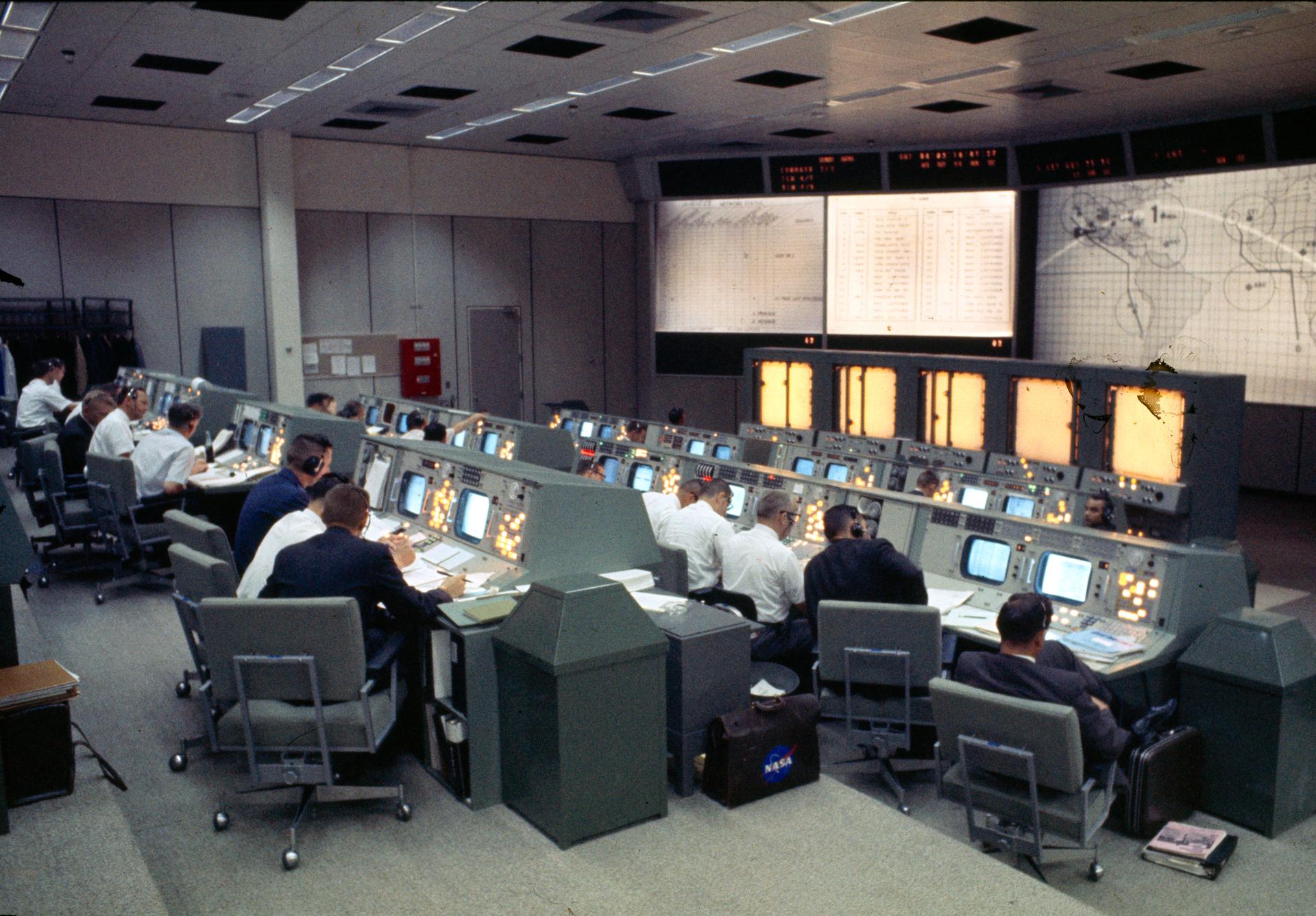
Construction of Building 30 housing the Mission Control Center began in June 1963 and finished in November 1964, with technicians installing the real-time computer in April 1964 and the first employees moving in two months later. The center initially housed two mission operations control rooms to support Gemini and Apollo missions and simulations. By January 1965, the center monitored the uncrewed Gemini 2 mission and the crewed Gemini 3 mission in a flight following mode.
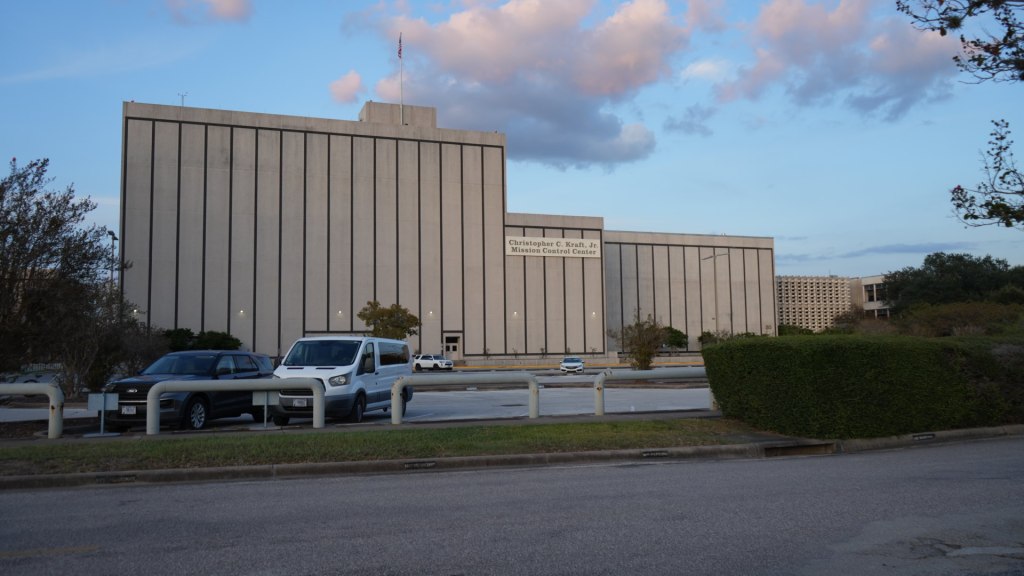
In June 1965, Houston had full control of Gemini IV and has controlled each of NASA’s human space flight missions ever since. The control center received a major upgrade to its computer systems in the mid-1970s to support upcoming space shuttle flights. On April 4, 2011, the building was renamed the Christopher C. Kraft, Jr. Mission Control Center, in honor of the man who created the concepts still in use today in human spaceflight control. The control center continues to support the space station around the clock as well as Artemis missions taking humans back to the Moon.
The exterior of Building 30 that houses the Mission Control Center during final stages of construction in September 1964.
Building 30 in 2026, showing the space station building expansion at left and the plaque naming the facility after Christopher Kraft.
NASA/Sumer Loggins
Flight Control Room 1 at the Mission Control Center during the Gemini IV mission in June 1965, the first mission control from Houston.
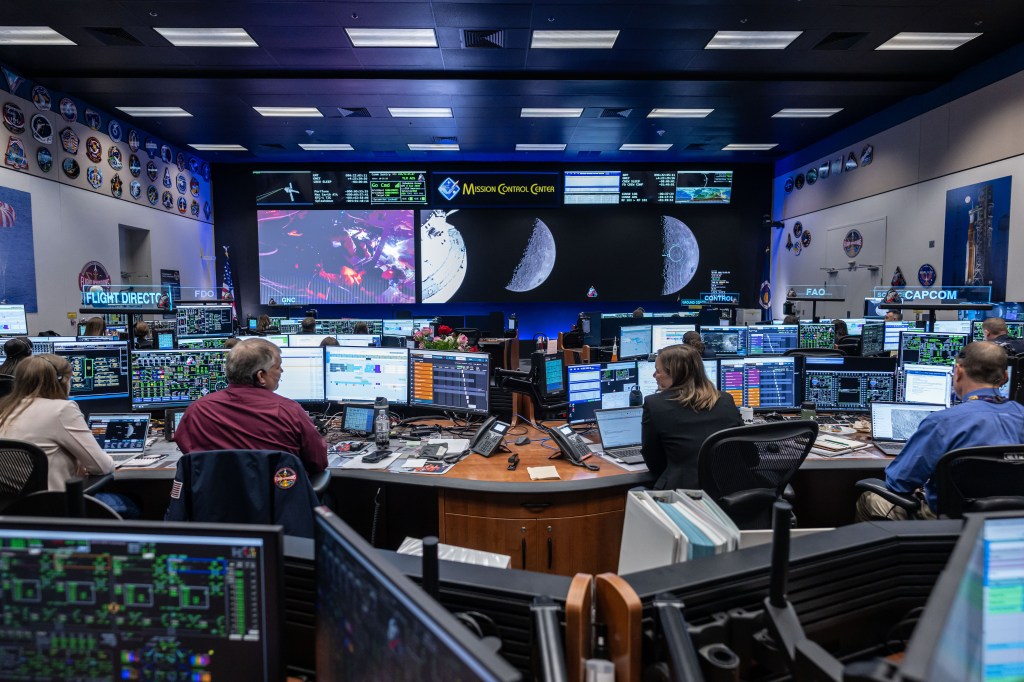
NASA’s Artemis II flight control team works on console in the White Flight Control Room in the Mission Control Center during the mission’s lunar flyby on April 6, 2026.
An instrumented hammer test does not require an idealized single half-sine waveform. When the complete force and response are measured accurately, crest ripples and separated contacts remain known inputs. Force shape changes excitation, but does not inherently invalidate the record. Adequacy depends on measurement accuracy, bandwidth, signal-to-noise ratio, and coverage of the test objective.
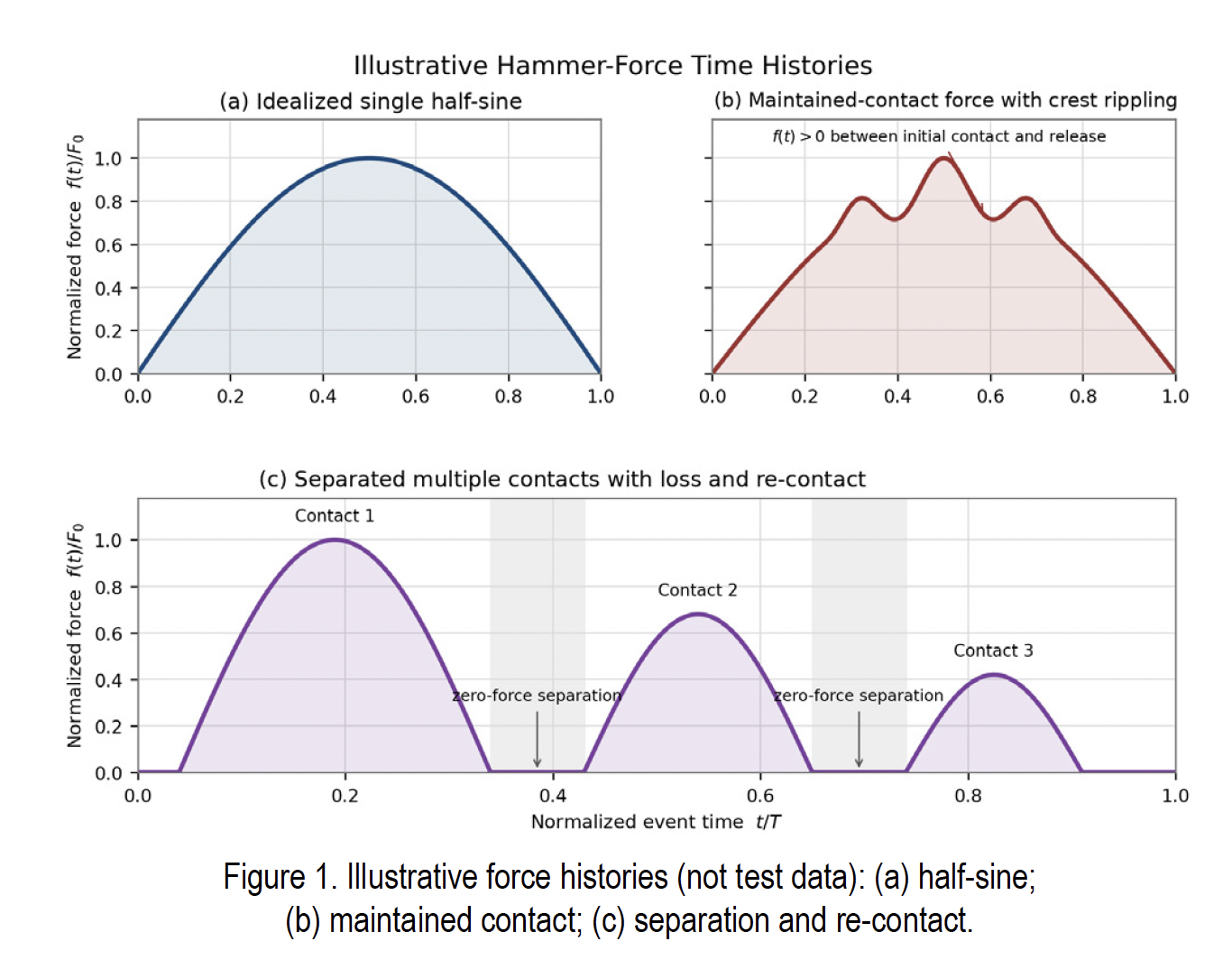
Background: What the Hammer Actually Measures Hammer tests support modal analysis [2–4] and can precede pyroshock testing [6]. Figure 1 compares a half-sine, maintained-contact rippling, and separated contacts. During a zero-force interval, the structure continues to vibrate; re-contact acts on that vibration.
If an exact model and test article receive the same force and initial conditions, uniqueness gives identical responses for each bounded measured history. An approximate model can show different errors as inputs excite different frequencies, amplitudes, or nonlinear states. See [1] for the exact-model derivation.
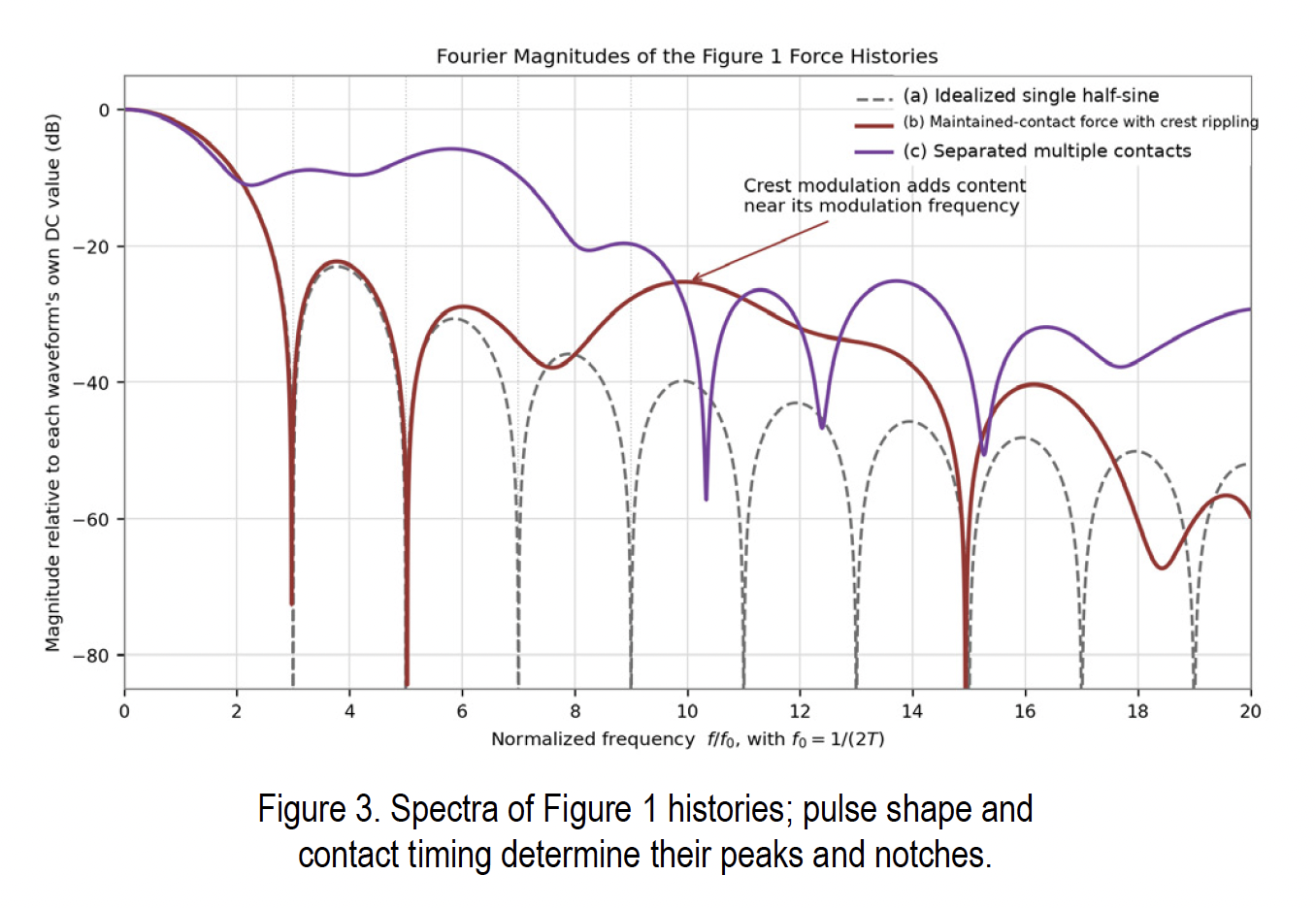
Analysis: A Half-Sine Is Broadband, but Not Flat Figure 2 shows that a finite half-sine is broadband but contains spectral zeros at f/fo = 3, 5, 7, …, with fo = 1/(2T) for pulse duration T. Its appearance alone cannot establish adequate excitation.
Analysis: Spectral Content Is Determined by the Measured Force History Figure 3 normalizes each spectrum to its own DC value. Crest rippling adds content and can fill half-sine notches. Timing between separated contacts creates deterministic interference. For adequacy, inspect the unnormalized measured spectrum and response signal-to-noise ratio.
Recommended Practice: Evaluate Test Adequacy Against the Intended Objective • Measure the complete applied force with adequate bandwidth, calibration, dynamic range, and time synchronization. • Verify that the response measurements have adequate bandwidth and signal-to-noise ratio and are not clipped or saturated. • Confirm that the excitation covers the frequency, amplitude, and nonlinear-response ranges required by the intended test objective. • Reject or repeat a test only for an identified measurement, excitation, or coverage deficiency.
Conclusion Half-sine appearance neither establishes validity nor guarantees adequacy. Judge each hammer test by its purpose and by accurate, complete force and response measurements over the required range.
References 1. A. Majed, J. Sills, E. Henkel, V. Babuska, S. Yunis, D. Hamilton, J. Akers, and T. Kinney, Validity and Predictability of Measured Hammer Tap Inputs: Linear and Nonlinear Structural Systems, September 2026. 2. D. J. Ewins, Modal Testing: Theory, Practice and Application, 2nd ed., 2000. 3. ISO 7626-5:2019, Mechanical Vibration and Shock—Experimental Determination of Mechanical Mobility—Part 5 4. K. G. McConnell and P. S. Varoto, Vibration Testing: Theory and Practice, 2nd ed., 2008. 5. A. H. Nayfeh and D. T. Mook, Nonlinear Oscillations, 1979. 6. NASA-STD-7003, Pyroshock Test Criteria, 1999