Thursday, 3 October 2024

The Marshall Star for October 2, 2024
20 Min Read

The Marshall Star for October 2, 2024

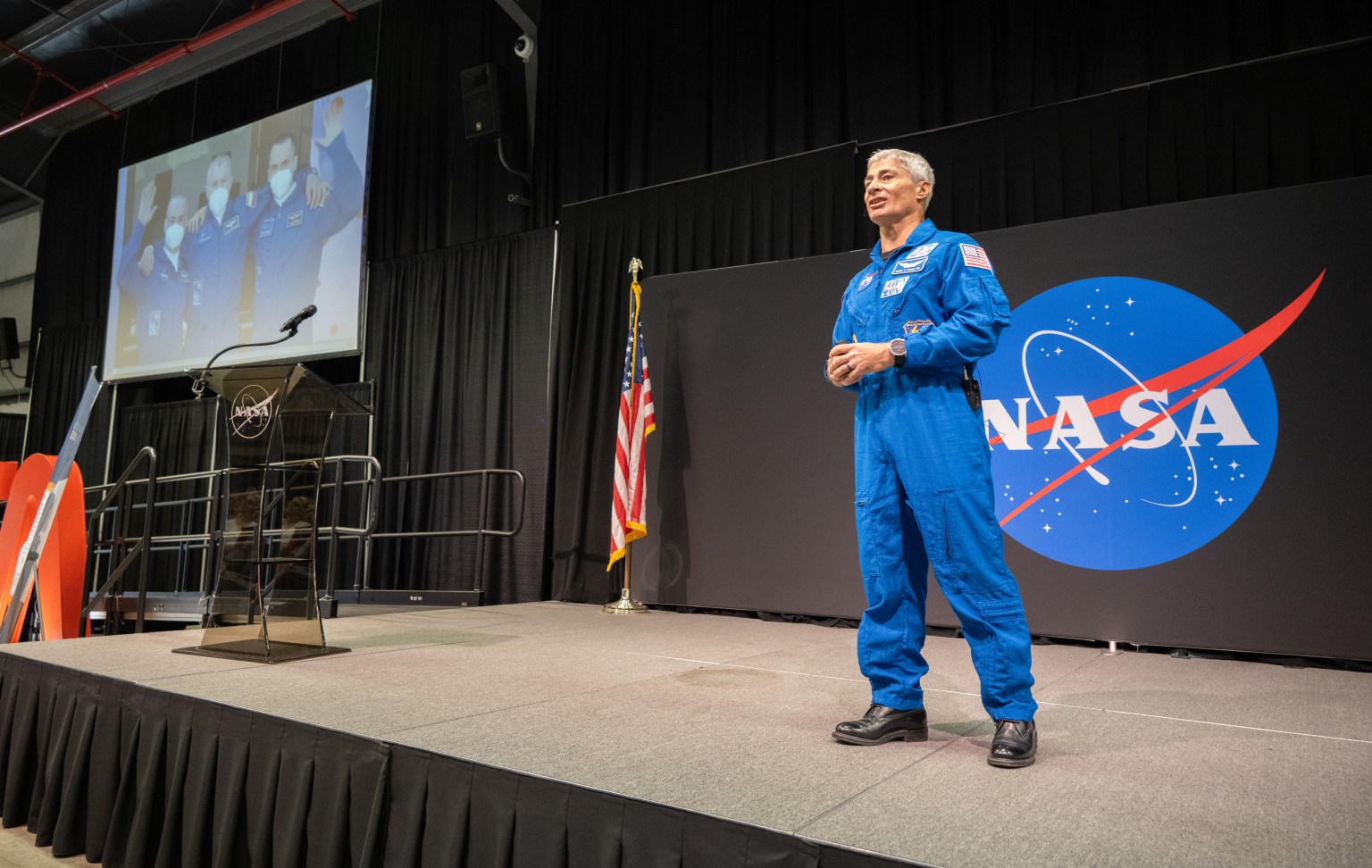
NASA astronaut Mark T. Vande Hei talks about his time in space aboard the International Space Station.

The Fabric of Marshall: Center Hosts Safety Day 2024

By Serena Whitfield

“Safety Woven Throughout the Fabric of Marshall” was the theme for Safety Day at NASA’s Marshall Space Flight Center on Sept. 26.

Kickoff activities were held in Building 4316 and other sites around the center.

“It is crucial to ensure that each of us weaves safety into everything we do, not only at work, but in our daily lives,” Marshall Director Joseph Pelfrey said.

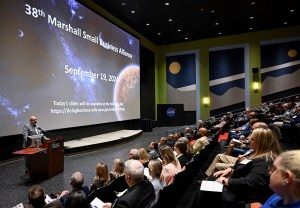
NASA Marshall Space Flight Center Director Joseph Pelfrey, left, with NASA astronaut Mark T. Vande Hei, who was the keynote speaker for Marshall’s Safety Day on Sept. 26.
NASA/Krisdon Manecke

NASA started the Safety Day tradition following the space shuttle Columbia accident in 2003. Centers across the agency dedicate a day each year for team members to pause and reflect on keeping the work environment safe. 

This year’s Safety Day began with a breakfast for employees, which was sponsored by Jacobs and Bastion Technologies. After breakfast, Bill Hill, director of the Safety and Mission Assurance Directorate at Marshall, welcomed center team members before introducing Pelfrey.

“Over the past year, Marshall’s leadership and workforce have highlighted that transparency is an essential cultural attribute of our workforce and center,” Pelfrey said. “It is also important to our core value of safety. Transparency fosters an environment where employees feel comfortable in reporting potential risks or safety concerns without fear of retribution. This openness ensures that issues are addressed early. It builds trust and accountability within our workforce, center, NASA, and external stakeholders.”

NASA astronaut Mark T. Vande Hei talks about his time in space aboard the International Space Station.
NASA/Krisdon Manecke

Guest speaker Marceleus Venable, a purpose coach, trainer, and author, followed Pelfrey’s remarks, telling team members to be safe by taking care of their physical and mental health. He encouraged them to take the time to pat themselves on the back for all their hard work and to appreciate their fellow workers at Marshall.

NASA astronaut Mark T. Vande Hei was the keynote speaker, encouraging employees to be team players in NASA’s safety mission.

“We need a lot of talented team players to meet the challenges that we have for future space flights,” said Vande Hei, who was selected as a NASA astronaut in 2009 and most recently served as a flight engineer on the International Space Station as part of Expedition 65 and 66. “Always try to do your best, but make sure that other people around you are doing their best as well and help them do that rather than you standing out as always being the best.”

Peter Wreschinsky, second from left, a Jacobs Space Exploration Group employee, is presented with the Golden Eagle Award during Safety Day. He is joined by his wife, Terri. They are joined by Bill Hill, left, director of the Safety and Mission Assurance Directorate at Marshall, and Jeff Haars, right, Jacobs vice president. The Golden Eagle Award is a part of the Mission Success is in Our Hands initiative, a collaboration between Marshall and Jacobs. Wreschinsky was recognized with the award for voicing concern about a valve impacted by corrosion on the Commercial Crew Program Crew-8 Dragon Capsule. The valve and several others were subsequently replaced.
NASA/Serena Whitfield

Micah Embry, the Safety Day 2024 chairperson, presented Vande Hei with a certificate for his participation. 

Also during the event, Hill awarded the Golden Eagle Award to Peter Wreschinsky, a Jacobs Space Exploration Group employee. The award is part of the Mission Success is in Our Hands safety initiative, a collaboration between Marshall and Jacobs.

More than 400 civil servants and contractors participated in Safety Day, with organizational and vender booths providing information to employees across a variety of safety topics, including Emergency Management Services, fire protection, storm shelters, and more.

“As Marshall continues to be a leader at NASA and across the aerospace industry, … we must always be looking forward to improve our procedures and anticipate potential hazards,” Pelfrey said. “Safety is directly tied to our mission success. Without safety, we cannot achieve the goals we set for ourselves in space exploration, research, and innovation.”

Whitfield is an intern supporting the Marshall Office of Communications.

› Back to Top

Human Lander System Spotlight: Preparing for the First Crewed Lunar Landings for Artemis

The featured business unit for the month of September at NASA’s Marshall Space Flight Center was Lander Systems. Marshall leads the development of the systems needed to safely land humans on the Moon and, eventually Mars. This includes the Human Landing System Program (HLS), which manages the development of commercial lunar landing systems that will transport astronauts to and from the surface of the Moon as part of the agency’s Artemis campaign.

For Artemis III and Artemis IV, NASA has selected SpaceX’s Starship HLS, while Blue Origin’s Blue Moon lander will be used for Artemis V. Having two distinct lunar lander designs, with different approaches to how they meet NASA’s mission needs, provides more robustness while ensuring a regular cadence of Moon landings.

NASA works closely with its industry partners to mature the landers, exercising insight and offering collaboration to ensure astronaut safety and mission success. Through Artemis, NASA aims to land the first woman, first person of color, and first international partner astronaut on the lunar surface while advancing key science and discovery for the benefit of all.

Learn more about HLS and meet some of the NASA Marshall teammates below who are working on the lunar landers:

Amy Buck
Amy Buck
NASA/Ken Hall

Amy Buck has been working with Artemis systems since she first came to Marshall 10 years ago. Previously part of the cryogenic insulation team for the SLS (Space Launch System) rocket, Buck is now the materials discipline lead for HLS. In her role, she has the chance to work on nearly every piece of hardware for the two landers as she and her team work with each of the HLS providers to ensure compliance with NASA’s requirements.

“The NASA HLS materials team is vital in supporting the design, testing, and manufacturing of the landers,” Buck said. “Landing on the Moon is central to the larger Artemis mission, and I’m super excited to be part of the Artemis Generation.”

Buck is most excited to see the first woman land on the Moon under Artemis and says she hopes it will inspire young girls – the next generation of engineers and scientists – to go into science and engineering.
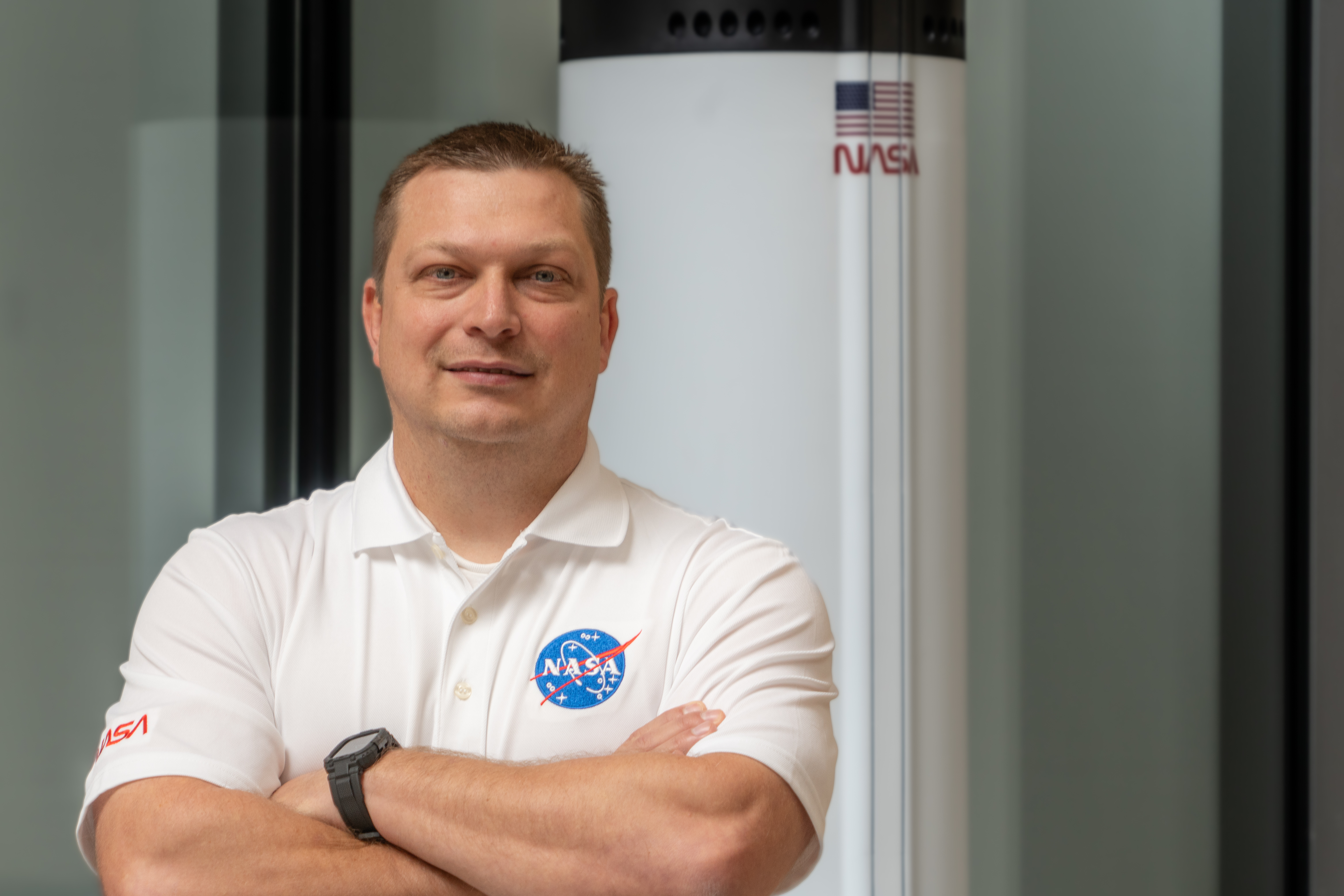
Sean Underwood
Sean Underwood
NASA/Ken Hall

Mission success is all in the details for Sean Underwood, the thermal discipline lead for HLS. The Georgia native works with a team responsible for ensuring that the lunar landers can operate in the Moon’s harsh environment.

“There are unique thermal challenges associated with the Artemis III, IV, and V missions,” Underwood said. “Our primary objective is to manage thermal energy and heating rates, ensuring that HLS components and systems remain within thermal limits across all mission environments.”

Underwood joined Marshall in 2020 and sees his role with Artemis as one that will shape the future of space exploration – and Marshall. “Marshall Space Flight Center has been at the forefront of monumental space projects since its inception,” he said. “Through Artemis, we are ensuring that the legacy of past missions continues to inspire and drive us forward.”

› Back to Top

Innovative Thermal Energy Storage Tanks Keep Marshall Cool – and Save Taxpayer Dollars

By Rick Smith

As any home or business owner in the Southern United States knows, maintaining energy costs while trying to keep cool in the sweltering summer months is no simple challenge.

But one “cool” new infrastructure upgrade at NASA’s Marshall Space Flight Center will reduce the center’s utility costs by approximately $250,000 a year, shrinking Marshall’s environmental footprint and streamlining long-term infrastructure maintenance costs.

NASA Marshall Space Flight Center facilities engineers Connor McLean, left, and Angela Bell assess the readiness of Marshall’s new thermal energy storage tank, which officially goes into operation in October. The tank stands alongside Marshall’s original thermal tank outside Building 4473, where they chill and store water to cool off laboratories, offices, and other buildings during the hot summer months. McLean and Bell lead the tank project on behalf of Marshall’s Office of Center Operations.
NASA/Charles Beason

It’s called a thermal energy storage tank – 60 feet high, 60 feet in diameter, each unit capable of holding approximately 1.125 million gallons of chilled water – and it represents another milestone for facilities engineers in Marshall’s Office of Center Operations, whose tactics have already reduced center-wide energy expenditure by a dizzying 58.3% since fiscal year 2003.

Thermal energy storage is not a new process; it’s been used for decades to maximize efficiency in temperature control, particularly among industrial facilities and large public venues from hospitals to indoor stadiums. At Marshall, the chilled water serves a critical purpose center-wide, circulating from a central plant via a network of underground pipes to help keep laboratories and other buildings temperate throughout the summer heat.

“The average team member might not realize it’s chilled water, not just air, that keeps our labs, offices, and test facilities cool,” said Marshall facilities engineer Angela Bell, who helped oversee the installation of the second tank. “Our tanks operate at night, when utility prices drop and there is less overall demand on the regional energy grid, then send the chillwater out during the day.”

Marshall’s first tank was built and put into operation in 2008-2009. The second officially goes into service in October, joining its counterpart in creating chilled water overnight. Together, the tanks – situated adjacent to Building 4473 on the corner of Morris and Titan roads – provide an annual energy savings of roughly half a million dollars.

Marshall facilities engineer Connor McLean, who succeeded Bell as project manager for the new tank, noted that each thermal energy storage tank handles approximately 106,000 kilo-BTUs worth of cooling activity per day – or roughly 1,750 times as much cooling capacity as a central air system in a traditional family home.

Even with that considerable output, Marshall’s original tank had been hard-pressed to keep up with demand across the entire center over the past decade and a half, as climate change steadily pushed temperatures to sustained extremes.

“This is a huge stride in critical system redundancy,” McLean said. “Having the second tank enables us to run both concurrently or give one of them some necessary downtime without loss of center-wide functionality. That added capability makes Marshall more resilient and bolsters our confidence in our ability to handle unforeseen challenges.”

The electricity that powers the storage tanks is a mix – hydroelectric, fossil fuels, nuclear, and an increasing amount of renewable energy sources – provided by the Tennessee Valley Authority via the U.S. Army, from whom NASA leases property on Redstone Arsenal. 

“The tanks will be tremendous cost-savers for the next 40-50 years,” Bell said. “They allow us to use energy much more efficiently, based on past energy consumption levels – and that allows Marshall to do other things with those dollars.”

Over the past 20 years, Marshall has reinvested energy savings and facilities cost underruns back into center operations, often to fund new, cost-saving overhauls: upgrading facility HVAC systems or replacing obsolete lighting with more efficient LEDs.

“If we didn’t reduce consumption, our projected utility costs would be around $30 million per year,” said Rhonda Truitt, Marshall’s energy and water manager. “Thanks to efficient strategizing, encouraged and championed by Marshall and NASA leadership, we typically operate in the range of just $16-18 million per year.”

Such strategies have enabled Marshall to effectively keep its infrastructure budget flat since the early 2010s – reducing overall energy consumption and replacing outdated facilities with more cost-conscious, environmentally friendly modern buildings, a program known among facilities engineers as “repair by replacement.”

The U.S. Army at Redstone doesn’t employ a central chiller plant of its own, but the Marshall facilities team works “very closely” with their counterparts on the military side.

“We have a great working relationship,” Truitt said. “The real advantage of our system is that by reducing our peak energy demand, it reduces it for all of Redstone – which benefits the rest of the Arsenal and the lower Tennessee Valley.”

The new tank goes into operation just in time for the start of National Energy Awareness Month in October – and Truitt and her team encourage the Marshall workforce to continue to practice sensible energy conservation tactics even as sweat-inducing temperatures subside.

“Turn off lights and computer monitors wherever possible, don’t leave doors or windows propped open, and be mindful of all the small things that can add up over time,” Truitt said. “Our goal is always to help team members do their jobs in the most efficient way possible, to accomplish Marshall’s objectives and conserve our energy budget without impeding the mission.”

Thanks to the center’s new thermal energy storage tank, that should be no sweat.

Smith, an Aeyon employee, supports the Marshall Office of Communications.

› Back to Top

Marshall Welcomes Members of the NASA Advisory Council

Rae Ann Meyer, front right, deputy director of NASA’s Marshall Space Flight Center, is joined by members of the NASA Advisory Council and NASA Headquarters staff Oct. 1 at Marshall. The group toured various areas across the center during their visit Sept. 30-Oct. 2. Council members are appointed by the NASA administrator to provide advice and make recommendations on programs, policies, and other matters pertaining to the agency’s mission.

Rae Ann Meyer, front right, deputy director of NASA’s Marshall Space Flight Center, is joined by members of the NASA Advisory Council and NASA Headquarters staff Oct. 1 at Marshall. The group toured various areas across the center during their visit Sept. 30-Oct. 2. Council members are appointed by the NASA administrator to provide advice and make recommendations on programs, policies, and other matters pertaining to the agency’s mission. (NASA/Charles Beason)

› Back to Top

Commercial Crew Program Hangs Expedition 70 Plaque, Highlighting Work Done by Marshall Team

NASA’s Marshall Space Flight Center continued the tradition of honoring engineers for their exceptional efforts on Commercial Crew Program (CCP) missions to the International Space Station on Sept. 4, with a plaque hanging for Expedition 70 at the Huntsville Operations Support Center (HOSC). Holding their plaques are, from left, Shelby Bates, Ali Reilly, Chris Buckley, Mandy Clayton, Elease Smith, Sara Dennis, Stephanie Stoll, John Griffin, Kylie Keeton, and Blake Parker. Team members are nominated from Marshall, Johnson Space Center, and Kennedy Space Center to hang the plaque of the mission they supported. Expedition 70 – which ended April 5 – researched heart health, cancer treatments, space manufacturing techniques, and more during their long-duration stay in Earth orbit. The HOSC provides engineering and mission operations support for the space station, the CCP, and Artemis missions, as well as science and technology demonstration missions. The Payload Operations Integration Center within HOSC operates, plans, and coordinates the science experiments onboard the space station 365 days a year, 24 hours a day.

NASA’s Marshall Space Flight Center continued the tradition of honoring engineers for their exceptional efforts on Commercial Crew Program (CCP) missions to the International Space Station on Sept. 4, with a plaque hanging for Expedition 70 at the Huntsville Operations Support Center (HOSC). Holding their plaques are, from left, Shelby Bates, Ali Reilly, Chris Buckley, Mandy Clayton, Elease Smith, Sara Dennis, Stephanie Stoll, John Griffin, Kylie Keeton, and Blake Parker. Team members are nominated from Marshall, Johnson Space Center, and Kennedy Space Center to hang the plaque of the mission they supported. Expedition 70 – which ended April 5 – researched heart health, cancer treatments, space manufacturing techniques, and more during their long-duration stay in Earth orbit. The HOSC provides engineering and mission operations support for the space station, the CCP, and Artemis missions, as well as science and technology demonstration missions. The Payload Operations Integration Center within HOSC operates, plans, and coordinates the science experiments onboard the space station 365 days a year, 24 hours a day. (NASA/Charles Beason)
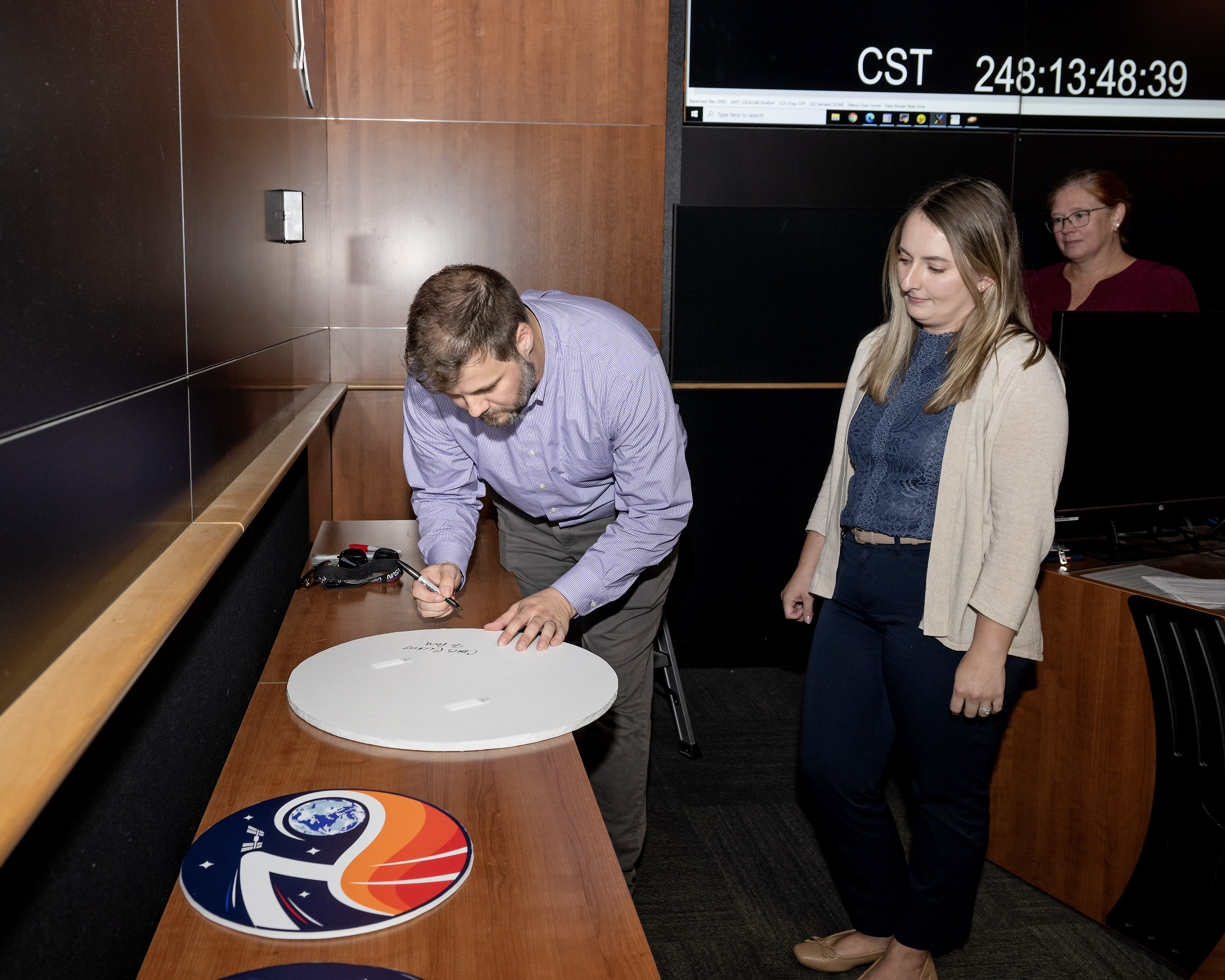
Chris Buckley, left, signs an Expedition 70 plaque as Sara Dennis, center, and Shelby Bates look on.

Buckley, left, signs an Expedition 70 plaque as Dennis looks on. (NASA/Charles Beason)

Sara Dennis hangs the Expedition 70 plaque inside the Huntsville Operations Support Center.

Dennis hangs the Expedition 70 plaque inside the Huntsville Operations Support Center. (NASA/Charles Beason)

› Back to Top

NASA’s SpaceX Crew-9 Aboard International Space Station

NASA astronaut Nick Hague and Roscosmos cosmonaut Aleksandr Gorbunov arrived at the International Space Station on Sept. 29 as the SpaceX Dragon Freedom docked to the orbiting complex at 4:30 p.m. CDT, joining Expedition 72 for a five-month science research mission aboard the orbiting laboratory.

NASA's SpaceX Crew-9 crew joins Expedition 72 aboard the International Space Station. Credit: NASA
NASA’s SpaceX Crew-9 crew joins Expedition 72 aboard the International Space Station.
NASA

The two crew members of NASA’s SpaceX Crew-9 mission launched at 12:17 p.m. CDT Sept. 28 for a science expedition aboard the International Space Station. This is the first human spaceflight mission launched from Space Launch Complex-40 at Cape Canaveral Space Force Station, and the agency’s ninth commercial crew rotation mission to the space station.

The duo joined the space station’s Expedition 72 crew of NASA astronauts Michael Barratt, Matthew Dominick, Jeanette Epps, Don Pettit, Butch Wilmore, and Suni Williams, as well as Roscosmos cosmonauts Alexander Grebenkin, Alexey Ovchinin, and Ivan Vagner. The number of crew aboard the space station increased to 11 for a short time until Crew-8 members Barratt, Dominick, Epps, and Grebenkin depart the space station early this month.

The crewmates will conduct more than 200 scientific investigations, including blood clotting studies, moisture effects on plants grown in space, and vision changes in astronauts during their mission. Following their stay aboard the space station, Hague and Gorbunov will be joined by Williams and Wilmore to return to Earth in February 2025.

With this mission, NASA continues to maximize the use of the orbiting laboratory, where people have lived and worked continuously for more than 23 years, testing technologies, performing science, and developing the skills needed to operate future commercial destinations in low Earth orbit and explore farther from Earth. Research conducted at the space station benefits people on Earth and paves the way for future long-duration missions to the Moon under NASA’s Artemis campaign, and beyond.

Learn more about NASA’s SpaceX Crew-9 mission and the agency’s Commercial Crew Program. Follow the space station blog for updates on station activities.

› Back to Top

Keeping the Pace: Marshall Hosts Annual ‘Racin’ the Station’ Duathlon

A costumed gorilla pacer leads a group of runners during “Racin’ the Station” duathlon, a run/bike/run event where the participants “raced” the International Space Station. The event was Sept. 28 at NASA’s Marshall Space Flight Center, which is on Redstone Arsenal. “Racin’ the Station” is an annual event where participants try to complete the course faster than it takes the space station to complete one Earth orbit, which is every 91 minutes, 12 seconds. Organizers track the starting location of the space station at the race start, and a costumed pacer keeps up with the station time on the course as a visual marker for participants to stay ahead of. Before the race, organizers drew a to-scale SLS (Space Launch System) Block 1 rocket in chalk onto the Activities Building parking lot near the race transition area. The opening ceremonies featured a video of the Artemis 1 launch, with the race starting with the launch of a model rocket. “The rain was a first for race day since we started this event in 2012,” said Kent Criswell, race organizer for Marshall. “But we still had a safe race with 106 individuals and 13 relay teams finishing.” The event is organized by the Team Rocket Triathlon Club in Huntsville and by the Marshall Association, a professional employee service organization at the Marshall Center whose members include civil service employees, retirees and contractors. Proceeds from the registration fee for the event go to the Marshall Association scholarship fund.

A costumed gorilla pacer leads a group of runners during “Racin’ the Station” duathlon, a run/bike/run event where the participants “raced” the International Space Station. The event was Sept. 28 at NASA’s Marshall Space Flight Center, which is on Redstone Arsenal. “Racin’ the Station” is an annual event where participants try to complete the course faster than it takes the space station to complete one Earth orbit, which is every 91 minutes, 12 seconds. Organizers track the starting location of the space station at the race start, and a costumed pacer keeps up with the station time on the course as a visual marker for participants to stay ahead of.  Before the race, organizers drew a to-scale SLS (Space Launch System) Block 1 rocket in chalk onto the Activities Building parking lot near the race transition area. The opening ceremonies featured a video of the Artemis 1 launch, with the race starting with the launch of a model rocket. “The rain was a first for race day since we started this event in 2012,” said Kent Criswell, race organizer for Marshall. “But we still had a safe race with 106 individuals and 13 relay teams finishing.” The event is organized by the Team Rocket Triathlon Club in Huntsville and by the Marshall Association, a professional employee service organization at the Marshall Center whose members include civil service employees, retirees and contractors. Proceeds from the registration fee for the event go to the Marshall Association scholarship fund. Race results can be found here. (NASA/Charles Beason)

Participants take off in the bike portion of the “Racin’ the Station” duathlon.

Participants take off in the bike portion of the “Racin’ the Station” duathlon. (NASA/Charles Beason)

› Back to Top

NASA Seeks Innovators for Lunar Waste Competition 

By Savannah Bullard 

A new NASA competition, the LunaRecycle Challenge, is open and offering $3 million in prizes for innovations in recycling material waste on deep space missions. 

As NASA continues efforts toward long-duration human space travel, including building a sustained human presence on the Moon through its Artemis missions, the agency needs novel solutions for processing inorganic waste streams like food packaging, discarded clothing, and science experiment materials. While previous efforts focused on the reduction of trash mass and volume, this challenge will prioritize technologies for recycling waste into usable products needed for off-planet science and exploration activities.  

NASA’s LunaRecycle Challenge will incentivize the design and development of energy-efficient, low-mass, and low-impact recycling solutions that address physical waste streams and improve the sustainability of longer-duration lunar missions. Through the power of open innovation, which draws on the public’s ingenuity and creativity to find solutions, NASA can restructure the agency’s approach to waste management, support the future of space travel, and revolutionize waste treatments on Earth, leading to greater sustainability on our home planet and beyond. 

“Operating sustainably is an important consideration for NASA as we make discoveries and conduct research both away from home and on Earth,” said Amy Kaminski, program executive for NASA’s Prizes, Challenges, and Crowdsourcing program. “With this challenge, we are seeking the public’s innovative approaches to waste management on the Moon and aim to take lessons learned back to Earth for the benefit of all.” 

NASA’s LunaRecycle Challenge will offer two competition tracks: a Prototype Build track and a Digital Twin track. The Prototype Build Track focuses on designing and developing hardware components and systems for recycling one or more solid waste streams on the lunar surface. The Digital Twin Track focuses on designing a virtual replica of a complete system for recycling solid waste streams on the lunar surface and manufacturing end products. Offering a Digital Twin track further lowers the barrier of entry for global solvers to participate in NASA Centennial Challenges and contribute to agency missions and initiatives.  

Teams will have the opportunity to compete in either or both competition tracks, each of which will carry its own share of the prize purse. 

The LunaRecycle Challenge also will address some of the aerospace community’s top technical challenges. In July, NASA’s Space Technology Mission Directorate released a ranked list of 187 technology areas requiring further development to meet future exploration, science, and other mission needs. The results integrated inputs from NASA mission directorates and centers, industry organizations, government agencies, academia, and other interested individuals to help guide NASA’s space technology development and investments. This list and subsequent updates will help inform future Centennial Challenges.  

The three technological needs that LunaRecycle will address include logistics tracking, clothing, and trash management for habitation; in-space and on-surface manufacturing of parts and products; and in-space and on-surface manufacturing from recycled and reused materials. 

“I am pleased that NASA’s LunaRecycle Challenge will contribute to solutions pertaining to technological needs within advanced manufacturing and habitats,” said Kim Krome, acting program manager for agency’s Centennial Challenges, and challenge manager of LunaRecycle. “We are very excited to see what solutions our global competitors generate, and we are eager for this challenge to serve as a positive catalyst for bringing the agency, and humanity, closer to exploring worlds beyond our own.” 

NASA has contracted The University of Alabama to be the allied partner for the duration of the challenge. The university, based in Tuscaloosa, Alabama, will coordinate with former Centennial Challenge winner AI Spacefactory to facilitate the challenge and manage its competitors.  

To register as a participant in NASA’s LunaRecycle Challenge, visit: lunarecyclechallenge.ua.edu. 

NASA’s LunaRecycle Challenge is led by the agency’s Kennedy Space Center with support from Marshall Space Flight Center. The competition is a NASA’s Centennial Challenge, based at Marshall. Centennial Challenges are part of NASA’s Prizes, Challenges, and Crowdsourcing program within the agency’s Space Technology Mission Directorate.  

Bullard, a Manufacturing Technical Solutions Inc. employee, supports the Marshall Office of Communications.

› Back to Top

Fueling Complete on Europa Clipper Spacecraft

Technicians completed loading propellants in the agency’s Europa Clipper spacecraft Sept. 22, inside the Payload Hazardous Servicing Facility at NASA’s Kennedy Space Center.

This image shows technicians working to complete operations prior to propellant load for NASA’s Europa Clipper spacecraft inside the Payload Hazardous Servicing Facility at the agency’s Kennedy Space Center in Florida on Tuesday, Sept. 11, 2024.
Technicians work to complete operations prior to propellant load for NASA’s Europa Clipper spacecraft inside the Payload Hazardous Servicing Facility at the agency’s Kennedy Space Center on Sept. 11.
NASA/Kim Shiflett

Housed in the largest spacecraft NASA has ever built for a planetary mission, Europa Clipper’s propulsion module is an aluminum cylinder 10 feet long and 5 feet wide, and it holds the spacecraft’s array of 24 engines and 6067.6 pounds of propellant in two propulsion tanks, as well as the spacecraft’s helium pressurant tanks. The fuel and oxidizer held by the tanks will flow to the 24 engines, creating a controlled chemical reaction to produce thrust in space during its journey to determine whether there are places below the surface of Jupiter’s icy moon, Europa, that could support life.

After launch, the spacecraft plans to fly by Mars in February 2025, then back by Earth in December 2026, using the gravity of each planet to increase its momentum. With help of these “gravity assists,” Europa Clipper will achieve the velocity needed to reach Jupiter in April 2030.

NASA is targeting launch Oct. 10 aboard a Space X Falcon Heavy rocket from NASA Kennedy’s historic Launch Complex 39A.

Managed by Caltech in Pasadena, California, NASA’s Jet Propulsion Laboratory leads the development of the Europa Clipper mission in partnership with the Johns Hopkins Applied Physics Laboratory (APL) in Laurel, Maryland, for NASA’s Science Mission Directorate. The main spacecraft body was designed by APL in collaboration with NASA JPL and NASA’s Goddard Space Flight Center. The Planetary Missions Program Office at NASA’s Marshall Space Flight Center executes program management of the Europa Clipper mission. NASA’s Launch Services Program, based at Kennedy, manages the launch service for the Europa Clipper spacecraft.

› Back to Top


from NASA https://ift.tt/UdS5ZAK
New NASA eClips VALUE Bundles for Learners with Varied Needs

2 min read

New NASA eClips VALUE Bundles for Learners with Varied Needs

The NASA Science Activation program’s NASA eClips project, led by the National Institute of Aerospace (NIA), aims to increase Science, Technology, Engineering, & Mathematics (STEM) literacy and inspire the next generation of engineers and scientists by providing effective web-based, standards-aligned, in-school and out-of-school learning and teaching resources through the lens of NASA.

In Summer 2024, NASA eClips developed six new Varied & Accessible Learning Resources for Universal Engagement (VALUE) Bundles. These VALUE Bundles are a thematic and curated set of NASA eClips and partner resources, organized in a user-friendly dashboard, providing a thematic, cohesive, and engaging set of materials to meet learners’ varied needs for their:

  • Engagement – The WHY of Learning;
  • Representation – The WHAT of Learning; and
  • Action & Expression – The HOW of Learning.

These new NASA eClips VALUE Bundles empower learners to explore topics of their choice through multiple modalities and focus on six science themes:

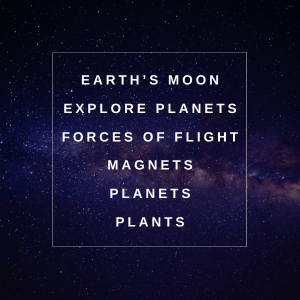
  • Earth’s Moon
  • Explore Planets
  • Forces of Flight
  • Magnets
  • Planets
  • Plants

Educators and learners of all ages are invited to explore these brand new VALUE bundles: https://nasaeclips.arc.nasa.gov/resources/valuebundle. Learn more about NASA eClips and access its varied resources developed for use by K-12 teachers and informal educators at https://nasaeclips.arc.nasa.gov.

NASA eClips is supported by NASA under cooperative agreement award number NNX16AB91A and is part of NASA’s Science Activation Portfolio. Learn more about how Science Activation connects NASA science experts, real content, and experiences with community leaders to do science in ways that activate minds and promote deeper understanding of our world and beyond: https://science.nasa.gov/learn

Dark sky background with list of the new VALUE Bundle themes, Earth’s Moon, Explore Planets, Forces of Flight, Magnets, Planets, and Plants.
New VALUE Bundles were developed for learners of varied needs on six science themes.

Share

Details

Last Updated
Oct 02, 2024
Editor
NASA Science Editorial Team


from NASA https://ift.tt/lWXKf8B

Wednesday, 2 October 2024

NASA’s Webb Reveals Unusual Jets of Volatile Gas from Icy Centaur 29P

7 Min Read

NASA’s Webb Reveals Unusual Jets of Volatile Gas from Icy Centaur 29P

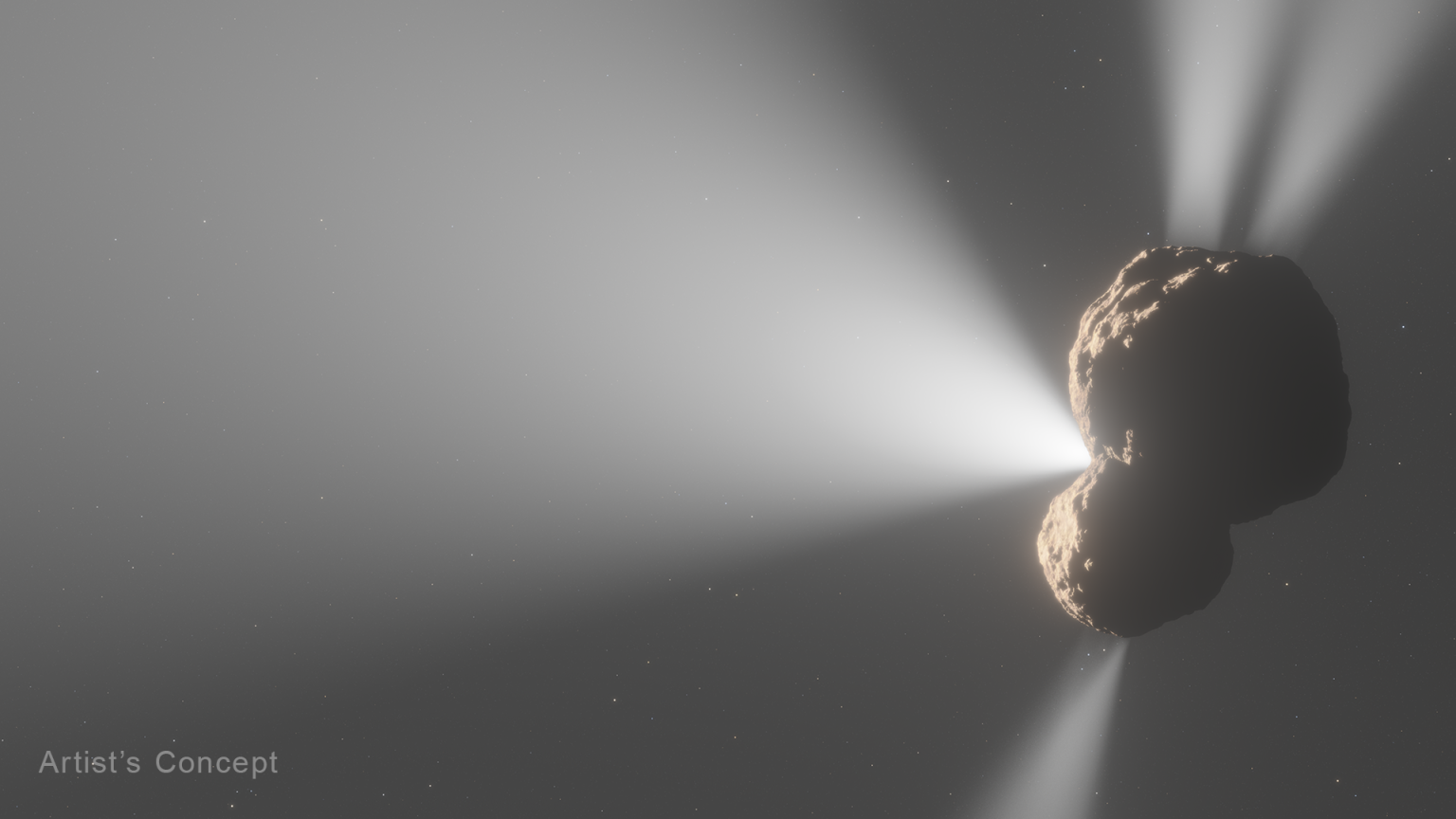
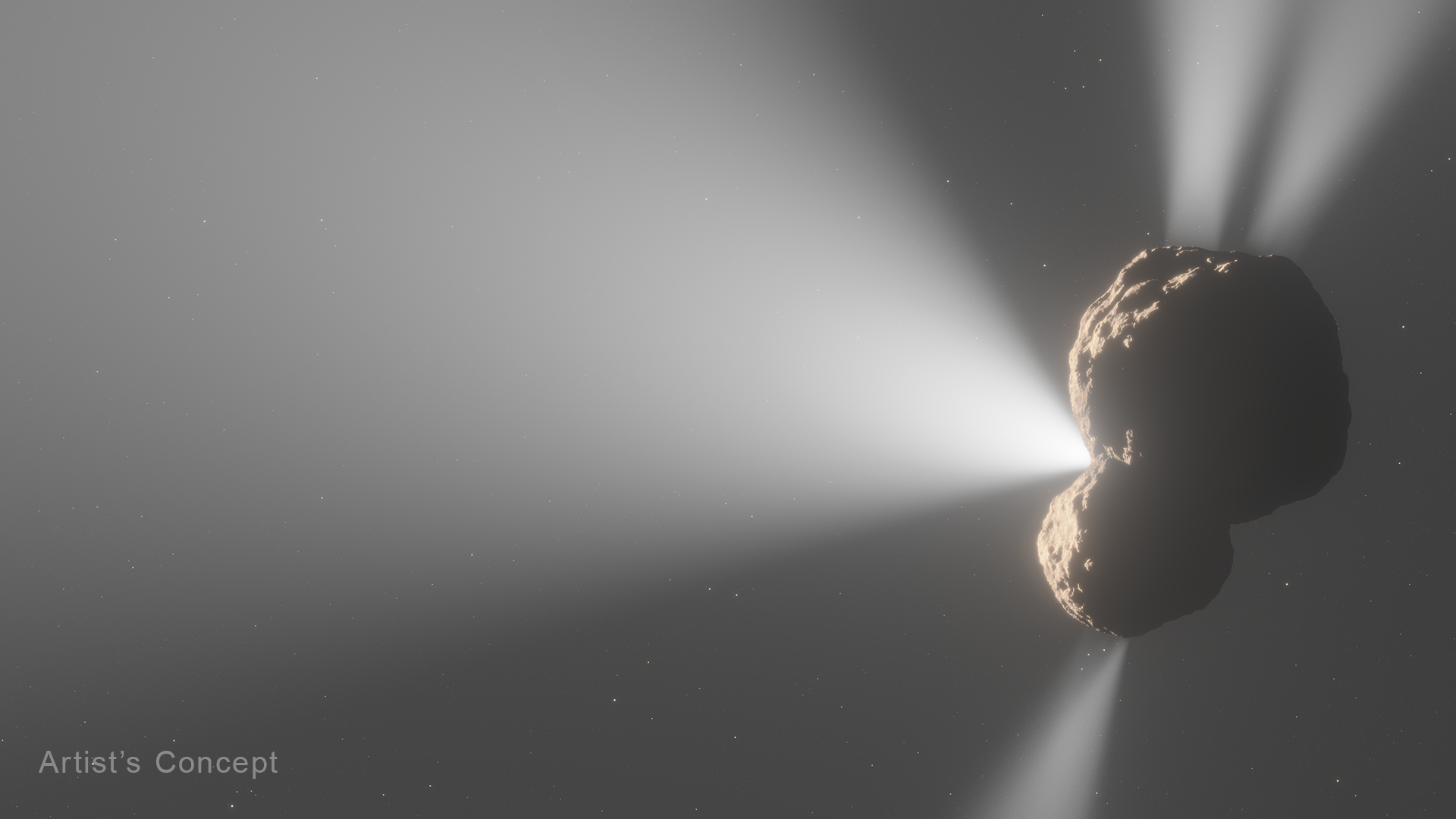
Artist’s concept of Centaur 29P/Schwassmann-Wachmann 1 as seen from the side against a dark, mostly starless swath of space. The rocky, bilobed nucleus is toward the right and resembles the simplified shape of a peanut. The left side of the centaur is partially illuminated by the Sun, which is off-screen, revealing the nucleus’ light brown surface. Four jets of gas, depicted as translucent cones of white, emanate from various points on the Centaur’s surface and extend beyond the frame: two emanate upward from the top, one jet spews from the bottom and extends downward, and one jet emanates from the left side of the nucleus and extends toward the left. A label in the bottom left corner reads “Artist’s Concept.”
An artist’s concept of Centaur 29P/Schwassmann-Wachmann 1’s outgassing activity as seen from the side.
Credits:
NASA, ESA, CSA, L. Hustak (STScI)

Inspired by the half-human, half-horse creatures that are part of Ancient Greek mythology, the field of astronomy has its own kind of centaurs: distant objects orbiting the Sun between Jupiter and Neptune. NASA’s James Webb Space Telescope has mapped the gases spewing from one of these objects, suggesting a varied composition and providing new insights into the formation and evolution of the solar system.

Centaurs are former trans-Neptunian objects that have been moved inside Neptune’s orbit by subtle gravitational influences of the planets in the last few million years, and may eventually become short-period comets. They are “hybrid” in the sense that they are in a transitional stage of their orbital evolution: Many share characteristics with both trans-Neptunian objects (from the cold Kuiper Belt reservoir), and short-period comets, which are objects highly altered by repeated close passages around the Sun.

Image A: Illustration

Artist’s concept of Centaur 29P/Schwassmann-Wachmann 1 as seen from the side against a dark, mostly starless swath of space. The rocky, bilobed nucleus is toward the right and resembles the simplified shape of a peanut. The left side of the centaur is partially illuminated by the Sun, which is off-screen, revealing the nucleus’ light brown surface. Four jets of gas, depicted as translucent cones of white, emanate from various points on the Centaur’s surface and extend beyond the frame: two emanate upward from the top, one jet spews from the bottom and extends downward, and one jet emanates from the left side of the nucleus and extends toward the left. A label in the bottom left corner reads “Artist’s Concept.”
An artist’s concept of Centaur 29P/Schwassmann-Wachmann 1’s outgassing activity as seen from the side. While prior radio-wavelength observations showed a jet of gas pointed toward Earth, astronomers used NASA’s James Webb Space Telescope to gather additional insight on the front jet’s composition and noted three more jets of gas spewing from Centaur 29P’s surface.
NASA, ESA, CSA, L. Hustak (STScI)

Since these small icy bodies are in an orbital transitional phase, they have been the subject of various studies as scientists seek to understand their composition, the reasons behind their outgassing activity — the loss of their ices that lie underneath the surface — and how they serve as a link between primordial icy bodies in the outer solar system and evolved comets.

A team of scientists recently used Webb’s NIRSpec (Near-Infrared Spectrograph) instrument to obtain data on Centaur 29P/Schwassmann-Wachmann 1 (29P for short), an object that is known for its highly active and quasi-periodic outbursts. It varies in intensity every six to eight weeks, making it one of the most active objects in the outer solar system. They discovered a new jet of carbon monoxide (CO) and previously unseen jets of carbon dioxide (CO2) gas, which give new clues to the nature of the centaur’s nucleus.

“Centaurs can be considered as some of the leftovers of our planetary system’s formation. Because they are stored at very cold temperatures, they preserve information about volatiles in the early stages of the solar system,” said Sara Faggi of NASA’s Goddard Space Flight Center in Greenbelt, Maryland, and American University in Washington, DC, lead author of the study. “Webb really opened the door to a resolution and sensitivity that was impressive to us — when we saw the data for the first time, we were excited. We had never seen anything like this.”

Webb and the Jets

Centaurs’ distant orbits and consequent faintness have inhibited detailed observations in the past. Data from prior radio wavelength observations of Centaur 29P showed a jet pointed generally toward the Sun (and Earth) composed of CO. Webb detected this face-on jet and, thanks to its large mirror and infrared capabilities, also sensitively searched for many other chemicals, including water (H2O) and CO2. The latter is one of the main forms in which carbon is stored across the solar system. No indication of water vapor was detected in the atmosphere of 29P, which could be related to the extremely cold temperatures present in this body.

The telescope’s unique imaging and spectral data revealed never-before-seen features: two jets of CO2 emanating in the north and south directions, and another jet of CO pointing toward the north. This was the first definitive detection of CO2 in Centaur 29P.

Image B: IFU Graphic

Graphic titled “Centaur 29P Outgassing: NIRSpec Prism Integral Field Unit” with two maps at the left, and two artist’s concepts with graphic overlays showing jets of CO and C O 2 emanating from the centaur at the right. The top map is labeled “C O 2” and shows two jets of carbon dioxide gas emanating from Centaur 29P toward the north and south, while the bottom map is labeled “C O” and shows one jet of carbon monoxide gas pointing toward the north. On the right is a labeled artist’s concept of Centaur 29P, which includes the two C O 2 jets, one C O jet, and a front jet composed of C O and C O 2. Toward the lower right corner is a side view of the labeled artist’s concept. View description for details.
A team of scientists used NASA’s James Webb Space Telescope’s spectrographic capabilities to gather data on Centaur 29P/Schwassmann-Wachmann 1, one of the most active objects in the outer solar system. The Webb data revealed never-before-seen features: two jets of carbon dioxide spewing in the north and south directions, and a jet of carbon monoxide pointing toward north.
NASA, ESA, CSA, L. Hustak (STScI), S. Faggi (NASA-GSFC, American University)

Based on the data gathered by Webb, the team created a 3D model of the jets to understand their orientation and origin. They found through their modeling efforts that the jets were emitted from different regions on the centaur’s nucleus, even though the nucleus itself cannot be resolved by Webb. The jets’ angles suggest the possibility that the nucleus may be an aggregate of distinct objects with different compositions; however, other scenarios can’t yet be excluded.

Video A: Zoom and Spin

An artist’s concept of Centaur 29P/Schwassmann-Wachmann 1’s outgassing activity as seen from the side. While prior radio-wavelength observations showed a jet of gas pointed toward Earth, astronomers used NASA’s James Webb Space Telescope to gather additional insight on the front jet’s composition and noted three more jets of gas spewing from Centaur 29P’s surface.
Credit: NASA, ESA, CSA, L. Hustak (STScI)

“The fact that Centaur 29P has such dramatic differences in the abundance of CO and CO2 across its surface suggests that 29P may be made of several pieces,” said Geronimo Villanueva, co-author of the study at NASA Goddard. “Maybe two pieces coalesced together and made this centaur, which is a mixture between very different bodies that underwent separate formation pathways. It challenges our ideas about how primordial objects are created and stored in the Kuiper Belt.”

Persisting Unanswered Questions (For Now)

The reasons for Centaur 29P’s bursts in brightness, and the mechanisms behind its outgassing activity through the CO and CO2 jets, continue to be two major areas of interest that require further investigation.

In the case of comets, scientists know that their jets are often driven by the outgassing of water. However, because of the centaurs’ location, they are too cold for water ice to sublimate, meaning that the nature of their outgassing activity differs from comets.

“We only had time to look at this object once, like a snapshot in time,” said Adam McKay, a co-author of the study at Appalachian State University in Boone, North Carolina. “I’d like to go back and look at Centaur 29P over a much longer period of time. Do the jets always have that orientation? Is there perhaps another carbon monoxide jet that turns on at a different point in the rotation period? Looking at these jets over time would give us much better insights into what is driving these outbursts.”

The team is hopeful that as they increase their understanding of Centaur 29P, they can apply the same techniques to other centaurs. By improving the astronomical community’s collective knowledge of centaurs, we can simultaneously better our understanding on the formation and evolution of our solar system.

These findings have been published in Nature.

The observations were taken as part of General Observer program 2416.

The James Webb Space Telescope is the world’s premier space science observatory. Webb is solving mysteries in our solar system, looking beyond to distant worlds around other stars, and probing the mysterious structures and origins of our universe and our place in it. Webb is an international program led by NASA with its partners, ESA (European Space Agency) and CSA (Canadian Space Agency).

Downloads

Right click any image to save it or open a larger version in a new tab/window via the browser’s popup menu.

View/Download all image products at all resolutions for this article from the Space Telescope Science Institute.

View/Download the research results from Nature.

Media Contacts

Laura Betz – laura.e.betz@nasa.gov, Rob Gutro – rob.gutro@nasa.gov
NASA’s Goddard Space Flight Center, Greenbelt, Md.

Abigail Major – amajor@stsci.edu, Christine Pulliam – cpulliam@stsci.edu
Space Telescope Science Institute, Baltimore, Md.

Related Information

Article: More about Solar System studies with Webb

Webb Blog: Chariklo Ring System

Kuiper Belt Facts

More Webb News

More Webb Images

Webb Science Themes

Webb Mission Page

Related For Kids

What is the Webb Telescope?

SpacePlace for Kids

En Español

Ciencia de la NASA

NASA en español 

Space Place para niños


from NASA https://ift.tt/Nh07vFK

October’s Night Sky Notes: Catch Andromeda Rising!

3 Min Read

October’s Night Sky Notes: Catch Andromeda Rising!

Composite image showing a spiral galaxy. The dust and gas is illuminated by bright stars,
Hot stars burn brightly in this new image from NASA’s Galaxy Evolution Explorer, showing the ultraviolet side of a familiar face. At approximately 2.5 million light-years away, the Andromeda galaxy, or M31, is our Milky Way’s largest galactic neighbor.
Credits:
NASA

If you’re thinking of a galaxy, the image in your head is probably the Andromeda Galaxy! Studies of this massive neighboring galaxy, also called M31, have played an incredibly important role in shaping modern astronomy. As a bonus for stargazers, the Andromeda Galaxy is also a beautiful sight.

Sky map highlighting the Cassiopeia, Perseus, Andromeda and Pegasus constellations, with the Andromeda Galaxy circled
Spot the Andromeda Galaxy! M31’s more common name comes from its parent constellation, which becomes prominent as autumn arrives in the Northern Hemisphere. Surprising amounts of detail can be observed with unaided eyes when seen from dark sky sites. Hints of it can even be made out from light polluted areas. Use the Great Square of Pegasus or the Cassiopeia constellation as guides to find it.
Credit: Stellarium Web

Have you heard that all the stars you see at night are part of our Milky Way galaxy? While that is mostly true, one star-like object located near the border between the constellations of Andromeda and Cassiopeia appears fuzzy to unaided eyes. That’s because it’s not a star, but the Andromeda Galaxy, its trillion stars appearing to our eyes as a 3.4 magnitude patch of haze. Why so dim? Distance! It’s outside our galaxy, around 2.5 million light years distant – so far away that the light you see left M31’s stars when our earliest ancestors figured out stone tools. Binoculars show more detail: M31’s bright core stands out, along with a bit of its wispy, saucer-shaped disc. Telescopes bring out greater detail but often can’t view the entire galaxy at once. Depending on the quality of your skies and your magnification, you may be able to make out individual globular clusters, structure, and at least two of its orbiting dwarf galaxies: M110 and M32. Light pollution and thin clouds, smoke, or haze will severely hamper observing fainter detail, as they will for any “faint fuzzy.” Surprisingly, persistent stargazers can still spot M31’s core from areas of moderate light pollution as long as skies are otherwise clear.

Generated version of the Andromeda Galaxy and its companion galaxies M32 and M110.
Stellarium Web

Modern astronomy was greatly shaped by studies of the Andromeda Galaxy. A hundred years ago, the idea that there were other galaxies beside our own was not widely accepted, and so M31 was called the “Andromeda Nebula.” Increasingly detailed observations of M31 caused astronomers to question its place in our universe – was M31 its own “island universe,” and not part of our Milky Way? Harlow Shapley and Heber Curtis engaged in the “Great Debate” of 1920 over its nature. Curtis argued forcefully from his observations of dimmer than expected nova, dust lanes, and other oddities that the “nebula” was in fact an entirely different galaxy from our own. A few years later, Edwin Hubble, building on Henrietta Leavitt’s work on Cepheid variable stars as a “standard candle” for distance measurement, concluded that M31 was indeed another galaxy after he observed Cepheids in photos of Andromeda, and estimated M31’s distance as far outside our galaxy’s boundaries. And so, the Andromeda Nebula became known as the Andromeda Galaxy.

purple-hued illustration of Andromeda galaxy's halo, with background quasars (shown with yellowish dots) scattered throughout
This illustration shows the location of the 43 quasars scientists used to probe Andromeda’s gaseous halo. These quasars—the very distant, brilliant cores of active galaxies powered by black holes—are scattered far behind the halo, allowing scientists to probe multiple regions. Looking through the immense halo at the quasars’ light, the team observed how this light is absorbed by the halo and how that absorption changes in different regions. By tracing the absorption of light coming from the background quasars, scientists are able to probe the halo’s material.
NASA, ESA, and E. Wheatley (STScI)

These discoveries inspire astronomers to this day, who continue to observe M31 and many other galaxies for hints about the nature of our universe. One of the Hubble Space Telescope’s longest-running observing campaigns was a study of M31: the Panchromatic Hubble Andromeda Treasury (PHAT). Dig into NASA’s latest discoveries about the Andromeda Galaxy, on their Messier 31 page.

Originally posted by Dave Prosper: September 2021

Last Updated by Kat Troche: September 2024


from NASA https://ift.tt/0Dto9zb

Tuesday, 1 October 2024

NASA’s Instruments Capture Sharpest Image of Earth’s Radiation Belt

4 min read

NASA’s Instruments Capture Sharpest Image of Earth’s Radiation Belt

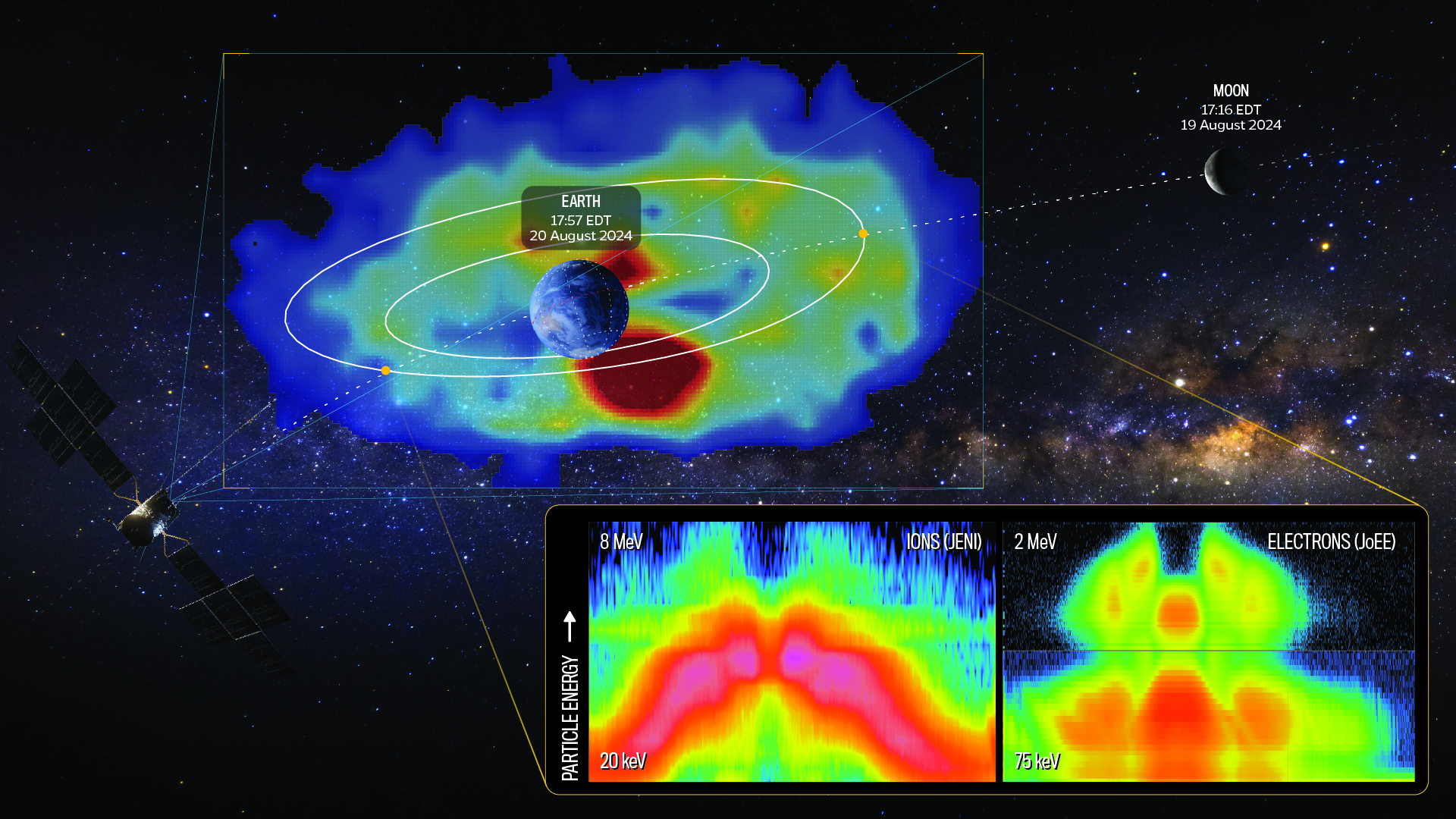
From Aug. 19-20, ESA’s (European Space Agency’s) Juice (Jupiter Icy Moons Explorer) mission made history with a daring lunar-Earth flyby and double gravity assist maneuver, a spaceflight first. As the spacecraft zipped past our Moon and home planet, Juice’s instruments came online for a dry run of what they’ll do when they reach Jupiter. During that time, two of NASA’s onboard instruments added another first to the list: capturing the sharpest-ever image of Earth’s radiation belts – swaths of charged particles trapped in Earth’s magnetic shield, or magnetosphere. 

The Jovian Energetic Neutrals and Ions (JENI) instrument, built and managed by the Johns Hopkins Applied Physics Laboratory (APL) in Laurel, Maryland, on behalf of NASA, took the image as Juice soared away from Earth. What it captured is invisible to the human eye. Unlike traditional cameras that rely on light, JENI uses special sensors to capture energetic neutral atoms emitted by charged particles interacting with the extended atmospheric hydrogen gas surrounding Earth. The JENI instrument is the newest generation of this type of camera, building on the success of a similar instrument on NASA’s Cassini mission that revealed the magnetospheres of Saturn and Jupiter.

An illustration showing the trajectory of ESA’s Juice spacecraft during its lunar-Earth gravity assist, featuring a high-resolution ENA image of the million-degree hot plasma halo encircling Earth captured by NASA’s JENI instrument
An illustration showing the trajectory of ESA’s Juice spacecraft during its lunar-Earth gravity assist, featuring a high-resolution ENA image of the million-degree hot plasma halo encircling Earth captured by NASA’s JENI instrument. The white rings denote equatorial distance of 4 and 6 Earth radii. The inset showcases measurements taken by the NASA’s JENI and JoEE instruments during their passage through the radiation belts, revealing a highly structured energetic ion and electron environment.
Credit: ESA/NASA/Johns Hopkins APL/Josh Diaz

“As soon as we saw the crisp, new images, high fives went around the room,” said Matina Gkioulidou, deputy lead of JENI at APL. “It was clear we had captured the vast ring of hot plasma encircling Earth in unprecedented detail, an achievement that has sparked excitement for what is to come at Jupiter.”

On Aug. 19, JENI and its companion particle instrument Jovian Energetic Electrons (JoEE) made the most of their brief 30-minute encounter with the Moon. As Juice zoomed just 465 miles (750 kilometers) above the lunar surface, the instruments gathered data on the space environment’s interaction with our nearest celestial companion. It’s an interaction scientists expect to see magnified at Jupiter’s moons, as the gas giant’s radiation-rich magnetosphere barrels over them. 

On Aug. 20, Juice hurled into Earth’s magnetosphere, passing some 37,000 miles (60,000 km) above the Pacific Ocean, where the instruments got their first taste of the harsh environment that awaits at Jupiter. Racing through the magnetotail, JoEE and JENI encountered the dense, lower-energy plasma characteristic of this region before plunging into the heart of the radiation belts. There, the instruments measured the million-degree plasma encircling Earth to investigate the secrets of plasma heating that are known to fuel dramatic phenomena in planetary magnetospheres. 

“I couldn’t have hoped for a better flyby,” said Pontus Brandt, principal investigator of JoEE and JENI at APL. “The richness of the data from our deep-dive through the magnetosphere is astounding. JENI’s image of the entire system we just flew through was the cherry on top. It’s a powerful combination we will exploit in the Jovian system.”

Now after using the Moon’s and Earth’s gravity, Juice’s trajectory has been successfully adjusted for a future encounter with Venus in August 2025. That Venus flyby will serve as a gravitational slingshot, propelling Juice back toward Earth and priming it for two additional flybys in September 2026 and January 2029. Only then will the spacecraft, now boosted into high gear, make its grand arrival at Jupiter in July 2031.

The Johns Hopkins Applied Physics Laboratory, in Laurel, Maryland, manages the JoEE and JENI instruments, which together make up the Particle Environment Package (PEP-Hi) instrument suite, for NASA on ESA’s Juice mission. The JoEE and JENI instruments are part of the Solar System Exploration Program, managed at NASA’s Marshall Space Flight Center for the agency’s Science Mission Directorate in Washington. 

For more information on NASA’s involvement with ESA’s Juice mission, visit:

https://science.nasa.gov/mission/juice/

Keep Exploring

Discover More Topics From NASA


from NASA https://ift.tt/rQeVGzD

NASA Invites Media to Preview its Museum Earth Information Center

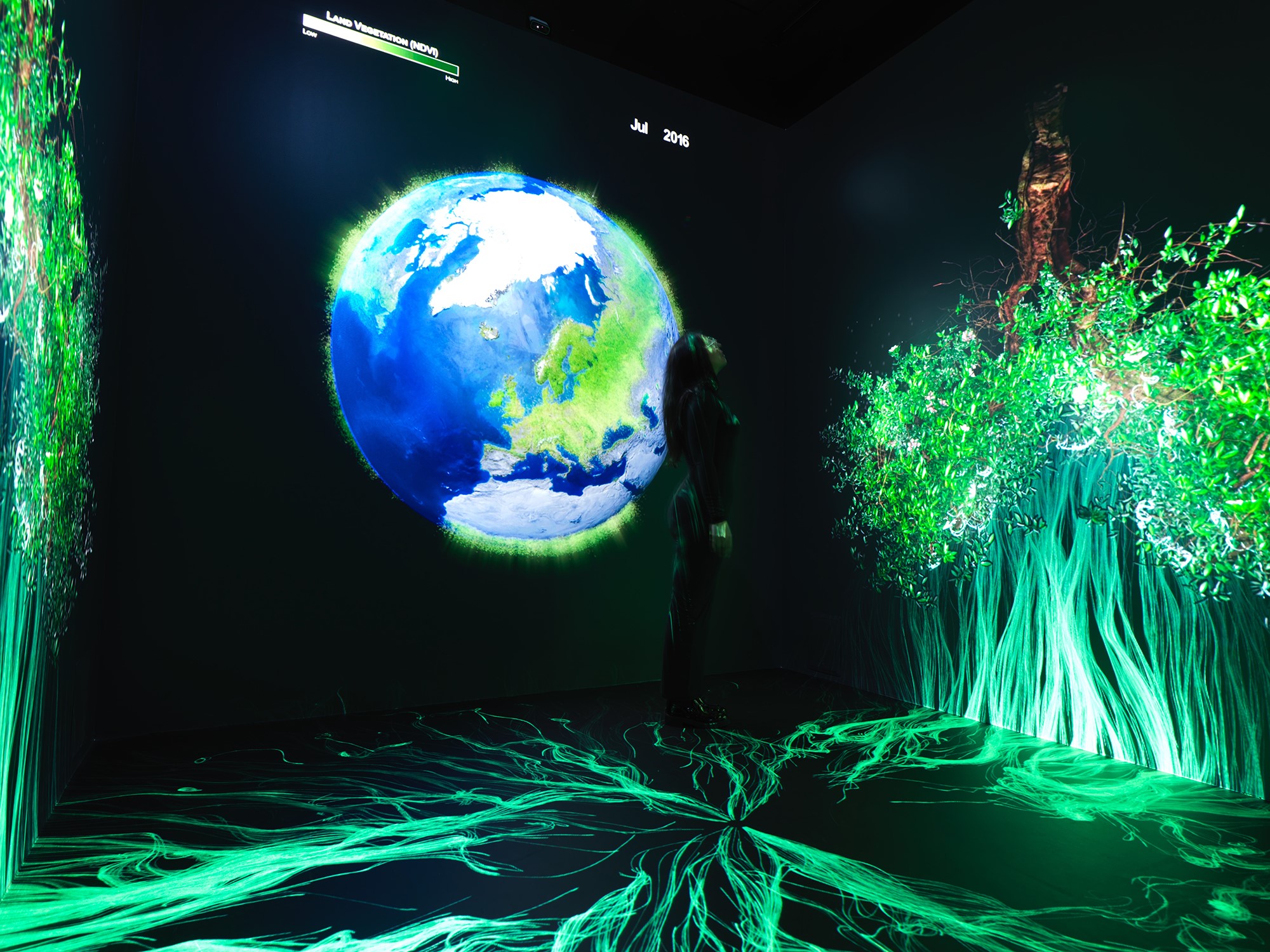
A person stands in a dark room surrounded by images of green leaves and a large depiction of the Earth.
Space for Earth is an immersive experience that is part of the Earth Information Center.
Credit: NASA

Media is invited to preview and interview NASA leadership ahead of the opening of the Earth Information Center at the Smithsonian National Museum of Natural History at 10 a.m. EDT, Monday, Oct. 7.

The 2,000-square-foot exhibit includes a 32-foot-long, 12-foot-high video wall displaying Earth science data visualizations and videos, an interpretive panel showing Earth’s connected systems, information on our changing world, and an overview of how NASA and the Smithsonian study our home planet. Visitors also can explore Earth observing missions, changes in Earth’s landscape over time, and how climate is expected to change regionally through multiple interactive experiences.

The event will take place at the Smithsonian National Museum of Natural History 1000 Constitution Ave. NW, Washington from 10 a.m. to 3 p.m. Members of the media interested in attending should email Liz Vlock at: elizabeth.a.vlock@nasa.gov. NASA’s media accreditation policy is available online.

Participants will be available for media interviews starting at the following times:

  • 10 a.m.: NASA Administrator Bill Nelson
  • 10 a.m.: Kirk Johnson, Sant director, Museum of Natural History
  • 10:30 a.m.: Karen St. Germain, division director, NASA Earth Sciences Division
  • 10:30 a.m.: Julie Robinson, deputy director, NASA Earth Sciences Division  

The Earth Information Center draws insights from across all NASA centers and its fellow partners – National Oceanic and Atmospheric Administration, U.S. Geological Survey, U.S. Department of Agriculture, U.S. Agency for International Development, Environmental Protection Agency, and Federal Emergency Management Administration. It allows viewers to see how our home planet is changing and gives decision makers information to develop the tools they need to mitigate, adapt, and respond to climate change.

NASA’s Earth Information Center is a virtual and physical space designed to aid people to make informed decisions on Earth’s environment and climate. It provides easily accessible, readily usable, and scalable Earth information – enabling global understanding of our changing planet. 

The expansion of the physical Earth Information Center at the Smithsonian National Museum of Natural History Museum makes it the second location in the Washington area. The first is located at NASA Headquarters in Washington at 300 E St., SW.

To learn more about the Earth Information Center visit:

https://earth.gov

-end-

Elizabeth Vlock
Headquarters, Washington
202-358-1600
elizabeth.a.vlock@nasa.gov

Share

Details

Last Updated
Sep 30, 2024


from NASA https://ift.tt/pMjFXbB

NASA Seeks Innovators for Lunar Waste Competition 

4 min read

Preparations for Next Moonwalk Simulations Underway (and Underwater)

By Savannah Bullard 

A new NASA competition, the LunaRecycle Challenge, is open and offering $3 million in prizes for innovations in recycling material waste on deep space missions. 

As NASA continues efforts toward long-duration human space travel, including building a sustained human presence on the Moon through its Artemis missions, the agency needs novel solutions for processing inorganic waste streams like food packaging, discarded clothing, and science experiment materials. While previous efforts focused on the reduction of trash mass and volume, this challenge will prioritize technologies for recycling waste into usable products needed for off-planet science and exploration activities.  

NASA’s LunaRecycle Challenge will incentivize the design and development of energy-efficient, low-mass, and low-impact recycling solutions that address physical waste streams and improve the sustainability of longer-duration lunar missions. Through the power of open innovation, which draws on the public’s ingenuity and creativity to find solutions, NASA can restructure the agency’s approach to waste management, support the future of space travel, and revolutionize waste treatments on Earth, leading to greater sustainability on our home planet and beyond. 

“Operating sustainably is an important consideration for NASA as we make discoveries and conduct research both away from home and on Earth,” said Amy Kaminski, program executive for NASA’s Prizes, Challenges, and Crowdsourcing program. “With this challenge, we are seeking the public’s innovative approaches to waste management on the Moon and aim to take lessons learned back to Earth for the benefit of all.” 

NASA’s LunaRecycle Challenge will offer two competition tracks: a Prototype Build track and a Digital Twin track. The Prototype Build Track focuses on designing and developing hardware components and systems for recycling one or more solid waste streams on the lunar surface. The Digital Twin Track focuses on designing a virtual replica of a complete system for recycling solid waste streams on the lunar surface and manufacturing end products. Offering a Digital Twin track further lowers the barrier of entry for global solvers to participate in NASA Centennial Challenges and contribute to agency missions and initiatives.  

Teams will have the opportunity to compete in either or both competition tracks, each of which will carry its own share of the prize purse. 

The LunaRecycle Challenge also will address some of the aerospace community’s top technical challenges. In July 2024, NASA’s Space Technology Mission Directorate released a ranked list of 187 technology areas requiring further development to meet future exploration, science, and other mission needs. The results integrated inputs from NASA mission directorates and centers, industry organizations, government agencies, academia, and other interested individuals to help guide NASA’s space technology development and investments. This list and subsequent updates will help inform future Centennial Challenges.  

The three technological needs that LunaRecycle will address include logistics tracking, clothing, and trash management for habitation; in-space and on-surface manufacturing of parts and products; and in-space and on-surface manufacturing from recycled and reused materials. 

“I am pleased that NASA’s LunaRecycle Challenge will contribute to solutions pertaining to technological needs within advanced manufacturing and habitats,” said Kim Krome,  acting program manager for agency’s Centennial Challenges, and challenge manager of LunaRecycle. “We are very excited to see what solutions our global competitors generate, and we are eager for this challenge to serve as a positive catalyst for bringing the agency, and humanity, closer to exploring worlds beyond our own.” 

NASA has contracted The University of Alabama to be the allied partner for the duration of the challenge. The university, based in Tuscaloosa, Alabama, will coordinate with former Centennial Challenge winner AI Spacefactory to facilitate the challenge and manage its competitors.  

To register as a participant in NASA’s LunaRecycle Challenge, visit: lunarecyclechallenge.ua.edu. 

NASA’s LunaRecycle Challenge is led by the agency’s Kennedy Space Center in Merritt Island, Florida, with support from Marshall Space Flight Center in Huntsville, Alabama. The competition is a NASA’s Centennial Challenge, based at NASA Marshall. Centennial Challenges are part of NASA’s Prizes, Challenges, and Crowdsourcing program within the agency’s Space Technology Mission Directorate.  

For more information on LunaRecycle, visit: 

Jasmine Hopkins 
Headquarters, Washington 
321-432-4624 
jasmine.s.hopkins@nasa.gov  

Lane Figueroa 
Marshall Space Flight Center, Huntsville, Ala. 
256-544-0034 
lane.e.figueroa@nasa.gov   

Share

Details

Last Updated
Sep 30, 2024
Editor
Beth Ridgeway


from NASA https://ift.tt/wBsofzL

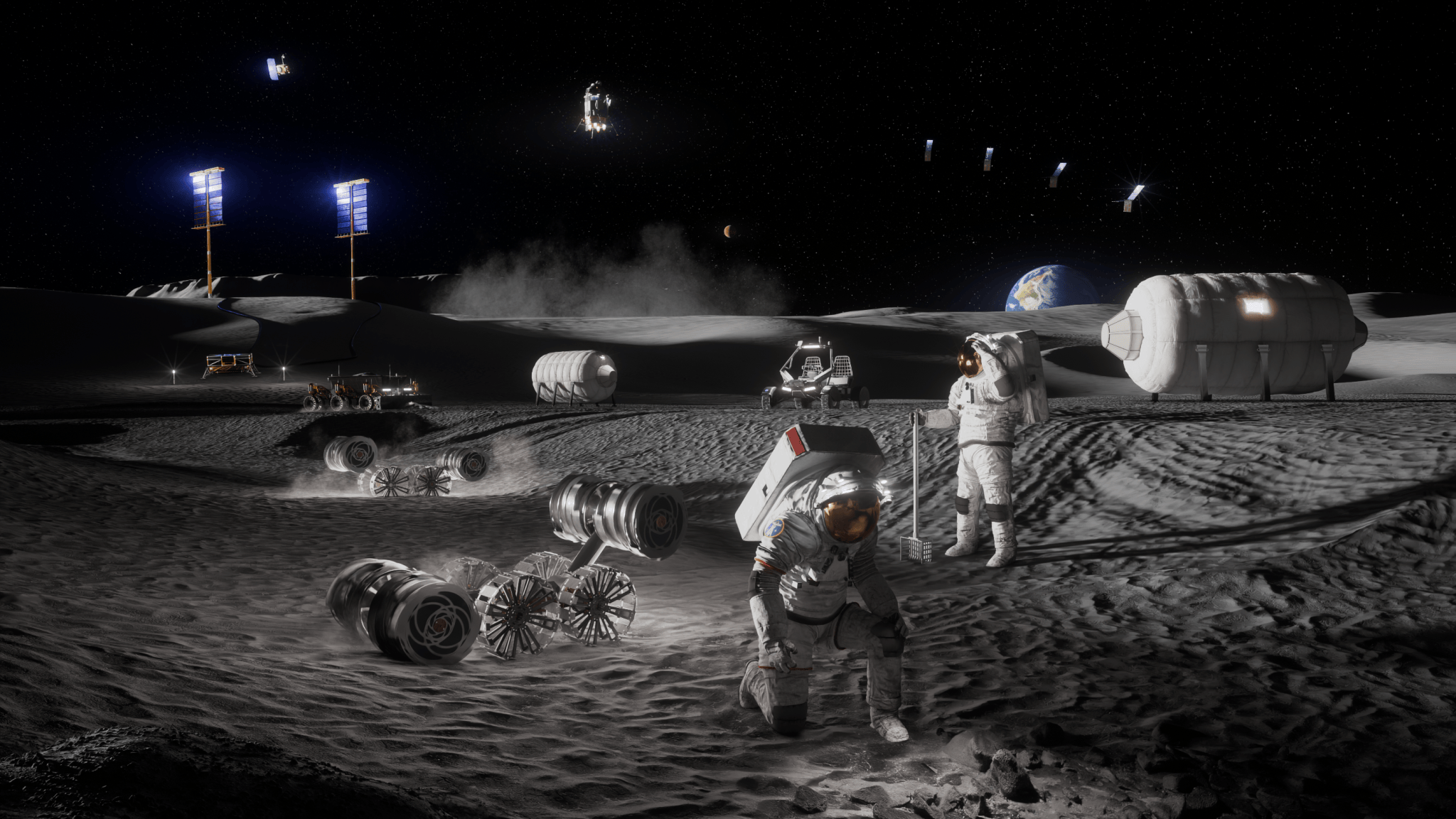
NASA Announces $1 Million to Students for Moon Base Challenge

Artist’s concept depicting astronauts, habitats, rovers, power systems, and cargo operations supporting sustained human activities at the Mo...