Monday, 9 September 2024

NASA’s Hubble, Chandra Find Supermassive Black Hole Duo

5 min read

NASA’s Hubble, Chandra Find Supermassive Black Hole Duo
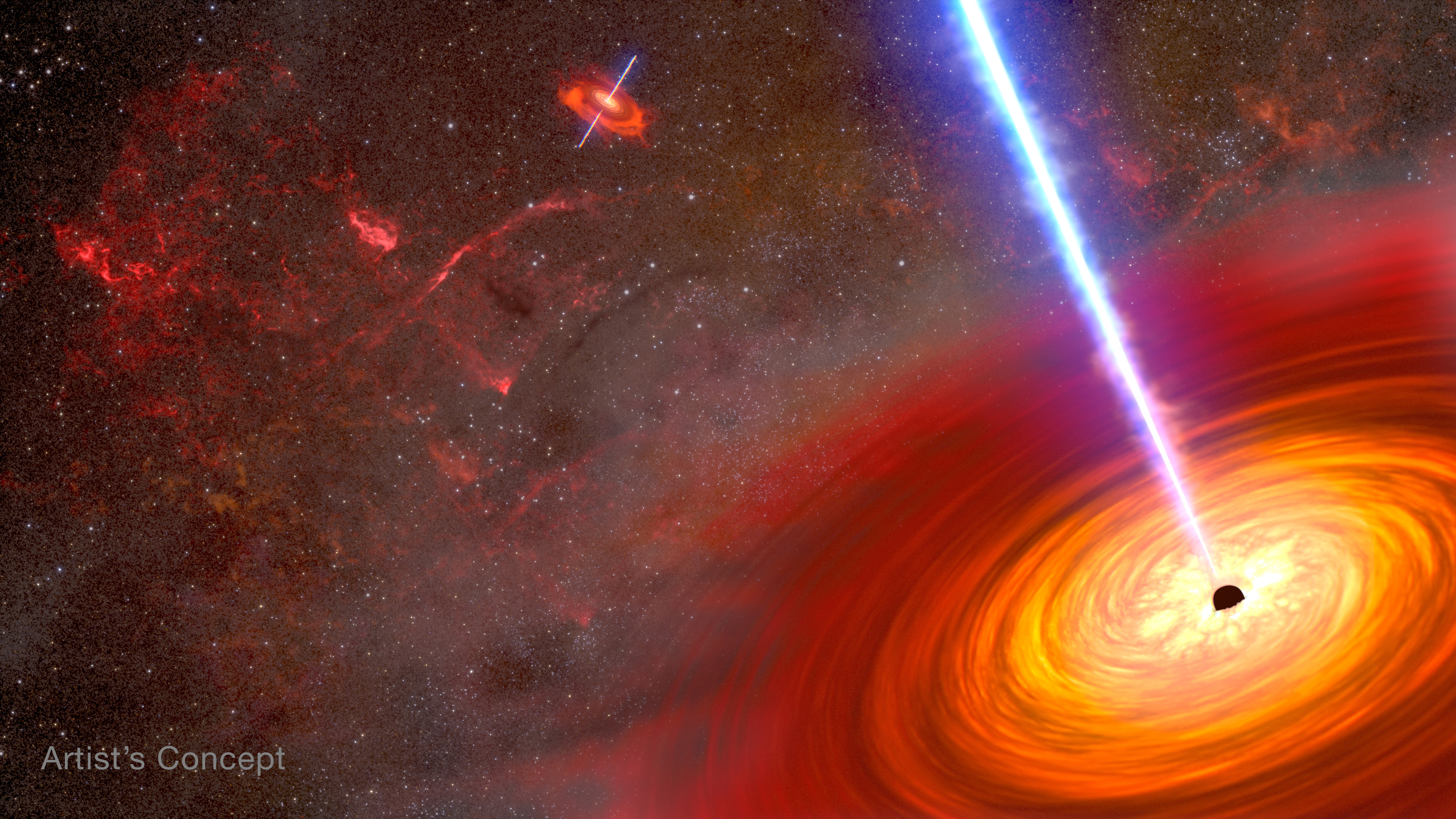
Artist's depiction of a pair of active black holes at the heart of two merging galaxies. One distant black hole is at upper left, and a foreground black hole is at lower right.
This is an artist’s depiction of a pair of active black holes at the heart of two merging galaxies. They are both surrounded by an accretion disk of hot gas. Some of the material is ejected along the spin axis of each black hole. Confined by powerful magnetic fields, the jets blaze across space at nearly the speed of light as devastating beams of energy.
NASA, ESA, Joseph Olmsted (STScI)

Like two Sumo wrestlers squaring off, the closest confirmed pair of supermassive black holes have been observed in tight proximity. These are located approximately 300 light-years apart and were detected using NASA’s Hubble Space Telescope and the Chandra X-ray Observatory. These black holes, buried deep within a pair of colliding galaxies, are fueled by infalling gas and dust, causing them to shine brightly as active galactic nuclei (AGN).

This AGN pair is the closest one detected in the local universe using multiwavelength (visible and X-ray light) observations. While several dozen “dual” black holes have been found before, their separations are typically much greater than what was discovered in the gas-rich galaxy MCG-03-34-64. Astronomers using radio telescopes have observed one pair of binary black holes in even closer proximity than in MCG-03-34-64, but without confirmation in other wavelengths.

AGN binaries like this were likely more common in the early universe when galaxy mergers were more frequent. This discovery provides a unique close-up look at a nearby example, located about 800 million light-years away.
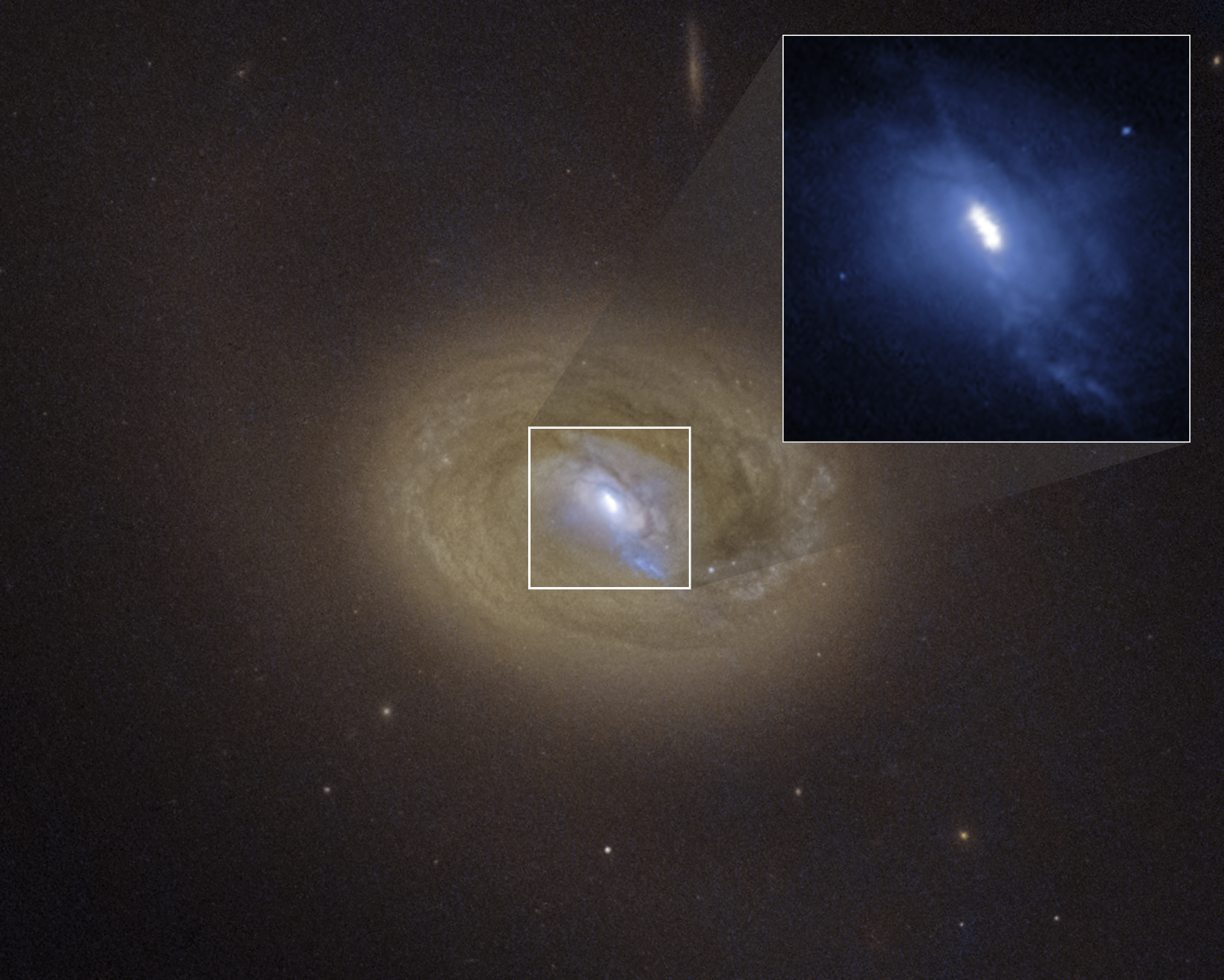
A Hubble Space Telescope visible-light image of the galaxy MCG-03-34-064 that appears as an orange spiral. It has a blue center (expanded in an inset image at upper right) with three bright spots embedded in a white ellipse at the galaxy's center. Two of these bright spots are the source of strong X-ray emission, a telltale sign that they are supermassive black holes converting matter to energy.
A Hubble Space Telescope visible-light image of the galaxy MCG-03-34-064. Hubble’s sharp view reveals three distinct bright spots embedded in a white ellipse at the galaxy’s center (expanded in an inset image at upper right). Two of these bright spots are the source of strong X-ray emission, a telltale sign that they are supermassive black holes. The black holes shine brightly because they are converting infalling matter into energy, and blaze across space as active galactic nuclei. Their separation is about 300 light-years. The third spot is a blob of bright gas. The blue streak pointing to the 5 o’clock position may be a jet fired from one of the black holes. The black hole pair is a result of a merger between two galaxies that will eventually collide.
NASA, ESA, Anna Trindade Falcão (CfA); Image Processing: Joseph DePasquale (STScI)

The discovery was serendipitous. Hubble’s high-resolution imaging revealed three optical diffraction spikes nested inside the host galaxy, indicating a large concentration of glowing oxygen gas within a very small area. “We were not expecting to see something like this,” said Anna Trindade Falcão of the Center for Astrophysics | Harvard & Smithsonian in Cambridge, Massachusetts, lead author of the paper published today in The Astrophysical Journal. “This view is not a common occurrence in the nearby universe, and told us there’s something else going on inside the galaxy.”

Diffraction spikes are imaging artifacts caused when light from a very small region in space bends around the mirror inside telescopes.

Falcão’s team then examined the same galaxy in X-rays light using the Chandra observatory to drill into what’s going on. “When we looked at MCG-03-34-64 in the X-ray band, we saw two separated, powerful sources of high-energy emission coincident with the bright optical points of light seen with Hubble. We put these pieces together and concluded that we were likely looking at two closely spaced supermassive black holes,” said Falcão.

In a surprise finding, astronomers, using NASA’s Hubble Space Telescope have discovered that the jet from a supermassive black hole at the core of M87, a huge galaxy 54 million light years away, seems to cause stars to erupt along its trajectory. The stars, called novae, are not caught inside the jet, but in a dangerous area near it.
NASA’s Goddard Space Flight Center; Lead Producer: Paul Morris

To support their interpretation, the researchers used archival radio data from the Karl G. Jansky Very Large Array near Socorro, New Mexico. The energetic black hole duo also emits powerful radio waves. “When you see bright light in optical, X-rays, and radio wavelengths, a lot of things can be ruled out, leaving the conclusion these can only be explained as close black holes. When you put all the pieces together it gives you the picture of the AGN duo,” said Falcão.

The third source of bright light seen by Hubble is of unknown origin, and more data is needed to understand it. That might be gas that is shocked by energy from a jet of ultra high-speed plasma fired from one of the black holes, like a stream of water from a garden hose blasting into a pile of sand.

“We wouldn’t be able to see all of these intricacies without Hubble’s amazing resolution,” said Falcão.

The two supermassive black holes were once at the core of their respective host galaxies. A merger between the galaxies brought the black holes into close proximity. They will continue to spiral closer together until they eventually merge — in perhaps 100 million years — rattling the fabric of space and time as gravitational waves.

The National Science Foundation’s Laser Interferometer Gravitational-Wave Observatory (LIGO) has detected gravitational waves from dozens of mergers between stellar-mass black holes. But the longer wavelengths resulting from a supermassive black hole merger are beyond LIGO’s capabilities. The next-generation gravitational wave detector, called the LISA (Laser Interferometer Space Antenna) mission, will consist of three detectors in space, separated by millions of miles, to capture these longer wavelength gravitational waves from deep space. ESA (European Space Agency) is leading this mission, partnering with NASA and other participating institutions, with a planned launch in the mid-2030s.

NASA’s Marshall Space Flight Center manages the Chandra program. The Smithsonian Astrophysical Observatory’s Chandra X-ray Center controls science from Cambridge, Massachusetts and flight operations from Burlington, Massachusetts. Northrop Grumman Space Technologies in Redondo Beach, California was the prime contractor for the spacecraft.

The Hubble Space Telescope has been operating for over three decades and continues to make ground-breaking discoveries that shape our fundamental understanding of the universe. Hubble is a project of international cooperation between NASA and ESA (European Space Agency). NASA’s Goddard Space Flight Center in Greenbelt, Maryland, manages the telescope and mission operations. Lockheed Martin Space, based in Denver, Colorado, also supports mission operations at Goddard. The Space Telescope Science Institute in Baltimore, Maryland, which is operated by the Association of Universities for Research in Astronomy, conducts Hubble science operations for NASA.

Media Contacts:

Claire Andreoli
NASA’s Goddard Space Flight Center, Greenbelt, MD
claire.andreoli@nasa.gov

Ray Villard
Space Telescope Science Institute, Baltimore, MD

Science Contact:

Anna Trindade Falcão
Center for Astrophysics | Harvard & Smithsonian, Cambridge, MA


from NASA https://ift.tt/sNMLfzJ

NASA Science for Your Classroom: Opportunities for Educators

4 min read

NASA Science for Your Classroom: Opportunities for Educators

The summer season for educators can be a time of rest and rejuvenation, but it can also offer opportunities for professional learning with new colleagues beyond your own school. The following programs from NASA’s Science Activation Program offer end-of-summer/early-fall curricular resources and connections with other educators that can help you bring new science ideas and activities into your instructional practice.  

Celebrating the Moon & Moon Rocks with NASA – A Webinar for Educators

Join us, as the world awaits this year’s International Observe the Moon Night (InOMN on September 14, 2024), for this free NASA Astromaterials Research and Exploration Science (ARES) interactive webinar focusing on the Moon, Moon rocks, Apollo and future Artemis Missions! This session will be geared towards educators and their students (targeting grades 5-9 but other grade levels, college students, and individual educators are welcome to participate). Participants will interact with Dr. Juliane Gross, Artemis Curation Lead at the NASA Johnson Space Center in Houston, TX. The presentation will last approximately 45 minutes followed by an optional 15-30 minutes of Q&A. If you can’t participate live, feel free to register to receive an archived recording of the presentation. 

Infusing Space Rock Content and More into Learning Environments

Join NASA Astromaterials Research and Exploration Science for an interactive webinar focusing on hands-on and digital Earth and Space Science resources appropriate for both formal and informal learning settings. This session, geared towards educators who work with grades 3 through HS or general audiences at public events, will prepare you to engage learners with content associated with Moon rocks, meteorites, samples from asteroids and more! Presentation will last approximately 50 minutes followed by an optional 10+ minutes of Q&A. Those who register below will receive an archived recording of the presentation. 

Spark Curiosity with Infiniscope’s Free Resources!

Infiniscope is a NASA-funded project focused on sparking curiosity, fostering exploration, and delivering digital content and tools that transform the learning experience. NGSS-Designed digital learning experiences are just the beginning. Whether you want classroom-ready content or the tools and support to build your own, we’ve got you covered. 

If you’re a middle school or highschool educator, join the webinars below and discover the incredible FREE resources waiting for you at Infiniscope.org. In this guided tour, you’ll learn how to: search for classroom-ready content on the website, find educator resources and detailed lesson information, enroll students in lessons and collections, sign up for future training events, access the virtual field trip creator, and get more information on our adaptive lesson builder. Learn more about Infiniscope.

  • Intro to Infiniscope Registration – September 17 at 4 p.m. EDT
  • Intro to Infiniscope Registration – October 22  at 6 p.m. EDT

Take Your Learners Anywhere with Tour It!

With Tour It, Infiniscope’s free virtual field trip creator, you can make place-based learning accessible to all your learners, boosting engagement and learning outcomes while enabling them to build personal connections. Tour It is your gateway to creating captivating virtual field trips! As a member of the Infiniscope teaching network, you’ll have exclusive access to this amazing tool that brings immersive learning experiences to life. Whether you’re a seasoned educator or just starting your journey, Tour It empowers you to craft engaging and interactive virtual tours that inspire learners and enable them to build personal connections to a place. Learn more about Tour it.

Heliophysics Webinars for Educators: Physics in an Astronomy Context

NASA’s Heliophysics Education Activation Team (HEAT) and the American Association of Physics Teachers (AAPT) have put together a free, monthly, virtual workshop series for teachers of astrophysics taught in the context of introductory and upper division physics and astronomy courses. While these workshops are intended for secondary- and tertiary-level teachers who teach in formal classroom contexts, other educators are also welcome if the content covered is appropriate to your teaching context. 

These virtual gatherings of 25-50 teachers occur one Saturday per month and provide an astrophysics mini-lecture, a small group engagement with the core activity, and discussion time to connect with like-minded educators. 

Dates and Topics: 

  • September, 21, 2024 – Coronal Mass Ejection Science
  • October 12, 2024 – Planetary Magnetism Science
  • November 9, 2024 – Auroral Currents
  • December 7, 2024 – Star Spectra Science

Time: 1 – 2:30 p.m. EDT

Register here 

We hope these resources will help prepare you for a wonderful year of amazing science learning… and beyond!

Share

Details

Last Updated
Sep 09, 2024


from NASA https://ift.tt/jqMHAxs

Saturday, 7 September 2024

NASA Selects Companies for Commercial SmallSat Services Award

The letters NASA on a blue circle with red and white detail, all surrounded by a black background
Credit: NASA

NASA has selected eight companies for a new award to help acquire Earth observation data and provide related services for the agency.

The Commercial SmallSat Data Acquisition Program On-Ramp1 Multiple Award contract is a firm-fixed-price indefinite-delivery/indefinite-quantity multiple-award contract with a maximum value of $476 million, cumulatively amongst all the selected contractors, and a performance period through Nov. 15, 2028.

The selectees are:

  • BlackSky Geospatial Solutions, Inc. in Herndon, Virginia
  • ICEYE US Inc. in Irvine, California
  • MDA Geospatial Service Inc. in Richmond, British Columbia, Canada
  • Pixxel Space Technologies, Inc in El Segundo, California
  • Planet Labs Federal, Inc. in Arlington, Virginia
  • Satellogic Federal, LLC in Davidson, North Carolina
  • Teledyne Brown Engineering, Inc. in Huntsville, Alabama
  • The Tomorrow Companies Inc. in Boston

Under the contract, the recipients will be responsible for acquiring observation data from commercial sources that support NASA’s Earth science research and application activities that help improve life on the planet. The goal of the awards is to give NASA a cost-effective way to augment or complement the Earth observations acquired by the agency and other U.S. government and international agencies for the benefit of all.

For information about NASA and agency programs, visit:

https://www.nasa.gov

-end-

Tiernan Doyle
Headquarters, Washington
202-358-1600
tiernan.doyle@nasa.gov


from NASA https://ift.tt/SRqXBs6

NASA Scientific Balloon Takes Flight With Student-Built Payloads

2 min read

Preparations for Next Moonwalk Simulations Underway (and Underwater)

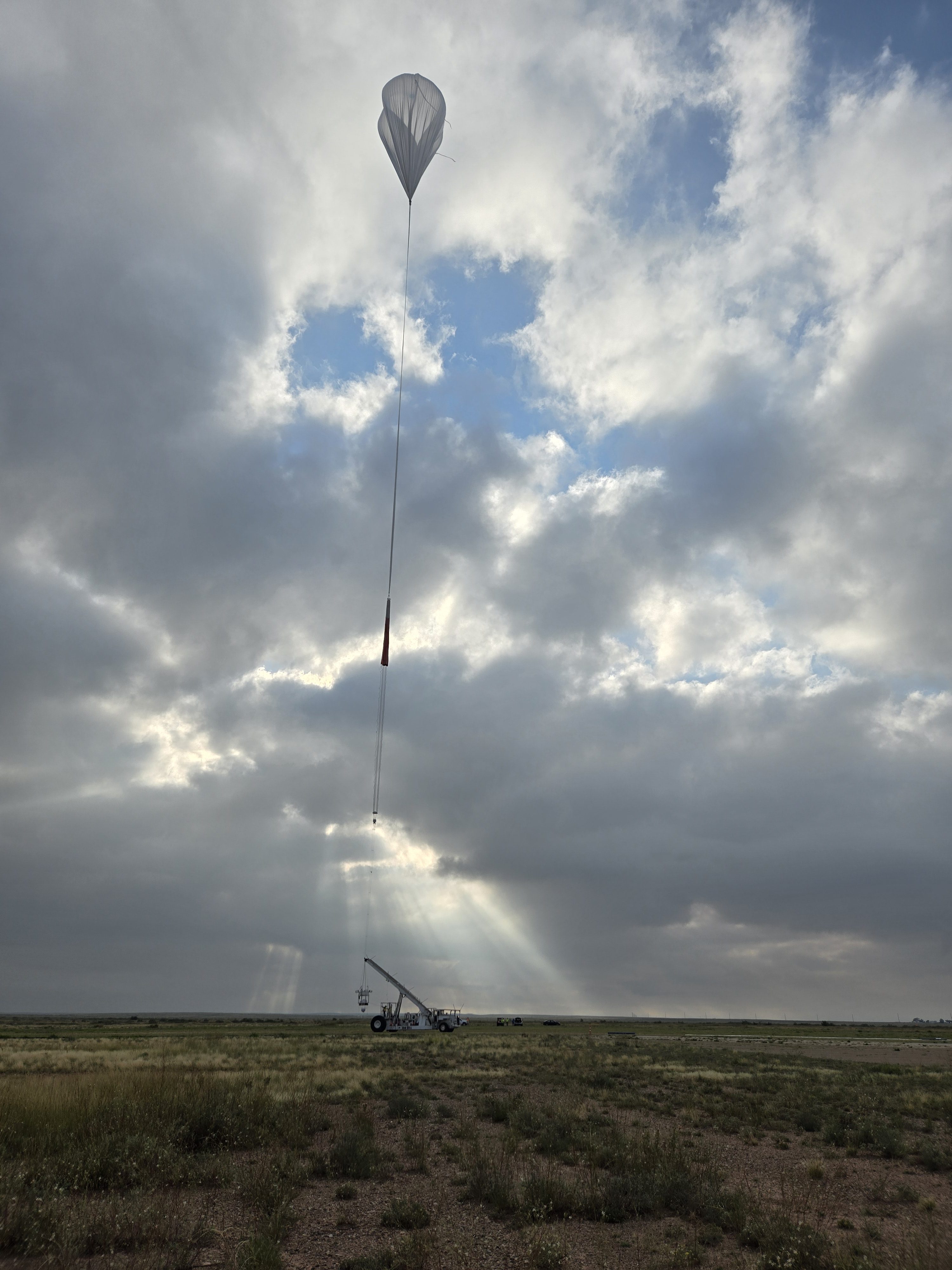
A NASA balloon lifts off connected to HASP payload attached to a launch vehicle. The Sun peeks through clouds, shining on the gondola.
The HASP 1.0 (High-Altitude Student Platform) scientific balloon mission launched Sept. 4, 2024, during NASA’s fall balloon campaign in Fort Sumner, N.M.
NASA/Erin Reed

NASA’s Scientific Balloon Program’s fifth balloon mission of the 2024 fall campaign took flight Wednesday, Sept. 4, 2024, from the agency’s Columbia Scientific Balloon Facility in Fort Sumner, New Mexico. The HASP 1.0 (High-Altitude Student Platform) mission remained in flight over 11 hours before it safely touched down. Recovery is underway.

HASP is a partnership among the Louisiana Space Grant Consortium, the Astrophysics Division of NASA’s Science Mission Directorate, and the agency’s Balloon Program Office and Columbia Scientific Balloon Facility. The HASP platform supports up to 12 student-built payloads and is designed to flight test compact satellites, prototypes, and other small experiments. Since 2006, HASP has engaged more than 1,600 undergraduate and graduate students involved in the missions.

Teams participating in the 2024 HASP 1.0 flight included: University of North Florida and University of North Dakota; Arizona State University; Louisiana State University; University of Colorado Boulder; College of the Canyons; Fort Lewis College; Capitol Technical College; University of Arizona; Universidad Nacional de Ingeniería (Peru); and McMaster University (Canada).

A new, larger version of the High-Altitude Student Platform (HASP 2.0) had its engineering test flight a few days prior. HASP 2.0 will be able to accommodate twice as many student experiments as HASP 1.0 once operational in the next year.

The remaining three balloon flights scheduled for the 2024 Fort Sumner fall campaign await next launch opportunities. To follow the missions, visit NASA’s Columbia Scientific Balloon Facility website for real-time updates on balloons altitudes and GPS locations during flight.

For more information on NASA’s Scientific Balloon Program, visit:

https://www.nasa.gov/scientificballoons

Share

Details

Last Updated
Sep 06, 2024
Editor
Olivia F. Littleton
Contact
Olivia F. Littleton


from NASA https://ift.tt/3z2C6yo

NASA Sets Coverage for Crew Launch; Trio to Join Expedition 71

A portrait image of a NASA astronaut and two Roscosmos cosmonauts sitting in front of the flags of the United States and Russia against a black backdrop.
The Roscosmos Soyuz MS-26 spacecraft will launch from the Baikonur Cosmodrome in Kazakhstan to the International Space Station with (pictured left to right) NASA astronaut Don Pettit and Roscosmos cosmonauts Alexey Ovchinin and Ivan Vagner.
Credit: Gagarin Cosmonaut Training Center

NASA astronaut Don Pettit will launch aboard the Roscosmos Soyuz MS-26 spacecraft, accompanied by cosmonauts Alexey Ovchinin and Ivan Vagner, to the International Space Station where they will join the Expedition 71 crew in advancing scientific research.

Pettit, Ovchinin, and Vagner will lift off at 12:23 p.m. EDT Wednesday, Sept. 11 (9:23 p.m. Baikonur time) from the Baikonur Cosmodrome in Kazakhstan.

Coverage will stream on NASA+, the NASA app, and the agency’s website. Learn how to stream NASA content through a variety of platforms including social media.

After a two-orbit, three-hour trajectory to the station, the spacecraft will automatically dock at 3:33 p.m. at the orbiting laboratory’s Rassvet module. Shortly after, hatches will open between the spacecraft and the station.

Once aboard, the trio will join NASA astronauts Tracy C. Dyson, Mike Barratt, Matthew Dominick, Jeanette Epps, Butch Wilmore, and Suni Williams, as well as Roscosmos cosmonauts Nikolai Chub, Alexander Grebenkin, and Oleg Kononenko.

NASA’s coverage is as follows (all times Eastern and subject to change based on real-time operations):

11:15 a.m. – Launch coverage begins on NASA+, the NASA app, YouTube, and the agency’s website.

12:23 p.m. – Launch

2:30 p.m. – Rendezvous and docking coverage begins on NASA+, the NASA app, YouTube, and the agency’s website.

3:33 p.m. – Docking

5:30 p.m. – Hatch opening and welcome remarks coverage begins on NASA+, the NASA app, YouTube, and the agency’s website.

5:50 p.m. – Hatch opening

The trio will spend approximately six months aboard the orbital laboratory as Expedition 71 and 72 crew members before returning to Earth in the spring of 2025. This will be the fourth spaceflight for Pettit and Ovchinin, and the second for Vagner.

For more than two decades, people have lived and worked continuously aboard the International Space Station, advancing scientific knowledge, and making research breakthroughs that are not possible on Earth. The station is a critical testbed for NASA to understand and overcome the challenges of long-duration spaceflight and to expand commercial opportunities in low Earth orbit. As commercial companies focus on providing human space transportation services and destinations as part of a robust low Earth orbit economy, NASA is focusing more resources on deep space missions to the Moon as part of Artemis in preparation for future human missions to Mars.

Learn more about International Space Station research and operations at:

https://www.nasa.gov/station

-end-

Joshua Finch / Claire O’Shea
Headquarters, Washington
202-358-1100
joshua.a.finch@nasa.gov / claire.a.o’shea@nasa.gov

Sandra Jones
Johnson Space Center, Houston
281-483-5111
sandra.p.jones@nasa.gov


from NASA https://ift.tt/kw5YiQ8

Friday, 6 September 2024

Persevering Through the Storm

2 min read

Persevering Through the Storm

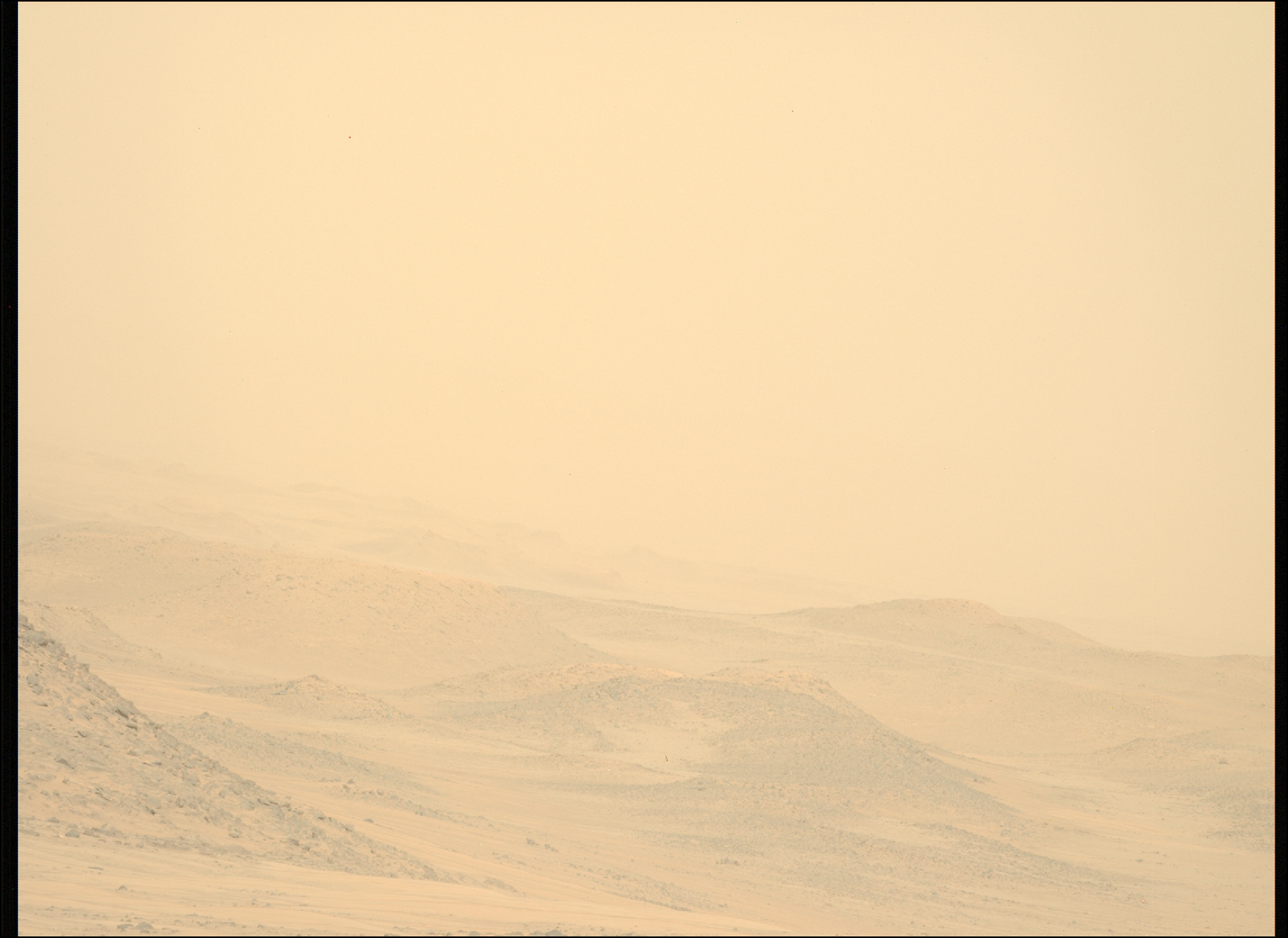
A color image from the Martian surface shows dunes extending from the left side of the frame down toward the bottom right corner, barely visible through a thick haze of pale yellowish-orange that covers the entire scene.
A region-wide seasonal dust storm obscures the Jezero Crater in this image from NASA’s Mars Perseverance rover, acquired using its Left Mastcam-Z camera. Mastcam-Z is a pair of cameras located high on the rover’s mast. Perseverance captured the image on Aug. 20, 2024 (Sol 1244, or Martian day 1,244 of the Mars 2020 mission) at the local mean solar time of 16:05:34. This image is part of a Mastcam-Z mosaic of the “northern fan,” a part of Jezero Crater that Perseverance never drove through, but is an area that’s thought to have been deposited in a similar way to the delta that the rover did explore.
NASA/JPL-Caltech/ASU

It is dust-storm season on Mars! Over the past couple of weeks, as we have been ascending the Jezero Crater rim, our science team has been monitoring rising amounts of dust in the atmosphere. This is expected: Dust activity is typically highest around this time of the Martian year (early Spring in the northern hemisphere). The increased dust has made our views back toward the crater hazier than usual, and provided our atmospheric scientists with a great opportunity to study the way that dust storms form, develop, and spread around the planet.

Perseverance has a suite of scientific instruments well-suited to study the Martian atmosphere. The Mars Environmental Dynamics Analyzer (MEDA) provides regular weather reports, the cadence of which has increased during the storm to maximize our science. We also routinely point our Mastcam-Z imager toward the sky to assess the optical density (“tau”) of the atmosphere.

There are not any signs that this regional dust storm will become planetwide — like the global dust storm in 2018 — but every day we are assessing new atmospheric data. Hopefully the skies will further clear up as we continue to climb in the coming weeks, because we are expecting stunning views of the crater floor and Jezero delta. This will offer the Perseverance team a unique chance to reflect on the tens of kilometers we have driven and years we have spent exploring Mars together.

Written by Henry Manelski, Ph.D. student at Purdue University

Share

Details

Last Updated
Sep 05, 2024

Related Terms


from NASA https://ift.tt/85QE6Xs

Sols 4295-4296: A Martian Moon and Planet Earth

2 min read

Sols 4295-4296: A Martian Moon and Planet Earth

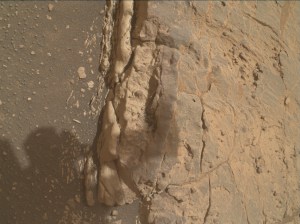
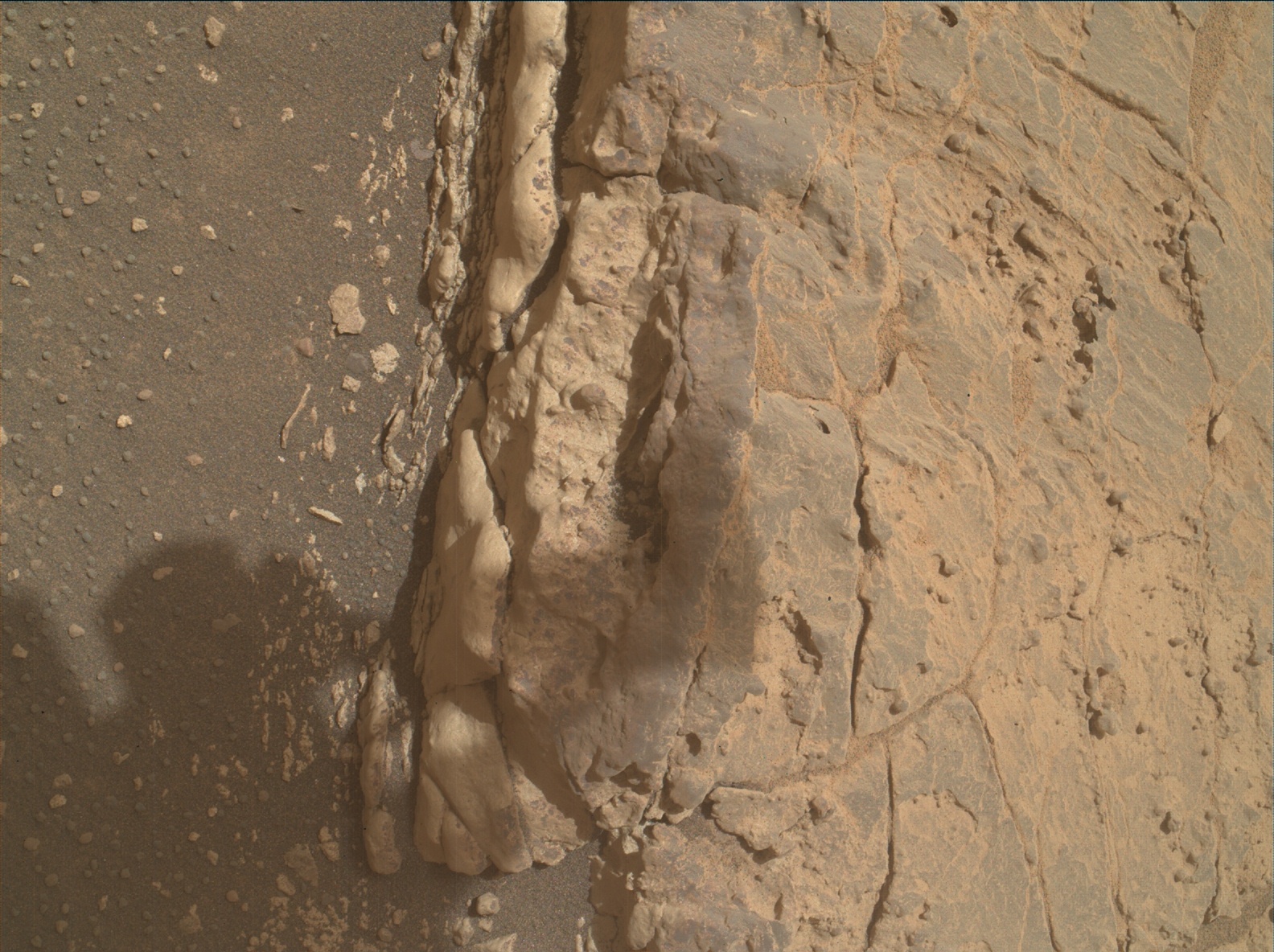
Using an onboard focusing process, the Mars Hand Lens Imager (MAHLI) aboard NASA’s Mars rover Curiosity created this product by merging two to eight images previously taken by the MAHLI, which is located on the turret at the end of the rover’s robotic arm. Curiosity performed the merge on Sept. 4, 2024, at 06:30:48 UTC — sol 4294, or Martian day 4,294 of the Mars Science Laboratory mission. The onboard focus merge is sometimes performed on images acquired the same sol as the merge, and sometimes using pictures obtained earlier. Focus merging is a method to make a composite of images of the same target acquired at different focus positions to bring as many features as possible into focus in a single image. The MAHLI focus merge also serves as a means to reduce the number of images sent back to Earth. Each focus merge produces two images: a color, best-focus product and a black-and-white image that scientists can use to estimate focus position for each element of the best-focus product. So up to eight images can be merged, but the number of images returned to Earth is two.
NASA/JPL-Caltech/MSSS

Earth planning date: Wednesday, Sept. 4, 2024

Today’s two-sol plan contains the usual science blocks filled with contact science and remote science to observe and assess the geology surrounding us. However, the Mastcam team is hoping to capture a special celestial event above the Martian skyline as one of Mars’ moons, Phobos, will be in conjunction with Earth on the evening of the first sol of this plan. So everyone look up, and smile for the camera!

Coming back to our beautiful workspace, in this plan there is a focus on targeting the different colors and tones we can see in the bedrock with our suite of instruments. In the image above we can see some of these varying tones — including gray areas, lighter-toned areas, and areas of tan-colored bedrock — with an image from the MAHLI instrument, Curiosity’s onboard hand lens.

APXS is targeting “Campfire Lake,” a lighter-toned area, and “Gemini,” a more gray-toned area situated in front of the rover. MAHLI is taking a suite of close-up images of these targets too. ChemCam is then taking two LIBS measurements of “Crazy Lake” and “Foolish Lake,” both of which appear to have lighter tones. Mastcam is documenting this whole area with a workspace mosaic and an 8×2 mosaic of “Picture Puzzle,” named after the rock in the image above that was taken during the previous plan. Mastcam will also be capturing a 6×3 mosaic of an outcrop named “Outguard Spire” that has an interesting gray rim. Looking further afield, ChemCam has planned a long-distance RMI image of the yardang unit and Navcam is taking a suprahorizon movie and dust-devil survey for our continued observations of the atmosphere to round out this plan.

Written by Emma Harris, Graduate Student at Natural History Museum, London

Share

Details

Last Updated
Sep 05, 2024

Related Terms


from NASA https://ift.tt/IoKyqND

NASA Selects Langley Research Center Support Contractor

The letters NASA on a blue circle with red and white detail, all surrounded by a black background
Credit: NASA

NASA has awarded the Center, Operations Maintenance, and Engineering II contract to Jacobs Technology Inc. of Tullahoma, Tennessee, to support operations at the agency’s Langley Research Center in Hampton, Virginia.

The contract is a cost-plus-fixed-fee indefinite-delivery/indefinite-quantity contract with a maximum potential value of $973.7 million. Following a phase-in period that starts Tuesday, Oct. 1 and runs to Dec. 31, the contract will have a base period of 15 months followed by five optional periods that could extend the contract to the end of 2035.

Under this contract, Jacobs Technology will assist in crucial research operations, engineering, and maintenance services at NASA Langley to help the center continue its work to solve the mysteries of our home planet, solar system, and beyond. The firm also will provide institutional and research operations support, maintenance and engineering for the center’s facilities, and central utilities operations, among other services.

For information about NASA and agency programs, visit:

https://www.nasa.gov

-end-

Tiernan Doyle
Headquarters, Washington
202-358-1600
tiernan.doyle@nasa.gov

Share

Details

Last Updated
Sep 05, 2024


from NASA https://ift.tt/R0uXaGT

An Early Look at Fall Color in Canada

Science Earth Observatory An Early Look at Fall Color in… Earth Earth Observatory Image of the Day EO Explorer All Top...