Explore the July 2024 issue, featuring NASA Stennis Achieves Primary Success for Historic In-Space Mission, NASA at the Mississippi Comic Convention, NASA Stennis Take Our Children to Work Day, and more!
Explore Lagniappe for July 2024 featuring:
NASA Stennis Achieves Primary Success for Historic In-Space Mission
Mississippi Comic Convention Experiences NASA
NASA Stennis Hosts Take Our Children to Work Day
Gator Speaks
Conversations filled the room with anticipation for the day ahead.
NASA’s Stennis Space Center hosted Take Our Children to Work Day on June 27 with a day set aside for children of employees to see up close the work carried out at NASA Stennis by its diverse workforce.
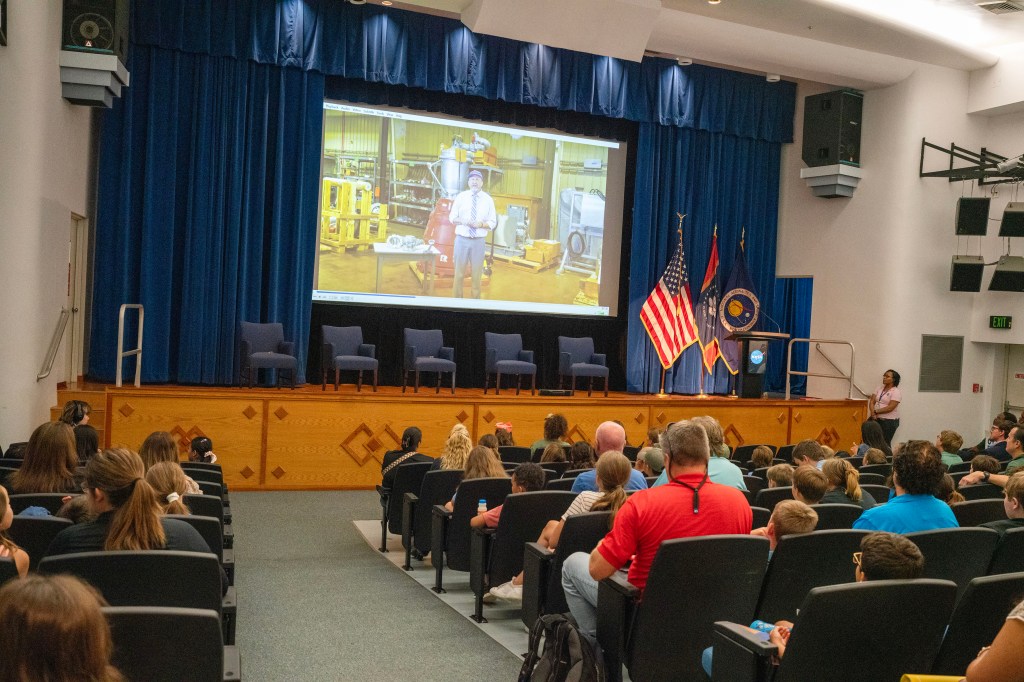
A video featuring NASA Stennis Associate Director Rodney McKellip welcomed the enthusiastic crowd. He shared about the different hats worn by the more than 5,000 employees throughout the NASA Stennis federal city.
There are engineers who help make the south Mississippi NASA center the premier rocket engine test facility in the country. NASA Stennis, the place that tested rocket stages to put the first humans on the Moon, remains on the frontlines of preparing NASA and the United States for its return to the Moon through the Artemis campaign to explore more of the lunar surface than ever before.
Those attending Take Our Children to Work Day learned how NASA Stennis has many rocket scientists and test engineers carrying out this work, but that is not all.
Gator Speaks
NASA/Stennis
A team of folks, including accountants, lawyers, environmental specialists, educators, and public affairs specialists, wear the NASA hat to ensure mission success too.
There also are teams climbing on test stands, installing rocket engines into the stands, working with piping, electrical, welding, construction projects, safety inspections, and more.
In addition to being the premier propulsion test site supporting NASA’s mission, NASA Stennis is where commercial companies experience success and benefit from the expertise of NASA personnel. Companies like Relativity Space, Rocket Lab, and Evolution Space have established ongoing operations at NASA Stennis as the commercialization of space continues.
The NASA Stennis federal city also includes a range agencies, universities, and companies sharing costs and carrying out individual missions.
It is the command site for the largest collection of oceanographers in the world and where Navy Seals train.
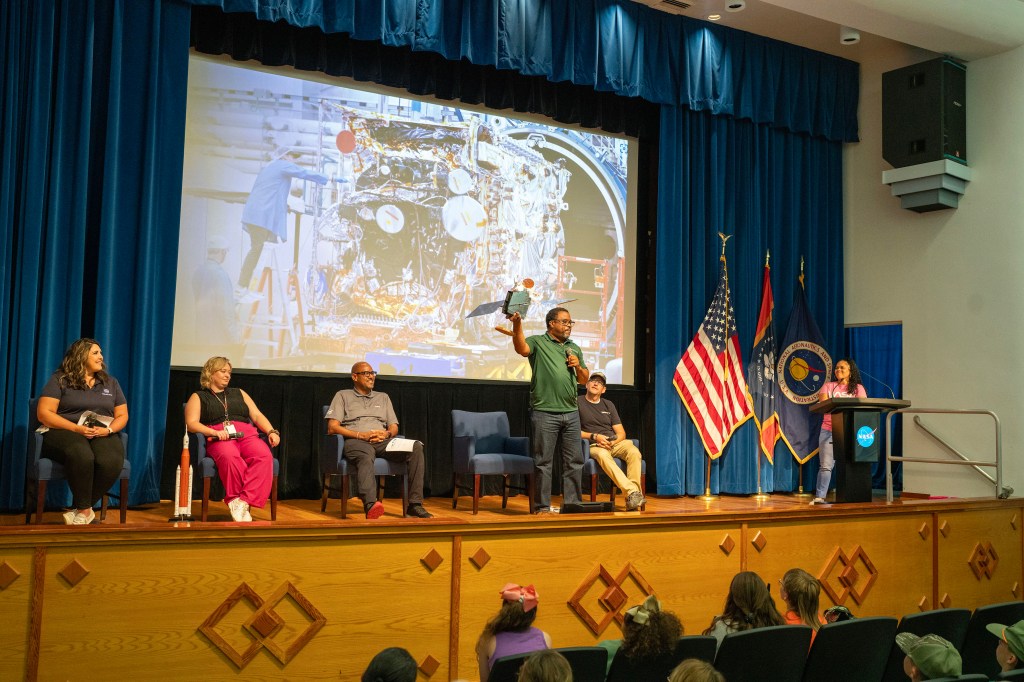
Participants learned about such operations from a panel of employees from NASA, Aerojet Rocketdyne, an L3 Harris Technologies company, Lockheed Martin, and Relativity Space.
They toured NASA Stennis and participated in activities facilitated by NASA, Aerojet Rocketdyne, and the National Data Buoy Center.
The NASA Stennis associate director left them with a final thought before their day started: If you hear something loud during the day, just know that is the sound of progress at the nation’s premier rocket propulsion test facility and federal city known as NASA Stennis.
Sure enough, that afternoon, the unmistakable sound of engine testing could be heard across the site. For this ol‘ Gator, it sounds like music to the ears.
NASA Stennis Top News
NASA Stennis Achieves Primary Success for Historic In-Space Mission
NASA’s Stennis Space Center and partner Sidus Space Inc. announced primary mission success July 2 for the center’s historic in-space mission – an autonomous systems payload aboard an orbiting satellite.
Science fiction fans at the Mississippi Comic Convention were provided an out-of-this world experience, while learning about NASA, during the two-day event in Jackson, Mississippi, thanks to employees from NASA’s Stennis Space Center.
“I’ve never been to an outreach activity that you reached so many people and from such a wide spectrum of people, from grade schoolers to retired grandparents,” said Troy Frisbie, NASA Stennis legislative affairs officer and chief of staff. “We interacted with a wide audience and really shared how NASA and NASA Stennis benefit all. It was a really, really good experience.”
The NASA booth, at an event that attracted 18,000 people to the Mississippi Trade Mart and Coliseum on June 22-23, featured an immersive experience with virtual reality goggles. Participants were able to view an engine test conducted at NASA Stennis, take a virtual spacewalk while visiting the International Space Station, and experience a simulated rocket launch to Mars.
One group enjoying the interaction with NASA was the Star Trek fan club from Jackson, Mississippi.
“They were real big supporters of NASA,” Frisbie said. “They loved the virtual reality experience and encouraged others at the convention to come by and visit with us.”
NASA Stennis budget analyst Rebecca Mataya and engineers Paul Fuller, Steven Helmstetter, and Chris Barnett-Woods volunteered with Frisbie. The center employees talked to college students majoring in engineering, graphic design, architecture, education, and healthcare.
“The assumption is everybody has to be an engineer to work at NASA, and that is not the case,” Frisbie said. “There are all kinds of opportunities, and that was an eye opener for many.”
Conversations centered on job opportunities and careers with NASA, as well as work conducted at NASA Stennis. The volunteers also fielded general questions about NASA’s powerful SLS (Space Launch System) rocket and the agency’s Artemis campaign of returning astronauts to the Moon for scientific discovery, economic benefits, and inspiration for a new generation of explorers: the Artemis Generation.
“We enjoyed telling the NASA story and how NASA Stennis on the Gulf Coast of Mississippi serves as an economic engine that contributes to this nation’s space dreams,” Frisbie added.
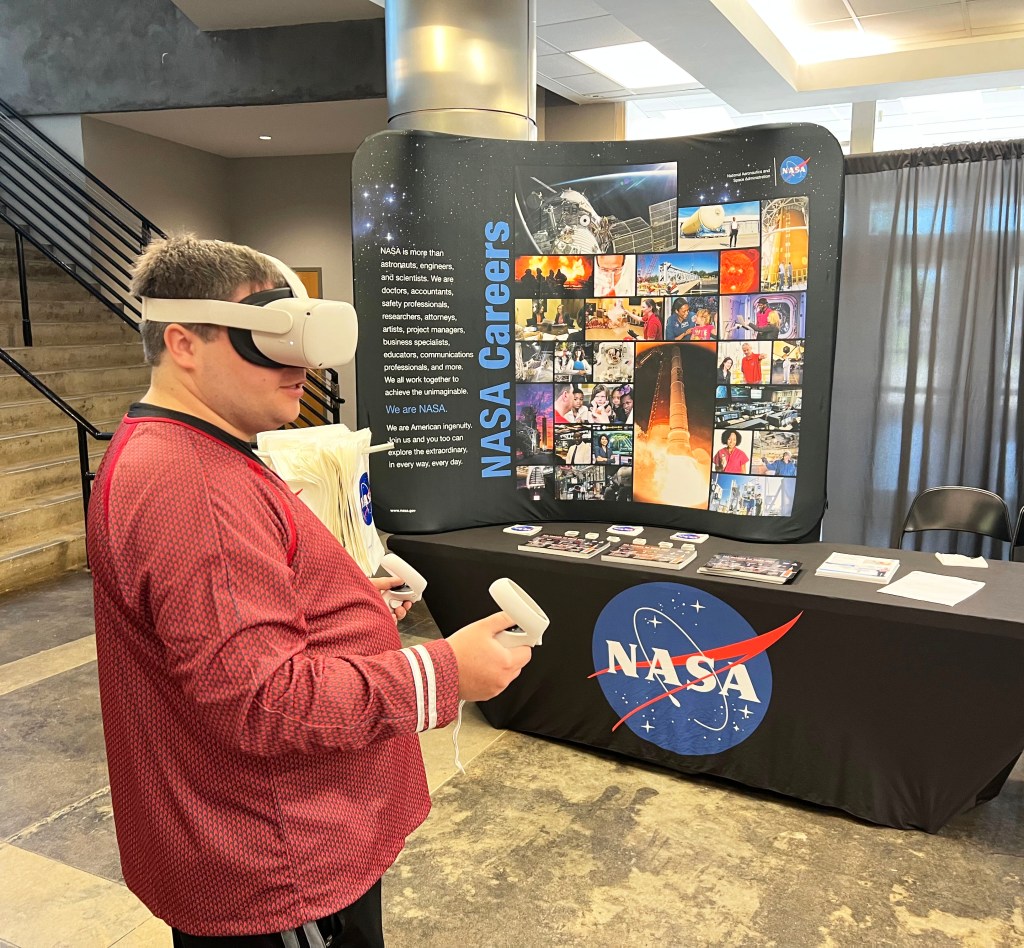
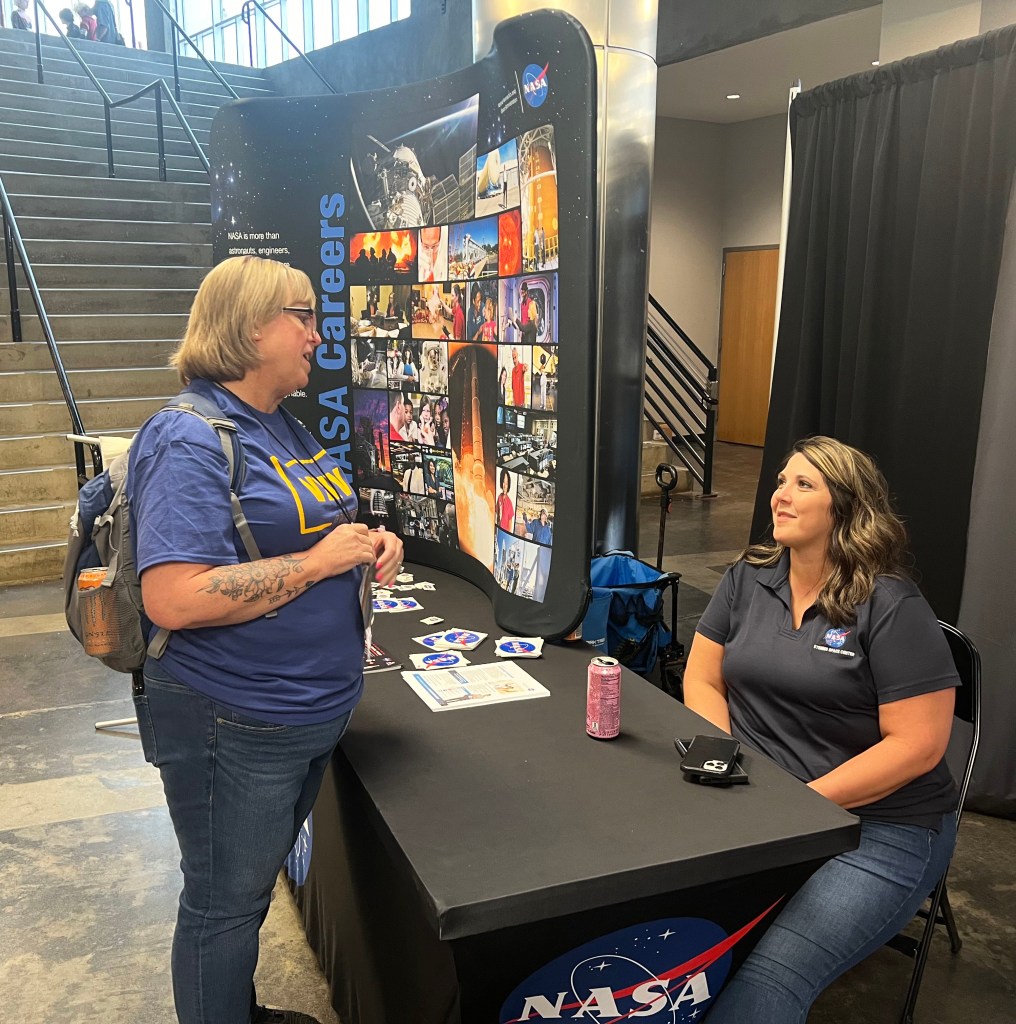
Jackson, Mississippi, Star Trek fan club, USS Haise member, volunteers to be the first user of the virtual reality experience provided by NASA Stennis before the Mississippi Comic Convention begins.
NASA/Rebecca Mataya
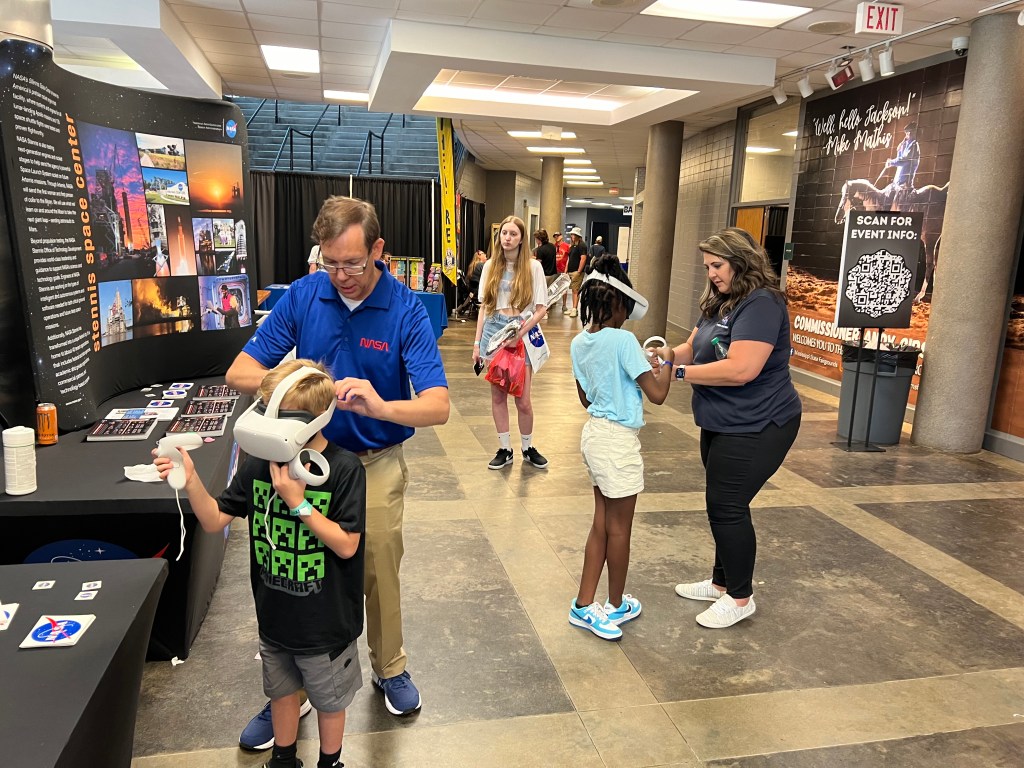
NASA Stennis budget analyst Rebecca Mataya, right, and NASA Stennis engineer Paul Fuller assist young space fans with the NASA virtual reality experience at the Mississippi Comic Convention in Jackson, Mississippi, on June 22 at the Mississippi Trade Mart and Coliseum.
NASA/Troy Frisbie
A Mississippi Comic Convention worker, an advocate for children with disabilities, speaks with NASA Stennis budget analyst Rebecca Mataya, right, during the event in Jackson, Mississippi, on June 22, about community outreach events and INFINITY Science Center’s ability to host children with special needs interested in learning more about NASA.
NASA/Troy Frisbie
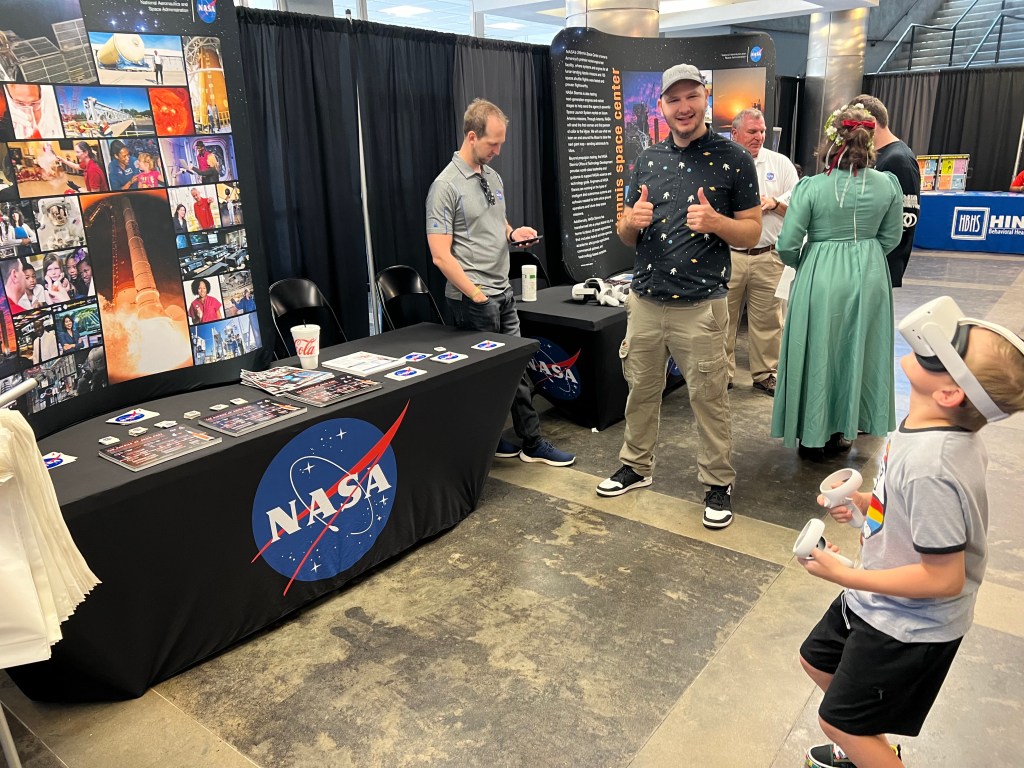
NASA engineer Steve Helmstetter, center, gives a thumbs up on June 22 at the Mississippi Comic Convention in Jackson, Mississippi, as a young fan has a virtual reality experience in space.
NASA/Rebecca Mataya
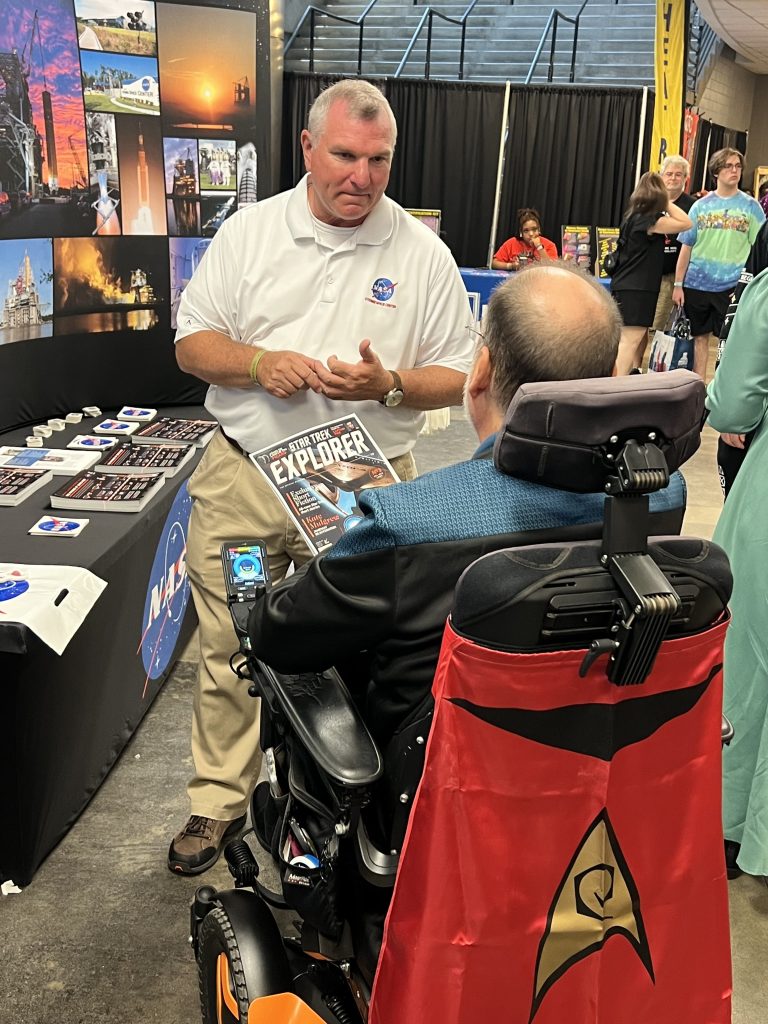
NASA Stennis legislative affairs specialist and chief of staff Troy Frisbie discusses his appearance in Star Trek Explorer magazine with a member of the Jackson, Mississippi, Star Trek fan club, USS Haise.
NASA/Rebecca Mataya
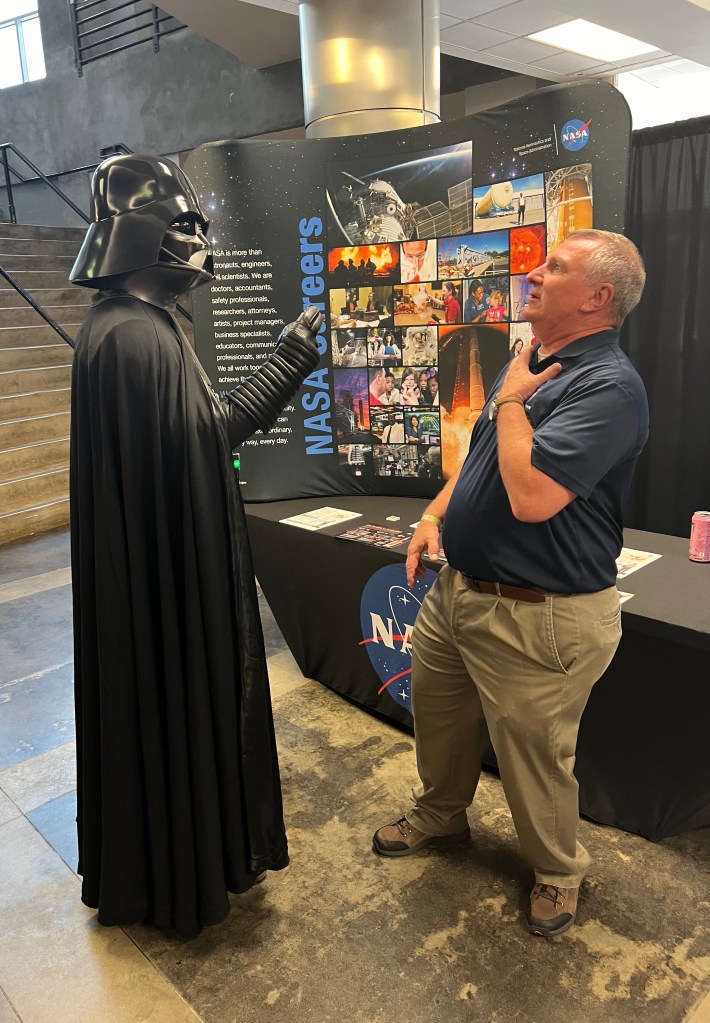
A Darth Vader character visits with NASA Stennis legislative affairs specialist and chief of staff Troy Frisbie at the NASA booth on June 23 at the Mississippi Comic Convention in Jackson, Mississippi.
NASA/Rebecca Mataya
Center Activities
NASA Stennis Breaks Ground with Rolls-Royce on New Testing Area
NASA’s Stennis Space Center continues to support commercial companies and benefit the aerospace industry. The latest example comes as officials from NASA Stennis and Rolls-Royce break ground for the E-1 Hydrogen Test Pad, located at the NASA Stennis E-Complex Test Facility, during a June 27 ceremony. The site will be where Rolls-Royce conducts hydrogen testing for the Pearl 15 engine. The Pearl 15 engine helps power the Bombardier Global 5500 & 6500 aircraft and enables top speeds of Mach 0.90. Groundbreaking participants include (left to right): Adam Newman, Rolls-Royce chief engineer of hydrogen technology; Deborah Robinson, Rolls-Royce director of test and experimental engineering; Troy Frisbie, NASA Stennis legislative affairs specialist and chief of staff; Dan Lyon, Rolls-Royce North America general manager; and Steven Blake, Rolls-Royce North America indirect purchasing, global commodity manager.
NASA/Danny Nowlin
NASA Stennis Hosts NASA Mission Support Directorate
Members of NASA’s Mission Support Directorate met with leaders from NASA’s Stennis Space Center and the NASA Shared Services Center during an onsite visit June 3. The group also participated in an in-depth tour of the NASA Stennis facilities. Pictured (left to right) are Ron Bald, chief counsel for the Office of the General Counsel at NASA Stennis and NASA Shared Services Center; Dinna Cottrell, chief information officer for the NASA Stennis and NASA Shared Services Center Office of the Chief Information Officer; Eli Ouder, procurement officer for NASA Stennis and NASA Shared Services Center; Stacy Houston, executive officer for NASA’s Mission Support Directorate; Michael Tubbs, acting director for the NASA Stennis Center Operations Directorate; Michael Hess, deputy associate administrator for NASA’s Mission Support Directorate; Rodney McKellip, associate director for NASA Stennis; Nichole Pinkney, program manager for NASA’s Mission Support Directorate; Duane Armstrong, manager for the NASA Stennis Strategic Development Office; Gary Benton, director for the NASA Stennis Safety and Mission Assurance Directorate; and Alison Butsch, associate chief financial officer for the External Business Operations Division within the NASA Stennis Office of the Chief Financial Officer.
NASA/Danny Nowlin
Space Force Students Visit NASA Stennis
United States Space Force training students and professors stand at the Thad Cochran Test Stand on June 4 during a tour of NASA’s Stennis Space Center. NASA Stennis is preparing the test stand to test the exploration upper stage, which will fly on future SLS (Space Launch System) missions as NASA continues its mission of exploring the secrets of the universe for the benefit of all. The upper stage is being built at NASA’s Michoud Assembly Facility in New Orleans as a more powerful second stage to send the Orion spacecraft to deep space. It is expected to fly on the Artemis IV mission. Before that, it will be installed on the Thad Cochran Test Stand (B-2) at NASA Stennis to undergo a series of Green Run tests of its integrated systems to demonstrate it is ready to fly. The Space Force, established in 2019, organizes, trains, and equips personnel to protect U.S. and allied interests in space and to provide space capabilities to the joint forces.
NASA/Danny Nowlin
Louisiana STEM Academy Visits NASA Stennis
Rising high school juniors and seniors from Ascension Parish, Louisiana, visit the Thad Cochran Test Stand on June 6 during a tour of NASA’s Stennis Space Center. The students are part of the week-long BASF Tech Academy, in coordination with River Parishes Community College, where participants learn about technical careers and education. NASA Stennis is preparing the test stand to test the exploration upper stage, which will fly on future SLS (Space Launch System) missions as NASA continues its mission of exploring the secrets of the universe for the benefit of all. The upper stage is being built at NASA’s Michoud Assembly Facility in New Orleans as a more powerful second stage to send the Orion spacecraft to deep space. It is expected to fly on the Artemis IV mission. Before that, it will be installed on the Thad Cochran Test Stand (B-2) at NASA Stennis to undergo a series of Green Run tests of its integrated systems to demonstrate it is ready to fly.
NASA/Danny Nowlin
Florida A&M STEM Group Visits NASA Stennis
Members of the Florida A&M University Program of Excellence in STEM attend a presentation June 21 during a visit to NASA’s Stennis Space Center. The NASA Office of STEM Engagement provided information on grants and student activities during the presentation about NASA Stennis and the work conducted at the unique federal city. The group also visited the Thad Cochran Test Stand and Relativity Space test complex during a site tour. The Program of Excellence in STEM summer academy aims to enhance student knowledge of opportunities in the fields of science, technology, engineering, and mathematics.
NASA/Danny Nowlin
Aerospace States Association Visits NASA Stennis
Members of the Aerospace States Association stand at the Thad Cochran Test Stand on June 25 during a visit to NASA’s Stennis Space Center. The group came to the south Mississippi NASA center during the Aerospace States Association conference in New Orleans June 24-27. NASA Stennis will use the Thad Cochran Test Stand (B-2) to test the exploration upper stage, a more powerful second stage to send the Orion spacecraft to deep space on NASA’s SLS (Space Launch System) rocket, ahead of its expected flight on the Artemis IV mission.
NASA/Danny Nowlin
Arkansas-Pine Bluff STEM Summer Institute Visits NASA Stennis
Participants in the University of Arkansas at Pine Bluff STEM (science, technology, engineering and mathematics) Summer Institute stand in front of the Roy Estess Building at NASA’s Stennis Space Center during a site tour on June 25. The students viewed multiple areas of the federal city, including a visit to the Thad Cochran Test Stand, where students learned about NASA Stennis’ role in the Artemis campaign. NASA is going back to the Moon for scientific discovery, economic benefits, and inspiration for a new generation of explorers: the Artemis Generation. The agency will use what is learned on and around the Moon to take the next giant leap – sending astronauts to Mars. The Arkansas at Pine Bluff STEM program started in 2003 and is designed to help increase the number and diversity of well-prepared STEM graduates.
NASA/Danny Nowlin
NASA Stennis Hosts Take Our Children to Work Day
NASA’s Stennis Space Center inspired the Artemis Generation during the 2024 Take Our Children to Work Day on June 27. Participants are shown in the StenniSphere auditorium following a site tour and full day of hands-on activities to promote interest in STEM (science, technology, engineering, and mathematics) and the variety of work conducted at NASA Stennis. NASA is returning to the Moon through the Artemis campaign for scientific discovery, economic benefits, and inspiration for a new generation of explorers.
NASA/Danny Nowlin
NASA Stennis Associate Director Rodney McKellip provides a video welcome to participants in the 2024 Take Our Children to Work Day event June 27 at NASA’s Stennis Space Center.
NASA/LaToya Dean
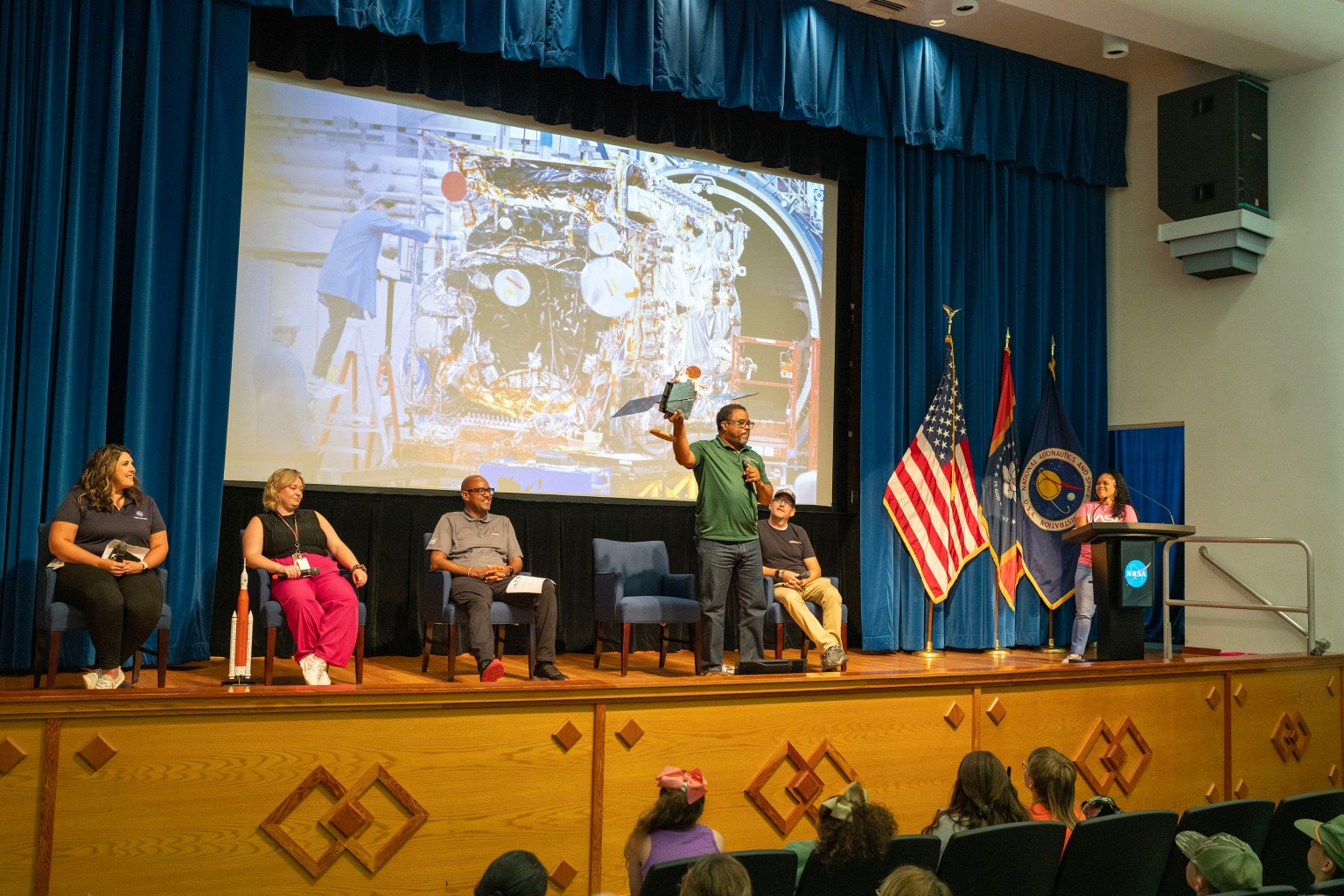
Take Our Children to Work Day participants join NASA Stennis federal city employees for a career panel discussion on June 27. The career panel discussion included (left to right): Rebecca Mataya, NASA Stennis budget analyst; Madison Rundell, Aerojet Rocketdyne information technology specialist; Troy Chivers, COLSA/All In Solutions representative; Clyde Conerly, Lockheed Martin quality engineer; Andy Guymon, Relativity Space test engineer; and moderator Apolonia Acker, NASA Stennis public affairs specialist.
NASA/LaToya Dean
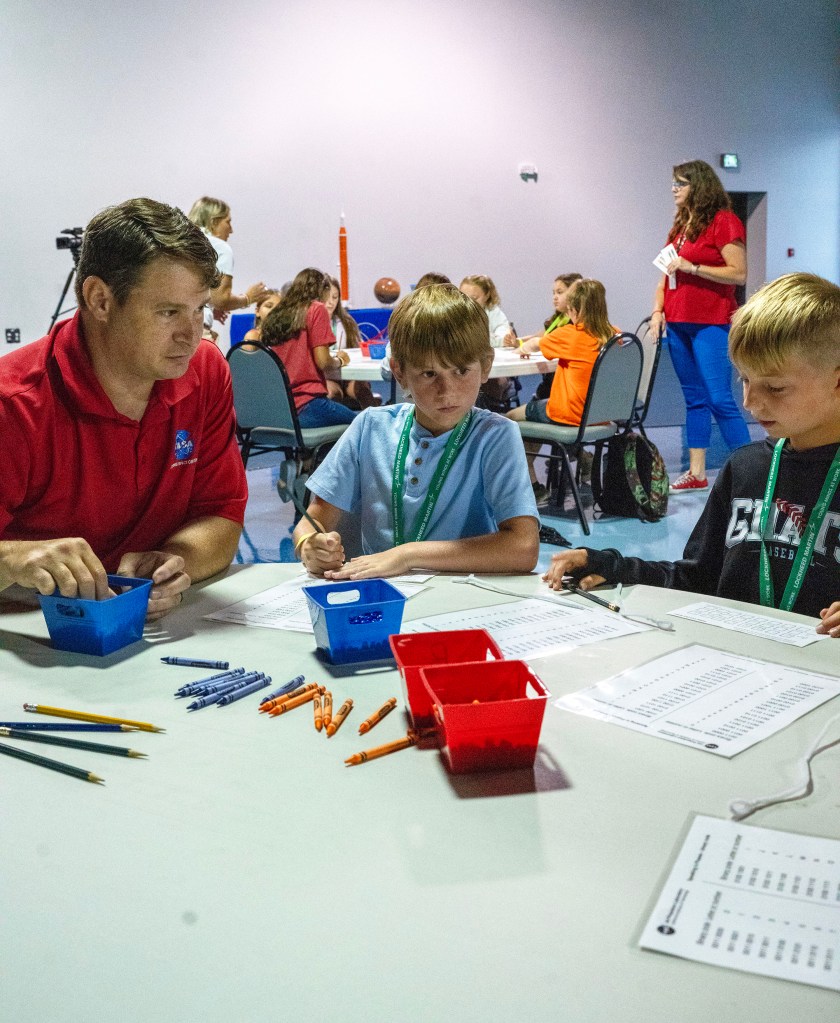
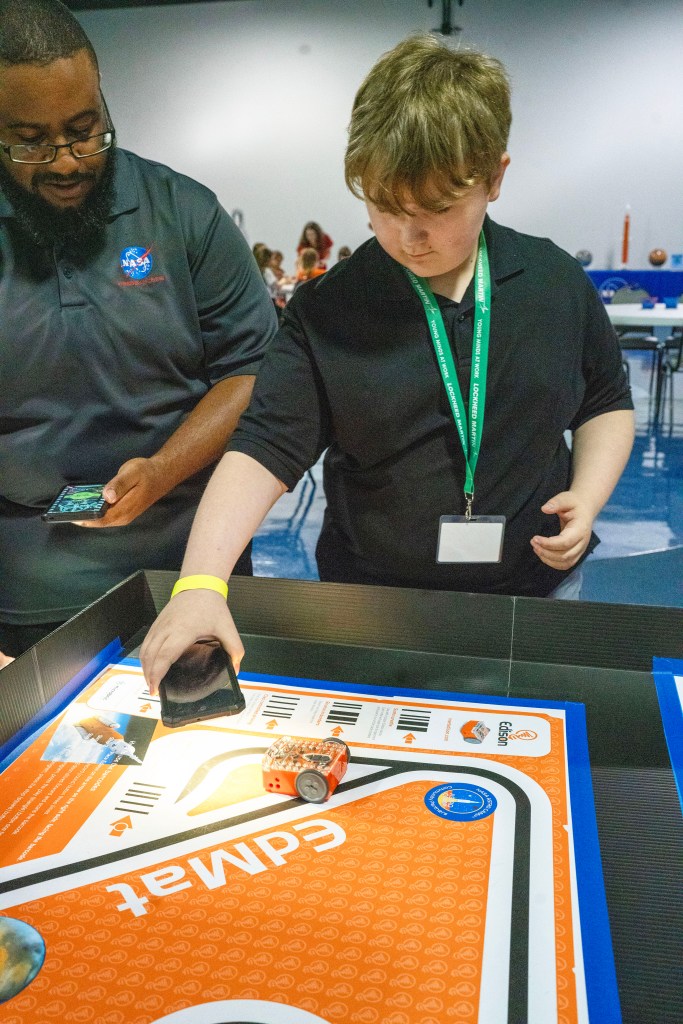
Christopher Sherman, NASA ASTRO CAMP Community Partners Program education specialist (left), conducts an activity with Take Our Children to Work Day participants on June 27 at NASA’s Stennis Space Center.
NASA/LaToya Dean
Morgan Necaise, NASA ASTRO CAMP Community Partners Program education specialist (left), conducts an activity with Take Our Children to Work Day participants on June 27 at NASA’s Stennis Space Center.
NASA/LaToya Dean
Danny Griffin, NASA ASTRO CAMP Community Partners Program logistics coordinator (left), conducts an activity with Take Our Children to Work Day participants on June 27 at NASA’s Stennis Space Center
NASA/LaToya Dean
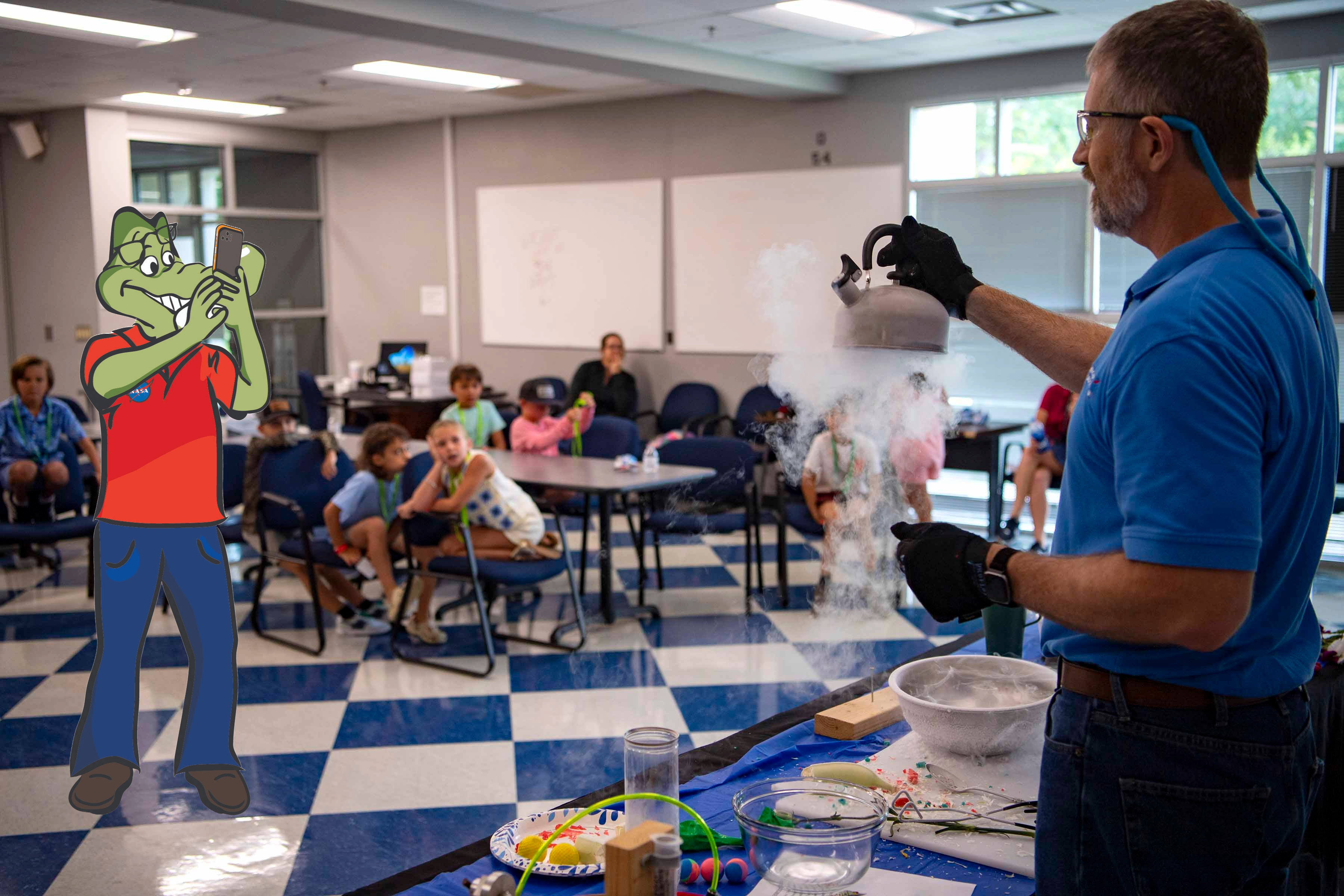
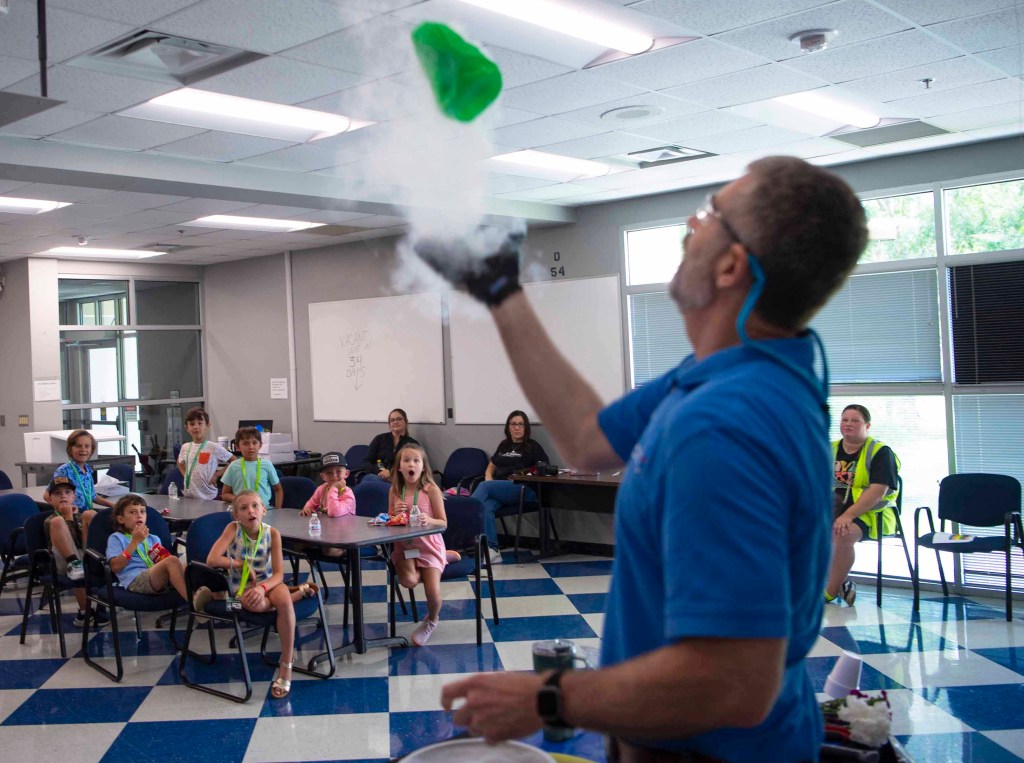
A group of Take Our Children Day participants watch a cryogenic demonstration led by Allen Forsman of Aerojet Rocketdyne, an L3Harris Technologies company, on June 27 at the Aerojet Rocketdyne Engine Assembly Facility at NASA Stennis.
NASA/Danny Nowlin
Take Our Children to Work Day participants learn about the ocean’s ecosystem on June 27 during an activity conducted by representatives with Mississippi State University, Northern Gulf Institute, and the Alliance for System Safety of UAS through Research Excellence.
NASA/LaToya Dean
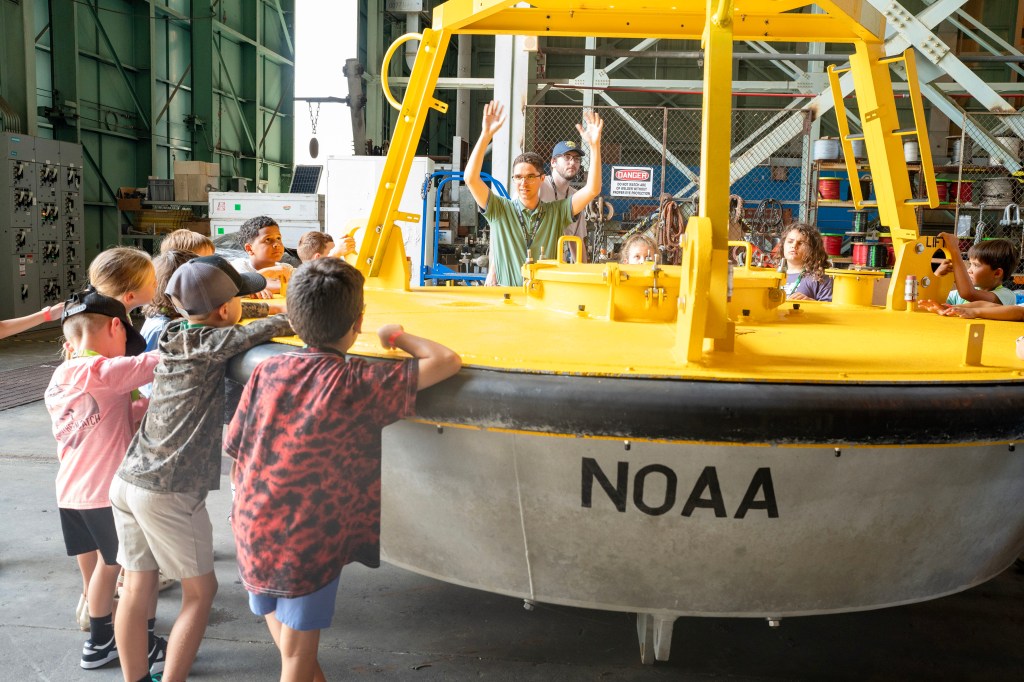
Take Our Children to Work Day participants learn about buoys on June 27 during an activity conducted by Brandon Elsensohn, Amentum software engineer, for the National Data Buoy Center at NASA’s Stennis Space Center.
Chris Barnett-Woods is shown at the E-1 Test Stand at NASA’s Stennis Space Center near Bay St. Louis, Mississippi, where NASA Stennis accelerates the exploration and commercialization of space and innovates to benefit NASA and industry.
NASA/Danny Nowlin
Chris Barnett-Woods’ favorite movie growing up – Back to the Future – led him to dream of one day building a DeLorean automobile. Instead, the electrical engineer is doing something never imagined as he helps NASA support the commercialization of space for the benefit of all.
20 Years Ago This Month: NASA Stennis Moon Tree Honors Apollo 11
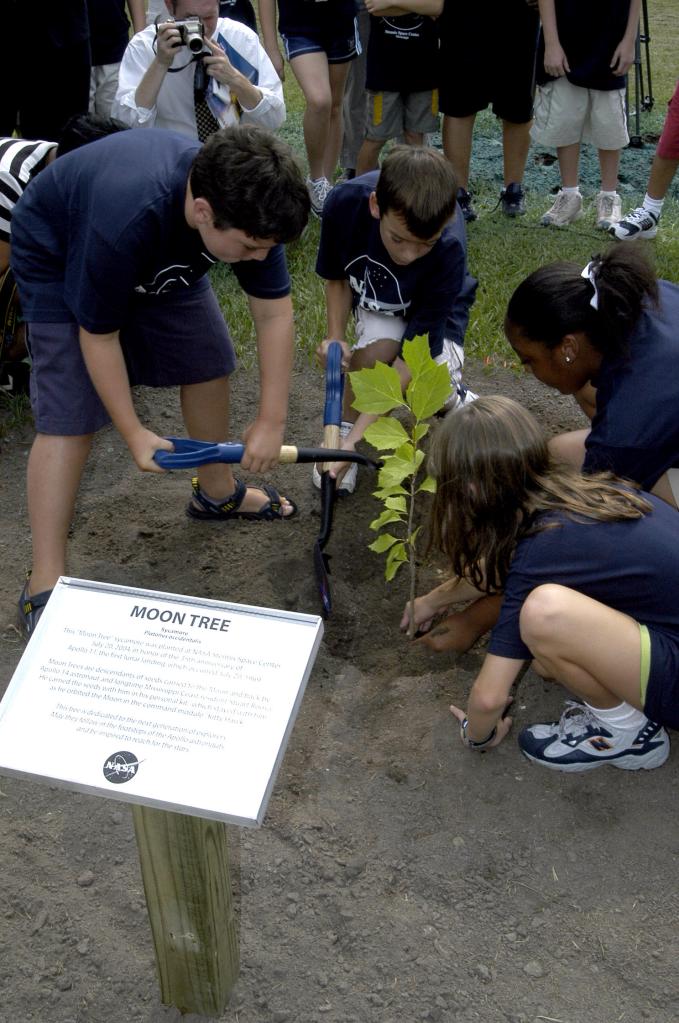
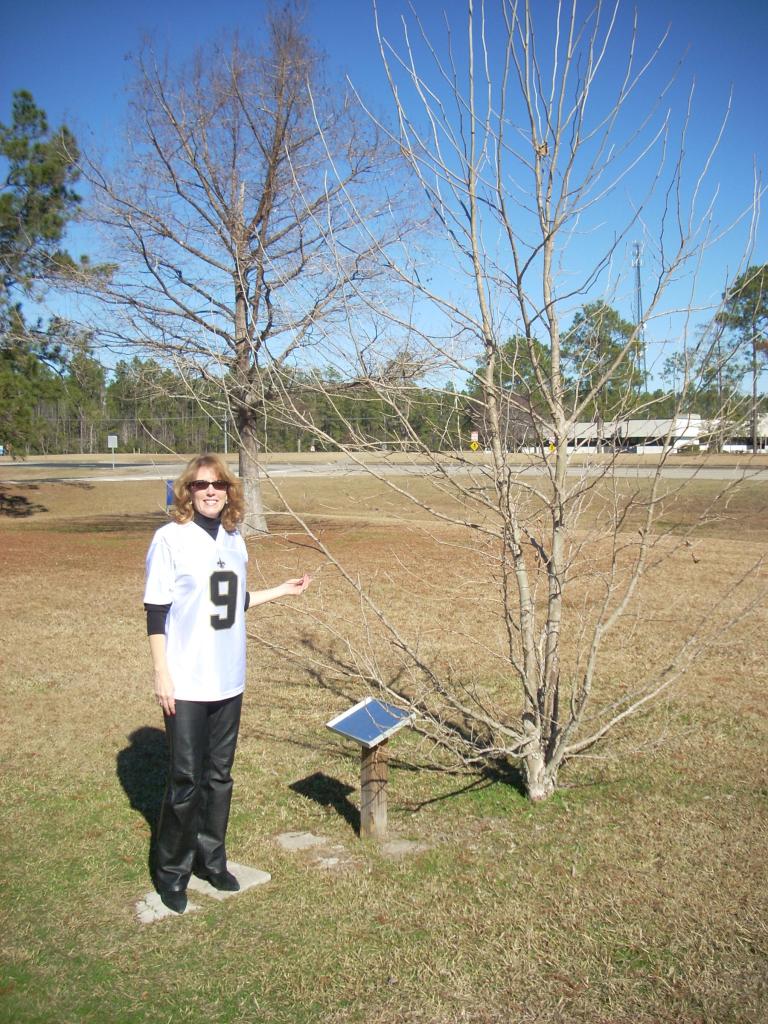
An image from July 20, 2004, shows Astro Camp participants planting a sycamore Moon tree at NASA’s Stennis Space Center near Bay St. Louis, Mississippi. The tree, planted 20 years ago this month, honors the 35th anniversary of Apollo 11 and the first lunar landing on July 20, 1969.
NASA/Stennis
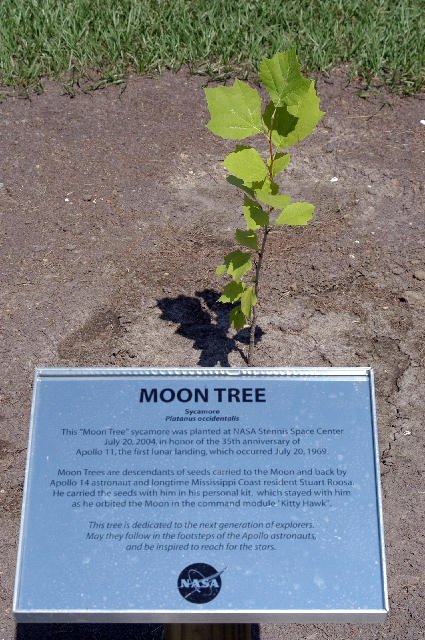
The Moon tree, planted on July 20, 2004, at NASA Stennis, is a descendant of seeds carried to the Moon and back by the late Apollo 14 astronaut and longtime Mississippi Coast resident, Stuart Roosa, as he orbited the Moon in the command module, nicknamed “Kitty Hawk.”
NASA/Stennis
An image from Jan. 7, 2011, shows Rosemary Roosa, daughter of the late Apollo 14 astronaut Stuart Roosa, standing beside the Moon tree outside of StenniSphere, the previous museum and visitor center at NASA’s Stennis Space Center. The Moon tree is grown from seeds carried into space by astronaut Stuart Roosa on the Apollo 14 mission.
NASA/Stennis
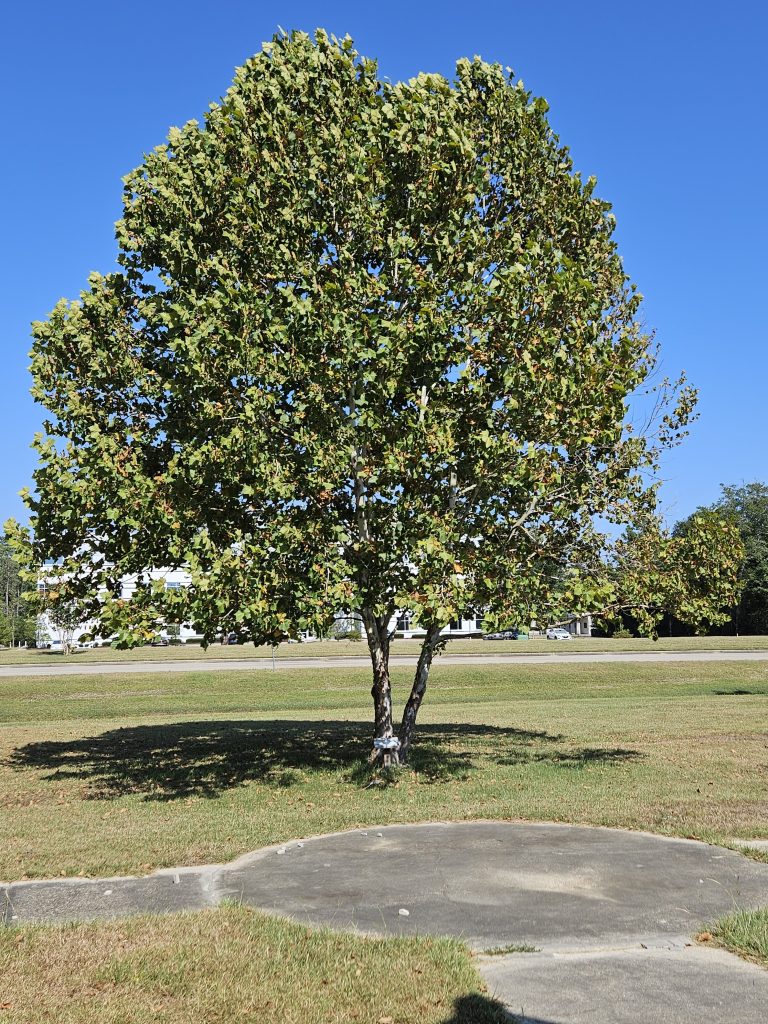
A 2023 image shows the sycamore Moon tree at NASA’s Stennis Space Center. The tree, planted 20 years ago this month, honors the 35th anniversary of Apollo 11 and the first lunar landing on July 20, 1969.
Lagniappe is published monthly by the Office of Communications at NASA’s Stennis Space Center. The NASA Stennis office may be contacted by at 228-688-3333 (phone); ssc-office-of-communications@mail.nasa.gov (email); or NASA OFFICE OF COMMUNICATIONS, Attn: LAGNIAPPE, Mail code IA00, Building 1111 Room 173, Stennis Space Center, MS 39529 (mail).
The Lagniappe staff includes: Managing Editor Lacy Thompson, Editor Bo Black, and photographer Danny Nowlin.
Let’s start with your childhood, where you were born, where you’re from, your young years, your family at the time, what your parents did, and how early it was in your life that you decided you’d like to pursue a career like the one you’re pursuing now?
I was born in a small town in Sichuan, China. It is not far from the famous Emei Mountain, and the beautiful Qingyi river runs through it. At the beginning, I lived with my grandmother’s family in a small village on the riverbank, called “Pond in heaven”. After I left there at four years old, I lived with my parents in Sichuan and Xinjiang provinces, alternatively, as my parents had been working apart. Luckily their reunion came after three years, and finally there was a real “home” for us. My parents were both high school teachers, they worked in the school system opened by a research institute for the children of their employees. It has elementary schools, middle schools, and high schools. That’s where I grew up and received my pre-college education.
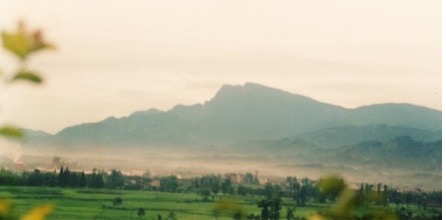
The Emei Mountain lookout. In China, it is the holy site of Samantabhadra Bodhisattva in Buddhism. Many monkeys live there.
Family photo when Xinchuan was 2 yrs. old
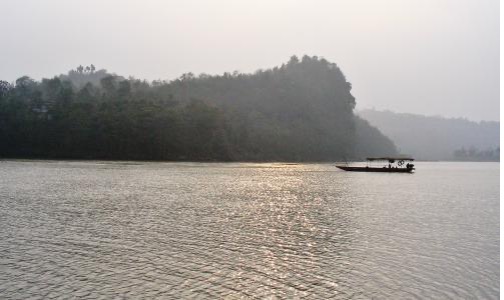
The Qingyi river runs through Xinchuan’s home village.
Since I was young, my mother has taught me enlightenment and urged my study. While my father was not quite involved in my academics, he valued the importance of reading and cultivated my interest in books. Every time we walked into a bookstore together, I was just purely happy because it simply meant one or two new books were coming home with me. He encouraged me to keep expanding my knowledge and horizons by also subscribing to many educational magazines and newspapers for kids, among which I remember two of my most favorite magazines. Before elementary school it was the “Children’s Science Pictorial”, and in elementary school it was the “Youth Science”. Those magazines started and nurtured my interest in science and the universe.
In middle school, there was an advertisement for a simple and cheap monocular telescope. I told my dad about it and he helped me order one, even though all it could show was the craters on the moon. But I was so excited, I could lay on the cold ground, watching the moon for hours, as if a new world was unfolding in front of me. Seeing how much I enjoyed it, my father later ordered for me the astronomy volume of the Chinese Encyclopedia. It cost 20 Yuan, which was not a small amount at that time. I was so thrilled to have the book. Holding that hardcover book, I felt that I was holding the universe in my arms.
I can imagine!
But most contents in that encyclopedia were still too advanced for me at the time, so I was more obsessed with the colorful photos in the book. Along with my interest in space and the universe, I was also interested in the topics of UFOs and extraterrestrial civilizations. For example, I read a book called “The Mystery of Flying Saucers”, which was a collection of reports and discussions translated from French. In that book, it mentioned the Drake equation for estimating the likelihood of civilizations in the universe. It deeply impressed me. In 2009, after my postdoc at Ames, I had an opportunity to meet with Dr. Drake. He’s the author of the equation and the founder of the SETI Institute. I must say that not everyone has the opportunity or the luck to meet an idol from their childhood and truly chat with him.
Good luck indeed!
However, when I told Dr. Drake that my first time reading about his equation was in a book of UFOs, he laughed and said “(it) was in a wrong story!” (laughs)
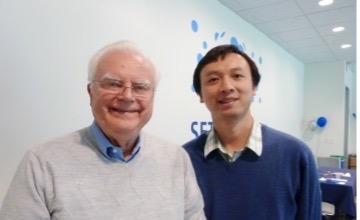
Dr. Drake (left) and Xinchuan at SETI Institute (2010)
When I graduated from high school, I did consider a major in astronomy, but there were very few undergraduate astronomy majors in China universities. The only few available that year were either not recruiting in Sichuan or in a city I didn’t like. The famous Peking University did have astrophysics major, but each year they only recruited about 10 undergraduate students from the whole country, and few from Sichuan. Otherwise, I could have enrolled there thirty years ago.
Any idea why they didn’t place more emphasis on astronomy? China, as you know, has a strong reputation in space exploration.
There is tradition for astronomy in China, and people know of ancient records and scientists, but it likely wasn’t the focus at that time. The astronomy and astrophysics research of Peking university and other China institutions have expanded significantly in last 30 years.
That’s for sure.
Anyway, I was admitted to the Fudan University in Shanghai, to major in Applied Chemistry II. That’s an interesting name. Usually you see chemistry, applied chemistry, materials chemistry, etc. What does the “II” mean? Previously, it was the Radiochemistry major, but people adjusted its content to keep up with the growth of economy, and to make it easier for their students to find jobs. There was already a major of “Applied Chemistry” in the Chemistry department, so it became “Applied Chemistry II”. My undergraduate thesis was done in the Institute of Laser Chemistry at Fudan, on the UV dissociation of a small organic molecule under cryogenic matrix isolation conditions.
Well, you certainly were well served by both your parents, as they helped direct your focus and your education. I also looked it up because I had not remembered that you came to Ames as a postdoc when I was associated with the NPP program as the Ames representative.
Yes.
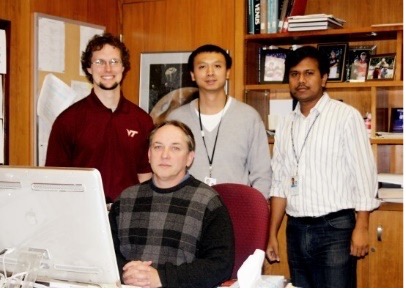
In Tim’s Office. From Left to Right: Ryan Fortenberry, Timothy Lee, Xinchuan Huang, and Partha Bera (03/2011)
I don’t remember all of them of course as there were quite a few over that period of time, but I hope that was a good experience for you. You were working with Tim Lee as your advisor and I’d known him for a very long time.
I appreciated and enjoyed the opportunity of doing my postdoc at Ames. I had been thinking of other career choices right before Tim sent an email to Joel (my PhD advisor) asking if there was any student suited for a research project at Ames, about ammonia’s Infrared spectrum calculations. The target was to generate a complete IR line list which people can utilize to characterize the NH3 related celestial environments and eliminate all the NH3 features from the astronomical observations, such as those in Titan’s atmosphere. It was a very good match to my Ph.D. background on the potential energy surface and vibrational dynamics of water cluster ions.
You had another postdoc before you came to Ames? At Emory University?
Yes, that was more like a one-year extension after the thesis defense, to finish up my Ph.D. projects.
How did you get from China to the United States? Was it because of your educational pursuits?
During my undergraduate study, I had some interest in laser chemistry and spectroscopy. For example, photodissociation products were detected and characterized by their infrared spectrum, and we know the spectroscopic fingerprints of molecules are determined by their nature, or internal properties. After college, I became a graduate student at the Institute of Chemistry, Chinese Academy of Science, in Beijing. Supposedly I should learn how to use a femtosecond laser system to investigate some ultra-fast processes in chemical reactions, but my supervisor left the institute unexpectedly.
So, I applied to some graduate programs in United States, and later enrolled in the chemistry department of Emory University in Atlanta. The admission could be related to my background in laser chemistry labs, but I didn’t continue that path. Instead, I changed to theoretical chemistry and vibrational dynamics studies. But I always admired our colleague experimental spectroscopists working in the laboratories, perhaps because I have myself witnessed how difficult an experimental study could become. It may include sample preparation, optical path platform construction, vacuum pumps, laser tuning, circuit of detectors, hardware interface and software development, etc., so requiring a variety of knowledge and skills from chemistry, physics, to mechanics, electronics, and even materials and computer science. Compared to that, it is relatively simpler to do theoretical spectroscopic studies. But from our perspective, our work still belongs to the laboratory astrophysics. Our lab is set up inside computers, and our equipment and devices are computing programs and algorithms.
Did you come to Emory because of a connection or a contact with them? Or did they just have a good program in what you were studying?
I applied to several graduate programs in the US, and received admissions including Emory, but I had no connections with them before. I chose the physical chemistry graduate program at Emory, for their reputation in both experimental and theoretical research.
So, you applied to several programs and you chose and got admitted to Emory. And then what was your route to Ames? Was it your postdoc? You got a postdoc here and then you stayed?
Yes.
That’s very straightforward.
Straight and simple.
Did you know Tim at all beforehand? From a conference or something like that?
Not personally, except that he was an expert in Coupled Cluster theory. After Tim contacted my advisor in the summer of 2005, I met him later that year in the ACS meeting at D.C.
You were going to tell us something about the work that you are doing, which I found very complicated. It had to do with something called a “potential energy surface” and some other things which I don’t even know what they are, but let’s go ahead because one of the reasons we asked this question is because we want to know why it is important enough that taxpayers should fund research into it.
Our research focuses on the Infrared and microwave spectrum ranges, provides high quality spectroscopic constants, or highly accurate Infrared line list predictions for small molecules in outer space. Those molecules play important roles in the interstellar medium, atmospheres of solar system objects, like Venus and Titan, and atmospheres of brown dwarfs and exoplanets. The IR spectroscopic constants and line lists will facilitate the detection of those molecules, help characterize the physical conditions of related environments, determine column densities or atmospheric concentrations, and improve the chemistry evolution models. Since a large part of the astronomical research involves spectrum data analysis and modeling, naturally more reliable and more accurate reference data will be needed to better support NASA strategic goals, help maximize the scientific output of various NASA missions, and eventually help us better understand what’s going on in the universe.
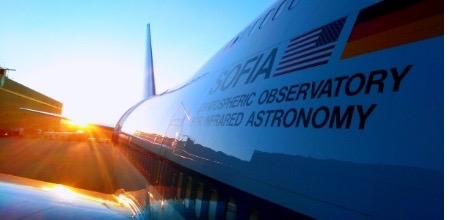
Inside SOFIA flight as a Guest Investigator (09/2015)
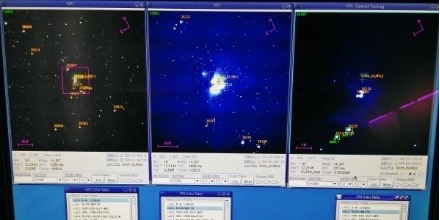
EXES observation towards Orion KL/IRc2 (09/2015)
Sgr B2, looking for c-C3H3+ IR features (09/2015)
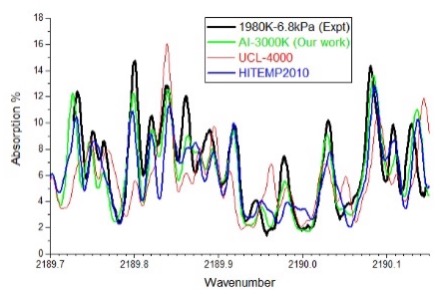
In the last two decades, the generation of more accurate reference data and predictions has required us to combine the advantages of experiments and theories. Our colleagues in Europe adopted similar strategies. For example, the latest Infrared line list we computed for hot carbon dioxide up to 3000 K has several components: high quality ab initio potential energy surface refined using reliable, high resolution experimental data or models, and the best dipole moment surfaces with accuracy already verified by recent highly accurate experiment IR intensities, and the most accurate line positions from the experiment based effective Hamiltonian models. In this way, the spectral line position and intensity accuracy from existing experiment data are integrated with the completeness, reliability and consistency from theoretical predictions. We hope the line list can improve the accuracy of CO2 analysis and modeling for brown dwarf and hot exoplanet atmospheres, which include, but not limited to the recent CO2 discoveries that JWST made on exoplanets.
Hot CO2 IR Simulation at 1980 K using our AI-3000K line list, compared to experiment, UCL-4000, and HITEMP2010. See details in “AI-3000K Infrared line list for hot CO2” (Huang et al, 2023, JMSpec) open access.
On the other hand, like I mentioned earlier, some molecules, like methyl cyanide, SO2, and ammonia, generate a plethora of spectral lines, appearing like wild grasses. That’s why some molecules were called “weeds”. They’re the “weeds” in the field of spectrum and may overshadow other important signals. Once I looked at a small segment of SOFIA EXES spectrum at 20 mm. Although I already knew it contained hundreds of sulfur dioxide bending mode transitions, I did not expect that so many very weak oscillations and tiny bumps in the observed spectrum could be excellently explained and reproduced until I ran the simulations by myself using SO2 line lists. Without a reliable and complete line list, many weak features may go unnoticed and treated as noises. But when you have a good line list, you can identify all the features of a specific molecule, then try to remove them, like removing weeds, so more interesting features or molecules can be found. We may call them the “flowers”. From this angle, we are like farmers in the spectroscopy field, or treasure hunters in the jungle of spectrum.
That’s a good way of putting it. And this leads to a greater understanding of what elements of the NASA mission? How does this fit in with what NASA is trying to accomplish, which could be just exploration, or the search for life, or some of the other great questions that NASA is trying to help answer?
There are several potential impacts from the basic scientific research we have been doing. One is to identify those molecules for their existence in the universe, where they are, and how many they are. Second is to figure out what their environment looks like, e.g., the pressure and temperature. An accurate reference line list can help to extract that information from observed spectrum data. The third impact is about some potential biosignature molecules for habitable exoplanets. Like the one we worked on recently, the nitrous oxide or laughing gas, N2O, it is one of those molecules contributing to the transit spectrum of Earth. Another impact is on chemical evolution models. Because our reliable predictions have very high consistency across isotopologues, higher than experiments, we can help to determine more accurate isotopic ratios and evolution history in outer space. In summary, and in the larger picture, we are contributing to the exploration of the universe and the search for habitable planets by providing basic reference data and tools for all NASA missions related to Infrared astronomy, from past Herschel, SOFIA, to JWST, and future ARIEL and other missions.
You mentioned biosignatures, which caught my attention because we’re hoping to find some evidence that we’re not alone in the universe, that there is other biology going on somewhere out there. Almost all of our research focuses on trying to address that, at some level. And it has a lot of popular support, taxpayer support, because they want the answer to that question perhaps most of all.
The IR spectra based astronomical research involves many models and datasets from different sources, like the spectra modeling on the JWST observations of exoplanet atmospheres. Every piece of work has its own uncertainties, which will add up model by model, database by database. A recent study published in Nature Astronomy revealed that the abundance errors resulting from the opacity inaccuracies can be about one order of magnitude larger than those brought on from JWST-quality observations. This is a bottleneck. From this perspective, our study can help to reduce, or to minimize those uncertainties and errors associated with the opacity data. Compared to experimental measurements under certain conditions, we are trying to provide a complete picture for molecules in the full range of IR and MW spectra. The computed line lists can be used to generate more reliable opacity data at different target temperatures. Having more accurate opacity data with uncertainty reduced or minimized, scientists can determine more accurate properties for exoplanets and other objects in the universe.
Have there been any surprising or breakthrough findings or discoveries or something not expected that has come from your work?
Not expected? Let me think. We should be careful about the claims on the strengths and limitations of our work. On one side we should have enough confidence, but every molecule is unique, we also need to properly estimate the limitation of our line list predictions. With the synergy between experimental data and high-quality theoretical calculations, many improvements actually can be expected. If we know clearly what we can do and what our limits are, they are not real surprises. Some predictions may look surprising, but they need verifications from future experiments. If verified, the agreement is still expected. If rejected, it means something we need to explain or fix, not real breakthrough or findings.
If we really want to talk about “surprises”, I can name two kinds of them. One is that we find surprisingly good agreement or high accuracy verification between predictions and experiments. For example, our room temperature CO2 line list. The IR intensity agreement with the best experiment measurement has reached the level of sub-half percent, for both accuracy and uncertainty, and towards 0.1 %, or permille level, 1‰. It was the best level ever achieved for CO2. That’s kind of a surprise because we were targeting a major upgrade, we knew we were doing better, but we didn’t know the improvements would be so good. That is a good surprise, but there could also be an opposite kind of surprise: a similar molecule or band, similar studies following the same track, so we had assumed it should come out as satisfactory as other molecules or bands, but it did not work out. Then we must figure out what’s going on, what we forgot or missed, or what’s the difference. For example, is that due to some unknown electronic state interference, sensitive resonances, potential defects in potential energy surface, or program bugs, etc.?
That is the science part of it.
Those are really the surprises.
You’re a very impressive and accomplished NASA research scientist, that’s obvious. And you’ve pursued that from youth, really, that line of work. Have you ever given any thought to, if you weren’t doing what you’re doing now, is there another dream job that you might like to have pursued if you had gone another way?
When people talk about a dream job, it usually means something that cannot be realized, except in our dreams. Maybe a contractor scientist without the need to worry about funding?
But still a scientist? OK, that’s good too. But what things would interest you if you couldn’t be a research scientist anymore? This is just to get into your personality and find out more about you.
Oh, if I forget the astronomer or scientist dream from childhood? My dream job has changed several times. Right now, I think it would be interesting to be a local tourist guide.
It would indeed. I like that.
It is also good for me, not only helps to get familiar with my neighborhood, community, the natural environment, but also gives me some good exercise! (laughs)
Right!
What advice might you give to a young aspiring student who would like to have a career like yours?
When I graduated from high school and went to Fudan University to study chemistry, I had never thought that one day I could still have the opportunity to work for NASA and become a scientist at SETI, Search for Extraterrestrial Intelligence Institute. I also met Dr. Drake and talked to him. In a way this was already infinitely close to my childhood dreams. In this life, I could not become a real astronomer, the most I can do is some basic and auxiliary research work in the field of astrochemistry and theoretical spectroscopy. But looking back from my childhood and my college, I can’t help thinking of a phrase that I read from Steve Jobs, the Apple founder. What he said was something like: “many seemingly unrelated and even useless points in your life may someday eventually connect together to form a path to your dreams. Every piece of past experience will have its meaning and function and role in your career. It Is only then that we can realize their meaning and their role”. This statement roughly applies to me, though of course my experience has been much simpler.
I like that quote because we don’t always realize as we’re living and moving forward, the significance of various things that happen. Something that’s just a coincidence can have quite an impact on one’s life or direction.
Yes. The universe is infinite, and all the Earth’s science and technology can be found useful in space explorations, sooner or later. If you are interested in the universe, in space sciences, but at the moment you cannot see how your specialty skills or major can be connected to space, don’t worry and don’t give up. Work hard on what you are doing now, whether it’s learning, research, or work, so that when the opportunity comes, you will be ready.
My second piece of advice was borrowed from Professor Yuan-Tseh Lee, a Nobel Prize winner in Chemistry. About 20 years ago I met him at a conference. At that time, people were talking about innovations everywhere, but I could not find out how to innovate at all, no matter where I looked, so I asked him for advice. Professor Lee said innovation is not like that; innovation comes from years of continuous accumulation and improvements. He said first you need to get very familiar with what you have at hand, get to the bottom, fully understand principles and techniques of what you are doing, and then try to make improvements. There is always room for improvements, and even a tiny improvement will count and will help. Keep improving, a little bit here, a little bit there. Over time, this will eventually lead to real innovation and breakthroughs. My understanding or take away from his replies, is just like the ancient Chinese saying: “No accumulation of steps, no distance to thousands of miles; no accumulation of small streams, there will be no rivers and seas.” That’s it.
Very good answer, thought provoking and true. Thank you for sharing that. Would you like to tell us anything about your family? Are you married? Do you have children?
Yeah, I’m married, and my wife was also from the Chemistry Department of Emory. But she works in the field of organic chemistry, which I could never figure out since my college years. (laughs) And we have two daughters, one in elementary school and the older one in high school. Our daily lives are kind of routine. Like driving the kids to school, back home doing my work, sometimes accompanying kids doing their homework, taking them to extra-curricular activities, cooking, etc.
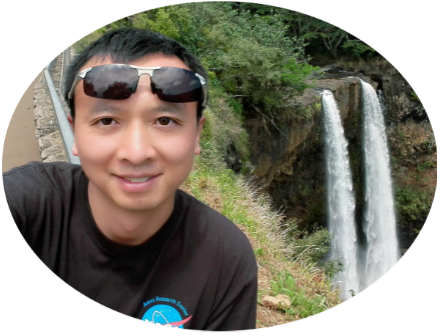
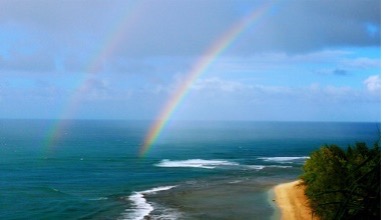
Rainbow at Ke’e beach (2007)
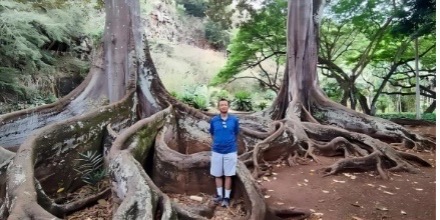
Moreton Bay fig trees and “dinosaur egg” in Allerton Garden (2021)
We have a favorite travel destination, the Kauai Island in Hawai’i. Our first visit to Kauai was in 2007, and we really, really like it. I went there more often than my family: I have been there seven times! (laughs) I enjoyed looking out to the west of Pacific Ocean at the end of the Waimea canyon and walking on the Ke’e beach at the east end of the Na Pali Trail. If there is a chance, I may think about living there after retirement.
You could do worse than that! In fact, that might be the answer to the next question, which is: with all your work and family responsibilities, and everything that you are involved in, what do you do for fun?
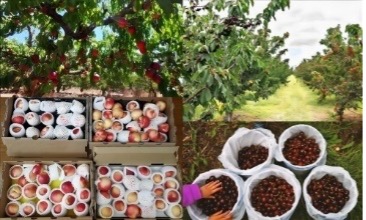
My interests include reading, like history, literature, and sci-fi books. I like sci-fi fictions and TV shows, such as “The Expanse” series, “The Peripheral” from last year, and the “Three-Body” TV series from China. For fun, I like Chinese Crosstalk, which is a comic dialogue between two people. Every year I also like to pick cherries and nectarines from farms in Brentwood.
Cherries and nectarines we picked from Brentwood farms.
Because I use my phone or camera like a recorder, I took too many photos here and there, far more than truly memorable moments. Those photos are a big headache when compiling a family yearbook. After our first child was born, it’s great fun to make annual photobooks for each year.
It’s wonderful that you do that. That will pay dividends in the future, for sure.
Before the pandemic, I also liked to have lunch together with a few colleagues every couple of weeks in some Chinese restaurants nearby, and most of the time we order spicy Chinese food.
You like that? I like that too, although not too spicy! What has been a prime inspiration for you in your life? Something that motivated you to accomplish all that you’ve accomplished so far.Is there a person that you particularly liked? Drake, for example, and his work, that helped to inspire you going forward?
A major motivation has been my curiosity about nature and stars. For inspirational figures, there were many – yes, Dr. Drake was one, because his work inspired people to think more seriously about the relation between life and the universe, and motivated me to make my own contributions. There was also inspiration from Professor Lee. After he won the chemistry Nobel Prize in 1986, there was a lot of laser chemistry related research going on in China. That’s what inspired me too, and why I asked him for advice.
This has been wonderful. I’ve learned a lot about you and that is the whole purpose of this series. Thank you very much. We’ve enjoyed chatting with you.
Thank you. It is great to have this opportunity to chat with you, I enjoyed it too.
Preparations for Next Moonwalk Simulations Underway (and Underwater)
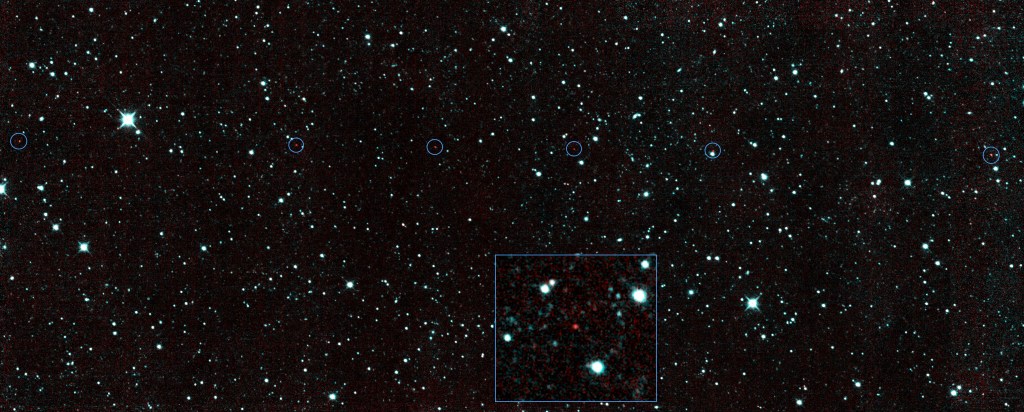
Moving across a background of stars, the six red dots in this composite picture indicate the location of six sequential detections of the first near-Earth object discovered by NEOWISE after the spacecraft came out of hibernation in 2013: the asteroid 2013 YP139. The inset shows a zoomed-in view of one of the detections.
NASA/JPL-Caltech
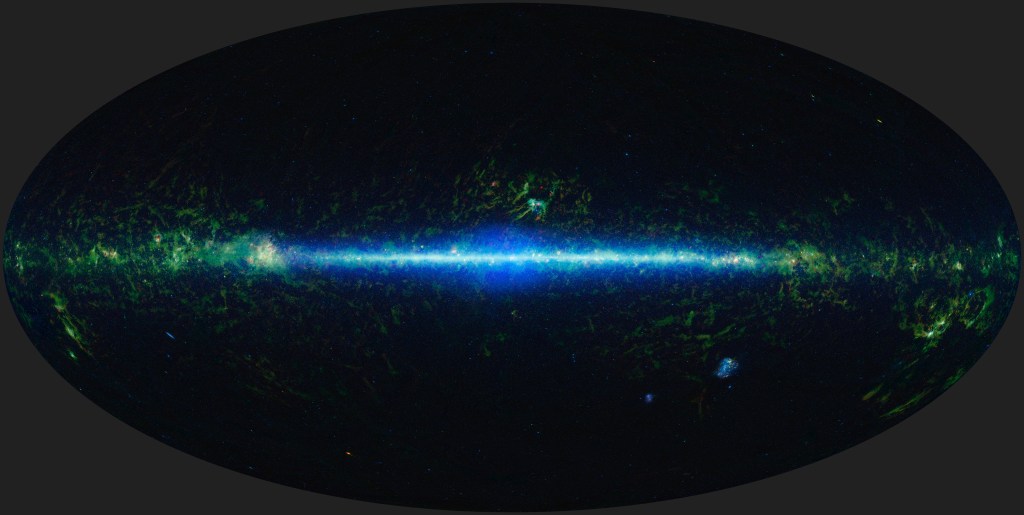
Observed by NASA’s WISE mission, this image shows the entire sky seen in infrared light. Running through the center of the image and seen predominantly in cyan are the stars of the Milky Way. Green and red represent interstellar dust.
NASA/JPL-Caltech/UCLA
NASA’s near-Earth-object-hunting mission NEOWISE is nearing its conclusion. But its work will carry on with NASA’s next-generation infrared mission: NEO Surveyor.
After more than 14 successful years in space, NASA’s NEOWISE (Near-Earth Object Wide-field Infrared Survey Explorer) mission will end on July 31. But while the mission draws to a close, another is taking shape, harnessing experience gained from NEOWISE: NASA’s NEO Surveyor (Near Earth Object Surveyor), the first purpose-built infrared space telescope dedicated to hunting hazardous near-Earth objects. Set for launch in late 2027, it’s a major step forward in the agency’s planetary defense strategy.
“After developing new techniques to find and characterize near-Earth objects hidden in vast quantities of its infrared survey data, NEOWISE has become key in helping us develop and operate NASA’s next-generation infrared space telescope. It is a precursor mission,” said Amy Mainzer, principal investigator of NEOWISE and NEO Surveyor at the University of California, Los Angeles. “NEO Surveyor will seek out the most difficult-to-find asteroids and comets that could cause significant damage to Earth if we don’t find them first.”
Seen here in a clean room at the Space Dynamics Laboratory in Logan, Utah, the WISE mission’s telescope is worked on by engineers. Avionics hardware and solar panels would later be attached before the spacecraft’s launch on Dec. 14, 2009.
SDL
WISE Beginnings
NEOWISE’s end of mission is tied to the Sun. About every 11 years, our star experiences a cycle of increased activity that peaks during a period called solar maximum. Explosive events, such as solar flares and coronal mass ejections, become more frequent and heat our planet’s atmosphere, causing it to expand. Atmospheric gases, in turn, increase drag on satellites orbiting Earth, slowing them down. With the Sun currently ramping up to predicted maximum levels of activity, and with no propulsion system for NEOWISE to keep itself in orbit, the spacecraft will soon drop too low to be usable.
The infrared telescope is going out of commission having exceeded scientific objectives for not one, but two missions, beginning as WISE (Wide-field Infrared Survey Explorer).
Managed by NASA’s Jet Propulsion Laboratory in Southern California, WISE launched in December 2009 with a six-month missionto scan the entire infrared sky. By July 2010, WISE had achieved this with far greater sensitivity than previous surveys, and NASA extended the mission until 2011.
During this phase, WISE studied distant galaxies, outgassing comets, exploding white dwarf stars, and brown dwarfs. It identified tens of millions of actively feeding supermassive black holes. It also generated data on circumstellar disks — clouds of gas, dust, and rubble spinning around stars — that citizen scientists continue to mine through the Disk Detective project.
In addition, it excelled at finding main belt asteroids, as well as near-Earth objects, and discovered the first known Earth Trojan asteroid. What’s more, the mission provided a census of dark, faint near-Earth objects that are difficult for ground-based telescopes to detect, revealing that these objects constitute a sizeable fraction of the near-Earth object population.
Comet NEOWISE was discovered by its namesake mission on March 27, 2020, and became a dazzling celestial object visible in the Northern Hemisphere for several weeks that year. It was one of 25 comets discovered by the mission.
SDL/Allison Bills
Infrared Heritage
Invisible to the naked eye, infrared wavelengths are emitted by warm objects. To keep the heat generated by WISE itself from interfering with its infrared observations, the spacecraft relied on cryogenic coolant. By the time the coolant had run out, WISE had mapped the sky twice, and NASA put the spacecraft into hibernation in February 2011.
Soon after, Mainzer and her team proposed a new mission for the spacecraft: to search for, track, and characterize near-Earth objects that generate a strong infrared signal from their heating by the Sun.
“Without coolant, we had to find a way to cool the spacecraft down enough to measure infrared signals from asteroids,” said Joseph Masiero, NEOWISE deputy principal investigator and a scientist at IPAC, a research organization at Caltech in Pasadena, California. “By commanding the telescope to stare into deep space for several months, we determined it would radiate only enough heat to reach lower temperatures that would still allow us to acquire high-quality data.” NASA reactivated the mission in 2013 under the Near-Earth Object Observations Program, a precursor to the agency’s current planetary defense program, with the new name NEOWISE.
By repeatedly observing the sky from low Earth orbit, NEOWISE has made 1.45 million infrared measurements of over 44,000 solar system objects to date. That includes more than 3,000 NEOs, 215 of which the space telescope discovered. Twenty-five of those are comets, among them the famed comet NEOWISE that was visible in the night sky in the summer of 2020.
“The spacecraft has surpassed all expectations and provided vast amounts of data that the science community will use for decades to come,” said Joseph Hunt, NEOWISE project manager at JPL. “Scientists and engineers who worked on WISE and through NEOWISE also have built a knowledge base that will help inform future infrared survey missions.”
The space telescope will continue its survey until July 31. Then, on Aug. 8, mission controllers at JPL will send a command that puts NEOWISE into hibernation for the last time. Since its launch, NEOWISE’s orbit has been dropping closer to Earth. NEOWISE is expected to burn up in our planet’s atmosphere sometime between late 2024 and early 2025.
More About the Mission
NEOWISE and NEO Surveyor support the objectives of NASA’s Planetary Defense Coordination Office (PDCO) at NASA Headquarters in Washington. The NASA Authorization Act of 2005 directed NASA to discover and characterize at least 90% of the near-Earth objects more than 140 meters (460 feet) across that come within 30 million miles (48 million kilometers) of our planet’s orbit. Objects of this size can cause significant regional damage, or worse, should they impact the Earth.
JPL manages and operates the NEOWISE mission for PDCO within the Science Mission Directorate. The Space Dynamics Laboratory in Logan, Utah, built the science instrument. Ball Aerospace & Technologies Corp. of Boulder, Colorado, built the spacecraft. Science data processing, archiving, and distribution is done at IPAC at Caltech. Caltech manages JPL for NASA.
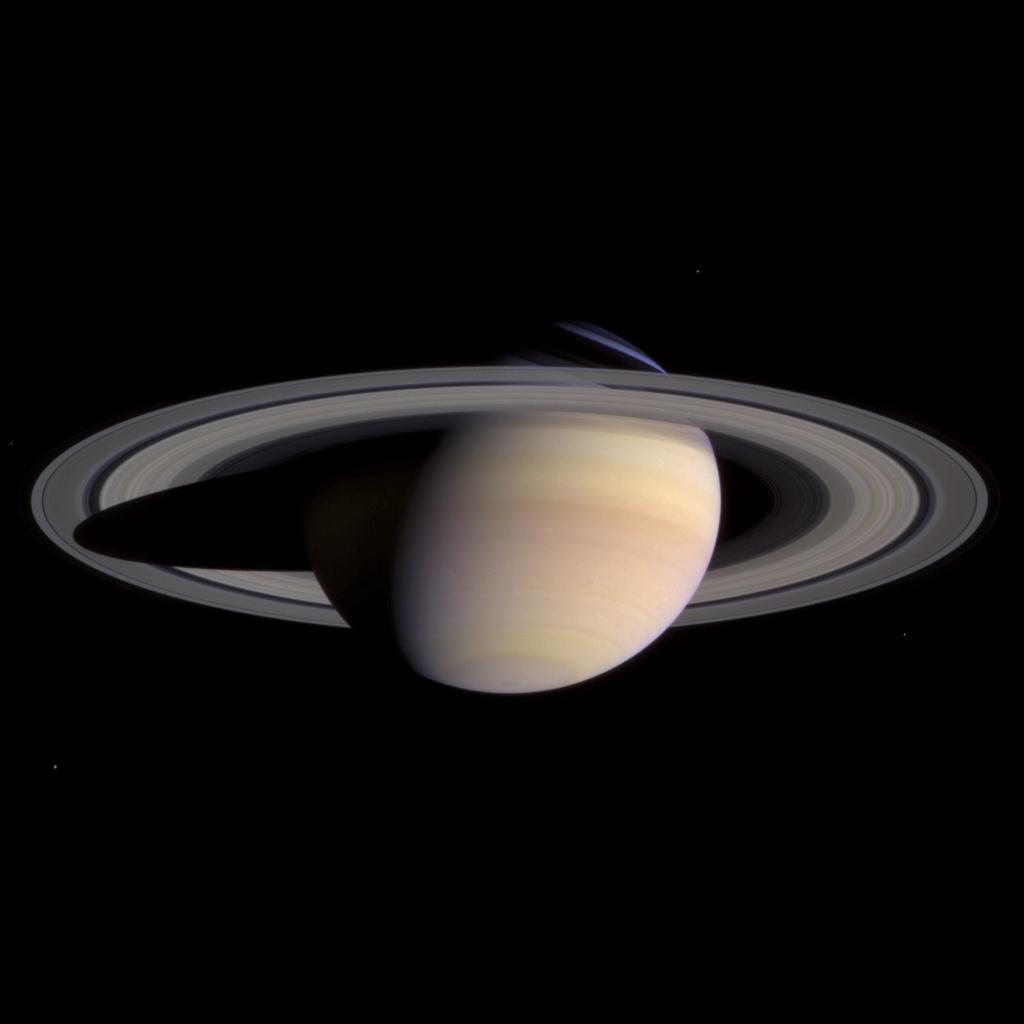
The Cassini-Huygens spacecraft captured this last “eyeful” of Saturn and its rings on March 27, 2004, as it continued its way to orbit insertion. This natural color image shows the color variations between atmospheric bands and features in the southern hemisphere of Saturn, subtle color differences across the planet’s middle B ring, as well as a bright blue sliver of light in the northern hemisphere – sunlight passing through the Cassini Division in Saturn’s rings and being scattered by the cloud-free upper atmosphere.
Cassini-Huygens, at 12,593 pounds one of the heaviest planetary probes ever, was launched on Oct. 15, 1997, on a Titan IVB/Centaur rocket from Cape Canaveral Air Force Station in Florida. Although that was the most powerful expendable launch vehicle available, it wasn’t powerful enough to send the massive Cassini-Huygens on a direct path to Saturn. Instead, the spacecraft relied on several gravity assist maneuvers to achieve the required velocity to reach the ringed planet. This seven-year journey took it past Venus twice, the Earth once, and Jupiter once, gaining more velocity with each flyby for the final trip to Saturn.
On July 1, 2004, with the Huygens lander still attached, Cassini fired its main engine for 96 minutes and entered an elliptical orbit around Saturn, becoming the first spacecraft to do so. Thus began an incredible 13-year in-depth exploration of the planet, its rings and its satellites, with scores of remarkable discoveries.
Preparations for Next Moonwalk Simulations Underway (and Underwater)
NAS visualization & data sciences lead Chris Henze demonstrates the newly upgraded hyperwall visualization system to Ames center director Eugene Tu, deputy center director David Korsmeyer, and High-End Computing Capability manager William Thigpen.
NASA/Brandon Torres Navarette
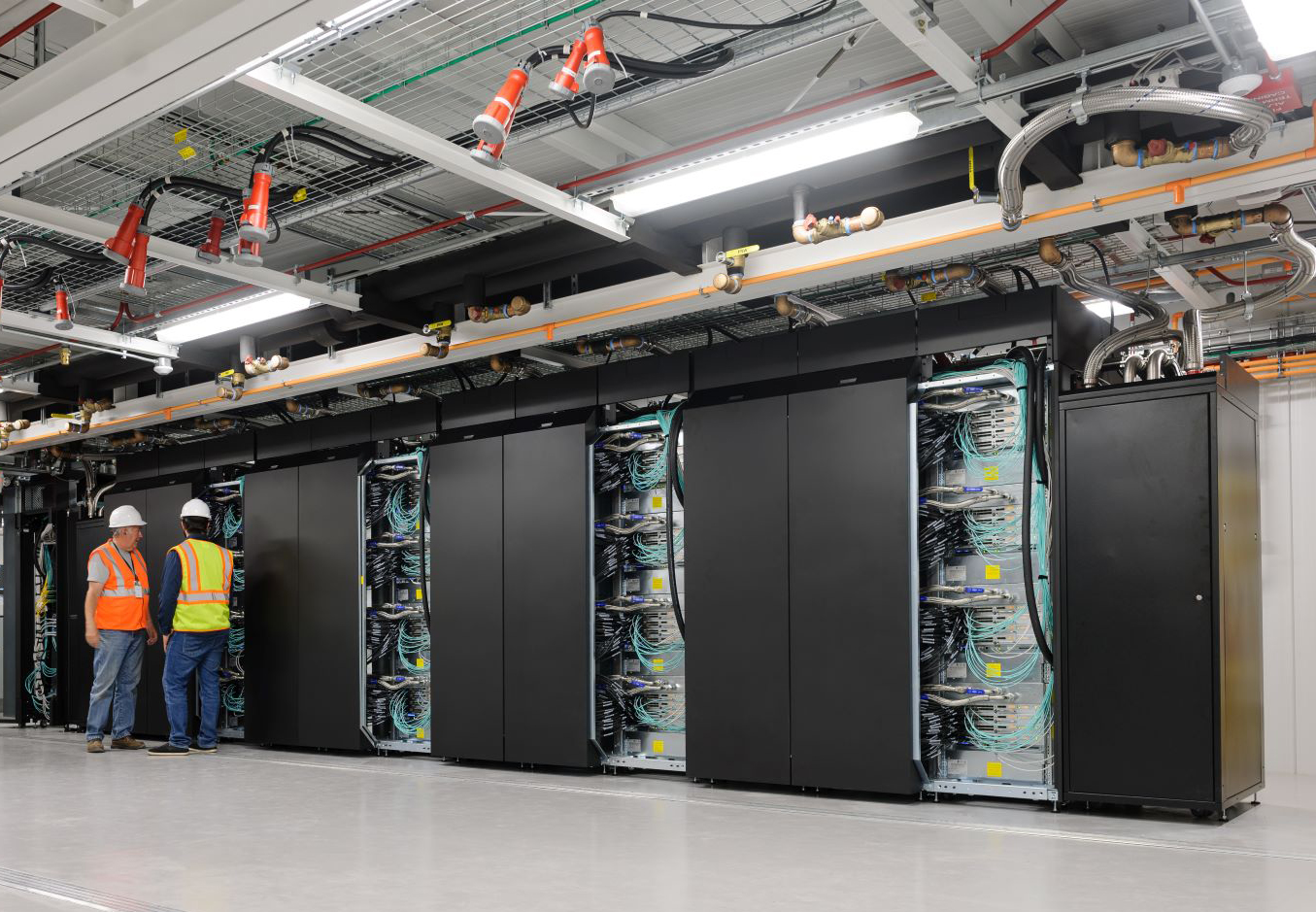
In May, the NASA Advanced Supercomputing (NAS) facility, located at NASA’s Ames Research Center in California’s Silicon Valley, celebrated the newest generation of its hyperwall system, a wall of LCD screens that display supercomputer-scale visualizations of the very large datasets produced by NASA supercomputers and instruments.
The upgrade is the fourth generation of hyperwall clusters at NAS. The LCD panels provide four times the resolution of the previous system, now spanning across a 300-square foot display with over a billion pixels. The hyperwall is one of the largest and most powerful visualization systems in the world.
Systems like the NAS hyperwall can help researchers visualize their data at large scale, across different viewpoints or using different parameters for new ways of analysis. The improved resolution of the new system will help researchers “zoom in” with greater detail.
The hyperwall is just one way researchers can utilize NASA’s high-end computing technology to better understand their data. The NAS facility offers world-class supercomputing resources and services customized to meet the needs of about 1,500 users from NASA centers, academia and industry.
July’s Night Sky Notes: A Hero, a Crown, and Possibly a Nova!
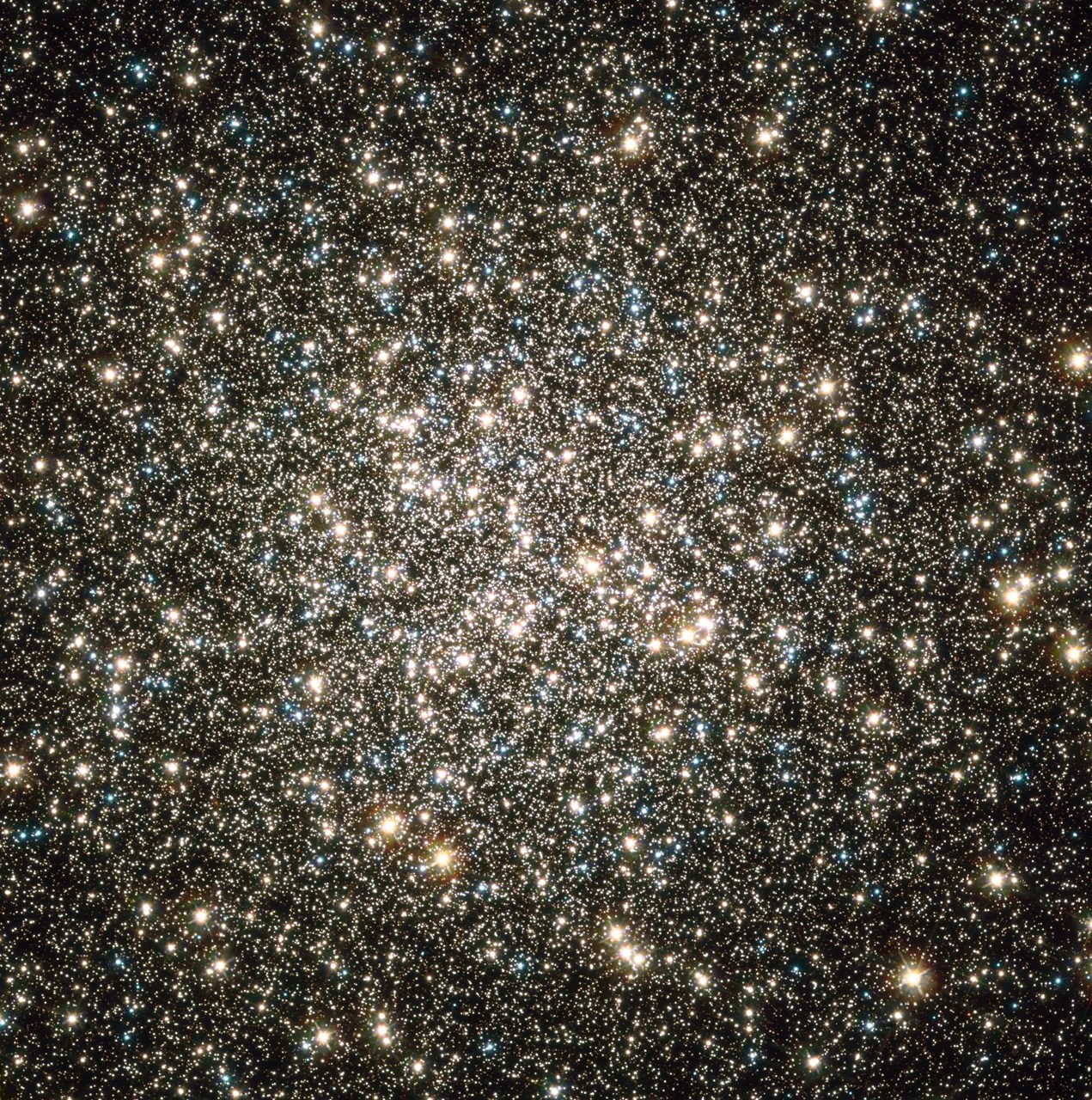
Like shiny flakes sparkling in a snow globe, over 100,000 stars whirl within the globular cluster M13, one of the brightest star clusters visible from the Northern Hemisphere. Located 25,000 light-years from Earth with an apparent magnitude of 5.8, this glittering metropolis of stars in the constellation Hercules can be spotted with a pair of binoculars most easily in July.
Credits: NASA
by Vivan White of the Astronomical Society of the Pacific
High in the summer sky, the constellation Hercules acts as a centerpiece for late-night stargazers. At the center of Hercules is the “Keystone,” a near-perfect square shape between the bright stars Vega and Arcturus that is easy to recognize and can serve as a guidepost for some amazing sights. While not the brightest stars, the shape of the hero’s torso, like a smaller Orion, is nearly directly overhead after sunset. Along the edge of this square, you can find a most magnificent jewel – the Great Globular Cluster of Hercules, also known as Messier 13.
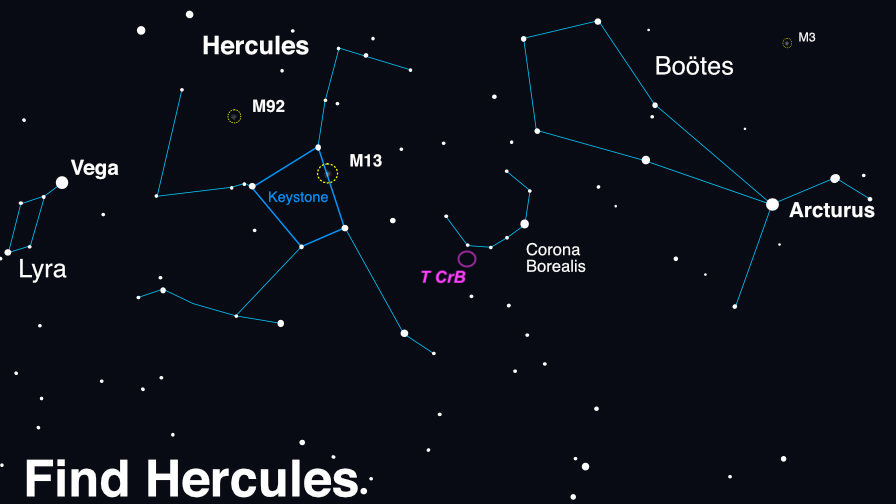
Look up after sunset during summer months to find Hercules! Scan between Vega and Arcturus, near the distinct pattern of Corona Borealis. Once you find its stars, use binoculars or a telescope to hunt down the globular clusters M13 (and a smaller globular cluster M92). If you enjoy your views of these globular clusters, you’re in luck – look for another great globular, M3, near the constellation Boötes.
Credit: Stellarium
Globular clusters are a tight ball of very old stars, closer together than stars near us. These clusters orbit the center of our Milky Way like tight swarms of bees. One of the most famous short stories, Nightfall by Isaac Asimov, imagines a civilization living on a planet within one of these star clusters. They are surrounded by so many stars so near that it is always daytime except for once every millennium, when a special alignment (including a solar eclipse) occurs, plunging their planet into darkness momentarily. The sudden night reveals so many stars that it drives the inhabitants mad.
Back here on our home planet Earth, we are lucky enough to experience skies full of stars, a beautiful Moon, and regular eclipses. On a clear night this summer, take time to look up into the Keystone of Hercules and follow this sky chart to the Great Globular Cluster of Hercules. A pair of binoculars will show a faint, fuzzy patch, while a small telescope will resolve some of the stars in this globular cluster.
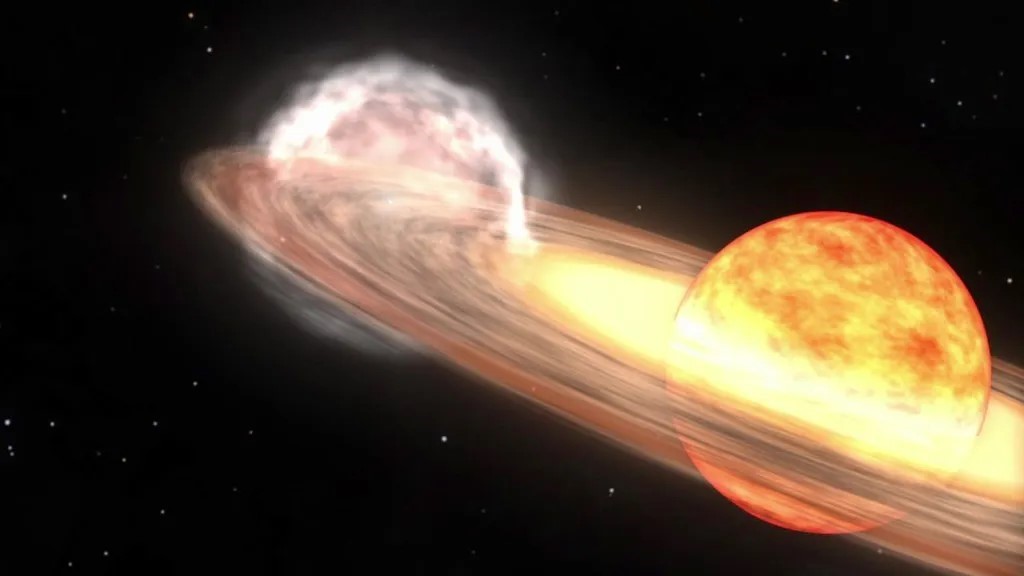
A red giant star and white dwarf orbit each other in this animation of a nova similar to T Coronae Borealis. The red giant is a large sphere in shades of red, orange, and white, with the side facing the white dwarf the lightest shades. The white dwarf is hidden in a bright glow of white and yellows, which represent an accretion disk around the star. A stream of material, shown as a diffuse cloud of red, flows from the red giant to the white dwarf. When the red giant moves behind the white dwarf, a nova explosion on the white dwarf ignites, creating a ball of ejected nova material shown in pale orange. After the fog of material clears, a small white spot remains, indicating that the white dwarf has survived the explosion.
NASA/Goddard Space Flight Center
Bonus! Between Hercules and the ice-cream-cone-shaped Boötes constellation, you’ll find the small constellation Corona Borealis, shaped like the letter “C.” Astronomers around the world are watching T Coronae Borealis, also known as the “Blaze Star” in this constellation closely because it is predicted to go nova sometime this summer. There are only 5 known nova stars in the whole galaxy. It is a rare observable event and you can take part in the fun! The Astronomical League has issued a Special Observing Challenge that anyone can participate in. Just make a sketch of the constellation now (you won’t be able to see the nova) and then make another sketch once it goes nova.
Tune into our mid-month article on the Night Sky Network page, as we prepare for the Perseids! Keep looking up!
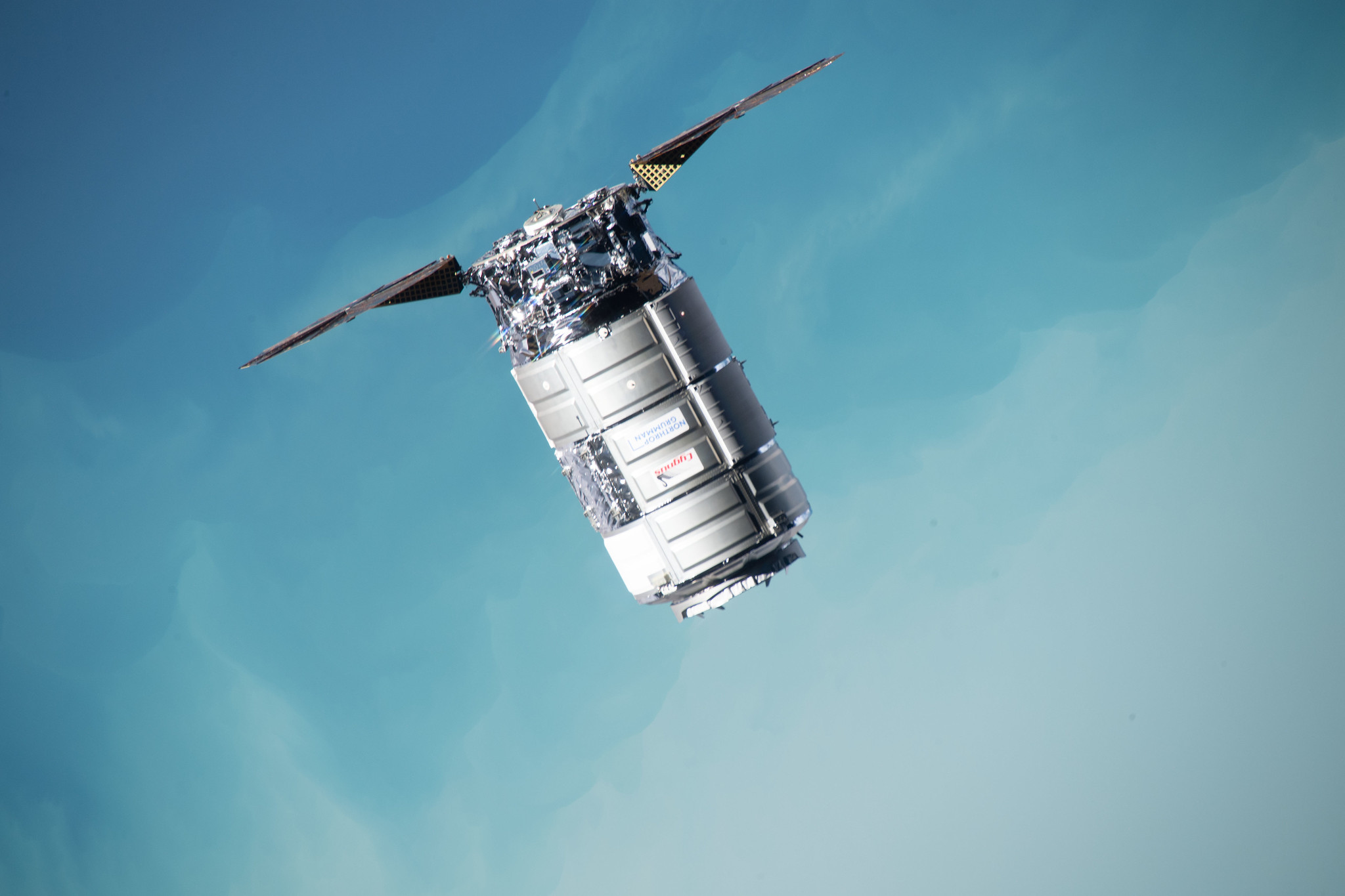
Northrop Grumman’s Cygnus spacecraft approaches the International Space Station. Cygnus will deliver science experiments, crew supplies, and station hardware (Credits: NASA).
Media accreditation is open for the next launch to deliver NASA science investigations, supplies, and equipment to the International Space Station. This launch is the 21st Northrop Grumman commercial resupply services mission to the orbital laboratory for the agency and will launch on a SpaceX Falcon 9 rocket.
NASA, Northrop Grumman, and SpaceX are targeting early August to launch the Cygnus spacecraft from Space Launch Complex 40 at Cape Canaveral Space Force Station in Florida.
Following launch, the space station’s Canadarm2 will grapple Cygnus and the spacecraft will attach to the Unity module’s Earth-facing port for cargo unloading.
Credentialing to cover prelaunch and launch activities is open to U.S. media. The application deadline for U.S. citizens is 11:59 p.m. EDT, Friday, July 19. All accreditation requests must be submitted online at:
Credentialed media will receive a confirmation email upon approval. NASA’s media accreditation policy is available online. For questions about accreditation, or to request special logistical support, email: ksc-media-accreditat@mail.nasa.gov. For other questions, please contact NASA’s Kennedy Space Center newsroom at: 321-867-2468.
Para obtener información sobre cobertura en español en el Centro Espacial Kennedy o si desea solicitor entrevistas en español, comuníquese con Antonia Jaramillo o Messod Bendayan a:antonia.jaramillobotero@nasa.govomessod.c.bendayan@nasa.gov.
Each resupply mission to the station delivers scientific investigations in the areas of biology and biotechnology, Earth and space science, physical sciences, and technology development and demonstrations. Cargo resupply from U.S. companies ensures a national capability to deliver scientific research to the space station, significantly increasing NASA’s ability to conduct new investigations aboard humanity’s laboratory in space.
In addition to food, supplies, and equipment for the crew, Cygnus will deliver research, including supplies for a new STEMonstration and several test articles to observe water flow in microgravity. Other investigations aboard include vascularized liver tissue and a bioreactor to demonstrate the production of blood and immune stem cells. Researchers will learn more about biomanufacturing in microgravity to create higher quality treatments for people on Earth.
NASA’s CubeSat Launch Initiative also is sending two CubeSats to deploy from the orbiting laboratory, CySat-1 from Iowa State Universityand DORA from Arizona State University, making up ELaNa 52 (Educational Launch of Nanosatellites).
Crews have occupied the space station continuously since November 2000. In that time, 280 people from 21 countries have visited the orbital outpost. The space station is a springboard to NASA’s next great leap in exploration, including future missions to the Moon under Artemis, and ultimately, human exploration of Mars.
Learn more about NASA’s commercial resupply missions at: