Tuesday, 6 February 2024

When Dead Stars Collide!

4 min read

When Dead Stars Collide!

Gravity has been making waves — literally. In October 2017, the Nobel Prize in Physics was awarded for the first direct detection of gravitational waves two years earlier. Also in that month, astronomers announced a huge advance in the field of gravitational waves: For the first time, they had observed light and gravitational waves from the same source. Let’s look at what happened.
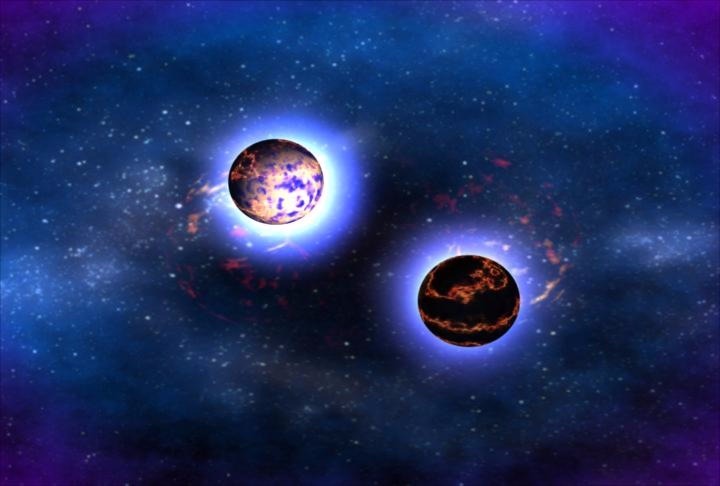
Two glowing stars with red and black surfaces sit in the middle of a starfield.
Two neutron stars are on the verge of colliding in this illustration.
NASA’s Goddard Space Flight Center

There was a pair of orbiting neutron stars in a galaxy (called NGC 4993). Neutron stars are the crushed leftover cores of massive stars (stars more than 8 times the mass of our sun) that long ago exploded as supernovae. There are many such pairs of binaries in this galaxy, and in all the galaxies we can see, but something special was about to happen to this particular pair.
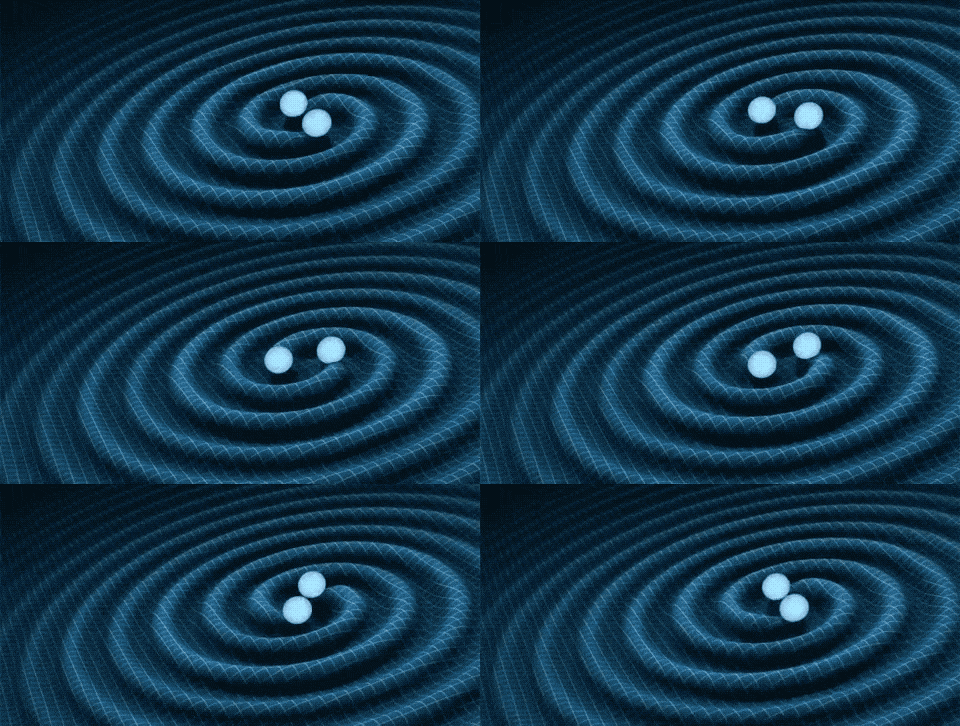
Two blue spheres circle each other on a grid representing space-time. As the spheres orbit, ripples propagate outward along the grid, representing gravitational waves.
An animation of gravitational wave propagation.
R. Hurt/Caltech/JPL

Each time these neutron stars orbited, they would lose a teeny bit of gravitational energy to gravitational waves. Gravitational waves are disturbances in space-time — the very fabric of the universe — that travel at the speed of light. The waves are emitted by any mass that is changing speed or direction, like this pair of orbiting neutron stars. However, the gravitational waves are very faint unless the neutron stars are very close and orbiting around each other very fast.
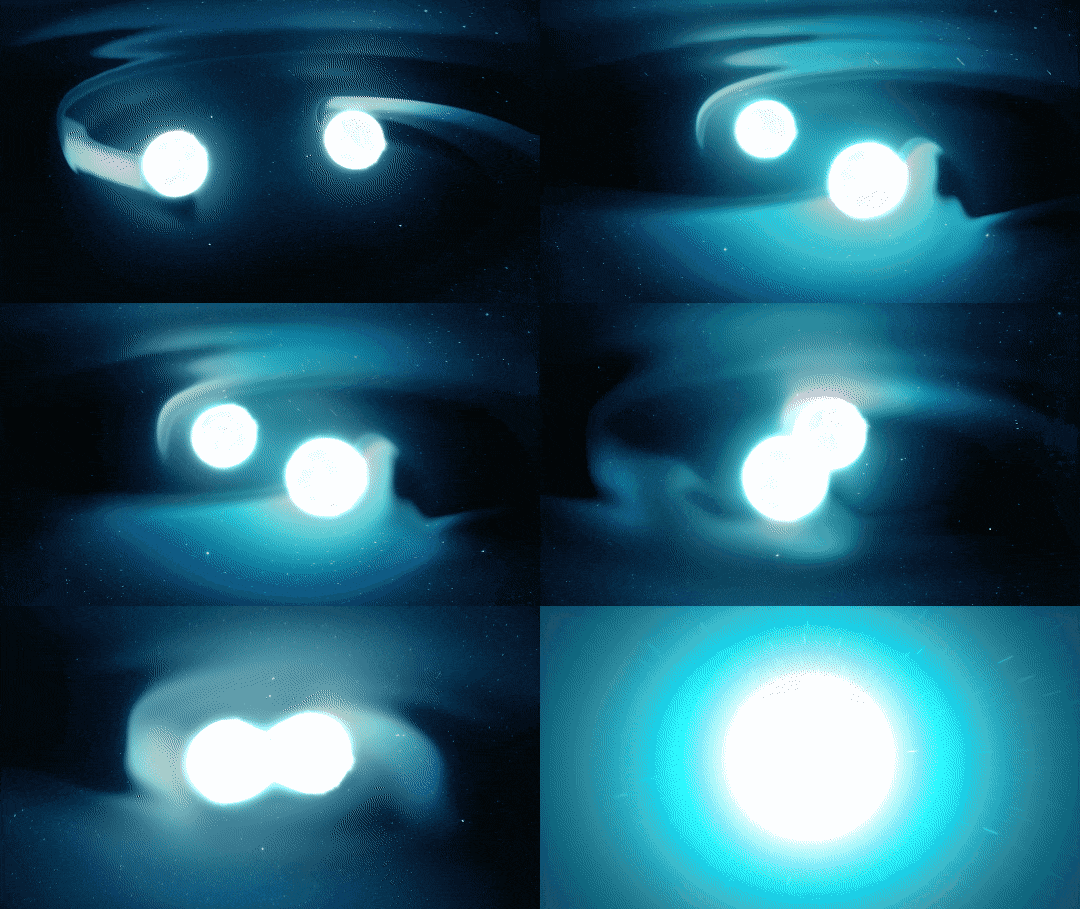
Two bright spheres orbit each other, and pale arcs of blue, representing gravitational waves, ripple away from the spheres. The spheres get closer with each orbit, and as they do they distort, turning into teardrop shapes, with the points pointing toward the center. Then they touch and finally merge in a bright, white explosion.
Doomed neutron stars whirl toward their demise in this illustration. Gravitational waves (pale arcs) bleed away orbital energy, causing the stars to move closer together and merge.
NASA’s Goddard Space Flight Center/Conceptual Image Lab

The teeny energy loss caused the two neutron stars to get a teeny bit closer to each other and orbit a teeny bit faster. After hundreds of millions of years, all those teeny bits added up, and the neutron stars were very close. So close that … BOOM! … they collided. And we witnessed it on Earth on August 17, 2017.
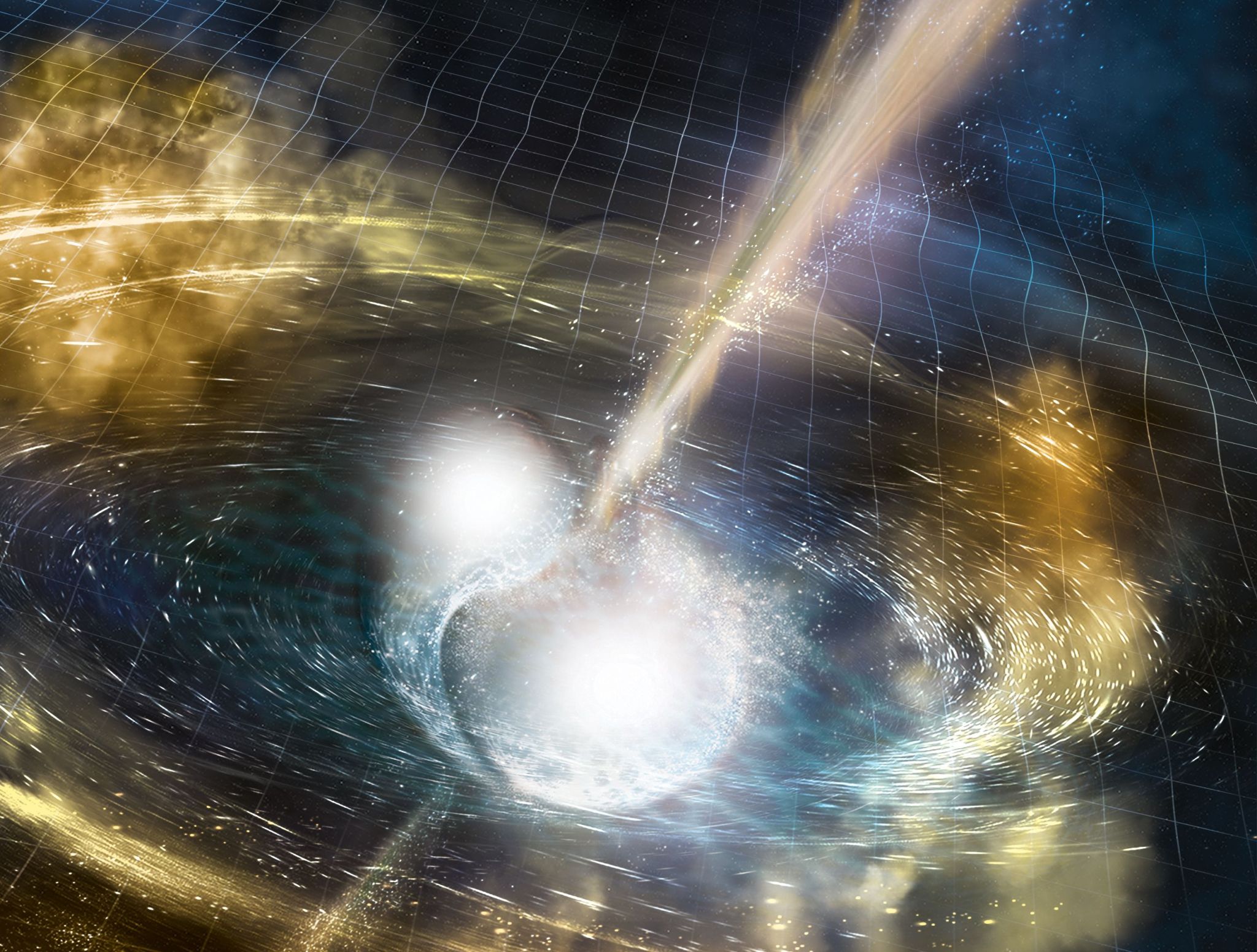
At the center of this illustration is a bright region of light that looks like two balls that haven’t quite merged into one. Two rays of white and orange light emanate from that central collision, one up and to the right, the other down and to the left, though you can’t see the one to the left quite as well because there is also a disk of swirling material blocking the view. There is also a faint grid across the entire image, representing space-time. Ripples in the grid can be seen at the edges of the image, showing gravitational waves that had been emitted by the merger.
Illustration of two merging neutron stars. The rippling space-time grid represents gravitational waves that travel out from the collision. Narrow beams show the burst of gamma rays that are shot out just seconds after the gravitational waves. The swirling clouds of material are ejected from the merging stars.
National Science Foundation/LIGO/A. Simonnet (Sonoma State Univ.)

A couple of very cool things happened in that collision, and we expect they happen in all such neutron-star collisions. Just before the neutron stars collided, the gravitational waves were strong enough and at just the right frequency that the National Science Foundation’s Laser Interferometer Gravitational-Wave Observatory (LIGO) and European Gravitational Observatory’s Virgo could detect them. Just after the collision, those waves quickly faded out because there are no longer two things orbiting around each other!

LIGO and Virgo are ground-based detectors waiting for gravitational waves to pass through their facilities on Earth. When it is active, it can detect them from almost anywhere in space.
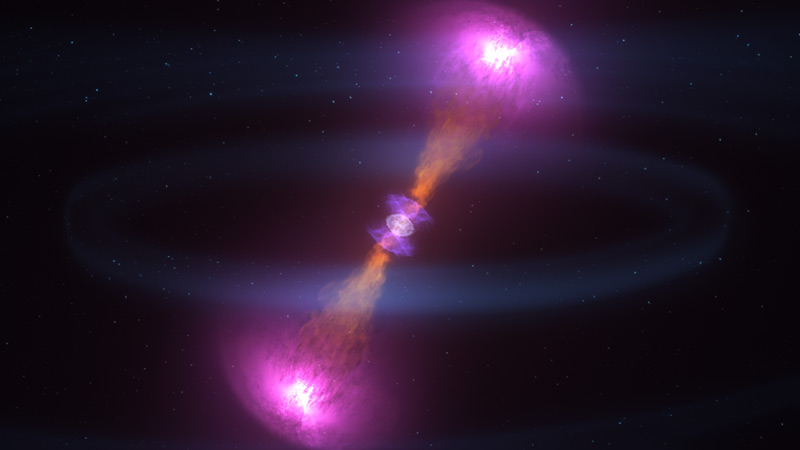
This animation of a gamma-ray burst shows two jets of material that look like two orange cones connected by their points and facing in opposite directions, one opening up and to the right of the center, the other opening down and to the left. The ends of the cones have bright magenta light, which represent an expanding shock wave. At the center is a wrapped-candy-shaped blue structure lined up with the jets which represents the kilonova, the neutron-rich debris of the explosion.
This illustration shows a snapshot of a gamma-ray burst caused by the merger of two neutron stars. Powerful jets (orange) emerge and plow into their surroundings, causing shock waves (pink). Just emerging at the center is the kilonova, the neutron-rich debris of the explosion (blue) powered by the decay of newly forged radioactive elements.
NASA’s Goddard Space Flight Center/Conceptual Image Lab

The other thing that happened was what we call a gamma-ray burst. When they get very close, the neutron stars break apart and create a spectacular, but short, explosion. For a couple of seconds, our Fermi satellite saw gamma rays from that explosion. Fermi’s Gamma-ray Burst Monitor is one of our eyes on the sky, looking out for such bursts of gamma rays that scientists want to catch as soon as they’re happening.

And those gamma rays came just 1.7 seconds after the gravitational wave signal. The galaxy this occurred in is 130 million light-years away, so the light and gravitational waves were traveling for 130 million years before we detected them.
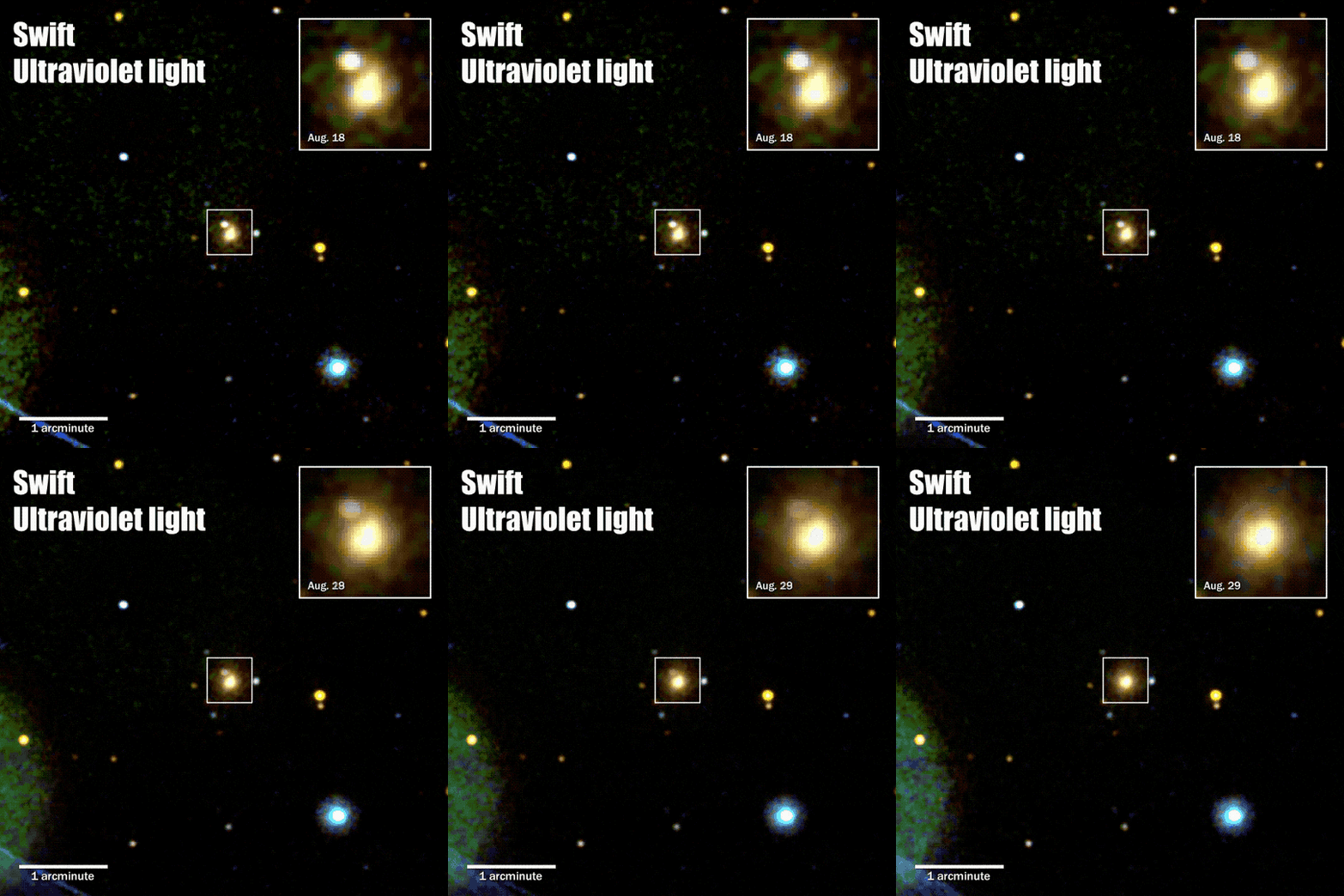
This animation GIF has text “Swift Ultraviolet light,” and shows the UV light Swift detected on August 18 and 29, fading between the two. The image shows the sky, black with several small circles of light. On August 18, the central source appears as a small yellow blob with a second white ball just to the side of it. On August 29, the white ball has disappeared, leaving just the larger yellow source.
NASA’s Neil Gehrels Swift Observatory imaged the kilonova produced by merging neutron stars in the galaxy NGC 4993 (box) on Aug. 18, 2017, about 15 hours after gravitational waves and the gamma-ray burst were detected. Inset: Magnified views of the galaxy.
NASA/Swift

After that initial burst of gamma rays, the debris from the explosion continued to glow, fading as it expanded outward. Our Swift, Hubble, Chandra, and Spitzer telescopes, along with a number of ground-based observatories, were poised to look at this afterglow from the explosion in ultraviolet, optical, X-ray, and infrared light. Such coordination between satellites is something that we’ve been doing with our international partners for decades, so we catch events like this one as quickly as possible and in as many wavelengths as possible.
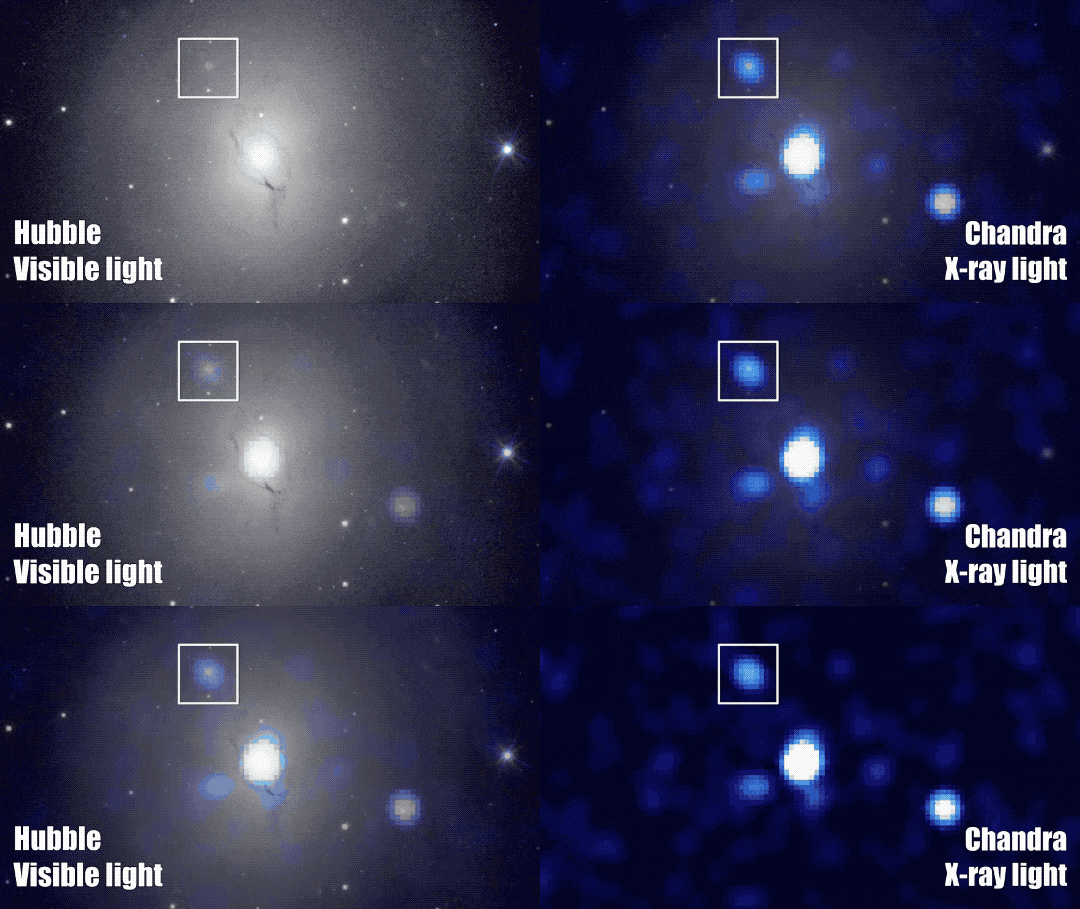
This animated GIF shows the region of the sky where the gravitational waves and gamma-ray burst were detected as seen by Hubble in visible light and Chandra in X-ray light, fading between the two. In visible light, there is a bright oval-shaped galaxy that takes up most of the image with a bright, white center region that fades into gray clouds around it. The site of the gamma-ray burst is outlined in a box, and shows a dim source in visible light about half way between the center of the galaxy and its edge. In X-ray light, the galaxy’s center and a couple of other sources appear as dots encircled in blue. The galaxy itself does not show up in X-rays. The site of the gamma-ray burst is a bright blue source.
The kilonova associated with GW170817 (box) was observed by NASA’s Hubble Space Telescope and Chandra X-ray Observatory. Hubble detected optical and infrared light from the hot expanding debris. Nine days later, Chandra detected the X-ray afterglow emitted by the jet directed toward Earth after it had spread into our line of sight.
NASA/CXC/E. Troja

Astronomers have thought that neutron star mergers were the cause of one type of gamma-ray burst — a short gamma-ray burst, like the one they observed on August 17. It wasn’t until we could combine the data from our satellites with the information from LIGO/Virgo that we could confirm this directly.
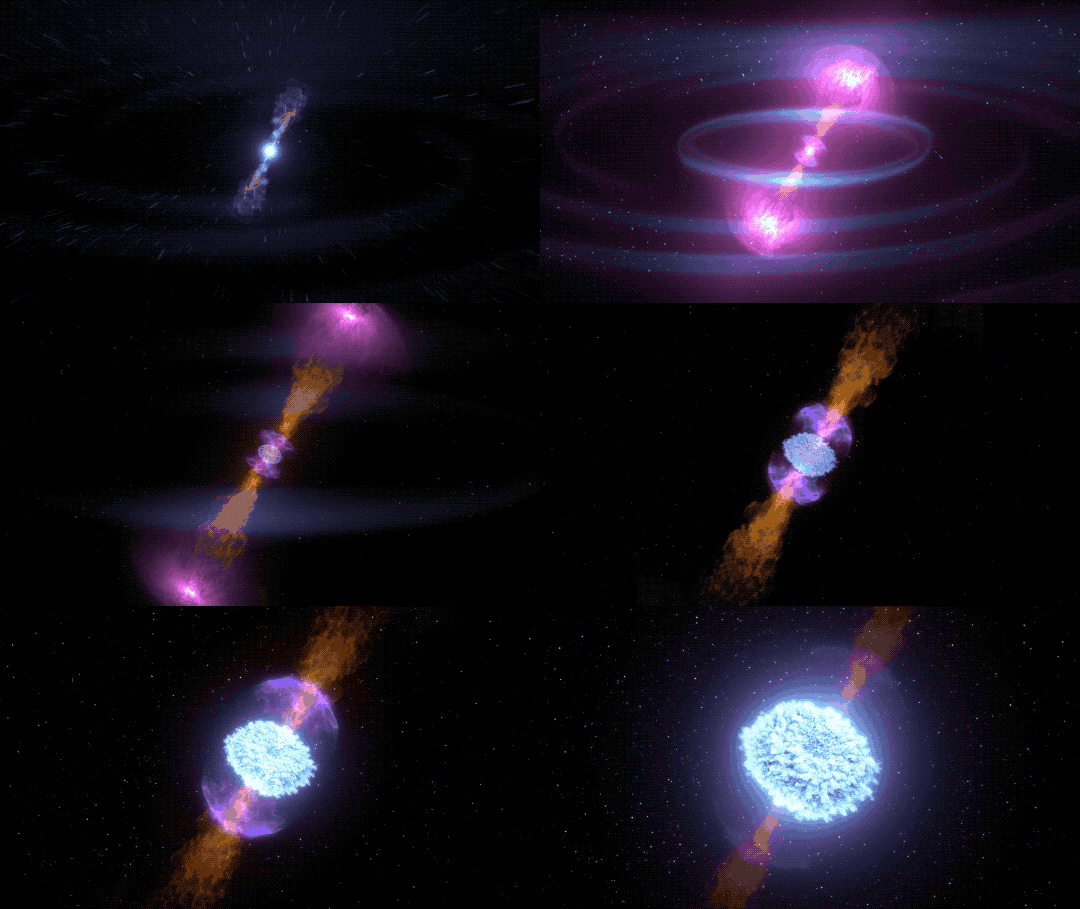
When this animation opens, there are concentric rings of pale blue the expand away and off the screen. At the center is a bright ball of light with two narrow cones of orange, fiery-looking material extend in opposing directions, tilted just to the right. During the first few seconds, there are magenta flashes of light that seem to be pushed along with the ends of the orange cones. The central ball expands into a puffy, electric blue cloud. The sequence represents the events that happened after two neutron stars merged, exploding in a gamma-ray burst.
This animation captures phenomena observed over the course of nine days following the neutron star merger known as GW170817, detected on Aug. 17, 2017. They include gravitational waves (pale arcs), a near-light-speed jet that produced gamma rays (magenta), expanding debris from a kilonova that produced ultraviolet (violet), optical and infrared (blue-white to red) emission, and, once the jet directed toward us expanded into our view from Earth, X-rays (blue).
NASA’s Goddard Space Flight Center/Conceptual Image Lab

That event began a new chapter in astronomy. For centuries, light was the only way we could learn about our universe. Now, we’ve opened up a whole new window into the study of neutron stars and black holes. This means we can see things we could not detect before.
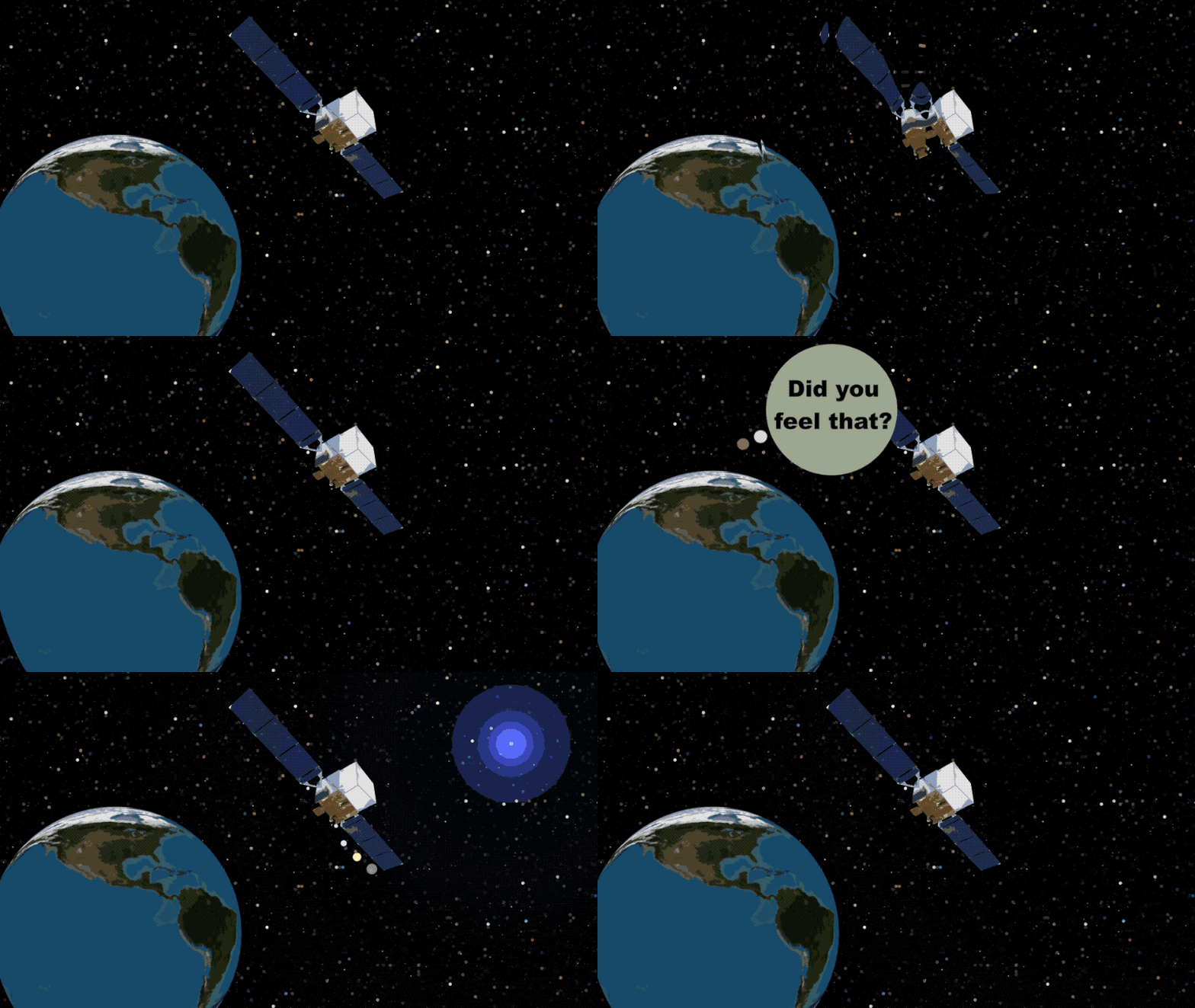
This animated GIF shows a fun animation of what happened on Aug. 17, 2017. The scene shows Earth on the left side with a cartoon depiction of the Fermi satellite near the center. The image appears to ripple, starting from a dot on the upper right of the image. A speech bubble raises from two site on Earth that says, “Did you hear that?” Then, 1.7 seconds after the ripple, a magenta “blast” of light appears where the ripple originated, and the Fermi telescope has a speech bubble that says, “I sure saw it!”
On Aug. 17, gravitational waves from merging neutron stars reached Earth. Just 1.7 seconds after that, NASA’s Fermi saw a gamma-ray burst from the same event. Now that astronomers can combined what we can “see” (light) and what we can “hear” (gravitational waves) from the same event, our ability to understand these extreme cosmic phenomena is greatly enhanced.
NASA’s Goddard Space Flight Center

The first LIGO detection was of a pair of merging black holes. Mergers like that may be happening as often as once a month across the universe, but they do not produce much light because there’s little to nothing left around the black hole to emit light. In that case, gravitational waves were the only way to detect the merger.

The neutron star merger, though, has plenty of material to emit light. By combining different kinds of light with gravitational waves, we are learning how matter behaves in the most extreme environments. We are learning more about how the gravitational wave information fits with what we already know from light — and in the process we’re solving some long-standing mysteries!


from NASA https://ift.tt/BkyFLNx
Monday, 5 February 2024

NASA Administrator Announces New Marshall Space Flight Center Director

Official portrait of Joseph Pelfrey, director, NASA’s Marshall Space Flight Center in Huntsville, Alabama.
NASA

NASA Administrator Bill Nelson on Monday named Joseph Pelfrey director of the agency’s Marshall Space Flight Center in Huntsville, Alabama, effective immediately. Pelfrey has served as acting center director since July 2023.

“Joseph is a respected leader who shares the passion for innovation and exploration at NASA Marshall. As center director, he will lead the entire Marshall workforce, which includes a world-renowned team of scientists, engineers, and technologists who have a hand in nearly every NASA mission,” said Nelson. “I am confident that under Joseph’s leadership, Marshall will continue to make critical advancements supporting Artemis and Moon to Mars that will benefit all humanity.” 

NASA Marshall is one of the agency’s largest field centers, and manages NASA’s Michoud Assembly Facility in New Orleans, where some of the largest elements of the SLS (Space Launch System) rocket and Orion spacecraft for the Artemis campaign are manufactured. The center also is responsible for the oversight and execution of an approximately $5 billion portfolio comprised of human spaceflight, science, and technology development efforts. Its workforce consists of nearly 7,000 employees, both civil servants and contractors. 

“Marshall is renowned for its expertise in exploration and scientific discovery, and I am honored and humbled to be chosen to lead the center into the future,” said Pelfrey. “We will continue to shape the future of human space exploration by leading SLS and human landing system development for Artemis and leveraging our capabilities to make critical advancements in human landing and cargo systems, habitation and transportation systems, advanced manufacturing, mission operations, and cutting-edge science and technology missions.”

Prior to joining NASA, Pelfrey worked in industry, supporting development of space station payload hardware. He began his NASA career as an aerospace engineer in the Science and Mission Systems Office, going on to serve in various leadership roles within the International Space Station Program, the Marshall Engineering Directorate and the SLS Spacecraft/Payload Integration and Evolution Office. He also served as manager for the Commercial Orbital Transportation Services Project at Marshall and the Exploration and Space Transportation Development Office in the Flight Programs and Partnerships Office.

Appointed to the Senior Executive Service in 2016, Pelfrey served as the associate director for operations in Engineering, later becoming deputy manager and subsequently manager for Marshall’s Human Exploration Development and Operations Office. He was appointed as Marshall’s deputy center director in April 2022.

Pelfrey received a bachelor’s degree in Aerospace Engineering from Auburn University in 2000.

Learn more about Pelfrey in his biography online at:

https://www.nasa.gov/people/joseph-pelfrey/

-end-

Faith McKie / Cheryl Warner 
Headquarters, Washington 
202-358-1600 
faith.d.mckie@nasa.gov / cheryl.m.warner@nasa.gov  

Lance Davis
Marshall Space Flight Center, Huntsville, Ala.
256-640-9065 
lance.d.davis@nasa.gov    

Share

Details

Last Updated
Feb 05, 2024


from NASA https://ift.tt/1It9ZqE

University High School Wins Regional Science Bowl at NASA’s JPL

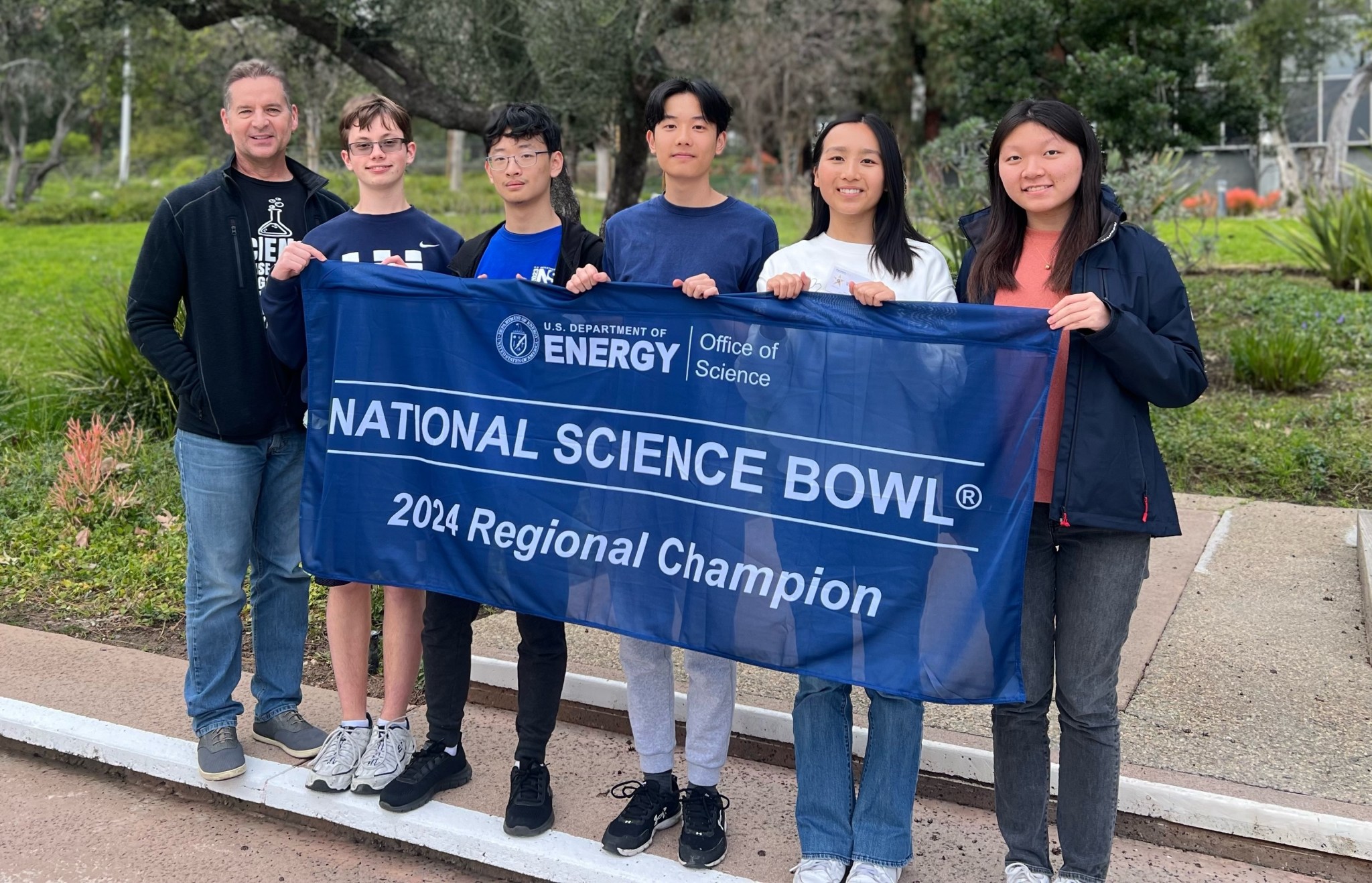
The 2024 National Science Bowl regional competition hosted by JPL included 21 schools, with this team from Irvine’s University High School taking first place. From left, coach David Knight, Feodor Yevtushenko, Yufei Chen, Nathan Ouyang, Wendy Cao, and Julianne Wu.
NASA/JPL-Caltech

After months of preparation, more than 100 students competed at the fast-paced annual academic competition hosted by NASA’s Jet Propulsion Laboratory.

For the second year in a row, a team from Irvine’s University High School claimed victory at a regional competition of the National Science Bowl, hosted Saturday, Feb. 3, by NASA’s Jet Propulsion Laboratory in Southern California.

More than 100 students from 21 schools in Los Angeles and Orange counties competed in the academic challenge, which marked JPL’s 32nd year as host. Fullerton’s Troy High won second place, and Arcadia High placed third.

Teams from University High have triumphed at the event several times in recent years. The school also won this year’s regional Ocean Sciences Bowl, hosted last month by JPL.

In National Science Bowl competitions, students have mere seconds to answer multiple-choice questions on topics including biology, chemistry, Earth science, physics, energy, and math. Four students and one alternate compose each team, with a teacher serving as coach.

Student teams spend months preparing, both studying and practicing their technique with the bowl’s “Jeopardy!”-style buzzers. Dozens of volunteers from JPL help make sure the contest runs smoothly. It all comes down to a surprisingly intense event.

“There’s so much energy, it’s a thrill to watch,” said JPL Public Services Office manager Kim Lievense, who’s been coordinating the competition for the lab since 1993. “I just love seeing the students’ concentration and commitment, and knowing how rewarding it is for volunteers as well.”

University High is now eligible to compete against winners from dozens of other regional competitions across the country at the national finals tournament, held in Washington April 25-29.

Run by the U.S. Department of Energy Office of Science, the National Science Bowl is one of the nation’s largest academic science competitions. More than 344,000 students have participated since the competition began in 1991.

News Media Contacts

Melissa Pamer
Jet Propulsion Laboratory, Pasadena, Calif.
626-314-4928
melissa.pamer@jpl.nasa.gov

2024-011

Share

Details

Last Updated
Feb 05, 2024


from NASA https://ift.tt/6CjvAYE

NASA’s Laser Navigation Tech Enables Commercial Lunar Exploration

5 Min Read

NASA’s Laser Navigation Tech Enables Commercial Lunar Exploration

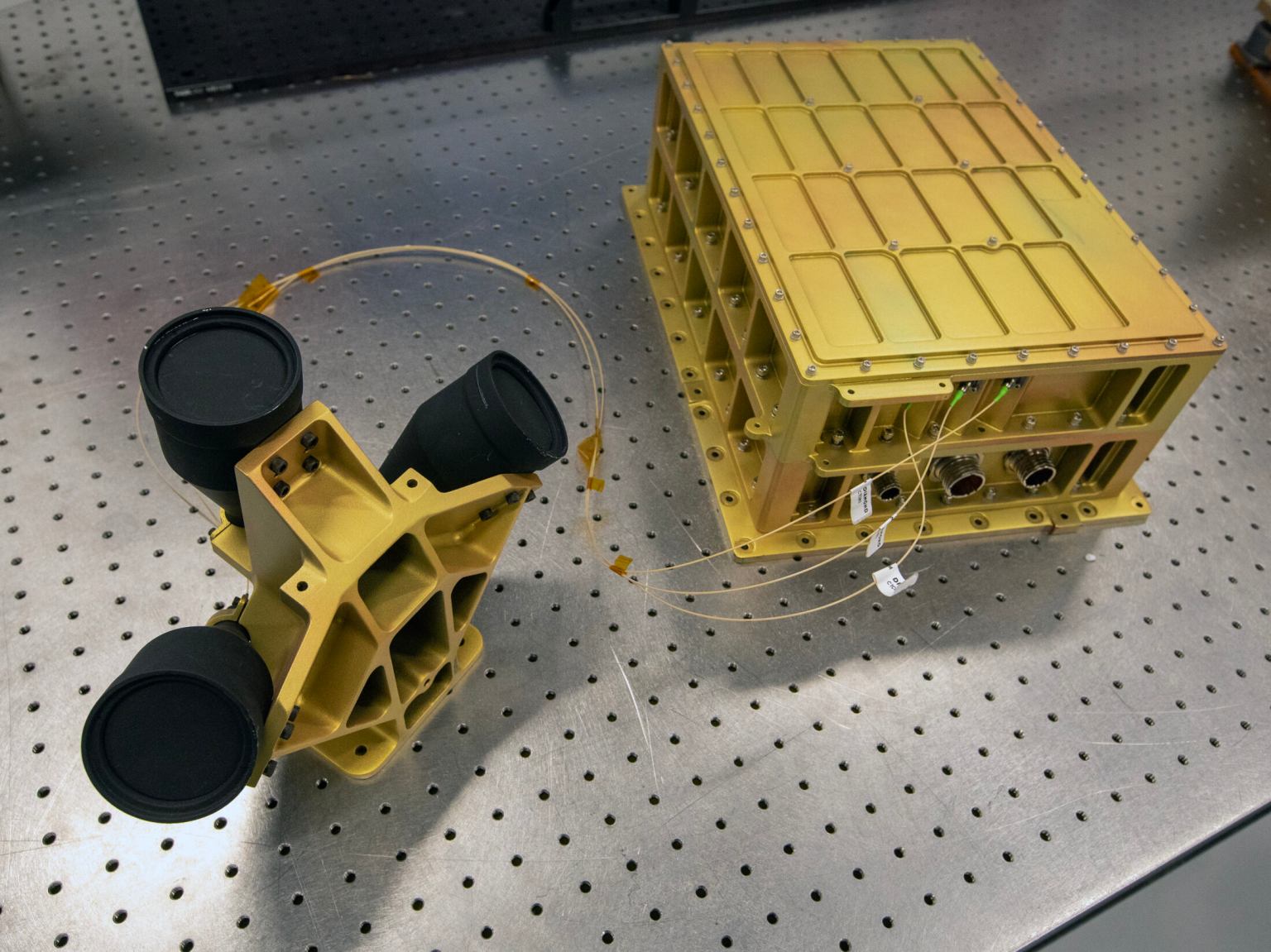
Navigation Doppler Lidar is a guidance system that uses laser pulses to precisely measure velocity and distance. NASA will demonstrate NDL’s capabilities in the lunar environment during the IM-1 mission.
Credits: NASA / David C. Bowman

Later this month, NASA’s commercial lunar delivery services provider Intuitive Machines will launch its Nova-C lunar lander carrying several NASA science and technology payloads, including the Navigation Doppler Lidar (NDL). This innovative guidance system, developed by NASA’s Langley Research Center in Hampton, Virginia, under the agency’s Space Technology Mission Directorate (STMD), can potentially revolutionize landing spacecraft on extraterrestrial worlds.

The NDL technology is a NASA payload for this Intuitive Machines Commercial Lunar Payload Services (CLPS) delivery, meaning NASA will demonstrate NDL’s capabilities in the lunar environment during the mission but the data is not considered mission-critical for the successful landing of Nova-C, as Intuitive Machines has its own navigation and landing systems.

The Artemis mission will take humans back to the Moon and Navigation Doppler Lidar will ensure a safe landing for everyone onboard. NDL Chief Engineer Glenn Hines explains how lasers will relieve astronauts of some of the burdens of making safe, precise landings on the Moon.

The NDL story started almost 20 years ago when Dr. Farzin Amzajerdian, NDL project manager at NASA Langley, made a breakthrough and successfully found a precise way to land rovers on Mars. In the late 1990s and early 2000s, several attempts at landing rovers on the surface of Mars were met with several significant challenges. 

Radar was inherently imprecise for this application. Radio waves cover a large area on the ground, meaning smaller craters and boulders that are commonly found on the Martian surface could ‘hide’ from detection and cause unexpected hazards for landers.

“The landers needed the radar sensor to tell them how far they were off the ground and how fast they were moving so they could time their parachute deployment,” said Amzajerdian. “Too early or too late, the lander would miss its target or crash into the surface.”

Radio waves also couldn’t measure velocity and range independently of one another, which is important, according to Aram Gragossian, electro-optics lead for NDL at NASA Langley, who joined the team about six years ago.

“If you go over a steep slope, the range changes very quickly, but that doesn’t mean your velocity has changed,” he said. “So if you just feed that information back to your system, it may cause catastrophic reactions.”

Amzajerdian knew about this problem, and he knew how to fix it.

“Why not use a lidar instead of a radar?” he asked.

LiDAR, which stands for light detection and ranging, is a technology that uses visible or infrared light the same way radar uses radio waves. Lidar sends laser pulses to a target, which reflects some of that light back onto a detector. As the instrument moves in relation to its target, the change in frequency of the returning signal – also known as the Doppler effect – allows the lidar to measure velocity directly and precisely. Distance is measured based on the travel time of the light to the target and back.

Lidar offered several advantages over radar, notably the fact that a laser transmits a pencil beam of light that can give a more precise and accurate measurement.

In 2004, Amzajerdian proposed NDL as a concept to the Mars Science Laboratory team. In 2005, he and his team received funding from Langley to put together a proof of concept. Then, in 2007, they received funding for building and testing a prototype of a helicopter. This is when Langley’s Dr. Glenn Hines joined NDL — first as electronic lead and now as chief engineer.

Since then, Amzajerdian, Hines, and numerous other team members have worked tirelessly to ensure NDL’s success. 

Hines credits the various NASA personnel who have continued to advocate for NDL. “In almost everything in life, you’ve got to have a champion,” Hines said, “somebody in your corner saying, ‘Look, what you’re doing is good. This has credibility.’ ”

The Intuitive Machines delivery is just the beginning of the NDL story; a next-generation system is already in the works. The team has developed a companion sensor to NDL, a multi-functional Flash Lidar camera. Flash Lidar is a 3D camera technology that surveys the surrounding terrain — even in complete darkness. When combined with NDL, Flash Lidar will allow you to go “anywhere, anytime.”

Other future versions of NDL could have uses outside the tricky business of landing on extraterrestrial surfaces. In fact, they may have uses in a very terrestrial setting, like helping self-driving cars navigate local streets and highways. 

Looking at the history and trajectory of NDL, one thing is certain: The initial journey to the Moon will be the culmination of decades of hard work, perseverance, determination, and a steadfast belief in the project across the team, but held most fervently by NDL’s champions, Amzajerdian and Hines.

NDL was NASA’s Invention of the Year in 2022. Four programs within STMD contributed to NDL’s development: Flight Opportunities, Technology Transfer, Small Business Innovation Research & Small Business Technology Transfer, and Game Changing Development.

NASA is working with multiple CLPS vendors to establish a regular cadence of payload deliveries to the Moon to perform experiments, test technologies, and demonstrate capabilities to help NASA explore the lunar surface. Payloads delivered through CLPS will help NASA advance capabilities for science, technology, and exploration on the Moon.

Simone Williams
NASA Langley Research Center

Share

Details

Last Updated
Feb 05, 2024


from NASA https://ift.tt/0ESu4ZV

Saturday, 3 February 2024

The Iconic Photos from STS-41B: Documenting the First Untethered Spacewalk

4 Min Read

The Iconic Photos from STS-41B: Documenting the First Untethered Spacewalk

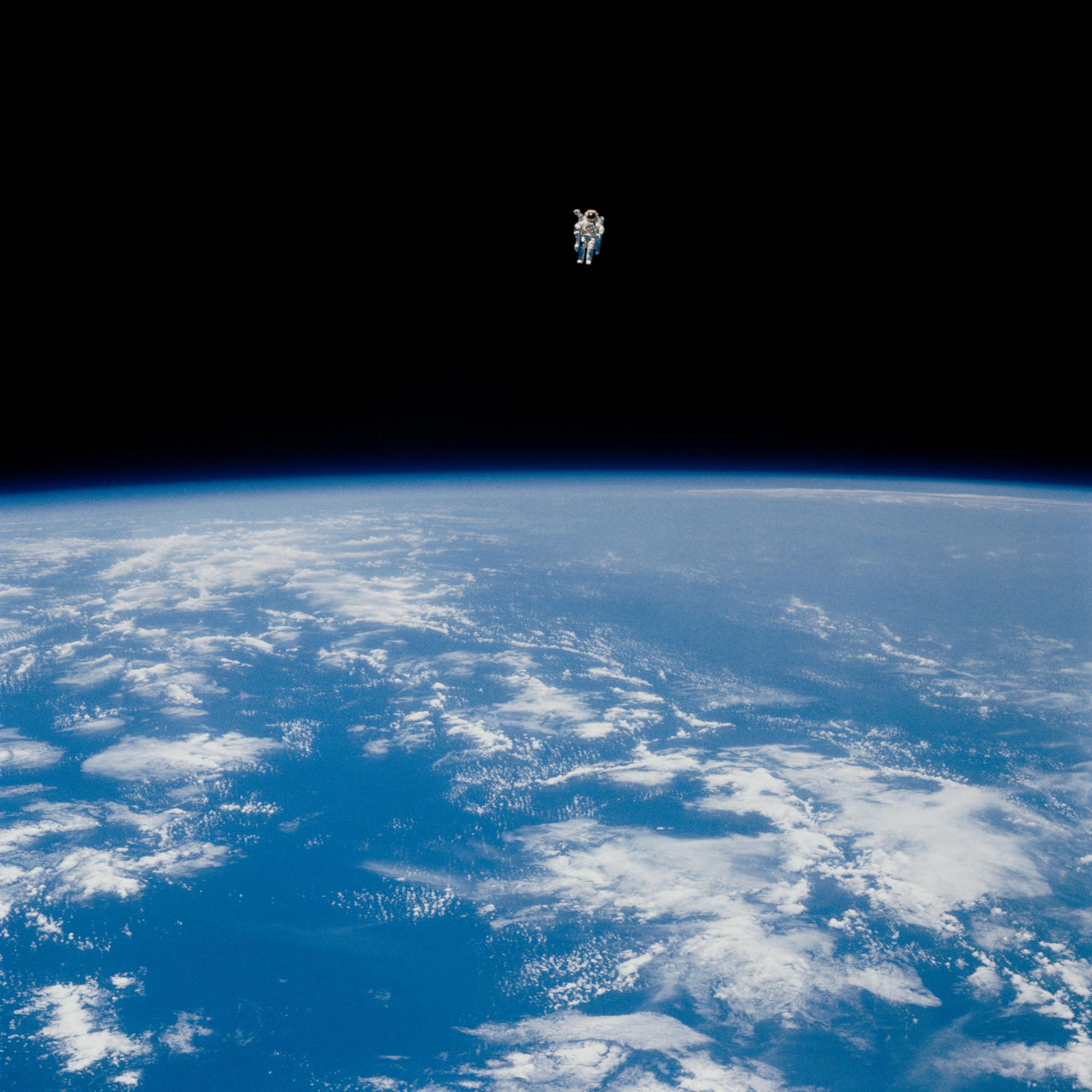
Astronaut Bruce McCandless II, STS-41B mission specialist, reaches his maximum distance from space shuttle Challenger before returning to the spacecraft using the Manned Maneuvering Unit (MMU).
Credits: NASA

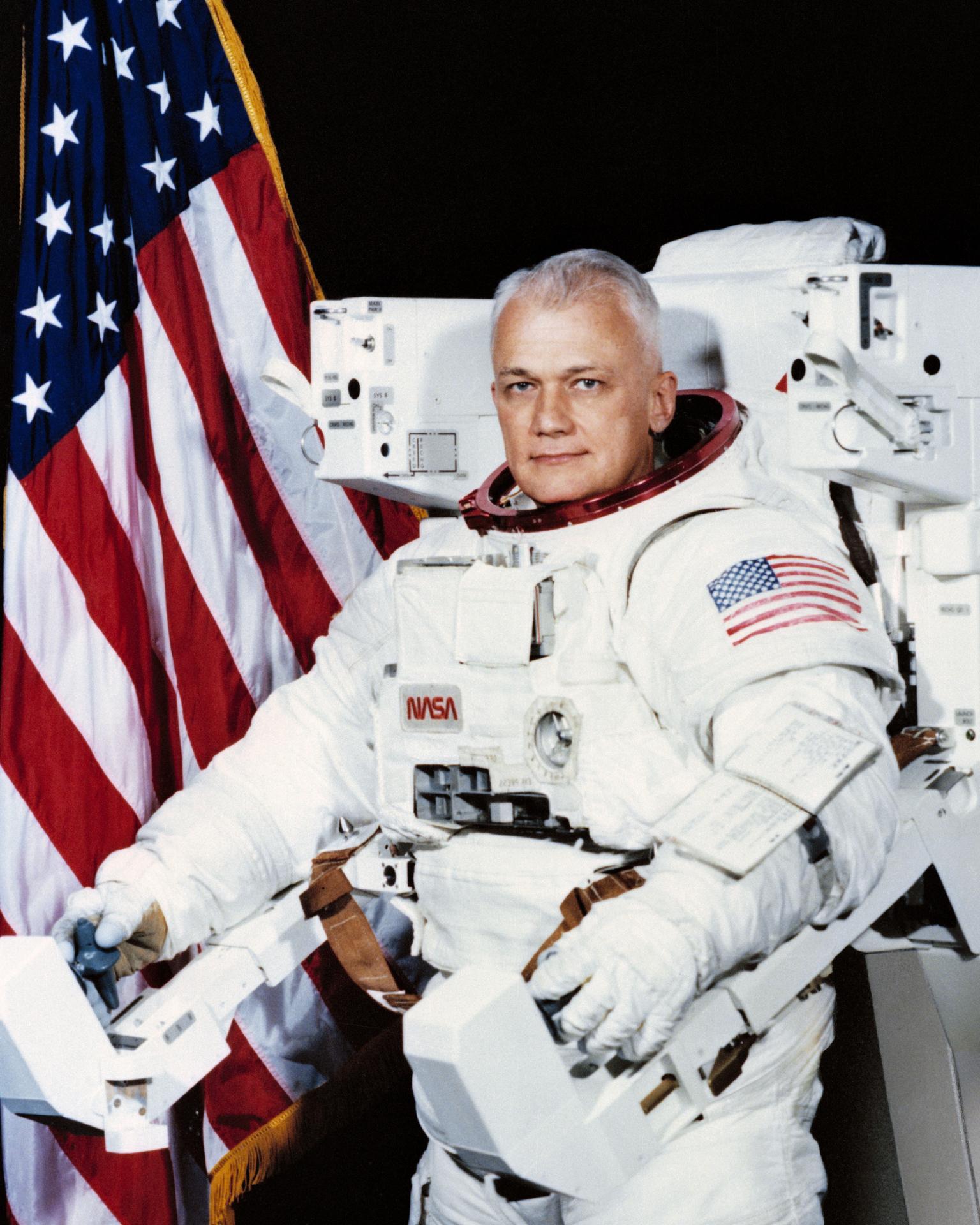
As astronaut Bruce McCandless II flew the Manned Maneuvering Unit (MMU) out of the space shuttle Challenger’s payload bay for the first time on February 7, 1984, many in the agency were fearful about the use of a self-propelled and untethered backpack in space.  (Previous spacewalkers remained connected to the vehicle with tethers. This jet-pack allowed crews to move outside of the cargo bay and perform activities away from the safety of the spacecraft.) He remembered trying to ease the tension for his wife and the flight controllers in Mission Control, saying something similar to Neil Armstrong’s declaration as he first stepped on the Moon in 1969. “It may have been one small step for Neil,” he proclaimed, “but it’s a heck of a big leap for me.”

It may have been one small step for Neil, but it’s a heck of a big leap for me.

Bruce McCandless II

Bruce McCandless II

NASA Astronaut

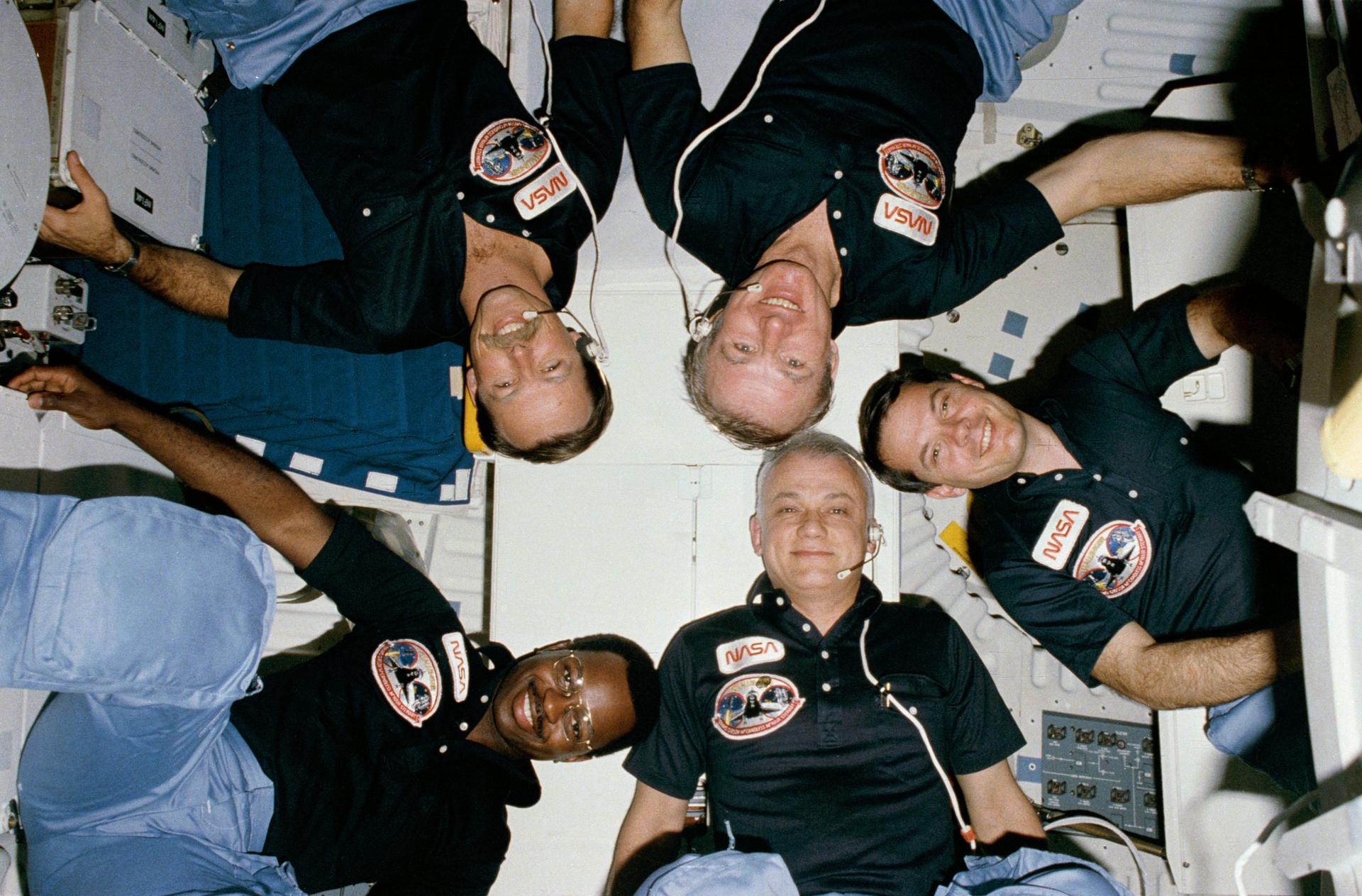
The 5-man crew of STS-41B take a group photo on the space shuttle
The crew of STS-41B take an informal portrait on the mid-deck of the Earth-orbiting Challenger. Counter clockwise from the top right are astronauts Vance D. Brand commander; Robert L. “Hoot” Gibson, pilot; and Dr. Ronald E. McNair, Bruce McCandless II, and Robert L. Stewart, all mission specialists.
NASA

The MMU was the highlight of the STS-41B mission as demonstrated by the stunning mission photographs that graced the cover of Aviation Week & Space Technology, not once, not twice, but three times.  

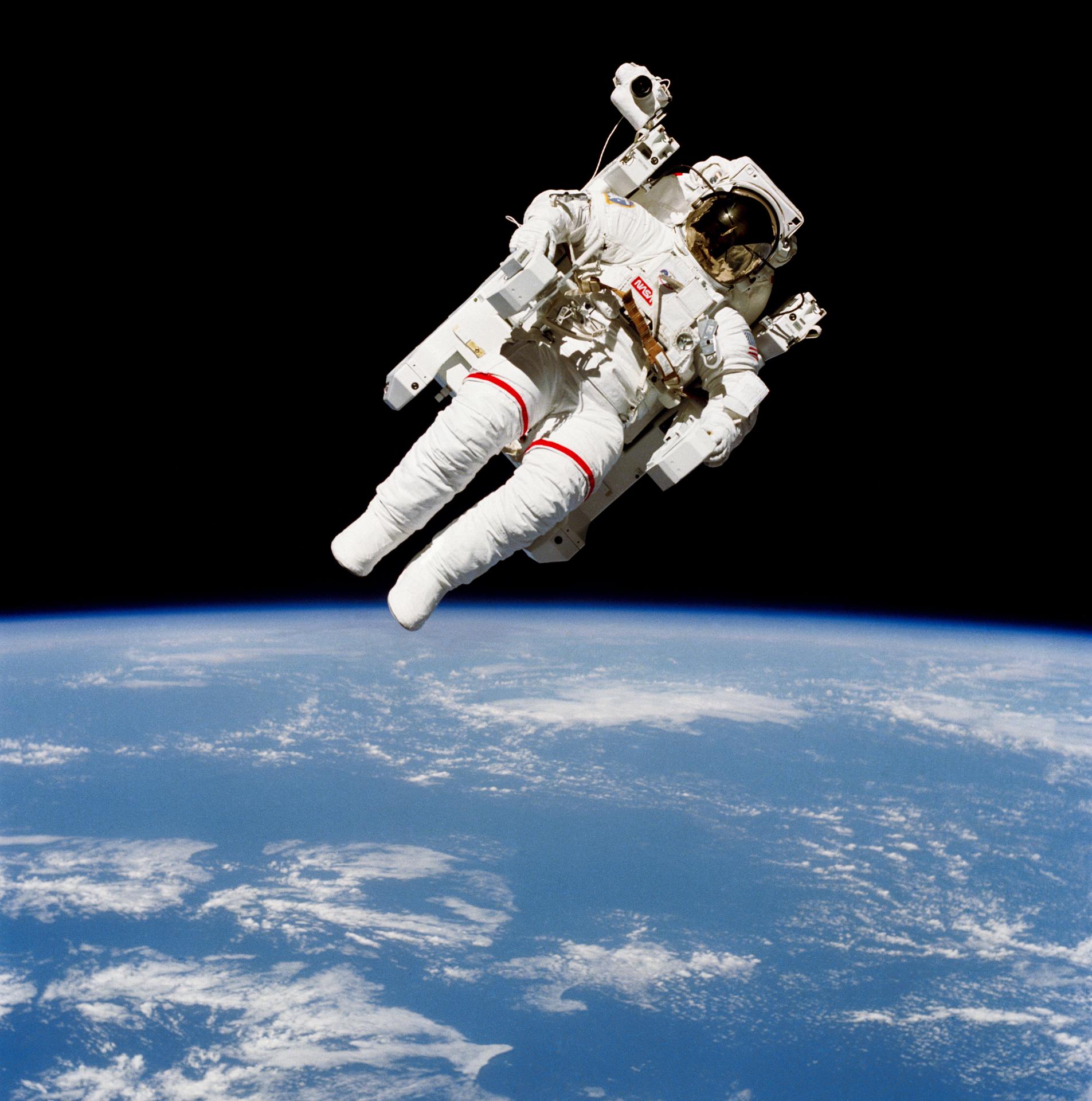
“Hoot” Gibson, the flight’s pilot, shot the photograph featured on the February 20, 1984, issue of the magazine from the crew cabin. Gibson remembered he was the only one on the crew that “had absolutely nothing to do” as McCandless made his way out into space, so he picked up a Hasselblad camera and began documenting the events. When he first looked through the camera’s viewfinder, he could not believe what an incredible sight it was to see McCandless untethered, floating above the Earth. Gibson wanted to capture what he was seeing and remembered how meticulous he was. For each photograph he took three light meter readings and checked the focus four times. In the crew’s photography training he learned that an off-kilter horizon looked wrong and was not pleasing to the eye. That presented a slight problem because Challenger was at a 28.5-degree inclination, so he “tilted the camera to put the horizon level in the pictures.”

An astronaut floats in space untethered with Earth far below
Astronaut Bruce McCandless II is a few meters away from the cabin of the Earth-orbiting space shuttle Challenger in this iconic photo taken by Hoot Gibson, which was featured on the February 20, 1984 issue of Aviation Week & Space Technology.
NASA

The result was one of NASA’s most iconic and requested images. McCandless called the photograph “beautiful, partly because the sun is shining directly on me.” His son, Bruce McCandless III, said his father “appears to be glowing.” Because the sun was in his eyes, he closed the helmet visor, which made it difficult to identify who exactly was inside the spacesuit. “My anonymity means people can imagine themselves doing the same thing,” he said. And, he added, “at visitor centres [sic], they often have life-sized cardboard versions with the visor cut out, so people can peep through.” Perhaps more importantly, as expressed by United States Senator John McCain, the photo “inspired generations of Americans to believe that there is no limit to the human potential.”

A second, but less recognized image, appeared on the cover of Aviation Week & Space Technology the following week: February 27, 1984. Also taken by Gibson, the image featured McCandless on the Manipulator Foot Restraint or “cherry picker” device at end of the Remote Manipulator System (RMS). The restraint was a platform where spacewalkers could work outside the vehicle but remain anchored at the end of the RMS to repair a satellite or other activities. STS-41B marked the first test of the new apparatus. Gibson explained how he chose to capture McCandless on the device. “What I did was I shifted the camera so that he wasn’t right in the center of the picture. I put him on the edge and the orbiter’s rudder on the other edge of the picture. That made a really cool photo.”

The feet of Bruce McCandless II are anchored in the Mobile Foot Restraint (MFR) and moved around by the Remote Manipulator System (RMS). The aft portion of the Challenger, to which the RMS is connected, is seen in lower left corner.
NASA

A third image from the mission appeared on the March 12, 1984, cover of the magazine. The photograph, taken by a fixed camera on McCandless’s helmet, captured Challenger in its entirety, which included the payload bay with the Shuttle Pallet Satellite and a glimpse of astronaut Robert Stewart standing just beneath the spacecraft’s RMS.

This photo of Challenger was the third from the STS-41B mission to be featured on the cover of Aviation Week & Space Technology.
NASA

These photographs from STS-41B, from the tenth flight of the space shuttle, illustrate just how engaging and exciting shuttle missions were. While flying in space became more routine in the 1980s, no one, not even the crew, “appreciated how spectacular” the first MMU flight “was going to be.” The STS-41B photos demonstrated that human spaceflight remained just as captivating, breathtaking, and inspiring as it had always been.

About the Author

Jennifer Ross-Nazzal

Jennifer Ross-Nazzal

NASA Human Spaceflight Historian

Jennifer Ross-Nazzal is the NASA Human Spaceflight Historian. She is the author of Winning the West for Women: The Life of Suffragist Emma Smith DeVoe and Making Space for Women: Stories from Trailblazing Women of NASA's Johnson Space Center.

Share

Details

Last Updated
Feb 02, 2024


from NASA https://ift.tt/AQlrqHs

Meet the Creators, Part 3: NASA’s 2024 Total Solar Eclipse Posters

3 min read

Meet the Creators, Part 3: NASA’s 2024 Total Solar Eclipse Posters

A total solar eclipse is a captivating experience – evoking feelings of awe and wonder that are sometimes best expressed through art.

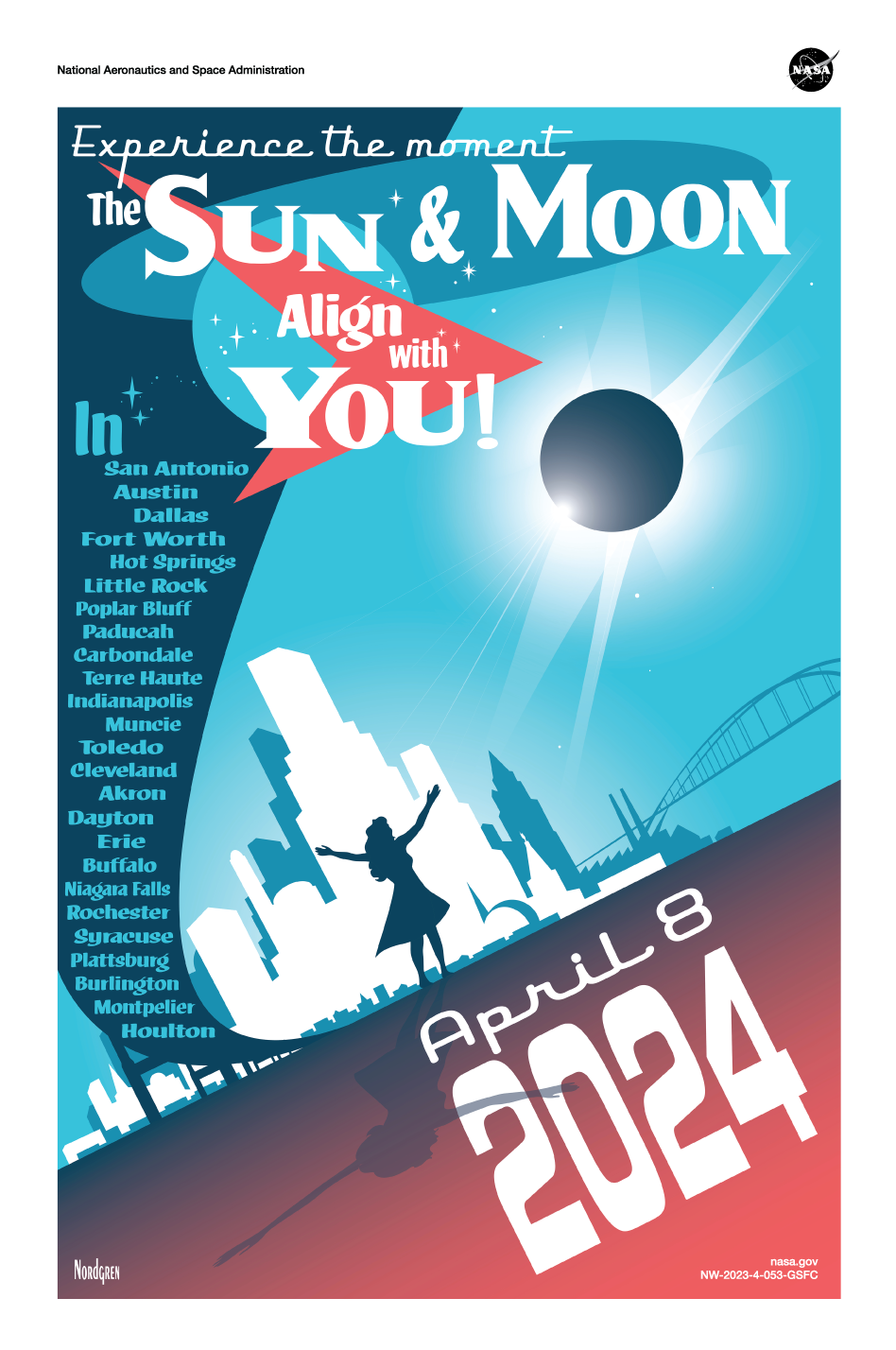
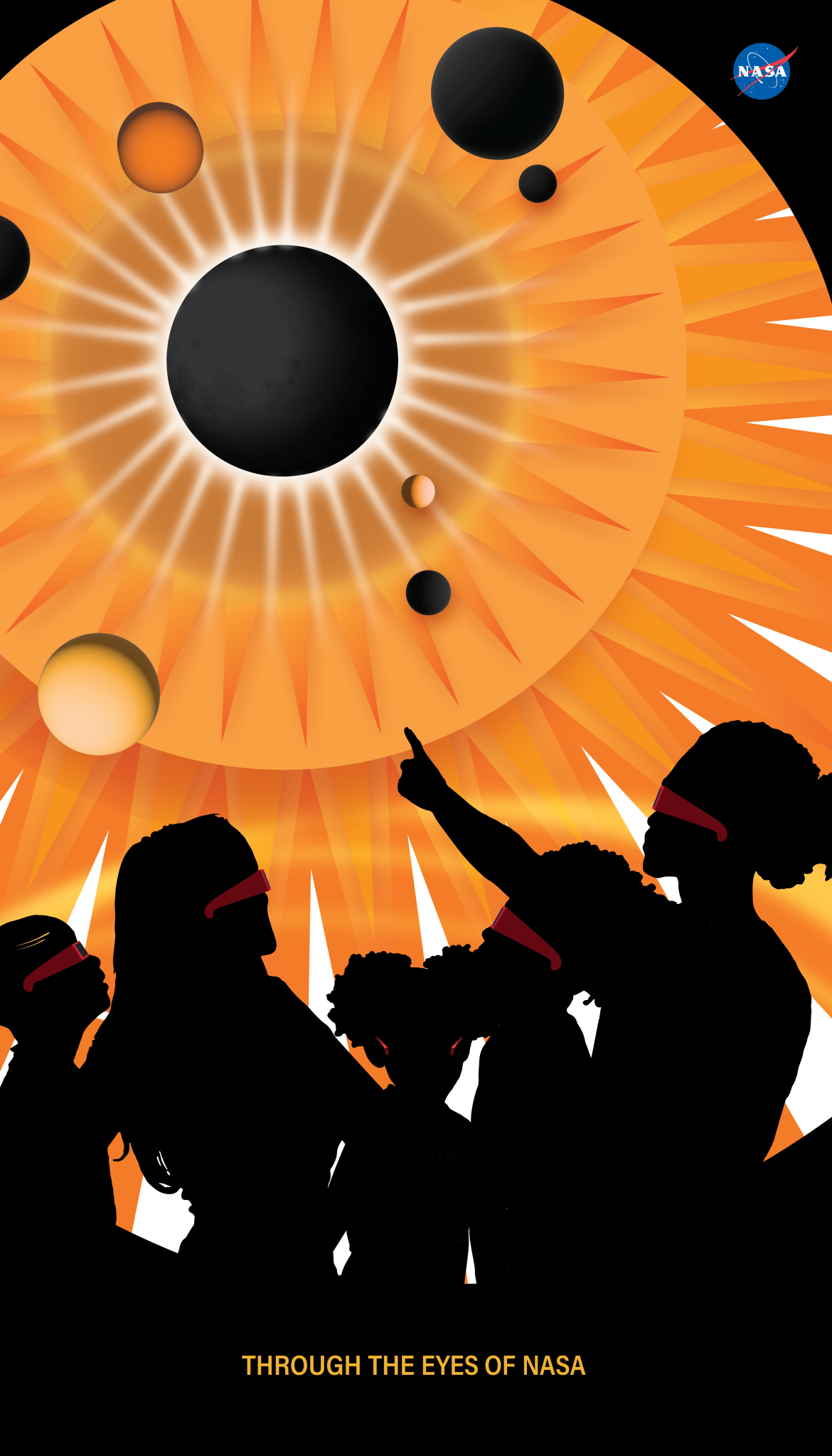
Inspired by the upcoming total solar eclipse of April 8, 2024, artists Tyler Nordgren and Kristen Perrin have designed two posters for NASA that present the magic of the eclipse in unique ways.

Tyler Nordgren

An illustrative poster shows the silhouette of a person with outstretched arms standing in front of a city skyline and looking up at a total solar eclipse in the sky. The top of the poster says “Experience the moment” and “The Sun & Moon Align with You!” The bottom of the poster has the date “April 8, 2024.” Along the left side, the word “In” appears above a list of 25 U.S. cities. The name “Nordgren” appears in the lower left corner.
Download the poster here.
NASA/Tyler Nordgren

In “The Sun and Moon Align with You” poster for NASA, Nordgren – who is a professional astronomer as well as an artist – said that his goal was to capture the experience that can be had by millions of people in cities across the United States in April, while reflecting on the last total solar eclipse that crossed the country in August 2017.

“For 2017, the total solar eclipse passed over so many national parks and natural landscapes with very few cities in the path. So I created a poster modeled after the 1930s ‘See America’ national parks posters produced by the Works Progress Administration to educate Americans about the parks. I figured I was doing the same thing. Now, seven years later in 2024, this time the total solar eclipse is passing over major metropolitan areas. Over 30 million people will be living directly in the path of totality – that’s almost three times the total in 2017. So I wanted to make a poster that emphasized what it would be like to see it in one of these cities.

“The poster shows a figure standing before a representative skyline where I used elements of different cities (like certain buildings and bridges) all across the path of totality. Along the underpass that sweeps overhead of our central figure are the names of major cities from every state along totality. It truly is stunning how many people in so many cities will get to see this. 

“Think about being in a sports or concert stadium when the crowd erupts in joy all at once. Now imagine, not just a stadium, but every single person in an entire city all at once at the instant the Sun goes black. This will be a day people will remember and talk about with awe for the rest of their lives. I hope I captured some small part of that.”

Kristen Perrin

An illustrative poster shows the black silhouettes of five people of different heights wearing red eclipse glasses and looking at a total solar eclipse. One person points toward the eclipse. The eclipse is represented as a black disk surrounded by concentric circles of yellow and orange with white, orange, and red rays. Several spheres appear around the eclipse. At the bottom are the words “Through the eyes of NASA” and the NASA logo appears in the upper right.
Download the poster here.
NASA/Kristen Perrin

For her “Through the Eyes of NASA” poster, Perrin – who is an African American woman, mother of four, and the Senior Multimedia and Graphic Specialist on the NASA Heliophysics communications team – said she wanted to show that the eclipse is an experience for everyone.

“Designing the poster to commemorate the total solar eclipse happening on April 8 was an honor. I wanted to highlight the event using people that represented all demographics. This was done so that the eclipse could be recognized as an event for ALL. Using the spherical elements to represent the Moon and some of the planets within our solar system encouraged the overall visual to help the audience see where the eclipse takes place and understand, by the coloring, what would happen. The look of the skyline from the audience point of view was also designed to resemble an eye. This visual honed in on the tagline ‘Through the eyes of NASA’.”

To learn more about these artists and other eclipse posters they’ve created, read Meet the Creators of NASA’s Newest Eclipse Art.

by Vanessa Thomas
NASA’s Goddard Space Flight Center, Greenbelt, Md.

Share

Details

Last Updated
Feb 02, 2024


from NASA https://ift.tt/evRktUn

NASA Announces $1 Million to Students for Moon Base Challenge

Artist’s concept depicting astronauts, habitats, rovers, power systems, and cargo operations supporting sustained human activities at the Mo...