The following is a statement from NASA Administrator Jim Bridenstine on Thursday’s announcement of the intended nomination by President Donald Trump of James Morhard to serve as the agency’s deputy administrator:
from NASA Breaking News https://ift.tt/2uuPYMH
via IFTTT

Friday, 13 July 2018

Thursday, 12 July 2018
Observatories Team Up to Reveal Rare Double Asteroid
New observations by three of the world's largest radio telescopes have revealed that an asteroid discovered last year is actually two objects, each about 3,000 feet (900 meters) in size, orbiting each other.
Three of the world's largest radio telescopes team up to show a rare double asteroid. 2017 YE5 is only the fourth binary near-Earth asteroid ever observed in which the two bodies are roughly the same size, and not touching. This video shows radar images of the pair gathered by Goldstone Solar System Radar, Arecibo Observatory and Green Bank Observatory.
Near-Earth asteroid 2017 YE5 was discovered with observations provided by the Morocco Oukaimeden Sky Survey on Dec. 21, 2017, but no details about the asteroid's physical properties were known until the end of June. This is only the fourth "equal mass" binary near-Earth asteroid ever detected, consisting of two objects nearly identical in size, orbiting each other. The new observations provide the most detailed images ever obtained of this type of binary asteroid.
On June 21, the asteroid 2017 YE5 made its closest approach to Earth for at least the next 170 years, coming to within 3.7 million miles (6 million kilometers) of Earth, or about 16 times the distance between Earth and the Moon. On June 21 and 22, observations by NASA's Goldstone Solar System Radar (GSSR) in California showed the first signs that 2017 YE5 could be a binary system. The observations revealed two distinct lobes, but the asteroid's orientation was such that scientists could not see if the two bodies were separate or joined. Eventually, the two objects rotated to expose a distinct gap between them.

Bi-static radar images of the binary asteroid 2017 YE5 from the Arecibo Observatory and the Green Bank Observatory on June 25. The observations show that the asteroid consists of two separate objects in orbit around each other. Credit: Arecibo/GBO/NSF/NASA/JPL-Caltech
Scientists at the Arecibo Observatory in Puerto Rico had already planned to observe 2017 YE5, and they were alerted by their colleagues at Goldstone of the asteroid's unique properties. On June 24, the scientists teamed up with researchers at the Green Bank Observatory (GBO) in West Virginia and used the two observatories together in a bi-static radar configuration (in which Arecibo transmits the radar signal and Green Bank receives the return signal). Together, they were able to confirm that 2017 YE5 consists of two separated objects. By June 26, both Goldstone and Arecibo had independently confirmed the asteroid's binary nature.
The new observations obtained between June 21 and 26 indicate that the two objects revolve around each other once every 20 to 24 hours. This was confirmed with visible-light observations of brightness variations by Brian Warner at the Center for Solar System Studies in Rancho Cucamonga, California.
Radar imaging shows that the two objects are larger than their combined optical brightness originally suggested, indicating that the two rocks do not reflect as much sunlight as a typical rocky asteroid. 2017 YE5 is likely as dark as charcoal. The Goldstone images taken on June 21 also show a striking difference in the radar reflectivity of the two objects, a phenomenon not seen previously among more than 50 other binary asteroid systems studied by radar since 2000. (However, the majority of those binary asteroids consist of one large object and a much smaller satellite.) The reflectivity differences also appear in the Arecibo images and hint that the two objects may have different densities, compositions near their surfaces, or different surface roughnesses.
Scientists estimate that among near-Earth asteroids larger than 650 feet (200 meters) in size, about 15 percent are binaries with one larger object and a much smaller satellite. Equal-mass binaries like 2017 YE5 are much rarer. Contact binaries, in which two similarly sized objects are in contact, are thought to make up another 15 percent of near-Earth asteroids larger than 650 feet (200 meters) in size.

Radar images of the binary asteroid 2017 YE5 from NASA's Goldstone Solar System Radar (GSSR). The observations, conducted on June 23, 2018, show two lobes, but do not yet show two separate objects. Credit: GSSR/NASA/JPL-Caltech
The discovery of the binary nature of 2017 YE5 provides scientists with an important opportunity to improve understanding of different types of binaries and to study the formation mechanisms between binaries and contact binaries, which may be related. Analysis of the combined radar and optical observations may allow scientists to estimate the densities of the 2017 YE5 objects, which will improve understanding of their composition and internal structure, and of how they formed.
Study contributors
The Goldstone observations were led by Marina Brozovi?, a radar scientist at NASA's Jet Propulsion Laboratory in Pasadena, California.
Anne Virkki, Flaviane Venditti and Sean Marshall of the Arecibo Observatory and the University of Central Florida led the observations using the Arecibo Observatory.
Patrick Taylor of the Universities Space Research Association (USRA), scientist at the Lunar and Planetary Institute, led the bi-static radar observations with GBO, home of the Green Bank Telescope (GBT), the world's largest fully steerable radio telescope.
The Arecibo, Goldstone and USRA planetary radar projects are funded through NASA's Near-Earth Object Observations Program within the Planetary Defense Coordination Office (PDCO), which manages the Agency's Planetary Defense Program. The Arecibo Observatory is a facility of the National Science Foundation operated under cooperative agreement by the University of Central Florida, Yang Enterprises, and Universidad Metropolitana. GBO is a facility of the National Science Foundation, operated under a cooperative agreement by Associated Universities, Inc.
In addition to the resources NASA puts into understanding asteroids, the PDCO also partners with other U.S. government agencies, university-based astronomers, and space science institutes across the country, often with grants, interagency transfers and other contracts from NASA. They also collaborate with international space agencies and institutions that are working to track and better understand these smaller objects of the Solar System. In addition, NASA values the work of numerous highly skilled amateur astronomers, whose accurate observational data helps improve asteroid orbits after discovery.
More information about asteroids and near-Earth objects is at these sites:
https://www.jpl.nasa.gov/asteroidwatch
News Media Contact
Calla Cofield
Jet Propulsion Laboratory, Pasadena, Calif.
818-393-1821
Calla.e.cofield@jpl.nasa.gov
JoAnna Wendel
NASA Headquarters, Washington
202-358-1003
joanna.r.wendel@nasa.gov
2018-164
from News and Features https://ift.tt/2uhn0At
via IFTTT
NASA’s Fermi Traces Source of Cosmic Neutrino to Monster Black Hole
For the first time ever, scientists using NASA’s Fermi Gamma-ray Space Telescope have found the source of a high-energy neutrino from outside our galaxy.
from NASA Breaking News https://ift.tt/2JhQnYl
via IFTTT
from NASA Breaking News https://ift.tt/2JhQnYl
via IFTTT
Coverage Set for Departure of US Cargo Ship from International Space Station
Nearly two months after Orbital ATK, now part of Northrop Grumman, delivered several tons of supplies and scientific experiments to the International Space Station aboard its Cygnus cargo spacecraft, the spacecraft is set to depart the orbiting laboratory Sunday, July 15.
from NASA Breaking News https://ift.tt/2mbAR6Q
via IFTTT
from NASA Breaking News https://ift.tt/2mbAR6Q
via IFTTT
Tuesday, 10 July 2018
NASA Names Six New Flight Directors to Lead Mission Control
NASA has selected six women and men to join the elite corps of flight directors who will lead mission control for a variety of new operations at the agency’s Johnson Space Center in Houston.
from NASA Breaking News https://ift.tt/2L349iR
via IFTTT
from NASA Breaking News https://ift.tt/2L349iR
via IFTTT
NASA Awards Information Technology Support Contract
NASA has awarded the contract to Venesco & SaiTech Joint Venture (VSJV), LLC of Chantilly, Virginia, to provide information technology support services for the Information Technology and Communications Division at NASA Headquarters in Washington.
from NASA Breaking News https://ift.tt/2N2CEqq
via IFTTT
from NASA Breaking News https://ift.tt/2N2CEqq
via IFTTT
Listen: Sound of Electromagnetic Energy Moving Between Saturn, Enceladus

New research from NASA's Cassini spacecraft's up-close Grand Finale orbits shows a surprisingly powerful and dynamic interaction of plasma waves moving from Saturn to its rings and its moon Enceladus. The observations show for the first time that the waves travel on magnetic field lines connecting Saturn directly to Enceladus. The field lines are like an electrical circuit between the two bodies, with energy flowing back and forth.
New research from the up-close Grand Finale orbits of NASA's Cassini mission shows a surprisingly powerful interaction of plasma waves moving from Saturn to its moon Enceladus. Researchers converted the recording of plasma waves into a "whooshing" audio file that we can hear -- in the same way a radio translates electromagnetic waves into music. Much like air or water, plasma (the fourth state of matter) generates waves to carry energy. The recording was captured by the Radio Plasma Wave Science (RPWS) instrument Sept. 2, 2017, two weeks before Cassini was deliberately plunged into the atmosphere of Saturn. Credit: NASA/JPL-Caltech/University of Iowa
Researchers converted the recording of plasma waves into a "whooshing" audio file that we can hear -- in the same way a radio translates electromagnetic waves into music. In other words, Cassini detected electromagnetic waves in the audio frequency range -- and on the ground, we can amplify and play those signals through a speaker. The recording time was compressed from 16 minutes to 28.5 seconds.
Much like air or water, plasma (the fourth state of matter) generates waves to carry energy. The Radio Plasma Wave Science (RPWS) instrument on board NASA's Cassini spacecraft recorded intense plasma waves during one of its closest encounters to Saturn.
"Enceladus is this little generator going around Saturn, and we know it is a continuous source of energy," said Ali Sulaiman, planetary scientist at the University of Iowa, Iowa City, and a member of the RPWS team. "Now we find that Saturn responds by launching signals in the form of plasma waves, through the circuit of magnetic field lines connecting it to Enceladus hundreds of thousands of miles away."
Sulaiman is lead author of a pair of papers describing the findings, published recently in Geophysical Research Letters.
The interaction of Saturn and Enceladus is different from the relationship of Earth and its Moon. Enceladus is immersed in Saturn's magnetic field and is geologically active, emitting plumes of water vapor that become ionized and fill the environment around Saturn. Our own Moon does not interact in the same way with Earth. Similar interactions take place between Saturn and its rings, as they are also very dynamic.
The recording was captured Sept. 2, 2017, two weeks before Cassini was deliberately plunged into the atmosphere of Saturn. The recording was converted by the RPWS team at the University of Iowa, led by physicist and RPWS Principal Investigator Bill Kurth.
The GRL research is available on the American Geophysical Union's website:
https://agupubs.onlinelibrary.wiley.com/doi/abs/10.1029/2018GL078130
https://agupubs.onlinelibrary.wiley.com/doi/abs/10.1029/2018GL077875
The Cassini-Huygens mission is a cooperative project of NASA, ESA (European Space Agency) and the Italian Space Agency. NASA's Jet Propulsion Laboratory, a division of Caltech in Pasadena, manages the mission for NASA's Science Mission Directorate, Washington. JPL designed, developed and assembled the Cassini orbiter. The RPWS instrument was built by the University of Iowa, working with team members from the U.S. and several European countries.
News Media Contact
Gretchen McCartney
Jet Propulsion Laboratory, Pasadena, California
818-393-6215
Gretchen.P.McCartney@jpl.nasa.gov
Dwayne Brown / JoAnna Wendel
NASA Headquarters, Washington
202-358-1726 / 202-358-1003
dwayne.c.brown@nasa.gov / joanna.r.wendel@nasa.gov
2018-162
from News and Features https://ift.tt/2MWmuPa
via IFTTT
Saturday, 7 July 2018
NASA TV to Air Launch, Docking of Russian Cargo Delivery to Space Station
A Russian cargo ship loaded with almost three tons of food, fuel and supplies is set to launch to the International Space Station Monday, July 9. Live coverage of the spacecraft’s launch and docking will air on NASA Television and the agency’s website.
from NASA Breaking News https://ift.tt/2IVkFzP
via IFTTT
from NASA Breaking News https://ift.tt/2IVkFzP
via IFTTT
Friday, 6 July 2018
Students from Ohio, Virginia, Maryland, Massachusetts to Call Space Station
Next week astronauts aboard the International Space Station will host several downlinks as part of NASA’s Year of Education on Station.
from NASA Breaking News https://ift.tt/2KV0u6X
via IFTTT
from NASA Breaking News https://ift.tt/2KV0u6X
via IFTTT
NASA Invites Media to Visit with Spacecraft That Will “Touch” Sun
Media are invited to view NASA’s Parker Solar Probe at 1:30 p.m. EDT Friday, July 13, at the Astrotech Space Operations payload processing facility in Titusville, Florida.
from NASA Breaking News https://ift.tt/2u7DvhH
via IFTTT
from NASA Breaking News https://ift.tt/2u7DvhH
via IFTTT
JPL Shares in Cosmology Prize for Planck Mission

The team of scientists behind the European Space Agency's Planck mission has been awarded the prestigious 2018 Gruber Cosmology Prize. NASA's Jet Propulsion Laboratory in Pasadena, California, played a key role in the design and construction of the Planck instrument, and in the scientific analysis of the mission's data.
The Gruber International Prize Program is sponsored by the Gruber Foundation, based at Yale University. The Cosmology Prize "honors a leading cosmologist, astronomer, astrophysicist or scientific philosopher for theoretical, analytical, conceptual or observational discoveries leading to fundamental advances in our understanding of the universe."
Launched in 2009, the Planck satellite spent 4 years making a high-resolution map of the oldest light in the universe, the cosmic microwave background (CMB), emitted 13.8 billion years ago when the universe was only 470,000 years old, giving us a "baby picture" of the cosmos.
This map allows researchers to learn about the entire 13.8-billion-year history of the universe, including its age, rate of expansion, and the distribution of mass and energy throughout. While Planck is not the first mission to map the microwave background, it did so with unprecedented angular resolution, sensitivity, and frequency coverage, producing the most accurate and detailed CMB map ever made.
JPL is managed by Caltech, also in Pasadena. Caltech's science and data center for astronomy, IPAC, hosted the U.S. Data Center for Planck.
"The scientific goals of Planck were highly ambitious and have been realized completely," said Charles Lawrence of JPL, project scientist for the U.S. Planck Project."Well over 100 people from JPL and IPAC worked on Planck over the years and contributed enabling hardware, software and analysis to the mission. We can be proud of this mission's legacy, and the recognition of its importance by the Gruber Cosmology Prize."
Mapping the CMB
Maps of the cosmic microwave background show the sky covered in seemingly random freckles of color. Those colors represent variations in the CMB's temperature, which the Planck satellite could measure down to one millionth of a degree. Those incredibly subtle variations arise from quantum fluctuations in the very early universe, which develop into the large-scale distribution of matter in the universe that we see today. In addition, the light from the CMB that reaches Earth has traveled through the entire visible universe, and very massive objects, like clusters of galaxies, act like obstacles that can also change the patterns that scientists observe in the Planck data.
NASA's Planck Project Office -- which led the US contribution to the mission -- was based at JPL, where scientists and engineers developed the overall thermal design concept for the mission; built the 20-K hydrogen sorption cooler system, which cooled the Low Frequency Instrument (LFI) to its operating temperature and provided precooling for the High Frequency Instrument (HFI); built the detectors for the HFI; and developed the amplifier technology for the LFI.
Engineers and scientists at IPAC are responsible for retrieving mission data from the Planck Data Processing Centers (in Paris, France and Trieste, Italy), staging data for usage by Planck team members, and for archival research by the astronomical community. The U.S. team at IPAC also generated the Early Release Compact Source Catalog (ERCSC), the first public data product from the mission.
The Planck data have provided a wealth of results for the field of cosmology, including: a refined measurement of the age of the universe, its rate of expansion and other cosmological properties; a refined estimate of when the first stars appeared; a catalog of more than 1,500 galaxy clusters (collections of multiple galaxies held together by gravity); unprecedented observations of the microwave and infrared light coming from the Milky Way galaxy; and studies of the galaxy's magnetic fields. The results tested the most widely accepted cosmological model of the universe to high precision, and opened up new areas of study both inside and outside the Milky Way.
Planck also helped researchers take a census of the three components that make up matter and energy in the universe: "regular matter," the kind we are made of, makes up just 4.9 percent; dark matter, detected only by the effects of its gravitational pull, makes up 26.2 percent; and dark energy, the name we give to whatever is causing the universe's accelerated expansion, makes up 68.9 percent.
JPL scientists also played essential roles in turning the Planck measurements into all-sky CMB maps of unprecedented quality, and in the scientific analysis that led to the cosmological results recognized by the Gruber Prize.
"Planck was by far the very best instrument of its kind, like a high-performance race," said Krsysztof Gorski, a senior research scientist at JPL. Gorski joined the Planck mission on the European side in 1996 before transferring to JPL and then joining the U.S. Planck Project in 2003.
"As it was designed to do, Planck provided complete closure on CMB temperature measurements and answered many important questions about the universe," he said. "But it also gave us hints about even bigger questions in cosmology that we can't fully answer yet -- so it left us wondering. All of that is a priceless legacy of the Planck mission."
The $500,000 prize will be divided between Planck's principal investigators, Nazzareno Mandolesi and Jean-Loup Puget, and "the Planck team." Hundreds of scientists have contributed to various aspects of the mission; a smaller group will represent the Planck team and accept the prize money. More than 300 scientists and engineers from the Planck mission, including many from JPL and IPAC, will accept the Gruber Prize at the 30th General Assembly of the International Astronomical Union in Vienna, Austria, this August.
The Gruber Prize wasalso awarded to two previous NASA missions that mapped the CMB: the Cosmic Background Explorer (COBE), launched in 1989, and the Wilkinson Microwave Anisotropy Probe (WMAP), launched in 2001.
News Media Contact
Calla Cofield
Jet Propulsion Laboratory, Pasadena, California
818-393-1821
Calla.e.cofield@jpl.nasa.gov
2018-161
from News and Features https://ift.tt/2Nuvoom
via IFTTT
Subscribe to:
Posts (Atom)
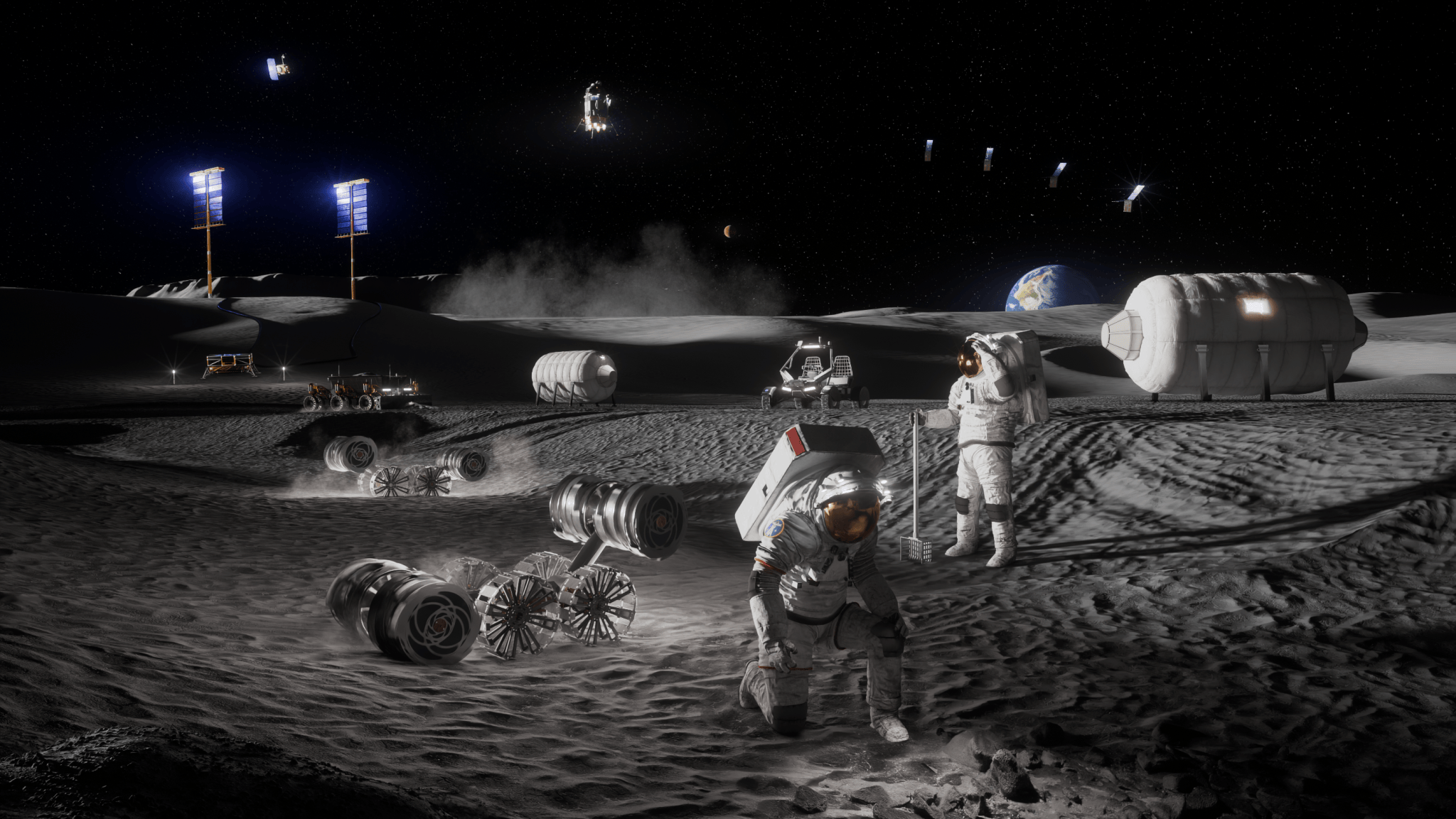
NASA Announces $1 Million to Students for Moon Base Challenge
Artist’s concept depicting astronauts, habitats, rovers, power systems, and cargo operations supporting sustained human activities at the Mo...
-
NASA has exercised the second option of its Information Technology and Multimedia Services (ITAMS) contract with DB Consulting Group, Inc., ...
-
Science Earth Observatory A Subtle Return of La Niña Earth Earth Observatory Image of the Day EO Explorer All Topics ...
