NASA will host a teleconference for members of the media and aviation industry at 4 p.m. EDT on Thursday, June 28, to discuss the details and preliminary results of the agency’s first large-scale, remotely piloted aircraft flight in the national airspace using detect and avoid technology to fly without a safety chase aircraft.
from NASA Breaking News https://ift.tt/2tJzDTZ
via IFTTT

Wednesday, 27 June 2018

Monday, 25 June 2018
NASA Technologies Significantly Reduce Aircraft Noise
A series of NASA flight tests has successfully demonstrated technologies that achieve a significant reduction in the noise generated by aircraft and heard by communities near airports.
from NASA Breaking News https://ift.tt/2tD7hum
via IFTTT
from NASA Breaking News https://ift.tt/2tD7hum
via IFTTT
Friday, 22 June 2018
Media Invited to Preview Expedition to Ocean Twilight Zone
Media are invited to Seattle on Friday, Aug. 9, to preview a seaborne expedition to study microscopic organisms in the dark depths of the sea that play a critical role in removing carbon dioxide from Earth’s atmosphere.
from NASA Breaking News https://ift.tt/2MPLdFD
via IFTTT
from NASA Breaking News https://ift.tt/2MPLdFD
via IFTTT
NASA Television to Air Launch of Next Space Station Resupply Mission
NASA commercial cargo provider SpaceX is targeting no earlier than 5:42 a.m. EDT Friday, June 29, for the launch of its 15th resupply mission to the International Space Station. Live coverage will begin on NASA Television and the agency’s website Thursday, June 28, with prelaunch events.
from NASA Breaking News https://ift.tt/2tkVfXg
via IFTTT
from NASA Breaking News https://ift.tt/2tkVfXg
via IFTTT
Tuesday, 19 June 2018
New NASA Mission to Detect Plant Water Use from Space

Doctors learn a lot about their patients' health by taking their temperature. An elevated temperature, or fever, can be a sign of illness. The same goes for plants, but their temperatures on a global scale are harder to measure than the temperatures of individual people.
That's about to change, thanks to a new NASA instrument that soon will be installed on the International Space Station called ECOSTRESS, or ECOsystem Spaceborne Thermal Radiometer Experiment on Space Station. ECOSTRESS will measure the temperature of plants from space. This will enable researchers to determine plant water use and to study how drought conditions affect plant health.
Plants draw in water from the soil, and as they are heated by the Sun, the water is released through pores on the plants' leaves through a process called transpiration. This cools the plant down, much as sweating does in humans. However, if there is not enough water available to the plants, they close their pores to conserve water, causing their temperatures to rise.
Plants use those same pores to take up carbon dioxide from the atmosphere for photosynthesis - the process they use to turn carbon dioxide and water into the sugar they use as food. If they continue to experience insufficient water availability, or "water stress," they eventually starve or overheat, and die.
ECOSTRESS data will show these changes in plants' temperatures, providing insight into their health and water use while there is still time for water managers to correct agricultural water imbalances.
"When a plant is so stressed that it turns brown, it's often too late for it to recover," said Simon Hook, ECOSTRESS principal investigator at NASA's Jet Propulsion Laboratory in Pasadena, California. "But measuring the temperature of the plant lets you see that a plant is stressed before it reaches that point."
These temperature measurements are also considered an early indicator of potential droughts. When plants in a given area start showing signs of water stress through elevated temperature, an agricultural drought is likely underway. Having these data in advance gives the agricultural community a chance to prepare and/or respond accordingly.
"ECOSTRESS will allow us to monitor rapid changes in crop stress at the field level, enabling earlier and more accurate estimates of how yields will be impacted," said Martha Anderson, an ECOSTRESS science team member with the U.S. Department of Agriculture in Beltsville, Maryland. "Even short-term moisture stress, if it occurs during a critical stage of crop growth, can significantly impact productivity."
ECOSTRESS will hitch a ride to the space station on a NASA-contracted, SpaceX cargo resupply mission scheduled to launch from Cape Canaveral Air Force Station in Florida on June 29. Once it arrives, it will be robotically installed on the exterior of the station's Japanese Experiment Module Exposed Facility Unit.
Over the next year, ECOSTRESS will use the space station's unique low Earth orbit to collect data over multiple areas of land at different times of day. The instrument will produce detailed images of areas as small as 43 by 76 yards (40 by 70 meters) -- about the size of a small farm -- every three to five days.
Other instruments in space can make measurements with the same level of detail or at different times of day -- but not both. ECOSTRESS' dual capability makes it especially important for scientists trying to better understand our natural ecosystems and others working toward improved food security and water resource management.
"As water resources become more critical for our growing population, we need to track precisely how much water our crops need," said ECOSTRESS science lead Josh Fisher of JPL. "We need to know when plants are becoming susceptible to droughts, and we need to know which parts of the ecosystem are more vulnerable because of water stress."
Although not part of its primary mission, ECOSTRESS temperature data will also be valuable for other studies that require temperature information, such as detecting and characterizing volcanoes, wildfires and heat waves.
JPL built and manages the ECOSTRESS mission for NASA's Earth Science Division in the Science Mission Directorate at NASA Headquarters in Washington. ECOSTRESS is sponsored by NASA's Earth System Science Pathfinder program, managed by NASA's Langley Research Center in Hampton, Virginia.
For more information on ECOSTRESS, visit:
https://www.nasa.gov/ecostress
News Media Contact
Alan Buis
Jet Propulsion Laboratory, Pasadena, Calif.
818-354-0474
Alan.buis@jpl.nasa.gov
Written by Esprit Smith
JPL Media Relations
2018-139
from News and Features https://ift.tt/2tmxEVl
via IFTTT
Astronomers See Distant Eruption as Black Hole Destroys Star

For the first time, astronomers have directly imaged the formation and expansion of a fast-moving jet of material ejected when the powerful gravity of a supermassive black hole ripped apart a star that wandered too close to the massive monster.
The scientists tracked the event with radio and infrared telescopes, including the National Science Foundation's Very Long Baseline Array (VLBA) and NASA's Spitzer Space Telescope, in a pair of colliding galaxies called Arp 299. The galaxies are nearly 150 million light-years from Earth. At the core of one of the galaxies, a black hole 20 million times more massive than the Sun shredded a star more than twice the Sun's mass, setting off a chain of events that revealed important details of the violent encounter. The researchers also used observations of Arp 299 made by NASA's Hubble space telescope prior to and after the appearance of the eruption.
Only a small number of such stellar deaths, called tidal disruption events, or TDEs, have been detected. Theorists have suggested that material pulled from the doomed star forms a rotating disk around the black hole, emitting intense X-rays and visible light, and also launches jets of material outward from the poles of the disk at nearly the speed of light.
"Never before have we been able to directly observe the formation and evolution of a jet from one of these events," said Miguel Perez-Torres, of the Astrophysical Institute of Andalucia in Granada, Spain, and an author on a paper describing the finding.
Discovery of a jet
The first indication came on January 30, 2005, when astronomers using the William Herschel Telescope in the Canary Islands discovered a bright burst of infrared emission coming from the nucleus of one of the colliding galaxies in Arp 299. On July 17, 2005, the VLBA revealed a new, distinct source of radio emission from the same location.
"As time passed, the new object stayed bright at infrared and radio wavelengths, but not in visible light and X-rays," said Seppo Mattila, of the University of Turku in Finland, another author on the new paper. "The most likely explanation is that thick interstellar gas and dust near the galaxy's center absorbed the X-rays and visible light, then re-radiated it as infrared." The researchers used the Nordic Optical Telescope on the Canary Islands and NASA's Spitzer to follow the object's infrared emission.
Continued observations with the VLBA, the European VLBI Network (EVN), and other radio telescopes, carried out over nearly a decade, showed the source of radio emission expanding in one direction, just as expected for a jet. The measured expansion indicated that the material in the jet moved at an average of one-fourth the speed of light. The radio waves are not absorbed by the dust, but pass through it.
These observations used multiple radio-telescope antennas, separated by thousands of miles, to gain the resolving power, or ability to see fine detail, required to detect the expansion of an object so distant.
Monster appetite
Most galaxies have supermassive black holes, containing millions to billions of times the mass of the Sun, at their cores. In a black hole, the mass is so concentrated that its gravitational pull is so strong that not even light can escape. When those supermassive black holes are actively drawing in material from their surroundings, that material forms a rotating disk around the black hole, and super-fast jets of particles are launched outward. This is the phenomenon seen in radio galaxies and quasars.
"Much of the time, however, supermassive black holes are not actively devouring anything, so they are in a quiet state," Perez-Torres explained. "Tidal disruption events can provide us with a unique opportunity to advance our understanding of the formation and evolution of jets in the vicinities of these powerful objects."
"Because of the dust that absorbed any visible light, this particular tidal disruption event may be just the tip of the iceberg of what until now has been a hidden population," Mattila said. "By looking for these events with infrared and radio telescopes, we may be able to discover many more, and learn from them."
Such events may have been more common in the distant universe, so studying them may help scientists understand the environment in which galaxies developed billions of years ago.
The discovery, the scientists said, came as a surprise. The initial infrared burst was discovered as part of a project that sought to detect supernova explosions in such colliding pairs of galaxies. Arp 299 has seen numerous stellar explosions, and has been dubbed a "supernova factory." This new object originally was considered to be a supernova explosion. Only in 2011, six years after discovery, the radio-emitting portion began to show an elongation. Subsequent monitoring showed the expansion growing, confirming that what the scientists are seeing is a jet, not a supernova.
Mattila and Perez-Torres led a team of 36 scientists from 26 institutions around the world in the observations of Arp 299. They published their findings in the June 14 issue of the journal Science.
The Long Baseline Observatory is a facility of the National Science Foundation, operated under cooperative agreement by Associated Universities, Inc. NASA's Jet Propulsion Laboratory, Pasadena, California, manages the Spitzer Space Telescope mission for NASA's Science Mission Directorate, Washington. Science operations are conducted at the Spitzer Science Center at Caltech in Pasadena. Spacecraft operations are based at Lockheed Martin Space Systems Company, Littleton, Colorado. Data are archived at the Infrared Science Archive housed at IPAC at Caltech. Caltech manages JPL for NASA.
The Hubble Space Telescope is a project of international cooperation between NASA and ESA (European Space Agency). NASA's Goddard Space Flight Center in Greenbelt, Maryland, manages the telescope. The Space Telescope Science Institute (STScI) in Baltimore conducts Hubble science operations. STScI is operated for NASA by the Association of Universities for Research in Astronomy, Inc., in Washington.
For more information about NASA's Hubble Space Telescope, visit:
For more information about NASA's Spitzer Space Telescope, visit:
News Media Contact
Calla Cofield
Jet Propulsion Laboratory, Pasadena, Calif.
818-393-1821
calla.e.cofield@jpl.nasa.gov
Dave Finley
Public Information Officer, NRAO
575-835-7302
dfinley@nrao.edu
2018-138
from News and Features https://ift.tt/2t8t1Ph
via IFTTT
NASA Administrator Statement on Space Policy Directive-3
The following is a statement from NASA Administrator Jim Bridenstine on Monday’s signing of Space Policy Directive-3 by President Donald Trump:
from NASA Breaking News https://ift.tt/2ylBfIZ
via IFTTT
from NASA Breaking News https://ift.tt/2ylBfIZ
via IFTTT
Monday, 18 June 2018
NASA, NSF Plunge Into Ocean ‘Twilight Zone’ to Explore Ecosystem Carbon Flow
A large multidisciplinary team of scientists, equipped with advanced underwater robotics and an array of analytical instrumentation, will set sail for the northeastern Pacific Ocean this August.
from NASA Breaking News https://ift.tt/2JX0bvb
via IFTTT
from NASA Breaking News https://ift.tt/2JX0bvb
via IFTTT
Brooklyn Students to Link Up with NASA Astronauts on Space Station
Students from Brooklyn, New York, will have the opportunity to talk with astronauts on the International Space Station this week as part of NASA’s Year of Education on Station.
from NASA Breaking News https://ift.tt/2LZyAqA
via IFTTT
from NASA Breaking News https://ift.tt/2LZyAqA
via IFTTT
Friday, 15 June 2018
Record-Setting NASA Astronaut Peggy Whitson Retires
NASA astronaut Peggy Whitson, who holds the U.S. record for most cumulative time in space, is retiring from the agency, effective Friday.
from NASA Breaking News https://ift.tt/2ld4uEI
via IFTTT
from NASA Breaking News https://ift.tt/2ld4uEI
via IFTTT
Subscribe to:
Posts (Atom)
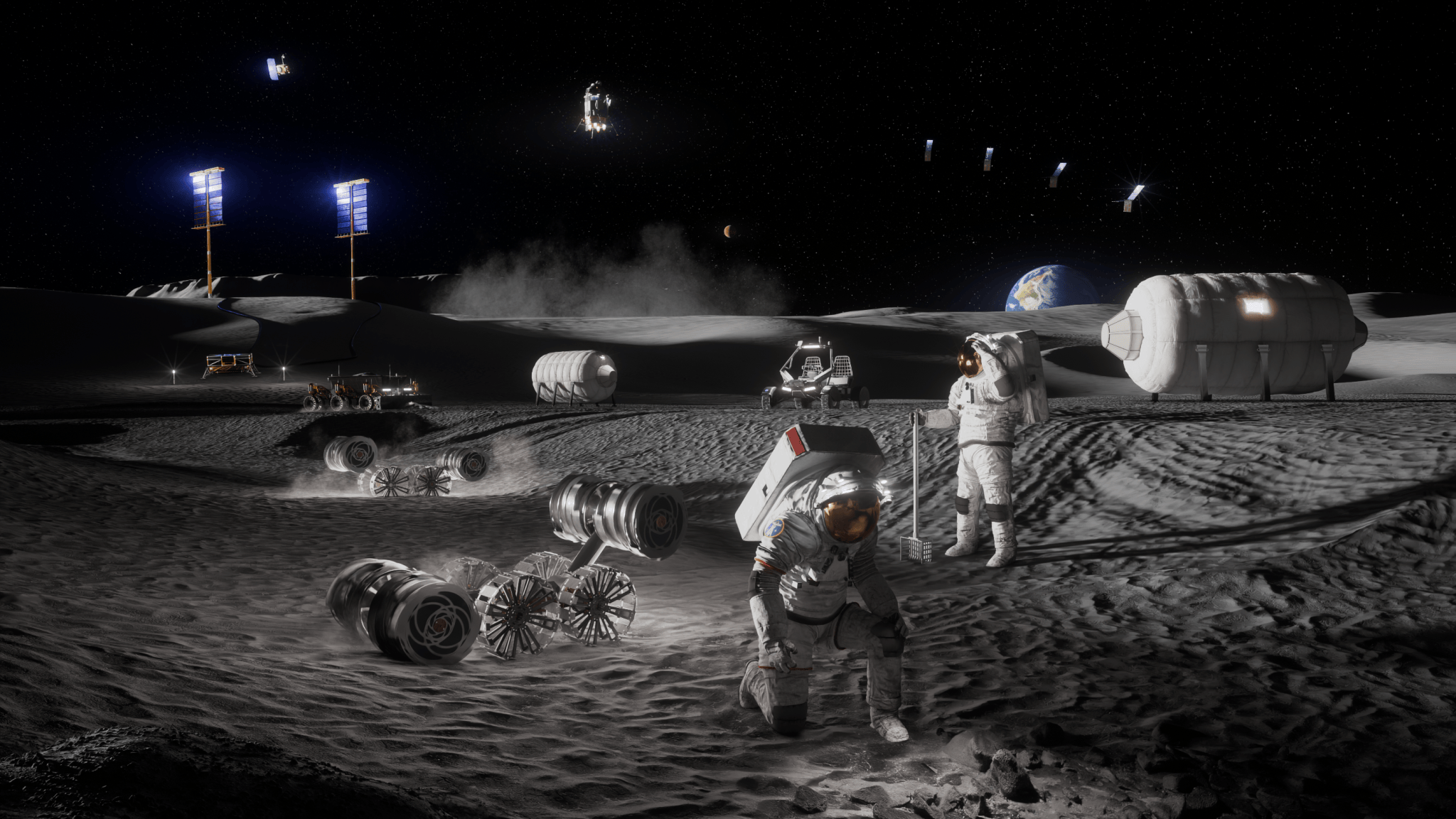
NASA Announces $1 Million to Students for Moon Base Challenge
Artist’s concept depicting astronauts, habitats, rovers, power systems, and cargo operations supporting sustained human activities at the Mo...
-
NASA has exercised the second option of its Information Technology and Multimedia Services (ITAMS) contract with DB Consulting Group, Inc., ...
-
Science Earth Observatory A Subtle Return of La Niña Earth Earth Observatory Image of the Day EO Explorer All Topics ...
