Ice losses from Antarctica have tripled since 2012, increasing global sea levels by 0.12 inch (3 millimeters) in that timeframe alone, according to a major new international climate assessment funded by NASA and ESA (European Space Agency).
from NASA Breaking News https://ift.tt/2JPHDwQ
via IFTTT

Wednesday, 13 June 2018

Monday, 11 June 2018
First Astronaut of 2013 Class to Fly to Space Available for Media Interviews
NASA astronaut Nick Hague, along with his crewmate Alexey Ovchinin of the Russian space agency Roscosmos, will discuss their upcoming mission to the International Space Station in a news conference at 2 p.m. EDT Monday, June 18, at NASA’s Johnson Space Center in Houston.
from NASA Breaking News https://ift.tt/2HDij8b
via IFTTT
from NASA Breaking News https://ift.tt/2HDij8b
via IFTTT
Thursday, 7 June 2018
NASA Finds Ancient Organic Material, Mysterious Methane on Mars
NASA’s Curiosity rover has found new evidence preserved in rocks on Mars that suggests the planet could have supported ancient life, as well as new evidence in the Martian atmosphere that relates to the search for current life on the Red Planet.
from NASA Breaking News https://ift.tt/2M60TnX
via IFTTT
from NASA Breaking News https://ift.tt/2M60TnX
via IFTTT
NASA TV to Air US Spacewalk at International Space Station
NASA astronauts will embark on a six-and-a-half-hour spacewalk Thursday, June 14, during which they will install new high-definition cameras to capture spacecraft docking with the International Space Station, including new American-made spacecraft with scheduled test flights later this year.
from NASA Breaking News https://ift.tt/2sECPk1
via IFTTT
from NASA Breaking News https://ift.tt/2sECPk1
via IFTTT
Wednesday, 6 June 2018
Juno Solves 39-Year Old Mystery of Jupiter Lightning

Ever since NASA's Voyager 1 spacecraft flew past Jupiter in March, 1979, scientists have wondered about the origin of Jupiter's lightning. That encounter confirmed the existence of Jovian lightning, which had been theorized for centuries. But when the venerable explorer hurtled by, the data showed that the lightning-associated radio signals didn't match the details of the radio signals produced by lightning here at Earth.
In a new paper published in Nature today, scientists from NASA's Juno mission describe the ways in which lightning on Jupiter is actually analogous to Earth's lightning. Although, in some ways, the two types of lightning are polar opposites.
"No matter what planet you're on, lightning bolts act like radio transmitters -- sending out radio waves when they flash across a sky," said Shannon Brown of NASA's Jet Propulsion Laboratory in Pasadena, California, a Juno scientist and lead author of the paper. "But until Juno, all the lightning signals recorded by spacecraft [Voyagers 1 and 2, Galileo, Cassini] were limited to either visual detections or from the kilohertz range of the radio spectrum, despite a search for signals in the megahertz range. Many theories were offered up to explain it, but no one theory could ever get traction as the answer."
Enter Juno, which has been orbiting Jupiter since July 4, 2016. Among its suite of highly sensitive instruments is the Microwave Radiometer Instrument (MWR), which records emissions from the gas giant across a wide spectrum of frequencies.
"In the data from our first eight flybys, Juno's MWR detected 377 lightning discharges," said Brown. "They were recorded in the megahertz as well as gigahertz range, which is what you can find with terrestrial lightning emissions. We think the reason we are the only ones who can see it is because Juno is flying closer to the lighting than ever before, and we are searching at a radio frequency that passes easily through Jupiter's ionosphere."
While the revelation showed how Jupiter lightning is similar to Earth's, the new paper also notes that where these lightning bolts flash on each planet is actually quite different.
"Jupiter lightning distribution is inside out relative to Earth," said Brown. "There is a lot of activity near Jupiter's poles but none near the equator. You can ask anybody who lives in the tropics -- this doesn't hold true for our planet."
Why do lightning bolts congregate near the equator on Earth and near the poles on Jupiter? Follow the heat.
Earth's derives the vast majority of its heat externally from solar radiation, courtesy of our Sun. Because our equator bears the brunt of this sunshine, warm moist air rises (through convection) more freely there, which fuels towering thunderstorms that produce lightning.
Jupiter's orbit is five times farther from the Sun than Earth's orbit, which means that the giant planet receives 25 times less sunlight than Earth. But even though Jupiter's atmosphere derives the majority of its heat from within the planet itself, this doesn't render the Sun's rays irrelevant. They do provide some warmth, heating up Jupiter's equator more than the poles -- just as they heat up Earth. Scientists believe that this heating at Jupiter's equator is just enough to create stability in the upper atmosphere, inhibiting the rise of warm air from within. The poles, which do not have this upper-level warmth and therefore no atmospheric stability, allow warm gases from Jupiter's interior to rise, driving convection and therefore creating the ingredients for lightning.
"These findings could help to improve our understanding of the composition, circulation and energy flows on Jupiter," said Brown. But another question looms, she said. "Even though we see lightning near both poles, why is it mostly recorded at Jupiter's north pole?"
In a second Juno lightning paper published today in Nature Astronomy, Ivana Kolmašová of the Czech Academy of Sciences, Prague, and colleagues, present the largest database of lightning-generated low-frequency radio emissions around Jupiter (whistlers) to date. The data set of more than 1,600 signals, collected by Juno's Waves instrument, is almost 10 times the number recorded by Voyager 1. Juno detected peak rates of four lightning strikes per second (similar to the rates observed in thunderstorms on Earth) which is six times higher than the peak values detected by Voyager 1.
"These discoveries could only happen with Juno," said Scott Bolton, principal investigator of Juno from the Southwest Research Institute, San Antonio. "Our unique orbit allows our spacecraft to fly closer to Jupiter than any other spacecraft in history, so the signal strength of what the planet is radiating out is a thousand times stronger. Also, our microwave and plasma wave instruments are state-of-the-art, allowing us to pick out even weak lightning signals from the cacophony of radio emissions from Jupiter. "
NASA's Juno spacecraft will make its 13th science flyby over Jupiter's mysterious cloud tops on July 16.
NASA's Jet Propulsion Laboratory, Pasadena, California, manages the Juno mission for the principal investigator, Scott Bolton, of the Southwest Research Institute in San Antonio. Juno is part of NASA's New Frontiers Program, which is managed at NASA's Marshall Space Flight Center in Huntsville, Alabama, for NASA's Science Mission Directorate. The Microwave Radiometer instrument (MWR) was built by JPL. The Juno Waves instrument was provided by the University of Iowa. Lockheed Martin Space, Denver, built the spacecraft.
More information on Juno can be found at:
https://www.missionjuno.swri.edu
More information about Jupiter can be found at:
The public can follow the mission on Facebook and Twitter at:
https://www.facebook.com/NASAJuno
https://www.twitter.com/NASAJuno
News Media Contact
DC Agle
Jet Propulsion Laboratory, Pasadena, Calif.
818-393-9011
agle@jpl.nasa.gov
JoAnna Wendel
NASA Headquarters, Washington
202-358-1003
joanna.r.wendel@nasa.gov
Richard Lewis
University of Iowa, Iowa City
319-384-0012
richard-c-lewis@uiowa.edu
Deb Schmid
Southwest Research Institute, San Antonio
210-522-2254
dschmid@swri.org
2018-128
from News and Features https://ift.tt/2JxFx4j
via IFTTT
Warm Water Creeps into Otherwise-Calm Central Pacific

After a mild La Niña late last year, temperatures, convection and rainfall rates in the equatorial Pacific Ocean returned to normal by early April of this year. An April 9 image of sea level height from the U.S./European Jason-3 satellite mission showed most of the ocean at neutral heights. But by the beginning of May, high sea levels began to build up in the Central Pacific. In the tropics, high sea levels are usually caused by a layer of warm water at or below the surface.
This patch of high sea level is slowly traveling eastward through the tropical Pacific Ocean along the equator. Known as a downwelling Kelvin wave, this type of signal is often a precursor to an El Niño event.
The Kelvin wave formed after a few short periods when winds changed from the prevailing easterlies to westerly -- known as westerly wind bursts -- in the far western Pacific in early 2018. In addition, there has been a general weakening of the easterly winds along the equator since January. Both of these wind conditions combine to create the Kelvin wave, which moves east along the equator and results in the spreading of warm water layers that are normally confined to the western Pacific Ocean eastward into the central Pacific. The red pattern visible at the equator on May 9 is the result of this downwelling Kelvin wave.
During a large El Niño, like the 2015-16 event, a huge area where sea levels are more than a foot (30 centimeters) higher than normal is visible in Jason-3 images. The high sea level is caused by a thick layer of warm water in the upper several hundred feet of the ocean. Such large El Niño events affect weather and climate across the globe, particularly in the western United States. In California, El Niños usually mean above-average winter rainfall, while Oregon and Washington typically see drier-than-normal winters.
El Niños happen when a series of Kelvin waves like this one spread warm water from west to east along the equator, causing high sea levels in the Central Pacific and sometimes as far east as the coastlines of Central and South America. The warm water is currently confined to the subsurface, with no warming at the ocean surface -- a first indicator of an upcoming El Niño event. But forecasters at agencies like NOAA (the National Oceanic and Atmospheric Administration) and ECMWF (European Centre for Medium-Range Weather Forecasts) will be watching closely for more Kelvin waves like this one as summer approaches.
NASA's Jet Propulsion Laboratory in Pasadena, California, manages the Jason-3 mission for NASA. NOAA operates Jason-3 in partnership with NASA, the French space agency (CNES), and the European Organisation for the Exploitation of Meteorological Satellites (EUMETSAT).
News Media Contact
Alan Buis
Jet Propulsion Laboratory, Pasadena, California
818-354-0474
Alan.Buis@jpl.nasa.gov
Written by Carol Rasmussen
NASA's Earth Science News Team
2018-127
from News and Features https://ift.tt/2JeBGdb
via IFTTT
Astronauts Safely in Orbit Following Launch to International Space Station
Three crew members are on their way to the International Space Station after launching from the Baikonur Cosmodrome in Kazakhstan at 7:12 a.m. EDT Wednesday (5:12 p.m. Baikonur time).
from NASA Breaking News https://ift.tt/2JdqSMl
via IFTTT
from NASA Breaking News https://ift.tt/2JdqSMl
via IFTTT
Monday, 4 June 2018
NASA to Host Live Discussion on New Mars Science Results
The media and public are invited to ask questions during a live discussion at 2 p.m. EDT Thursday, June 7, on new science results from NASA’s Mars Curiosity rover.
from NASA Breaking News https://ift.tt/2LZxc7V
via IFTTT
from NASA Breaking News https://ift.tt/2LZxc7V
via IFTTT
Sunday, 3 June 2018
NASA Astronaut, Crewmates Safely Return to Earth from Space Station
Three members of the International Space Station Expedition 55 crew, including NASA astronaut Scott Tingle, returned to Earth Sunday after 168 days of living and working in low-Earth orbit.
from NASA Breaking News https://ift.tt/2LjywRQ
via IFTTT
from NASA Breaking News https://ift.tt/2LjywRQ
via IFTTT
Saturday, 2 June 2018
NEOWISE Thermal Data Reveal Surface Properties of Over 100 Asteroids

Nearly all asteroids are so far away and so small that the astronomical community only knows them as moving points of light. The rare exceptions are asteroids that have been visited by spacecraft, a small number of large asteroids resolved by NASA's Hubble Space Telescope or large ground-based telescopes, or those that have come close enough for radar imaging.
When seen by optical telescopes, these individual sources of reflected sunlight can provide some very valuable but also very basic information -- for example, the asteroid's orbit, a ballpark estimate of its size, sometimes an approximation of its shape, and perhaps an idea of its physical makeup. But to learn more about these elusive and important celestial objects requires a different type of instrument. An infrared sensor can, in the right circumstances, not only provide data on an asteroid's orbit and data that can be used to more accurately measure its size, but also chemical makeup and sometimes even its surface characteristics.
NASA's Near-Earth Object Wide-field Infrared Survey Explorer, or NEOWISE, spacecraft, in orbit around Earth, uses asteroid-hunting thermal sensors that allow an infrared view of asteroids without the obscuring effects of Earth's atmosphere. In a paper published recently in the journal Icarus, researchers led by Josef Hanuš, a scientist at the Astronomical Institute of Charles University, Prague, have made an in-depth analysis of more than 100 asteroids that have come under the temperature-sensing gaze of NEOWISE. This analysis tripled the number of asteroids which have undergone detailed "thermophysical" modeling of asteroid properties that vary with temperature. The results provide a more accurate glimpse into the surface properties of main belt asteroids and also reinforce the capabilities of spaceborne infrared observatories to accurately assess the sizes of asteroids.
Value of this technique
Thermophysical modeling is a gold mine for asteroid researchers because it allows a more comprehensive analysis of the nature of asteroids. Not all asteroids are suitable for thermophysical modeling because the necessary raw data sets are not always available. But Hanuš's team found 122 asteroids that not only had NEOWISE data, but also detailed models of their rotation states (how fast an object rotates around its axis, and the orientation of the axis in space) and multi-faceted models of the asteroid's 3D shape.
"Using archived data from the NEOWISE mission and our previously derived shape models, we were able to create highly detailed thermophysical models of 122 main belt asteroids," said Hanuš, lead author of the paper. "We now have a better idea of the properties of the surface regolith and show that small asteroids, as well as fast rotating asteroids, have little, if any, dust covering their surfaces." (Regolith is the term for the broken rocks and dust on the surface.)
It could be difficult for fast-rotating asteroids to retain very fine regolith grains because their low gravity and high spin rates tend to fling small particles off their surfaces and into space. Also, it could be that fast-rotating asteroids do not experience large temperature changes because the sun's rays are more rapidly distributed across their surfaces. That would reduce or prevent the thermal cracking of an asteroid's surface material that could cause the generation of fine grains of regolith.
Hanuš's team also found that their detailed calculations for estimated sizes of the asteroids they studied were consistent with those of the same asteroids calculated by the NEOWISE team using simpler models.
"With the asteroids for which we were able to gather the most information from other sources, our calculations of their sizes were consistent with the radiometrically-derived values performed by the NEOWISE team," said Hanuš. "The uncertainties were within 10 percent between the two sets of results."
"This is an important example of how space-based infrared data can accurately characterize asteroids," said Alan Harris, a senior scientist at the German Aerospace Center (DLR) based in Berlin, Germany, who specializes in thermal modeling of asteroids but was not involved with the study. "NEOWISE is leading the way in demonstrating the value of space-based infrared observatories for asteroid and near-Earth object discovery and characterization, both vital to our understanding these important inhabitants of our solar system."
From WISE to NEOWISE
Originally called the Wide-field Infrared Survey Explorer (WISE), the spacecraft was launched in December 2009 to study galaxies, stars, and solar system bodies by imaging the entire sky in infrared light. It was placed in hibernation in 2011 after its primary astrophysics mission was completed. In September 2013, it was reactivated, renamed NEOWISE and assigned a new mission: to assist NASA's efforts to identify and characterize the population of near-Earth objects. NEOWISE also is characterizing more distant populations of asteroids and comets to provide information about their sizes and compositions.
NASA's Jet Propulsion Laboratory in Pasadena, California, manages and operates the NEOWISE mission for NASA's Planetary Defense Coordination Office within the Science Mission Directorate in Washington. The Space Dynamics Laboratory in Logan, Utah built the science instrument. Ball Aerospace & Technologies Corp. of Boulder, Colorado built the spacecraft. Science data processing takes place at IPAC at Caltech in Pasadena. Caltech manages JPL for NASA.
The thermophysical modeling paper accepted by Icarus is available at:
https://arxiv.org/pdf/1803.06116.pdf
For more information about NEOWISE, visit:
and
http://neowise.ipac.caltech.edu/
More information about asteroids and near-Earth objects is at:
https://www.jpl.nasa.gov/asteroidwatch
News Media Contact
DC Agle
Jet Propulsion Laboratory, Pasadena, Calif.
818-393-9011
agle@jpl.nasa.gov
JoAnna Wendel
NASA Headquarters, Washington
202-358-1003
joanna.r.wendel@nasa.gov
2018-122
from News and Features https://ift.tt/2H9yLwA
via IFTTT
Friday, 1 June 2018
NASA Selects US Companies to Advance Space Resource Collection
NASA has selected 10 companies to conduct studies and advance technologies to collect, process and use space-based resources for missions to the Moon and Mars.
from NASA Breaking News https://ift.tt/2JgoWSy
via IFTTT
from NASA Breaking News https://ift.tt/2JgoWSy
via IFTTT
Subscribe to:
Posts (Atom)
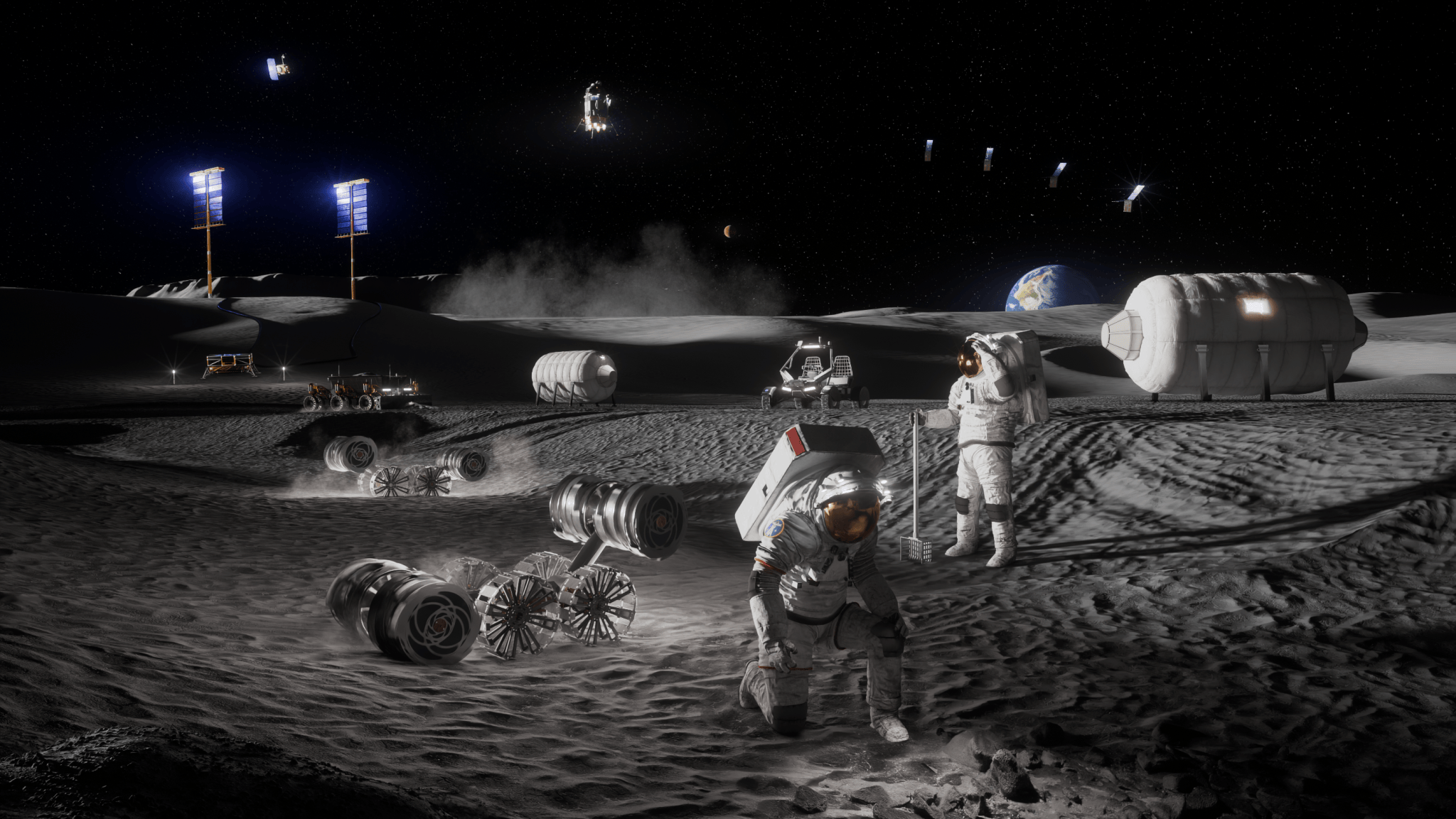
NASA Announces $1 Million to Students for Moon Base Challenge
Artist’s concept depicting astronauts, habitats, rovers, power systems, and cargo operations supporting sustained human activities at the Mo...
-
NASA has exercised the second option of its Information Technology and Multimedia Services (ITAMS) contract with DB Consulting Group, Inc., ...
-
Science Earth Observatory A Subtle Return of La Niña Earth Earth Observatory Image of the Day EO Explorer All Topics ...
