An experiment in space manufacturing and an enhanced study of solar energy are among the research currently heading to the International Space Station following Friday’s launch of a SpaceX Dragon spacecraft at 10:36 a.m. EST.
from NASA Breaking News http://ift.tt/2zfpIcG
via IFTTT

Friday, 15 December 2017

Thursday, 14 December 2017
Artificial Intelligence, NASA Data Used to Discover Eighth Planet Circling Distant Star
Our solar system now is tied for most number of planets around a single star, with the recent discovery of an eighth planet circling Kepler-90, a Sun-like star 2,545 light years from Earth. The planet was discovered in data from NASA’s Kepler Space Telescope.
from NASA Breaking News http://ift.tt/2B2kaS7
via IFTTT
from NASA Breaking News http://ift.tt/2B2kaS7
via IFTTT
NASA Astronaut Bresnik and Crewmates Return to Earth From Space Station
Three crew members who have been living and working aboard the International Space Station returned to Earth on Thursday, landing in Kazakhstan after opening a new chapter in the scientific capability of humanity’s premier microgravity laboratory.
from NASA Breaking News http://ift.tt/2C7vWd4
via IFTTT
from NASA Breaking News http://ift.tt/2C7vWd4
via IFTTT
Next-Generation GRACE Satellites Arrive at Launch Site

A pair of advanced U.S./German Earth research satellites with some very big shoes to fill is now at California's Vandenberg Air Force Base to begin final preparations for launch next spring.
Following a year-long test campaign by satellite manufacturer Airbus Defence and Space at IABG in Ottobrunn, near Munich, Germany, the twin Gravity Recovery and Climate Experiment Follow-On (GRACE-FO) satellites were loaded aboard an air freighter at Munich airport Dec. 11 and arrived at the launch site on California's central coast Tuesday, Dec. 12. GRACE-FO will provide continuity to the Earth climate data record of the extremely successful predecessor GRACE, which completed its science mission in October after more than 15 years in orbit.
GRACE-FO will extend GRACE's legacy of scientific achievements, which range from tracking mass changes of Earth's polar ice sheets and estimating global groundwater changes, to measuring the mass changes of large earthquakes and inferring changes in deep ocean currents, a driving force in climate. To date, GRACE observations have been used in more than 4,300 research publications. Its measurements provide a unique view of the Earth system and have far-reaching benefits to society, such as providing insights into where global groundwater resources may be shrinking or growing and where dry soils are contributing to drought. GRACE-FO is planned to fly at least five years.
The GRACE-FO spacecraft will undergo final tests before being integrated atop a SpaceX Falcon 9 rocket, where they will share a ride to space with five Iridium NEXT communications satellites.
"With this milestone, we are now in position to launch GRACE
Follow-On and restart the valuable observations and science that ceased in
mid-2017 with the end of the GRACE science mission," said Michael Watkins,
director of NASA's Jet Propulsion Laboratory in Pasadena, California, and GRACE
Follow-On science team lead.
After a few months of in-orbit checkout, GRACE-FO will track changes in the distribution of liquid water, ice and land masses by measuring changes in Earth's gravity field every 30 days. GRACE-FO will essentially measure how much mass is gained or lost each month on the continents, in the oceans, and in the ice sheets. These data will improve scientific understanding of Earth system processes and the accuracy of environmental monitoring and forecasts.
The continuous movement of masses of water, ice, air and the solid Earth that GRACE-FO will track is driven by Earth system processes such as:
- Terrestrial water cycle processes, such as precipitation, droughts, floods, changes in ice sheets and land glaciers, evaporation from the oceans, and groundwater use and storage.
- Tectonic processes, such as earthquakes and variations in Earth's lithosphere (the rigid outer layer of our planet that includes the crust and upper mantle) and mantle density.
The GRACE-FO satellites will be launched into a polar orbit at an altitude of about 311 miles (500 kilometers). Flying 137 miles (220 kilometers) apart, the satellites will use a JPL-built microwave ranging system to take continuous, very precise measurements of the variations in the distance between each other. These variations are caused by minute changes in the gravitational pull on the satellites from local changes in Earth's mass below them. The microwave ranging data are combined with GPS tracking for timing, star trackers for attitude information, and an accelerometer built at ONERA in France to account for non-gravitational effects, such as atmospheric drag and solar radiation. From these data, scientists will calculate how mass is redistributed each month and monitor its changes over time.
Each satellite will also carry an instrument called an atmospheric limb sounder that will provide an innovative and cost-effective technique to measure how much signals from GPS satellites are distorted by the atmosphere. The sounders will provide up to 200 profiles of atmospheric temperature and water vapor content each day to aid weather forecasting.
While similar to their predecessor GRACE satellites, GRACE-FO incorporates design upgrades gleaned from 15 years of GRACE operations that will improve satellite performance, reliability and mission operations. GRACE-FO will also fly a new, more precise inter-satellite laser ranging instrument, developed by a German/American joint venture, which will be tested for use in future generations of GRACE-like missions.
GRACE-FO is a partnership between JPL and the German Research Centre for Geosciences (GFZ) in Potsdam, with participation by Deutsches Zentrum für Luft- und Raumfahrt (DLR), the German Aerospace Center.
For more information on GRACE-FO, visit:
News Media Contact
Alan Buis
Jet Propulsion Laboratory, Pasadena, California
818-354-0474
Alan.Buis@jpl.nasa.gov
2017-320
from News and Features http://ift.tt/2AkvOGZ
via IFTTT
NASA Television Updates Broadcast Schedule for Cargo Resupply Mission
NASA commercial cargo provider SpaceX now is targeting no earlier than 10:36 a.m. EST Friday, Dec. 15, for its 13th commercial resupply services mission to the International Space Station.
from NASA Breaking News http://ift.tt/2C1OZFQ
via IFTTT
from NASA Breaking News http://ift.tt/2C1OZFQ
via IFTTT
Wednesday, 13 December 2017
Mars Mission Sheds Light on Habitability of Distant Planets

How long might a rocky, Mars-like planet be habitable if it were orbiting a red dwarf star? It's a complex question but one that NASA's Mars Atmosphere and Volatile Evolution mission can help answer.
"The MAVEN mission tells us that Mars lost substantial amounts of its atmosphere over time, changing the planet's habitability," said David Brain, a MAVEN co-investigator and a professor at the Laboratory for Atmospheric and Space Physics at the University of Colorado Boulder. "We can use Mars, a planet that we know a lot about, as a laboratory for studying rocky planets outside our solar system, which we don't know much about yet."
At the fall meeting of the American Geophysical Union on Dec. 13, 2017, in New Orleans, Louisiana, Brain described how insights from the MAVEN mission could be applied to the habitability of rocky planets orbiting other stars.
MAVEN carries a suite of instruments that have been measuring Mars' atmospheric loss since November 2014. The studies indicate that Mars has lost the majority of its atmosphere to space over time through a combination of chemical and physical processes. The spacecraft's instruments were chosen to determine how much each process contributes to the total escape.
In the past three years, the Sun has gone through periods of higher and lower solar activity, and Mars also has experienced solar storms, solar flares and coronal mass ejections. These varying conditions have given MAVEN the opportunity to observe Mars' atmospheric escape getting cranked up and dialed down.
Brain and his colleagues started to think about applying these insights to a hypothetical Mars-like planet in orbit around some type of M-star, or red dwarf, the most common class of stars in our galaxy.
The researchers did some preliminary calculations based on the MAVEN data. As with Mars, they assumed that this planet might be positioned at the edge of the habitable zone of its star. But because a red dwarf is dimmer overall than our Sun, a planet in the habitable zone would have to orbit much closer to its star than Mercury is to the Sun.
The brightness of a red dwarf at extreme ultraviolet (UV) wavelengths combined with the close orbit would mean that the hypothetical planet would get hit with about 5 to 10 times more UV radiation than the real Mars does. That cranks up the amount of energy available to fuel the processes responsible for atmospheric escape. Based on what MAVEN has learned, Brain and colleagues estimated how the individual escape processes would respond to having the UV cranked up.
Their calculations indicate that the planet's atmosphere could lose 3 to 5 times as many charged particles, a process called ion escape. About 5 to 10 times more neutral particles could be lost through a process called photochemical escape, which happens when UV radiation breaks apart molecules in the upper atmosphere.
Because more charged particles would be created, there also would be more sputtering, another form of atmospheric loss. Sputtering happens when energetic particles are accelerated into the atmosphere and knock molecules around, kicking some of them out into space and sending others crashing into their neighbors, the way a cue ball does in a game of pool.
Finally, the hypothetical planet might experience about the same amount of thermal escape, also called Jeans escape. Thermal escape occurs only for lighter molecules, such as hydrogen. Mars loses its hydrogen by thermal escape at the top of the atmosphere. On the exo-Mars, thermal escape would increase only if the increase in UV radiation were to push more hydrogen to the top of the atmosphere.
Altogether, the estimates suggest that orbiting at the edge of the habitable zone of a quiet M-class star, instead of our Sun, could shorten the habitable period for the planet by a factor of about 5 to 20. For an M-star whose activity is amped up like that of a Tasmanian devil, the habitable period could be cut by a factor of about 1,000 -- reducing it to a mere blink of an eye in geological terms. The solar storms alone could zap the planet with radiation bursts thousands of times more intense than the normal activity from our Sun.
However, Brain and his colleagues have considered a particularly challenging situation for habitability by placing Mars around an M-class star. A different planet might have some mitigating factors -- for example, active geological processes that replenish the atmosphere to a degree, a magnetic field to shield the atmosphere from stripping by the stellar wind, or a larger size that gives more gravity to hold on to the atmosphere.
"Habitability is one of the biggest topics in astronomy, and these estimates demonstrate one way to leverage what we know about Mars and the Sun to help determine the factors that control whether planets in other systems might be suitable for life," said Bruce Jakosky, MAVEN's principal investigator at the University of Colorado Boulder.
MAVEN's principal investigator is based at the University of Colorado's Laboratory for Atmospheric and Space Physics, Boulder. The university provided two science instruments and leads science operations, as well as education and public outreach, for the mission. NASA's Goddard Space Flight Center in Greenbelt, Maryland, manages the MAVEN project and provided two science instruments for the mission. NASA's Jet Propulsion Laboratory, a division of Caltech in Pasadena, California, manages the Mars Exploration Program for NASA's Science Mission Directorate, Washington.
For more information about MAVEN, visit:
News Media Contact
Laurie Cantillo / Dwayne Brown
NASA Headquarters, Washington
202-358-1077 / 202-358-1726
laura.l.cantillo@nasa.gov / dwayne.c.brown@nasa.gov
Written by Elizabeth Zubritsky
NASA's Goddard Space Flight Center, Greenbelt, Md.
2017-319
from News and Features http://ift.tt/2AB4dFw
via IFTTT
Sierras Lost Water Weight, Grew Taller During Drought

Loss of water from the rocks of California's Sierra Nevada caused the mountain range to rise nearly an inch (24 millimeters) in height during the drought years from October 2011 to October 2015, a new NASA study finds. In the two following years of more abundant snow and rainfall, the mountains have regained about half as much water in the rock as they had lost in the preceding drought and have fallen about half an inch (12 millimeters) in height.
"This suggests that the solid Earth has a greater capacity to store water than previously thought," said research scientist Donald Argus of NASA's Jet Propulsion Laboratory in Pasadena, California, who led the study. Significantly more water was lost from cracks and soil within fractured mountain rock during drought and gained during heavy precipitation than hydrology models show.
Argus is giving a talk on the new finding today at the American Geophysical Union's fall conference in New Orleans.
The research team used advanced data-processing techniques on data from 1,300 GPS stations in the mountains of California, Oregon and Washington, collected from 2006 through October 2017. These research-quality GPS receivers were installed as part of the National Science Foundation's Plate Boundary Observatory to measure subtle tectonic motion in the region's active faults and volcanoes. They can monitor elevation changes within less than a tenth of an inch (a few millimeters).
The team found that the amount of water lost from within fractured mountain rock in 2011-2015 amounted to 10.8 cubic miles of water. This water is too inaccessible to be used for human purposes, but for comparison, the amount is 45 times as much water as Los Angeles currently uses in a year.
JPL water scientist Jay Famiglietti, who collaborated on the research, said the finding solves a mystery for hydrologists. "One of the major unknowns in mountain hydrology is what happens below the soil. How much snowmelt percolates through fractured rock straight downward into the core of the mountain? This is one of the key topics that we addressed in our study."
Earth's surface falls locally when it is weighed down with water and rebounds when the weight disappears. Many other factors also change the ground level, such as the movement of tectonic plates, volcanic activity, high- and low-pressure weather systems, and Earth's slow rebound from the last ice age. The team corrected for these and other factors to estimate how much of the height increase was solely due to water loss from rock.
Before this study, scientists' leading theories for the growth of the Sierra were tectonic uplift or Earth rebounding from extensive groundwater pumping in the adjoining California Central Valley. Argus calculated that these two processes together only produced a quarter of an inch (7 millimeters) of growth -- less than a third of the total.
Famiglietti said the techniques developed for this study will allow scientists to begin exploring other questions about mountain groundwater. "What does the water table look like within mountain ranges? Is there a significant amount of groundwater stored within mountains? We just don't have answers yet, and this study identities a set of new tools to help us get them."
A paper on the research, titled "Sustained water loss in California's mountain ranges during severe drought from 2012 through 2015 inferred from GPS," was published in the Journal of Geophysical Research: Solid Earth.
News Media Contact
Alan Buis
Jet Propulsion Laboratory, Pasadena, California
818-354-0474
Alan.Buis@jpl.nasa.gov
Written by Carol Rasmussen
NASA's Earth Science News Team
2017-318
from News and Features http://ift.tt/2CcIKQe
via IFTTT
Bright Areas on Ceres Suggest Geologic Activity

If you could fly aboard NASA's Dawn spacecraft, the surface of dwarf planet Ceres would generally look quite dark, but with notable exceptions. These exceptions are the hundreds of bright areas that stand out in images Dawn has returned. Now, scientists have a better sense of how these reflective areas formed and changed over time -- processes indicative of an active, evolving world.
"The mysterious bright spots on Ceres, which have captivated both the Dawn science team and the public, reveal evidence of Ceres' past subsurface ocean, and indicate that, far from being a dead world, Ceres is surprisingly active. Geological processes created these bright areas and may still be changing the face of Ceres today," said Carol Raymond, deputy principal investigator of the Dawn mission, based at NASA's Jet Propulsion Laboratory in Pasadena, California. Raymond and colleagues presented the latest results about the bright areas at the American Geophysical Union meeting in New Orleans on Tuesday, Dec. 12.
Different Kinds of Bright Areas
Since Dawn arrived in orbit at Ceres in March 2015, scientists have located more than 300 bright areas on Ceres. A new study in the journal Icarus, led by Nathan Stein, a doctoral researcher at Caltech in Pasadena, California, divides Ceres' features into four categories.
The first group of bright spots contains the most reflective material on Ceres, which is found on crater floors. The most iconic examples are in Occator Crater, which hosts two prominent bright areas. Cerealia Facula, in the center of the crater, consists of bright material covering a 6-mile-wide (10-kilometer-wide) pit, within which sits a small dome. East of the center is a collection of slightly less reflective and more diffuse features called Vinalia Faculae. All the bright material in Occator Crater is made of salt-rich material, which was likely once mixed in water. Although Cerealia Facula is the brightest area on all of Ceres, it would resemble dirty snow to the human eye.
More commonly, in the second category, bright material is found on the rims of craters, streaking down toward the floors. Impacting bodies likely exposed bright material that was already in the subsurface or had formed in a previous impact event.
Separately, in the third category, bright material can be found in the material ejected when craters were formed.
The mountain Ahuna Mons gets its own fourth category -- the one instance on Ceres where bright material is unaffiliated with any impact crater. This likely cryovolcano, a volcano formed bythe gradual accumulation of thick, slowly flowing icy materials, has prominent bright streaks on its flanks.
Over hundreds of millions of years, bright material has mixed with the dark material that forms the bulk of Ceres' surface, as well as debris ejected during impacts. That means billions of years ago, when Ceres experienced more impacts, the dwarf planet's surface likely would have been peppered with thousands of bright areas.
"Previous research has shown that the bright material is made of salts, and we think subsurface fluid activity transported it to the surface to form some of the bright spots," Stein said.
The Case of Occator
Why do the different bright areas of Occator seem so distinct from one another? Lynnae Quick, a planetary geologist at the Smithsonian Institution in Washington, has been delving into this question.
The leading explanation for what happened at Occator is that it could have had, at least in the recent past, a reservoir of salty water beneath it. Vinalia Faculae, the diffuse bright regions to the northeast of the crater's central dome, could have formed from a fluid driven to the surface by a small amount of gas, similar to champagne surging out of its bottle when the cork is removed.
In the case of the Vinalia Faculae, the dissolved gas could have been a volatile substance such as water vapor, carbon dioxide, methane or ammonia. Volatile-rich salty water could have been brought close to Ceres' surface through fractures that connected to the briny reservoir beneath Occator. The lower pressure at Ceres' surface would have caused the fluid to boil off as a vapor. Where fractures reached the surface, this vapor could escape energetically, carrying with it ice and salt particles and depositing them on the surface.
Cerealia Facula must have formed in a somewhat different process, given that it is more elevated and brighter than Vinalia Faculae. The material at Cerealia may have been more like an icy lava, seeping up through the fractures and swelling into a dome. Intermittent phases of boiling, similar to what happened when Vinalia Faculae formed, may have occurred during this process, littering the surface with ice and salt particles that formed the Cerealia bright spot.
Quick's analyses do not depend on the initial impact that formed Occator. However, the current thinking among Dawn scientists is that when a large body slammed into Ceres, excavating the 57-mile-wide (92-kilometer-wide) crater, the impact may have also created fractures through which liquid later emerged.
"We also see fractures on other solar system bodies, such as Jupiter's icy moon Europa," Quick said. "The fractures on Europa are more widespread than the fractures we see at Occator. However, processes related to liquid reservoirs that might exist beneath Europa's cracks today could be used as a comparison for what may have happened at Occator in the past."
As Dawn continues the final phase of its mission, in which it will descend to lower altitudes than ever before, scientists will continue learning about the origins of the bright material on Ceres and what gave rise to the enigmatic features in Occator.
The Dawn mission is managed by JPL for NASA's Science Mission Directorate in Washington. Dawn is a project of the directorate's Discovery Program, managed by NASA's Marshall Space Flight Center in Huntsville, Alabama. UCLA is responsible for overall Dawn mission science. Orbital ATK Inc., in Dulles, Virginia, designed and built the spacecraft. The German Aerospace Center, Max Planck Institute for Solar System Research, Italian Space Agency and Italian National Astrophysical Institute are international partners on the mission team. For a complete list of mission participants, visit:
More information about Dawn is available at the following sites:
News Media Contact
Elizabeth Landau
Jet Propulsion Laboratory, Pasadena, Calif.
(818) 354-6425
Elizabeth.Landau@jpl.nasa.gov
2017-317
from News and Features http://ift.tt/2AcZXYv
via IFTTT
NASA Awards Contract for Safety, Mission Assurance Support
NASA has awarded the Safety and Mission Assurance Support Services III (SMASS III) contract to A-P-T Research, Inc. of Huntsville, Alabama, for a broad range of services at the agency’s Headquarters in Washington, Kennedy Space Center in Florida, and various sites supported by Kennedy’s programs and projects.
from NASA Breaking News http://ift.tt/2BXbU5a
via IFTTT
from NASA Breaking News http://ift.tt/2BXbU5a
via IFTTT
Tuesday, 12 December 2017
NASA Establishes Advisory Group for National Space Council
NASA has established a new advisory group on behalf of the National Space Council that will represent the expertise, interests and perspectives of non-federal aerospace organizations to the National Space Council.
from NASA Breaking News http://ift.tt/2BX2tCN
via IFTTT
from NASA Breaking News http://ift.tt/2BX2tCN
via IFTTT
Washington Students to Speak with NASA Astronaut on Space Station Today
Students from nine school districts in Port Orchard, Washington, will speak with a NASA astronaut living, working and doing research aboard the International Space Station at 1:10 p.m. EST today.
from NASA Breaking News http://ift.tt/2z3KnAj
via IFTTT
from NASA Breaking News http://ift.tt/2z3KnAj
via IFTTT
Subscribe to:
Posts (Atom)
NASA Announces $1 Million to Students for Moon Base Challenge
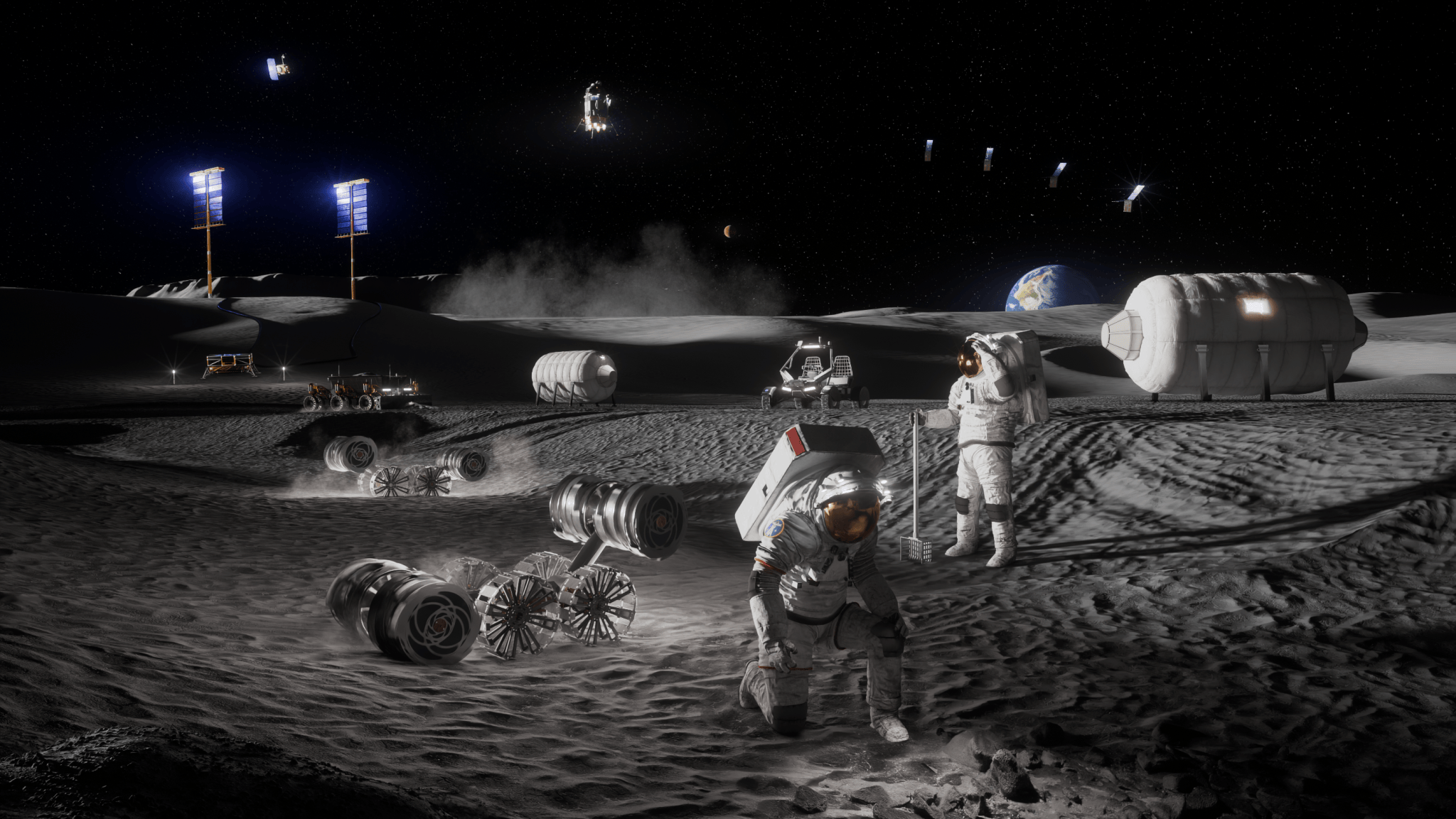
Artist’s concept depicting astronauts, habitats, rovers, power systems, and cargo operations supporting sustained human activities at the Mo...
-
NASA has exercised the second option of its Information Technology and Multimedia Services (ITAMS) contract with DB Consulting Group, Inc., ...
-
Science Earth Observatory A Subtle Return of La Niña Earth Earth Observatory Image of the Day EO Explorer All Topics ...
