Wednesday, 6 December 2017

Found: Most Distant Black Hole


Scientists have uncovered a rare relic from the early universe: the farthest known supermassive black hole. This matter-eating beast is 800 million times the mass of our Sun, which is astonishingly large for its young age. Researchers report the find in the journal Nature.

"This black hole grew far larger than we expected in only 690 million years after the Big Bang, which challenges our theories about how black holes form," said study co-author Daniel Stern of NASA's Jet Propulsion Laboratory in Pasadena, California.

Astronomers combined data from NASA's Wide-field Infrared Survey Explorer (WISE) with ground-based surveys to identify potential distant objects to study, then followed up with Carnegie Observatories' Magellan telescopes in Chile. Carnegie astronomer Eduardo Bañados led the effort to identify candidates out of the hundreds of millions of objects WISE found that would be worthy of follow-up with Magellan.

For black holes to become so large in the early universe, astronomers speculate there must have been special conditions to allow rapid growth -- but the underlying reason remains mysterious.

The newly found black hole is voraciously devouring material at the center of a galaxy -- a phenomenon called a quasar. This quasar is especially interesting because it comes from a time when the universe was just beginning to emerge from its dark ages. The discovery will provide fundamental information about the universe when it was only 5 percent of its current age.

"Quasars are among the brightest and most distant known celestial objects and are crucial to understanding the early universe," said co-author Bram Venemans of the Max Planck Institute for Astronomy in Germany.

The universe began in a hot soup of particles that rapidly spread apart in a period called inflation. About 400,000 years after the Big Bang, these particles cooled and coalesced

into neutral hydrogen gas. But the universe stayed dark, without any luminous sources, until gravity condensed matter into the first stars and galaxies. The energy released by these ancient galaxies caused the neutral hydrogen to get excited and ionize, or lose an electron. The gas has remained in that state since that time. Once the universe became reionzed, photons could travel freely throughout space. This is the point at which the universe became transparent to light.

Much of the hydrogen surrounding the newly discovered quasar is neutral. That means the quasar is not only the most distant -- it is also the only example we have that can be seen before the universe became reionized.

"It was the universe's last major transition and one of the current frontiers of astrophysics," Bañados said.

The quasar's distance is determined by what's called its redshift, a measurement of how much the wavelength of its light is stretched by the expansion of the universe before reaching Earth. The higher the redshift, the greater the distance, and the farther back astronomers are looking in time when they observe the object. This newly discovered quasar has a redshift of 7.54, based on the detection of ionized carbon emissions from the galaxy that hosts the massive black hole. That means it took more than 13 billion years for the light from the quasar to reach us.

Scientists predict the sky contains between 20 and 100 quasars as bright and as distant as this quasar. Astronomers look forward to the European Space Agency's Euclid mission, which has significant NASA participation, and NASA's Wide-field Infrared Survey Telescope (WFIRST) mission, to find more such distant objects.

"Withseveral next-generation, even-more-sensitive facilities currentlybeing built, we can expect many exciting discoveries in the very earlyuniverse in the coming years," Stern said.

Caltech in Pasadena, California, manages JPL for NASA.

News Media Contact

Elizabeth Landau

Jet Propulsion Laboratory, Pasadena, Calif.

818-354-6425

elizabeth.landau@jpl.nasa.gov

Eduardo Bañados

Carnegie Observatories, Pasadena, Calif.

626-304-0236

ebanados@carnegiescience.edu

2017-312


from News and Features http://ift.tt/2ksfqRv
via IFTTT

NASA Television Coverage Set for Space Station Crew Landing, Launch

Three crew members on the International Space Station are scheduled to end their mission and return to Earth on Thursday, Dec. 14, just days before another three space travelers begin their mission. Live coverage will air on NASA Television and the agency’s website.

from NASA Breaking News http://ift.tt/2k2fDah
via IFTTT

Tuesday, 5 December 2017

NASA Invites Media to Orion Spacecraft Parachute Test in Arizona

NASA is inviting media to attend a test of parachutes for the agency’s Orion spacecraft Wednesday, Dec. 13, at the U.S. Army’s Yuma Proving Ground in Arizona.

from NASA Breaking News http://ift.tt/2ATVJZj
via IFTTT

Saturday, 2 December 2017

JPL Invention Challenge: Students, Pros, Wiffle Balls


Catapults and leaf-blowers were among the many innovative devices built by students for the 2017 Invention Challenge, an annual engineering competition at NASA's Jet Propulsion Laboratory, Pasadena, California.

Middle schools and high schools were represented from across the greater Los Angeles area. Three teams even required passports, with students coming from Tanzania and Ethiopia.

This year's "Wiffle Ball Loft Contest" required competitors to create a device to launch up to 10 wiffle balls into a plastic tub located 19 feet, 8 inches (6 meters) away within a one-minute time allotment. The challenges were many: launching at the best angles with the varying wind directions; making sure the device was initiated by only one method; and even preventing the wiffle ball from breaking, which would result in disqualification.

The winners were from Southern California: "Project Defying Gravity" from Diamond Bar High School; "Cre8tive" from South East High School in Southgate; and "The Lizards" from Lawndale High School.

Paul MacNeal, a mechanical systems engineer at JPL, created the Invention Challenge 20 years ago to inspire students to pursue careers in engineering -- and have fun in the process. MacNeal said the event has influenced previous participants to recreate the competition in their local communities -- as far away as Istanbul.

"When I was in high school, I thought being involved with NASA-JPL was unattainable," MacNeal said. "I wanted to change that and inspire competitors to pursue engineering careers."

Yasin Giray, an Ethiopian volunteer teacher who brought the Ethiopian team to JPL, said Africa generally does not have enough opportunities for his students to show their skills in the science and technology fields.

"We encountered some difficulties along the way. Ethiopia does not sell the wiffle balls used in the contest, so we practiced with balls made of a different plastic," Giray said. "We could only practice when we arrived in the U.S., but we knew we had to take this opportunity."

Diamond Bar High School's first place team, "Project Defying Gravity," was a team of two. They developed a device elastically powered through a surgical tube calibrated to use multiple strengths to adjust to changing winds.

"A specific gelato container is the perfect size to fit a wiffle ball. So, we ate a lot of ice cream to use them in our device," Megan Ho, one of the two team members said. "I feel elated that we won. This competition has made me want to pursue engineering more -- specifically mechanical engineering."

Kenneth Chew, from the "PACKS" team representing Diamond Bar, was so inspired by JPL missions and launches that he brought lucky peanuts for his team to eat before launch - a JPL tradition before major mission events. He even designed a mission logo inspired by JPL mission patches.

Caltech in Pasadena, California, manages JPL for NASA.

News Media Contact

Andrew Good

Jet Propulsion Laboratory, Pasadena, Calif.

818-393-2433

andrew.c.good@jpl.nasa.gov

Written by: Elyssia Widjaja

2017-211


from News and Features http://ift.tt/2BDYP16
via IFTTT

The Voyagers in Popular Culture


Whether you're traveling across cities, continents or even oceans this holiday season, there is no long-haul flight quite like that of the Voyagers.

This year, we celebrated 40 years since the launch of NASA's twin Voyager probes -- the two farthest, fastest spacecraft currently in operation. Each Voyager has contributed an enormous amount of knowledge about the solar system, including the unexpected diversity of its planets and their moons. Among their many distinctions, Voyager 1 is the only spacecraft to enter interstellar space, and Voyager 2 is the only spacecraft to fly by all four giant planets: Jupiter, Saturn, Uranus and Neptune.

› DOWNLOAD VIDEO Voyager Images from the Odysseys

You might have missed the virtual Voyager party, though, since there was a lot of other space news around the time of the Voyager launch anniversaries. The solar eclipse, visible across America, took place on Aug. 21, just one day after Voyager 2 marked 40 years in flight. Sept. 5 was Voyager 1's launch anniversary, but space fans were already gearing up to commemorate the finale of NASA's Cassini mission on Sept. 15.

Don't worry -- it's never too late to appreciate the far-reaching influence the Voyagers have had. In fact, in addition to the news coverage the spacecraft have received, the spacecraft have also earned a place in popular culture.

So, since you might have some downtime as we head into the holidays, here are some Voyager-related movies, TV shows and songs. (Warning: a few spoilers ahead!)

Voyagers in Film and Television

Perhaps the most widely recognized pop culture Voyager homage is in the film "Star Trek: The Motion Picture" from 1979. In the film, a machine called V'Ger -- the fictional Voyager 6 spacecraft, its intelligence greatly enhanced by an alien race -- seeks the home of its creator, Earth, and threatens to wreak havoc on our planet in the process. In real life, John Casani, who was the Voyager project manager at that time at NASA's Jet Propulsion Laboratory in Pasadena, California, offered to loan a Voyager model to "Star Trek" creator Gene Roddenberry. Although the movie version altered the original design, it still used the mission as an inspiration.

The spacecraft had long passed the planets when a 2004 episode of "The West Wing" -- titled "The Warfare of Genghis Khan" -- mentioned a major mission milestone: Voyager 1 crossing the termination shock. The termination shock is a shockwave that marks the point at which the solar wind from the Sun, which travels at supersonic speeds up to that point, abruptly slows down and heats up. It represents the innermost part of the boundary of the heliosphere, the magnetic bubble that includes the Sun, planets and solar wind. Due to the termination shock crossing, the character Josh Lyman (mistakenly) declares this Voyager 1 to be the first man-made object to leave our solar system (mistakenly, because the solar system ends well beyond that landmark). "Funny, I'm going through a little termination shock myself," quips the character Donna Moss.

More recently, Voyager 1 did, in real life, cross into interstellar space in 2012, although technically it has still not left the solar system. In 2013, to talk about that milestone, the mission's project scientist, Ed Stone of Caltech in Pasadena, appeared on Comedy Central's Colbert Report.

The Golden Record

Each Voyager contains a copy of a Golden Record filled with Earth's sights and sounds, including images, music and audio clips of people and animals. This record has been featured in several works of science fiction. In the 1984 film "Starman," a race of aliens discovers the record and sends an emissary to Earth to learn more about our planet.

A 1994 episode of the X-Files titled "Little Green Men" also paid homage to Voyager. The episode opens with FBI agent Fox Mulder describing the Voyager mission and the Golden Record, including images, music and a child's voice saying, "Hello from the children of planet Earth." Mulder says the Voyagers passed the orbit of Neptune and "there were no further messages sent," but in reality, the Voyagers still communicate with Earth every day.

The mission wasn't exempt from fun on "Saturday Night Live." In episode 64, which aired in 1978, a psychic played by actor Steve Martin says the extraterrestrials had found the record and replied, "Send More Chuck Berry" -- referring to the iconic song "Johnny B. Goode" included on the Golden Record. Learn more about the Golden Record and see a full list of its contents here.

And More

Voyager has proved inspirational to contemporary musicians and songwriters as well. The Academy Award-winning composer Dario Marianelli wrote a Voyager violin concerto that had its world premiere in 2014 in Brisbane, Australia, and was subsequently played by the London Symphony Orchestra in 2015. Artist James Stretton also wrote a song in honor of the Voyagers' 40th anniversary.

For a deep dive into the history of the mission, the documentary "The Farthest" premiered on PBS in August, featuring numerous interviews with Voyager scientists and engineers, past and present.

And if you get tired of looking at your own vacation photos, there are lots to explore on the Voyager website. Live long and prosper, Voyagers!

The Voyager spacecraft were built by NASA's Jet Propulsion Laboratory, Pasadena, California, which continues to operate both. JPL is a division of Caltech in Pasadena. The Voyager missions are a part of the NASA Heliophysics System Observatory, sponsored by the Heliophysics Division of the Science Mission Directorate in Washington. For more information about the Voyager spacecraft, visit:

http://ift.tt/2tZGsDD

http://ift.tt/2pq4zpS

News Media Contact

Elizabeth Landau

Jet Propulsion Laboratory, Pasadena, Calif.

818-354-6425

elizabeth.landau@jpl.nasa.gov

2017-309


from News and Features http://ift.tt/2nmUZXe
via IFTTT

Voyager 1 Fires Up Thrusters After 37


If you tried to start a car that's been sitting in a garage for decades, you might not expect the engine to respond. But a set of thrusters aboard the Voyager 1 spacecraft successfully fired up Wednesday after 37 years without use.

Voyager 1, NASA's farthest and fastest spacecraft, is the only human-made object in interstellar space, the environment between the stars. The spacecraft, which has been flying for 40 years, relies on small devices called thrusters to orient itself so it can communicate with Earth. These thrusters fire in tiny pulses, or "puffs," lasting mere milliseconds, to subtly rotate the spacecraft so that its antenna points at our planet. Now, the Voyager team is able to use a set of four backup thrusters, dormant since 1980.

"With these thrusters that are still functional after 37 years without use, we will be able to extend the life of the Voyager 1 spacecraft by two to three years," said Suzanne Dodd, project manager for Voyager at NASA's Jet Propulsion Laboratory, Pasadena, California.

Since 2014, engineers have noticed that the thrusters Voyager 1 has been using to orient the spacecraft, called "attitude control thrusters," have been degrading. Over time, the thrusters require more puffs to give off the same amount of energy. At 13 billion miles from Earth, there's no mechanic shop nearby to get a tune-up.

The Voyager team assembled a group of propulsion experts at NASA's Jet Propulsion Laboratory, Pasadena, California, to study the problem. Chris Jones, Robert Shotwell, Carl Guernsey and Todd Barber analyzed options and predicted how the spacecraft would respond in different scenarios. They agreed on an unusual solution: Try giving the job of orientation to a set of thrusters that had been asleep for 37 years.

"The Voyager flight team dug up decades-old data and examined the software that was coded in an outdated assembler language, to make sure we could safely test the thrusters," said Jones, chief engineer at JPL.

In the early days of the mission, Voyager 1 flew by Jupiter, Saturn, and important moons of each. To accurately fly by and point the spacecraft's instruments at a smorgasbord of targets, engineers used "trajectory correction maneuver," or TCM, thrusters that are identical in size and functionality to the attitude control thrusters, and are located on the back side of the spacecraft. But because Voyager 1's last planetary encounter was Saturn, the Voyager team hadn't needed to use the TCM thrusters since November 8, 1980. Back then, the TCM thrusters were used in a more continuous firing mode; they had never been used in the brief bursts necessary to orient the spacecraft.

All of Voyager's thrusters were developed by Aerojet Rocketdyne. The same kind of thruster, called the MR-103, flew on other NASA spacecraft as well, such as Cassini and Dawn.

On Tuesday, Nov. 28, 2017, Voyager engineers fired up the four TCM thrusters for the first time in 37 years and tested their ability to orient the spacecraft using 10-millisecond pulses. The team waited eagerly as the test results traveled through space, taking 19 hours and 35 minutes to reach an antenna in Goldstone, California, that is part of NASA's Deep Space Network.

Lo and behold, on Wednesday, Nov. 29, they learnedthe TCM thrusters worked perfectly -- and just as well as the attitude control thrusters.

"The Voyager team got more excited each time with each milestone in the thruster test. The mood was one of relief, joy and incredulity after witnessing these well-rested thrusters pick up the baton as if no time had passed at all," said Barber, a JPL propulsion engineer.

The plan going forward is to switch to the TCM thrusters in January. To make the change, Voyager has to turn on one heater per thruster, which requires power -- a limited resource for the aging mission. When there is no longer enough power to operate the heaters, the team will switch back to the attitude control thrusters.

The thruster test went so well, the team will likely do a similar test on the TCM thrusters for Voyager 2, the twin spacecraft of Voyager 1. The attitude control thrusters currently used for Voyager 2 are not yet as degraded as Voyager 1's, however.

Voyager 2 is also on course to enter interstellar space, likely within the next few years.

The Voyager spacecraft were built by JPL, which continues to operate both. JPL is a division of Caltech in Pasadena. The Voyager missions are a part of the NASA Heliophysics System Observatory, sponsored by the Heliophysics Division of the Science Mission Directorate in Washington. For more information about the Voyager spacecraft, visit:

http://ift.tt/2tZGsDDhttp://ift.tt/2pq4zpS

News Media Contact

Elizabeth Landau

Jet Propulsion Laboratory, Pasadena, Calif.

818-354-6425

elizabeth.landau@jpl.nasa.gov

2017-310


from News and Features http://ift.tt/2zVCEq8
via IFTTT

Friday, 1 December 2017

NASA Television to Air Launch of Next Space Station Resupply Mission

NASA commercial cargo provider SpaceX is targeting its 13th commercial resupply services mission to the International Space Station for no earlier than 1:20 p.m. EST Friday, Dec. 8.

from NASA Breaking News http://ift.tt/2kexG0M
via IFTTT

Take the Driver's Seat on Sea Level Science


A new NASA sea level simulator lets you bury Alaska's Columbia glacier in snow, and, year by year, watch how it responds. Or you can melt the Greenland and Antarctic ice sheets and trace rising seas as they inundate the Florida coast.

Computer models are critical tools for understanding the future of a changing planet, including melting ice, rising seas and shifting precipitation patterns. But typically, these mathematical representations -- long chains of computer code giving rise to images of dynamic change -- are accessible mainly to scientists.

› DOWNLOAD VIDEO DIY Glacier Modeling with NASA's Virtual Earth System Laboratory

The new simulator, however, allows anyone with a computer to perform idealized experiments with sea level and learn about its complexities. Developed by scientists at NASA's Jet Propulsion Laboratory in Pasadena, California, the interactive platform, called the Virtual Earth System Laboratory (VESL), provides the public with a taste of how NASA models important Earth processes.

The platform will also prove useful to scientists as a convenient way to create visual representations of data.

While many interface tools are available to explore sea level effects, VESL stands apart for its strong representation of Earth's cryosphere - the melting ice caps, ice sheets and glaciers that are major contributors to sea level rise.

And the simulator is not just a simplified version of a model or a menu of preexisting results. It is direct access to the complex, number-crunching model itself, though with limited scenarios and factors that can be adjusted.

"It's the real software, being used on the fly, live, without being prerecorded or precomputed," said Eric Larour of JPL, who led VESL's development. "You have access to a segment of an ice sheet model or sea level model, running NASA's software."

Despite these capabilities, VESL won't overtax computers.

"A key to making the interface tool work is cloud computing," Larour said. Instead of burdening your own computer with heavy demand, "you can access a JPL cloud to run big simulations."

The VESL platform allows the user to control one or two parameters for each model scenario. For example, in a version of the model configured to represent Columbia Glacier, a slider allows users to change snowfall amounts and examine how the change affects the glacier's behavior in subsequent years. For a sea level simulation, sliders control the rates at which the ice sheets on Antarctica and Greenland are melting.

"You can explore different aspects of the model that maybe even the scientists didn't explore," Larour said.

The site will be updated frequently to keep up with the latest, peer-reviewed research. Scientists will eventually be able to use the graphical interface to display and present new data sets or model results, while lay users will be able to replicate published research results for themselves using models that are "open source," or publicly available.

"As we make progress, [the public] can rerun the science that we actually do," Larour said. "If anybody has concerns or finds issues with our simulation, they have the ability to replicate our results. We would welcome feedback and inputs to improve our science."

VESL was developed over five years by members of the Ice Sheet System Model development team at JPL and the University of California, Irvine (UCI), with the help of several students, including Dan Cheng from UCI and Gilberto Perez, who attended both Cal Poly Pomona and UCI.

The website hosting the simulator will also include a public outreach section, being developed by Daria Halkides, a scientist and outreach exhibit developer of Earth & Space Research in Seattle and a JPL affiliate.

"VESL was initially intended for scientists," Larour said. "Then we realized it could also be an excellent tool for public outreach. These simulations are so easy to run, and visually so compelling, that any person from the public can go and run them and probably understand what is going on."

You can find VESL at:

http://ift.tt/2zTTdiX

A paper describing the development of the ice sheet simulator, titled "A JavaScript API for the Ice Sheet System Model: Towards on online interactive model for the Cryosphere Community," appears today in the journal Geoscientific Model Development.

News Media Contact

Alan Buis

Jet Propulsion Laboratory, Pasadena, California

818-354-0474

Alan.Buis@jpl.nasa.gov

Written by Pat Brennan

NASA's Sea Level Portal

2017-308


from News and Features http://ift.tt/2itJ9ZB
via IFTTT

NASA TV to Broadcast Departure of Cygnus Cargo Spacecraft from International Space Station

After delivering almost 7,400 pounds of cargo to support dozens of science experiments from around the world, the Orbital ATK Cygnus cargo spacecraft is set to leave the International Space Station on Wednesday, Dec. 6. NASA Television and the agency’s website will provide live coverage of Cygnus' departure beginning at 7:45 a.m. EST.

from NASA Breaking News http://ift.tt/2j33jqy
via IFTTT

NASA Statement on Nomination for Agency Chief Financial Officer

The following is a statement from acting NASA Administrator Robert Lightfoot on Wednesday’s announcement of the intended nomination by President Donald Trump of Jeffrey DeWit to serve as the agency’s Chief Financial Officer:

from NASA Breaking News http://ift.tt/2AsNgMB
via IFTTT

First Space Station Crew of 2018 Available for News Conference, Interviews

NASA astronauts A.J. (Drew) Feustel and Ricky Arnold, and crewmate Oleg Artemyev of the Russian space agency Roscosmos, will discuss their upcoming mission to the International Space Station in a news conference at 2 p.m. EST Thursday, Dec. 7, at NASA’s Johnson Space Center in Houston.

from NASA Breaking News http://ift.tt/2j52Rbd
via IFTTT

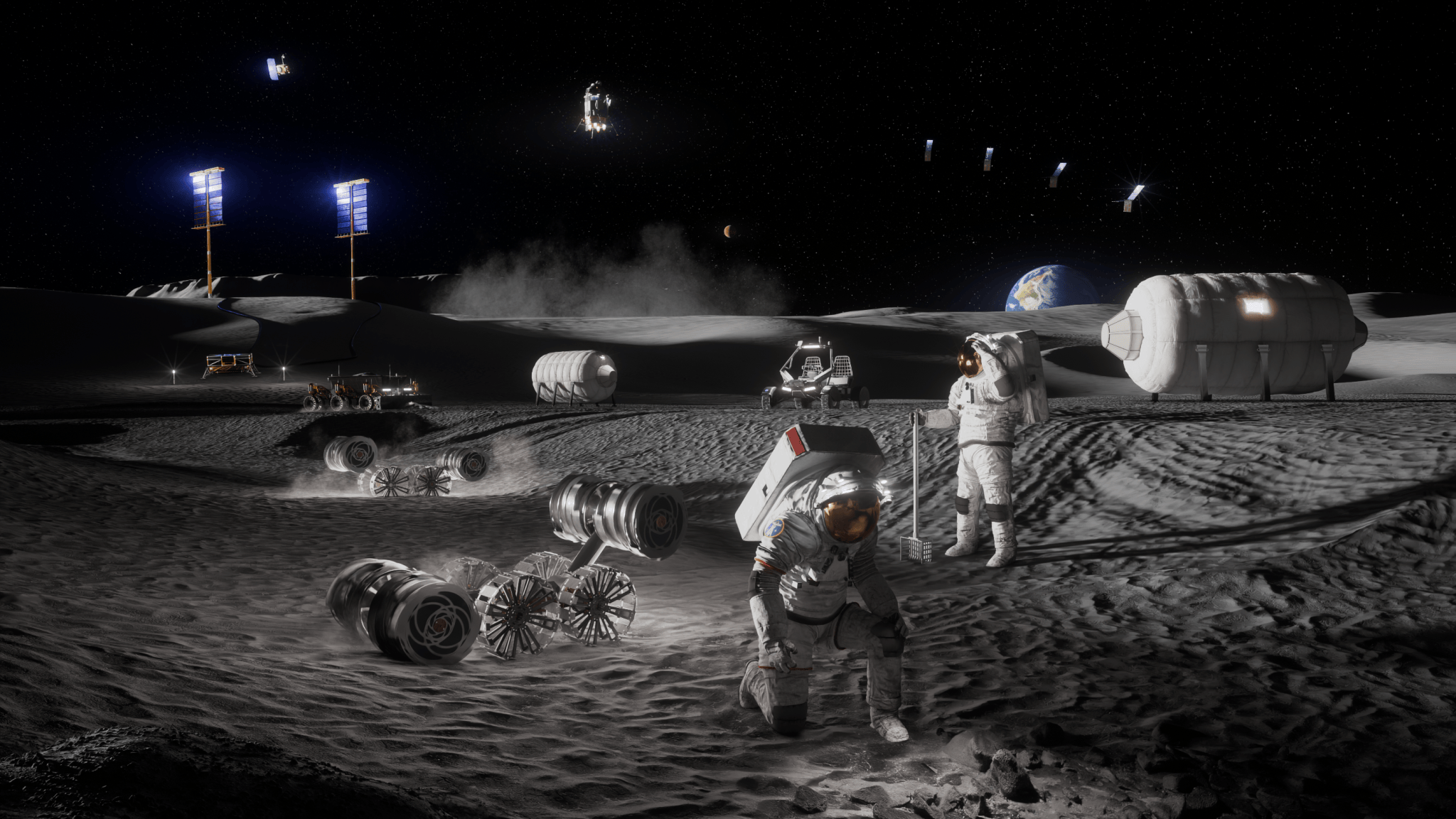
NASA Announces $1 Million to Students for Moon Base Challenge

Artist’s concept depicting astronauts, habitats, rovers, power systems, and cargo operations supporting sustained human activities at the Mo...