Monday, 20 November 2017

Recurring Martian Streaks: Flowing Sand, Not Water?


Fast Facts:

› Seasonal dark streaks on Mars have been described as possible signs of flowing water; a new study shows they are a better fit to dry flow processes.

› The steepness of more than 150 of these features was assessed with a telescopic camera on a NASA Mars orbiter.

› The findings add to evidence that these environments may be too dry for microbes to thrive, despite the presence of water in hydrated salts.

› How seasonal warming triggers these streaks is still a puzzle, and water may be involved.

Dark features on Mars previously considered evidence for subsurface flowing of water are interpreted by new research as granular flows, where grains of sand and dust slip downhill to make dark streaks, rather than the ground being darkened by seeping water.

Continuing examination of these still-perplexing seasonal dark streaks with a powerful camera on NASA's Mars Reconnaissance Orbiter (MRO) shows they exist only on slopes steep enough for dry grains to descend the way they do on faces of active dunes.

The findings published today in Nature Geoscience argue against the presence of enough liquid water for microbial life to thrive at these sites. However, exactly how these numerous flows begin and gradually grow has not yet been explained. Authors of the report propose possibilities that include involvement of small amounts of water, indicated by detection of hydrated salts observed at some of the flow sites.

These features have evoked fascination and controversy since their 2011 discovery, as possible markers for unexpected liquid water or brine on an otherwise dry planet. They are dark streaks that extend gradually downhill in warm seasons, then fade away in winter and reappear the next year. On Earth, only seeping water is known to have these behaviors, but how they form in the dry Martian environment remains unclear.

Many thousands of these Martian features, collectively called "recurring slope lineae" or RSL, have been identified in more than 50 rocky-slope areas, from the equator to about halfway to the poles.

"We've thought of RSL as possible liquid water flows, but the slopes are more like what we expect for dry sand," said Colin Dundas of the U.S. Geological Survey's Astrogeology Science Center in Flagstaff, Arizona. "This new understanding of RSL supports other evidence that shows that Mars today is very dry."

Dundas is lead author of the report, which is based on observations with the High Resolution Imaging Science Experiment (HiRISE) camera on MRO. The data include 3-D models of slope steepness using pairs of images for stereo information. Dundas and co-authors examined 151 RSL features at 10 sites.

The RSL are almost all restricted to slopes steeper than 27 degrees. Each flow ends on a slope that matches the dynamic "angle of repose" seen in the slumping dry sand of dunes on Mars and Earth. A flow due to liquid water should readily extend to less steep slopes.

"The RSL don't flow onto shallower slopes, and the lengths of these are so closely correlated with the dynamic angle of repose, it can't be a coincidence," said HiRISE Principal Investigator Alfred McEwen at the University of Arizona, Tucson, a co-author of the new report.

The seasonal dark streaks have been thought of as possible evidence for biologically significant liquid water -- sufficient water for microbial life -- though explaining how so much liquid water could exist on the surface in Mars' modern environment would be challenging. A granular-flow explanation for RSL fits with the earlier understanding that the surface of modern Mars, exposed to a cold, thin atmosphere, lacks flowing water. A 2016 report also cast doubt on possible sources of underground water at RSL sites. Liquid water on today's Mars may be limited to traces of dissolved moisture from the atmosphere and thin films, which are challenging environments for life as we know it.

However, RSL remain puzzling. Traits with uncertain explanations include their gradual growth, their seasonal reappearance, their rapid fading when inactive, and the presence of hydrated salts, which have water molecules bound into their crystal stucture.

The new report describes possible connections between these traits and how RSL form. For example, salts can become hydrated by pulling water vapor from the atmosphere, and this process can form drops of salty water. Seasonal changes in hydration of salt-containing grains might result in some trigger mechanism for RSL grainflows, such as expansion, contraction, or release of some water. Darkening and fading might result from changes in hydration. If atmospheric water vapor is a trigger, then a question is why the RSL appear on some slopes but not others.

"RSL probably form by some mechanism that is unique to the environment of Mars," McEwen said, "so they represent an opportunity to learn about how Mars behaves, which is important for future surface exploration."

"Full understanding of RSL is likely to depend upon on-site investigation of these features," said MRO Project Scientist Rich Zurek of NASA's Jet Propulsion Laboratory, Pasadena, California. "While the new report suggests that RSL are not wet enough to favor microbial life, it is likely that on-site investigation of these sites will still require special procedures to guard against introducing microbes from Earth, at least until they are definitively characterized. In particular, a full explanation of how these enigmatic features darken and fade still eludes us. Remote sensing at different times of day could provide important clues."

The University of Arizona operates HiRISE, which was built by Ball Aerospace & Technologies Corp., Boulder, Colorado. JPL, a division of Caltech in Pasadena, California, manages the MRO Project for the NASA Science Mission Directorate in Washington. Lockheed Martin Space Systems of Denver built the orbiter and supports its operations.

News Media Contact

Guy Webster

Jet Propulsion Laboratory, Pasadena, Calif.

818-354-6278

guy.webster@jpl.nasa.gov

Jennifer LaVista

U.S. Geological Survey, Denver

303-202-4764

jlavista@usgs.gov

Laurie Cantillo / Dwayne Brown

NASA Headquarters, Washington

202-358-1077 / 202-358-1726

laura.l.cantillo@nasa.gov / dwayne.c.brown@nasa.gov

2017-299


from News and Features http://ift.tt/2zlmJkM
via IFTTT

Saturday, 18 November 2017

NASA Launches NOAA Weather Satellite Aboard United Launch Alliance Rocket to Improve Forecasts

NASA has successfully launched for the National Oceanic and Atmospheric Administration (NOAA) the first in a series of four highly advanced polar-orbiting satellites, equipped with next-generation technology and designed to improve the accuracy of U.S. weather forecasts out to seven days.

from NASA Breaking News http://ift.tt/2yT2eHD
via IFTTT

New NASA Insights into the Secret Lives of Plants

Friday, 17 November 2017

NASA Selects Instrument for Future International Mission to Martian Moons

NASA has selected a science instrument for an upcoming Japan-led sample return mission to the moons of Mars planned for launch in 2024.

from NASA Breaking News http://ift.tt/2zNLz9G
via IFTTT

NASA Survey Technique Estimates Congo Forest's Carbon


The equivalent of 85 billion tons of carbon dioxide -- a huge amount equal to three-quarters of the carbon stored in forests across the contiguous United States -- is locked in the living vegetation of one African country that holds much of the second largest tropical rainforest in the world, according to new research.

The study conducted by NASA, UCLA and the World Wide Fund for Nature-Germany produced the first high-resolution map of the amount and distribution of carbon stored in the Democratic Republic of Congo (DRC). DRC is the largest country in the Congo Basin and home to a massive and largely inaccessible rainforest that is Earth's second largest reservoir of carbon in vegetation, second only to the Amazon Basin rainforest. The DRC's forests cover an area four times the size of California.

The DRC carbon stock estimates are based on very fine-scale three-dimensional measurements of forest structure that provide, for the first time, data for one of the most diverse tropical forests on Earth. The measurements will help scientists understand the role of this forest in the global carbon cycle and how variations in climate may influence their carbon stock and function.

"We learned that the distribution of carbon in the above-ground biomass of the more than 150 million hectares (about 371 million acres) of forest in the DRC is extremely variable and diverse because of the region's climate, soil types, and a long history of human presence," said Sassan Saatchi, a senior researcher at NASA's Jet Propulsion Laboratory in Pasadena, California, who led the research team. "You cannot think of the Congo rainforest as this big green carpet anymore. We encountered a large variety of tree sizes and densities across the DRC, producing extremely complex regional patterns of carbon stored in the forest."

Traditionally, inventories of forest carbon and biomass are done by researchers who hike into the forest and set up plots on the ground that attempt to capture the full range of terrain. These data are then catalogued, measured and revisited in the future to see how they've changed. The Congo Basin forests, however, span five countries, and many areas are difficult to access due to the lack of infrastructure and rough terrain, which doesn't allow for comprehensive ground measurements of the forest carbon. To observe the forests, the research team took to both air and space.

Using the same forestry techniques to establish inventory plots on the ground, the research team contracted a local African company to fly an airplane outfitted with a commercial Light Detection and Ranging (LIDAR) instrument over 216 locations covering more than 2.5 million acres (half a million hectares) of tropical forest. At each location, the LIDAR captured the height, canopy profile, and outline of treetop canopies with data points 20 inches (50 centimeters) apart, from which they derived the forest structure and carbon estimate. These data were paired with data from NASA's Shuttle Radar Topography Mission, which provided the slopes and curves of the ground surface itself; Japan Aerospace Exploration Agency Advanced Land Observing Satellite Phased Array type L-band Synthetic Aperture Radar (PALSAR) data; and U.S. Geological Survey-NASA Landsat vegetation observations. The combined data sets were scaled up to produce a map of the entire above-ground forest carbon stocks for each 12,000-square-yard (1-hectare) land unit.

Conserving tropical forests like the Congo is a high priority for the United Nations in its efforts to defray the effects of climate change. The U.N. has a policy initiative known as Reduce Emissions from Deforestation and Degradation (REDD+) in nations with large forests like the DRC. The new findings and research methods, conducted in partnership with scientists and the DRC government, are the first step for DRC to establish a baseline assessment of its carbon stocks and a system for future forest monitoring required to participate in REDD+ and be eligible for compensation for preserving the forests.

Saatchi says preserving forests is probably the most immediate mechanism we have to mitigate carbon dioxide accumulating in the atmosphere. A quarter of the entire amount of carbon that goes into the atmosphere globally is absorbed by Earth's vegetation, so protecting and possibly increasing the amount of carbon stored in forests could have significant benefits, such as mitigating climate change and preserving biodiversity and water quality.

"The DRC national carbon map is a truly significant contribution to DRC's future sustainable development," said co-author Aurélie Shapiro at World Wide Fund for Nature-Germany in Berlin. "This innovative product demonstrates with unprecedented accuracy the important role of Congolese forests in mitigating climate change, which is facilitating investments into emissions reductions programs."

To estimate the carbon stored above ground in DRC forests, the research team developed data sets for tree height and tree cover, which vary from one end of the DRC to the other. This information is also extremely helpful to conservationists interested in quantifying the health of habitats for gorillas and other at-risk animals, said Shapiro.

The new results will help test and validate the capabilities of two upcoming NASA missions: the NASA-Indian Space Research Organization Synthetic Aperture Radar, or NISAR, mission, managed by JPL; and the LIDAR observations from the Global Ecosystem Dynamics Investigation, or GEDI, mission, managed by NASA's Goddard Space Flight Center in Greenbelt, Maryland. GEDI will mount a space-based LIDAR on the International Space Station to produce high-resolution 3-D imagery of Earth's forests.

The study is published Nov. 8 in Scientific Reports, a Nature publication. The paper is at:

http://ift.tt/2hIVVTL

News Media Contact

Alan Buis

Jet Propulsion Laboratory, Pasadena, California

818-354-0474

Alan.Buis@jpl.nasa.gov

Written by Ellen Gray

NASA's Earth Science News Team

2017-297


from News and Features http://ift.tt/2yOBqZ4
via IFTTT

Tennessee Students to Speak with NASA Astronauts on International Space Station

Students at Southside Elementary School in Lebanon, Tennessee, will have the opportunity to speak with NASA astronauts living, working and doing research aboard the International Space Station at 10:05 a.m. EST Monday, Nov. 20.

from NASA Breaking News http://ift.tt/2AMwgNP
via IFTTT

Thursday, 16 November 2017

Lava or Not, Exoplanet 55 Cancri e Likely to have Atmosphere


Twice as big as Earth, the super-Earth 55 Cancri e was thought to have lava flows on its surface. The planet is so close to its star, the same side of the planet always faces the star, such that the planet has permanent day and night sides. Based on a 2016 study using data from NASA's Spitzer Space Telescope, scientists speculated that lava would flow freely in lakes on the starlit side and become hardened on the face of perpetual darkness. The lava on the dayside would reflect radiation from the star, contributing to the overall observed temperature of the planet.

Now, a deeper analysis of the same Spitzer data finds this planet likely has an atmosphere whose ingredients could be similar to those of Earth's atmosphere, but thicker. Lava lakes directly exposed to space without an atmosphere would create local hot spots of high temperatures, so they are not the best explanation for the Spitzer observations, scientists said.

"If there is lava on this planet, it would need to cover the entire surface," said Renyu Hu, astronomer at NASA's Jet Propulsion Laboratory, Pasadena, California, and co-author of a study published in The Astronomical Journal. "But the lava would be hidden from our view by the thick atmosphere."

Using an improved model of how energy would flow throughout the planet and radiate back into space, researchers find that the night side of the planet is not as cool as previously thought. The "cold" side is still quite toasty by Earthly standards, with an average of 2,400 to 2,600 degrees Fahrenheit (1,300 to 1,400 Celsius), and the hot side averages 4,200 degrees Fahrenheit (2,300 Celsius). The difference between the hot and cold sides would need to be more extreme if there were no atmosphere.

"Scientists have been debating whether this planet has an atmosphere like Earth and Venus, or just a rocky core and no atmosphere, like Mercury. The case for an atmosphere is now stronger than ever," Hu said.

Researchers say the atmosphere of this mysterious planet could contain nitrogen, water and even oxygen -- molecules found in our atmosphere, too -- but with much higher temperatures throughout. The density of the planet is also similar to Earth, suggesting that it, too, is rocky. The intense heat from the host star would be far too great to support life, however, and could not maintain liquid water.

Hu developed a method of studying exoplanet atmospheres and surfaces, and had previously only applied it to sizzling, giant gaseous planets called hot Jupiters. Isabel Angelo, first author of the study and a senior at the University of California, Berkeley, worked on the study as part of her internship at JPL and adapted Hu's model to 55 Cancri e.

In a seminar, she heard about 55 Cancri e as a potentially carbon-rich planet, so high in temperature and pressure that its interior could contain a large amount of diamond.

"It's an exoplanet whose nature is pretty contested, which I thought was exciting," Angelo said.

Spitzer observed 55 Cancri e between June 15 and July 15, 2013, using a camera specially designed for viewing infrared light, which is invisible to human eyes. Infrared light is an indicator of heat energy. By comparing changes in brightness Spitzer observed to the energy flow models, researchers realized an atmosphere with volatile materials could best explain the temperatures.

There are many open questions about 55 Cancri e, especially: Why has the atmosphere not been stripped away from the planet, given the perilous radiation environment of the star?

"Understanding this planet will help us address larger questions about the evolution of rocky planets," Hu said.

NASA's Jet Propulsion Laboratory, Pasadena, California, manages the Spitzer Space Telescope mission for NASA's Science Mission Directorate, Washington. Science operations are conducted at the Spitzer Science Center at Caltech in Pasadena. Spacecraft operations are based at Lockheed Martin Space Systems Company, Littleton, Colorado. Data are archived at the Infrared Science Archive housed at IPAC at Caltech. Caltech manages JPL for NASA. For more information about Spitzer, visit:

http://ift.tt/VbRnRM

http://ift.tt/2l0cZAc

News Media Contact

Elizabeth Landau

Jet Propulsion Laboratory, Pasadena, Calif.

818-354-6425

elizabeth.landau@jpl.nasa.gov

2017-296


from News and Features http://ift.tt/2A4yMTj
via IFTTT

NASA’s Fiscal Year 2017 Financial Audit Result

NASA has received an unmodified audit opinion on its Fiscal Year 2017 (FY 2017) financial statements, making this the seventh consecutive year of "clean" opinions.

from NASA Breaking News http://ift.tt/2hDDgZL
via IFTTT

Our Living Planet Shapes the Search for Life Beyond Earth


As a young scientist, Tony del Genio of NASA's Goddard Institute for Space Studies in New York City met Clyde Tombaugh, the discoverer of Pluto.

"I thought, 'Wow, this is a one-time opportunity,'" del Genio said. "I'll never meet anyone else who found a planet."

That prediction was spectacularly wrong. In 1992, two scientists discovered the first planet around another star, or exoplanet, and since then more people have found planets than throughout all of Earth's preceding history. As of this month, scientists have confirmed more than 3,500 exoplanets in more than 2,700 star systems. Del Genio has met many of these new planet finders.

Del Genio is now co-lead of a NASA interdisciplinary initiative to search for life on other worlds. This new position as the lead of this project may seem odd to those who know him professionally. Why? He has dedicated decades to studying Earth, not searching for life elsewhere.

We know of only one living planet: our own. But we know it very well. As we move to the next stage in the search for alien life, the effort will require the expertise of planetary scientists, heliophysicists and astrophysicists. However, the knowledge and tools NASA has developed to study life on Earth will also be one of the greatest assets to the quest.

Habitable Worlds

There are two main questions in the search for life: With so many places to look, how can we focus in on the places most likely to harbor life? What are the unmistakable signs of life -- even if it comes in a form we don't fully understand?

"Before we go looking for life, we're trying to figure out what kinds of planets could have a climate that's conducive to life," del Genio said. "We're using the same climate models that we use to project 21st century climate change on Earth to do simulations of specific exoplanets that have been discovered, and hypothetical ones."

Del Genio recognizes that life may well exist in forms and places so bizarre that it might be substantially different from Earth. But in this early phase of the search, "We have to go with the kind of life we know," he said.

Further, we should make sure we use the detailed knowledge of Earth. In particular, we should make sure of our discoveries on life in various environments on Earth, our knowledge of how our planet and its life have affected each other over Earth history, and our satellite observations of Earth's climate.

Above all else, that means liquid water. Every cell we know of -- even bacteria around deep-sea vents that exist without sunlight -- requires water.

Life in the Ocean

Research scientist Morgan Cable of NASA's Jet Propulsion Laboratory in Pasadena, California, is looking within the solar system for locations that have the potential to support liquid water. Some of the icy moons around Saturn and Jupiter have oceans below the ice crust. These oceans were formed by tidal heating, that is, warming of the ice caused by friction between the surface ice and the core as a result of the gravitational interaction between the planet and the moon.

"We thought Enceladus was just boring and cold until the Cassini mission discovered a liquid water subsurface ocean," said Cable. The water is spraying into space, and the Cassini mission found hints in the chemical composition of the spray that the ocean chemistry is affected by interactions between heated water and rocks at the seafloor. The Galileo and Voyager missions provided evidence that Europa also has a liquid water ocean under an icy crust. Observations revealed a jumbled terrain that could be the result of ice melting and reforming.

As missions to these moons are being developed, scientists are using Earth as a testbed. Just as prototypes for NASA's Mars rovers made their trial runs on Earth's deserts, researchers are testing both hypotheses and technology on our oceans and extreme environments.

Cable gave the example of satellite observations of Arctic and Antarctic ice fields, which are informing the planning for a Europa mission. The Earth observations help researchers find ways to date the origin of jumbled ice. "When we visit Europa, we want to go to very young places, where material from that ocean is being expressed on the surface," she said. "Anywhere like that, the chances of finding evidence of life goes up -- if they're there."

Water in Space

For any star, it's possible to calculate the range of distances where orbiting planets could have liquid water on the surface. This is called the star's habitable zone.

Astronomers have already located some habitable-zone planets, and research scientist Andrew Rushby, of NASA Ames Research Center, in Moffett Field, California, is studying ways to refine the search. Location alone isn't enough. "An alien would spot three planets in our solar system in the habitable zone [Earth, Mars and Venus]," Rushby said, "but we know that 67 percent of those planets are not very habitable." He recently developed a simplified model of Earth's carbon cycle and combined it with other tools to study which planets in the habitable zone would be the best targets to look at for life, considering probable tectonic activity and water cycles. He found that larger rocky planets are more likely than smaller ones to have surface temperatures where liquid water could exist, given the same amount of light from the star.

Renyu Hu, of JPL, refined the search for habitable planets in a different way, looking for the signature of a rocky planet. Basic physics tells us that smaller planets must be rocky and larger ones gaseous, but for planets ranging from Earth-sized to about twice that radius, astronomers can't tell a large rocky planet from a small gaseous planet. Hu pioneered a method to detect surface minerals on bare-rock exoplanets and defined the atmospheric chemical signature of volcanic activity, which wouldn't occur on a gas planet.

Vital Signs

When scientists are evaluating a possible habitable planet, "life has to be the hypothesis of last resort," Cable said. "You must eliminate all other explanations." Identifying possible false positives for the signal of life is an ongoing area of research in the exoplanet community. For example, the oxygen in Earth's atmosphere comes from living things, but oxygen can also be produced by inorganic chemical reactions.

Shawn Domagal-Goldman, of NASA's Goddard Space Flight Center in Greenbelt, Maryland, looks for unmistakable, chemical signs of life, or biosignatures. One biosignature may be finding two or more molecules in an atmosphere that shouldn't be there at the same time. He uses this analogy: If you walked into a college dorm room and found three students and a pizza, you could conclude that the pizza had recently arrived, because college students quickly consume pizza. Oxygen "consumes" methane by breaking it down in various chemical reactions. Without inputs of methane from life on Earth's surface, our atmosphere would become totally depleted of methane within a few decades.

Earth as Exoplanet

When humans start collecting direct images of exoplanets, even the closest one will appear as a handful of pixels in the detector - something like the famous "blue dot" image of Earth from Saturn. What can we learn about planetary life from a single dot?

Stephen Kane of the University of California, Riverside, has come up with a way to answer that question using NASA's Earth Polychromatic Imaging camera on the National Oceanic and Atmospheric Administration's Deep Space Climate Observatory (DSCOVR). These high-resolution images -- 2,000 x 2,000 pixels - document Earth's global weather patterns and other climate-related phenomena. "I'm taking these glorious pictures and collapsing them down to a single pixel or handful of pixels," Kane explained. He runs the light through a noise filter that attempts to simulate the interference expected from an exoplanet mission.

DSCOVR takes a picture every half hour, and it's been in orbit for two years. Its more than 30,000 images are by far the longest continuous record of Earth from space in existence. By observing how the brightness of Earth changes when mostly land is in view compared with mostly water, Kane has been able to reverse-engineer Earth's rotation rate -- something that has yet to be measured directly for exoplanets.

When Will We Find Life?

Every scientist involved in the search for life is convinced it's out there. Their opinions differ on when we'll find it.

"I think that in 20 years we will have found one candidate that might be it," says del Genio. Considering his experience with Tombaugh, he added, "But my track record for predicting the future is not so good."

Rushby, on the other hand, says, "It's been 20 years away for the last 50 years. I do think it's on the scale of decades. If I were a betting man, which I'm not, I'd go for Europa or Enceladus."

How soon we find a living exoplanet really depends on whether there's one relatively nearby, with the right orbit and size, and with biosignatures that we are able to recognize, Hu said. In other words, "There's always a factor of luck."

News Media Contact

Alan Buis

Jet Propulsion Laboratory, Pasadena, Calif.

818-354-0474

alan.buis@jpl.nasa.gov

Elizabeth Landau

Jet Propulsion Laboratory, Pasadena, Calif.

818-354-6425

Elizabeth.landau@jpl.nasa.gov

Written by Carol Rasmussen

NASA's Earth Science News Team

2017-294


from News and Features http://ift.tt/2A0Eohw
via IFTTT

NASA Expands Podcast Selections with New Science Series

“Gravity Assist,” a new NASA weekly podcast series launches Wednesday on NASA.gov and audio platforms SoundCloud and iTunes.

from NASA Breaking News http://ift.tt/2zLTT9U
via IFTTT

Tuesday, 14 November 2017

NASA's Mars 2020 Mission Performs First Supersonic Parachute Test


Landing on Mars is difficult and not always successful. Well-designed advance testing helps. An ambitious NASA Mars rover mission set to launch in 2020 will rely on a special parachute to slow the spacecraft down as it enters the Martian atmosphere at over 12,000 mph (5.4 kilometers per second). Preparations for this mission have provided, for the first time, dramatic video of the parachute opening at supersonic speed.

The Mars 2020 mission will seek signs of ancient Martian life by investigating evidence in place and by caching drilled samples of Martian rocks for potential future return to Earth. The mission's parachute-testing series, the Advanced Supersonic Parachute Inflation Research Experiment, or ASPIRE, began with a rocket launch and upper-atmosphere flight last month from the NASA Goddard Space Flight Center's Wallops Flight Facility in Wallops Island, Virginia.

› DOWNLOAD VIDEO NASA's Mars 2020 Supersonic Parachute: Test Flight #1

"It is quite a ride," said Ian Clark, the test's technical lead from NASA's Jet Propulsion Laboratory in Pasadena, California. "The imagery of our first parachute inflation is almost as breathtaking to behold as it is scientifically significant. For the first time, we get to see what it would look like to be in a spacecraft hurtling towards the Red Planet, unfurling its parachute."

A 58-foot-tall (17.7-meter) Black Brant IX sounding rocket launched from Wallops on Oct. 4 for this evaluation of the ASPIRE payload performance. The payload is a bullet-nosed, cylindrical structure holding a supersonic parachute, the parachute's deployment mechanism, and the test's high-definition instrumentation -- including cameras -- to record data.

The rocket carried the payload as high as about 32 miles (51 kilometers). Forty-two seconds later, at an altitude of 26 miles (42 kilometers) and a velocity of 1.8 times the speed of sound, the test conditions were met and the Mars parachute successfully deployed. Thirty-five minutes after launch, ASPIRE splashed down in the Atlantic Ocean about 34 miles (54 kilometers) southeast of Wallops Island.

"Everything went according to plan or better than planned," said Clark. "We not only proved that we could get our payload to the correct altitude and velocity conditions to best mimic a parachute deployment in the Martian atmosphere, but as an added bonus, we got to see our parachute in action as well."

The parachute tested during this first flight was almost an exact copy of the parachute used to land NASA's Mars Science Laboratory successfully on the Red Planet in 2012. Future tests will evaluate the performance of a strengthened parachute that could also be used in future Mars missions. The Mars 2020 team will use data from these tests to finalize the design for its mission.

The next ASPIRE test is planned for February 2018.

The Mars 2020 project's parachute-testing series, ASPIRE, is managed by the Jet Propulsion Laboratory, with support from NASA's Langley Research Center, Hampton, Virginia, and NASA's Ames Research Center, Mountain View, California, for NASA's Space Science Mission Directorate. NASA's Sounding Rocket Program is based at the agency's Wallops Flight Facility. Orbital ATK provides mission planning, engineering services and field operations through the NASA Sounding Rocket Operations Contract. NASA's Heliophysics Division manages the sounding-rocket program for the agency.

News Media Contact

DC Agle

Jet Propulsion Laboratory, Pasadena, Calif.

agle@jpl.nasa.gov

818-393-9011

Keith Koehler

NASA's Wallops Flight Facility

keith.a.koehler@nasa.gov

757-824-1579

Dwayne Brown / Laurie Cantillo

NASA Headquarters, Washington

202-358-1726 / 202-358-1077

dwayne.c.brown@nasa.gov / laura.l.cantillo@nasa.gov

2017-294


from News and Features http://ift.tt/2AJ9uqO
via IFTTT

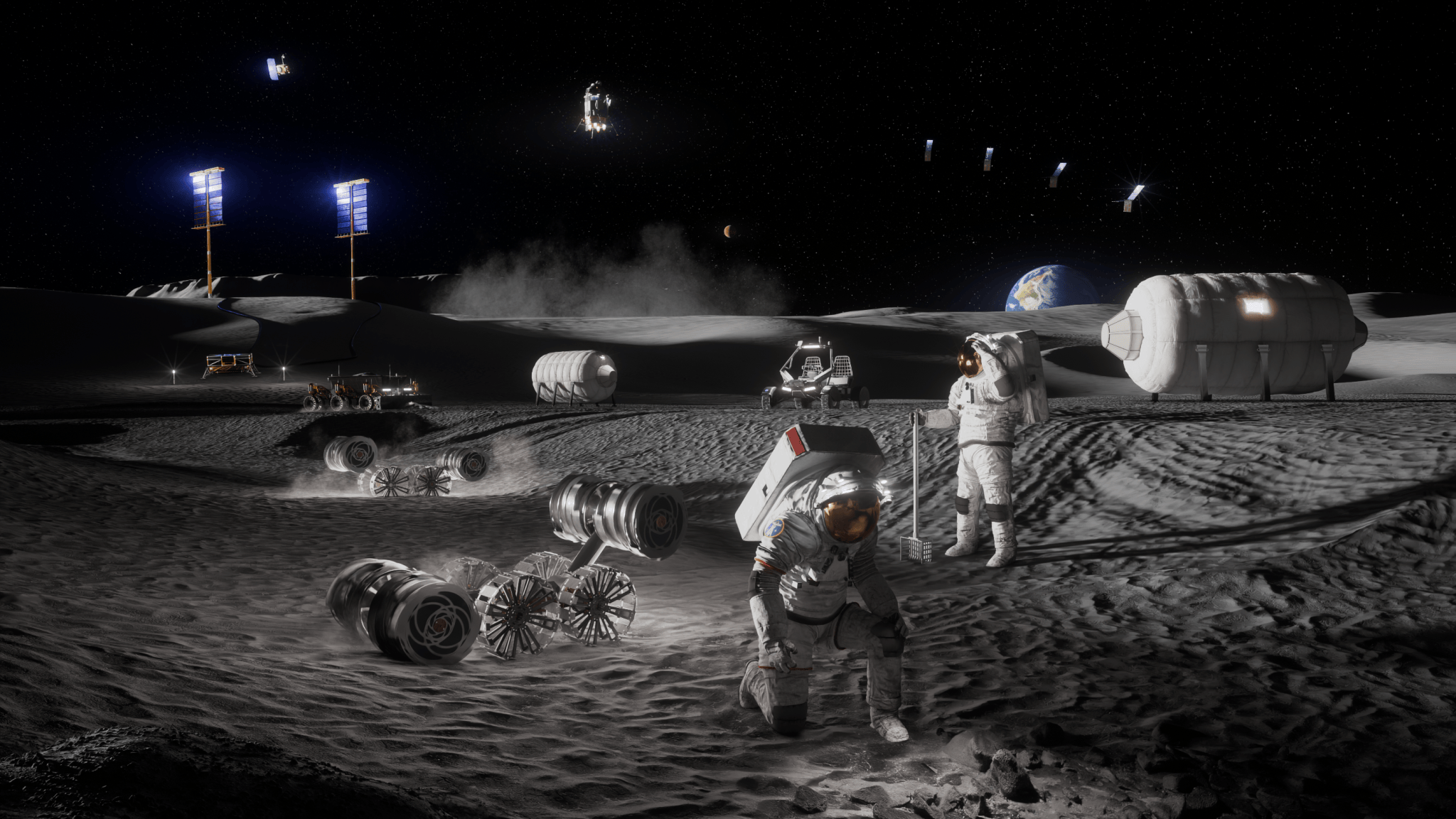
NASA Announces $1 Million to Students for Moon Base Challenge

Artist’s concept depicting astronauts, habitats, rovers, power systems, and cargo operations supporting sustained human activities at the Mo...