Monday, 13 November 2017

Listening for Gravitational Waves Using Pulsars


One of the most spectacular achievements in physics so far this century has been the observation of gravitational waves, ripples in space-time that result from masses accelerating in space. So far, there have been five detections of gravitational waves, thanks to the Laser Interferometer Gravitational-Wave Observatory (LIGO) and, more recently, the European Virgo gravitational-wave detector. Using these facilities, scientists have been able to pin down the extremely subtle signals from relatively small black holes and, as of October, neutron stars.

But there are merging objects far larger whose gravitational wave signals have not yet been detected: supermassive black holes, more than 100 million times more massive than our Sun. Most large galaxies have a central supermassive black hole. When galaxies collide, their central black holes tend to spiral toward each other, releasing gravitational waves in their cosmic dance. Much as a large animal like a lion produces a deeper roar than a tiny mouse's squeak, merging supermassive black holes create lower-frequency gravitational waves than the relatively small black holes LIGO and similar ground-based experiments can detect.

"Observing low-frequency gravitational waves would be akin to being able to hear bass singers, not just sopranos," said Joseph Lazio, chief scientist for NASA's Deep Space Network, based at NASA's Jet Propulsion Laboratory, Pasadena, California, and co-author of a new study in Nature Astronomy.

To explore this uncharted area of gravitational wave science, researchers look not to human-made machines, but to a natural experiment in the sky called a pulsar timing array. Pulsars are dense remnants of dead stars that regularly emit beams of radio waves, which is why some call them "cosmic lighthouses." Because their rapid pulse of radio emission is so predictable, a large array of well-understood pulsars can be used to measure extremely subtle abnormalities, such as gravitational waves. The North American Nanohertz Observatory for Gravitational Waves (NANOGrav), a Physics Frontier Center of the National Science Foundation, is one of the leading groups of researchers using pulsars to search for gravitational waves.

The new Nature Astronomy study concerns supermassive black hole binaries -- systems of two of these cosmic monsters. For the first time, researchers surveyed the local universe for galaxies likely to host these binaries, then predicted which black hole pairs are the likeliest to merge and be detected while doing so. The study also estimates how long it will take to detect one of these mergers.

"By expanding our pulsar timing array over the next 10 years or so, there is a high likelihood of detecting gravitational waves from at least one supermassive black hole binary," said Chiara Mingarelli, lead study author, who worked on this research as a Marie Curie postdoctoral fellow at Caltech and JPL, and is now at the Flatiron Institute in New York.

Mingarelli and colleagues used data from the 2 Micron All-Sky Survey (2MASS), which surveyed the sky from 1997 to 2001, and galaxy merger rates from the Illustris simulation project, an endeavor to make large-scale cosmological simulations. In their sample of about 5,000 galaxies, scientists found that about 90 would have supermassive black holes most likely to merge with another black hole.

While LIGO and similar experiments detect objects in the final seconds before they merge, pulsar timing arrays are sensitive to gravitational wave signals from supermassive black holes that are spiraling toward each other and will not combine for millions of years. That's because galaxies merge hundreds of millions of years before the central black holes they host combine to make one giant supermassive black hole.

Researchers also found that while bigger galaxies have bigger black holes and produce stronger gravitational waves when they combine, these mergers also happen fast, shortening the time period for detection. For example, black holes merging in the large galaxy M87 would have a 4-million-year window of detection. By contrast, in the smaller Sombrero Galaxy, black holes mergers typically take about 160 million years, offering more opportunities for pulsar timing arrays to detect gravitational waves from them.

Black hole mergers generate gravitational waves because, as they orbit each other, their gravity distorts the fabric of space-time, sending ripples outward in all directions at the speed of light. These distortions actually shift the position of Earth and the pulsars ever so slightly, resulting in a characteristic and detectable signal from the array of celestial lighthouses.

"A difference between when the pulsar signals should arrive, and when they do arrive, can signal a gravitational wave,"Mingarelli said. "And since the pulsars we study are about 3,000 light-years away, they act as a galactic-scale gravitational-wave detector."

Because all supermassive black holes are so distant, gravitational waves, which travel at the speed of light, take a long time to arrive at Earth. This study looked at supermassive black holes within about 700 million light-years, meaning waves from a merger between any two of them would take up to that long to be detected here by scientists.By comparison, the oldest animal life on Earth -- algae -- is thought to have arisen about 650 million years ago.

Many open questions remain about how galaxies merge and what will happen when the Milky Way approaches Andromeda, the nearby galaxy that will collide with ours in about 4 billion years.

"Detecting gravitational waves from billion-solar-mass black hole mergers will help unlock some of the most persistent puzzles in galaxy formation," said Leonidas Moustakas, a JPL research scientist who wrote an accompanying "News and Views" article in the journal.

2MASS was funded by NASA's Office of Space Science, the National Science Foundation, the U.S. Naval Observatory and the University of Massachusetts. JPL managed the program for NASA's Office of Space Science, Washington. Data was processed at IPAC at Caltech in Pasadena, California.

News Media Contact

Elizabeth Landau

Jet Propulsion Laboratory, Pasadena, Calif.

(818) 354-6425

Elizabeth.Landau@jpl.nasa.gov

2017-293


from News and Features http://ift.tt/2jmpWcB
via IFTTT

Sunday, 12 November 2017

NASA Space Station Cargo Launches Aboard Orbital ATK Mission

The International Space Station will receive about 7,400 pounds of cargo, including new science and technology investigations, following the successful launch of Orbital ATK’s Cygnus spacecraft from NASA’s Wallops Flight Facility in Virginia Sunday.

from NASA Breaking News http://ift.tt/2i8ebmt
via IFTTT

Thursday, 9 November 2017

Dawn Explores Ceres' Interior Evolution

NASA Sets Media Coverage of Rescheduled NOAA Weather Satellite Launch

The Joint Polar Satellite System-1 (JPSS-1) satellite, the first in a new series of four highly advanced National Oceanic and Atmospheric Administration (NOAA) polar-orbiting satellites, now is scheduled to launch on Tuesday, Nov. 14, from Vandenberg Air Force Base, California.

from NASA Breaking News http://ift.tt/2hWatME
via IFTTT

Wednesday, 8 November 2017

NASA Pays Tribute to Early Space Pioneer Richard Gordon

The following is a statement from acting NASA Administrator Robert Lightfoot on the passing of former NASA astronaut Richard Gordon:

from NASA Breaking News http://ift.tt/2hQdFt4
via IFTTT

Tuesday, 7 November 2017

Hot News from the Antarctic Underground


Study Bolsters Theory of Heat Source Under West Antarctica

A new NASA study adds evidence that a geothermal heat source called a mantle plume lies deep below Antarctica's Marie Byrd Land, explaining some of the melting that creates lakes and rivers under the ice sheet. Although the heat source isn't a new or increasing threat to the West Antarctic ice sheet, it may help explain why the ice sheet collapsed rapidly in an earlier era of rapid climate change, and why it is so unstable today.

The stability of an ice sheet is closely related to how much water lubricates it from below, allowing glaciers to slide more easily. Understanding the sources and future of the meltwater under West Antarctica is important for estimating the rate at which ice may be lost to the ocean in the future.

Antarctica's bedrock is laced with rivers and lakes, the largest of which is the size of Lake Erie. Many lakes fill and drain rapidly, forcing the ice surface thousands of feet above them to rise and fall by as much as 20 feet (6 meters). The motion allows scientists to estimate where and how much water must exist at the base.

Some 30 years ago, a scientist at the University of Colorado Denver suggested that heat from a mantle plume under Marie Byrd Land might explain regional volcanic activity and a topographic dome feature. Very recent seismic imaging has supported this concept. When Hélène Seroussi of NASA's Jet Propulsion Laboratory in Pasadena, California, first heard the idea, however, "I thought it was crazy," she said. "I didn't see how we could have that amount of heat and still have ice on top of it."

With few direct measurements existing from under the ice, Seroussi and Erik Ivins of JPL concluded the best way to study the mantle plume idea was by numerical modeling. They used the Ice Sheet System Model (ISSM), a numerical depiction of the physics of ice sheets developed by scientists at JPL and the University of California, Irvine. Seroussi enhanced the ISSM to capture natural sources of heating and heat transport from freezing, melting and liquid water; friction; and other processes.

To assure the model was realistic, the scientists drew on observations of changes in the altitude of the ice sheet surface made by NASA's IceSat satellite and airborne Operation IceBridge campaign. "These place a powerful constraint on allowable melt rates -- the very thing we wanted to predict," Ivins said. Since the location and size of the possible mantle plume were unknown, they tested a full range of what was physically possible for multiple parameters, producing dozens of different simulations.

They found that the flux of energy from the mantle plume must be no more than 150 milliwatts per square meter. For comparison, in U.S. regions with no volcanic activity, the heat flux from Earth's mantle is 40 to 60 milliwatts. Under Yellowstone National Park -- a well-known geothermal hot spot -- the heat from below is about 200 milliwatts per square meter averaged over the entire park, though individual geothermal features such as geysers are much hotter.

Seroussi and Ivins' simulations using a heat flow higher than 150 milliwatts per square meter showed too much melting to be compatible with the space-based data, except in one location: an area inland of the Ross Sea known for intense flows of water. This region required a heat flow of at least 150-180 milliwatts per square meter to agree with the observations. However, seismic imaging has shown that mantle heat in this region may reach the ice sheet through a rift, that is, a fracture in Earth's crust such as appears in Africa's Great Rift Valley.

Mantle plumes are thought to be narrow streams of hot rock rising through Earth's mantle and spreading out like a mushroom cap under the crust. The buoyancy of the material, some of it molten, causes the crust to bulge upward. The theory of mantle plumes was proposed in the 1970s to explain geothermal activity that occurs far from the boundary of a tectonic plate, such as Hawaii and Yellowstone.

The Marie Byrd Land mantle plume formed 50 to 110 million years ago, long before the West Antarctic ice sheet came into existence. At the end of the last ice age around 11,000 years ago, the ice sheet went through a period of rapid, sustained ice loss when changes in global weather patterns and rising sea levels pushed warm water closer to the ice sheet -- just as is happening today. Seroussi and Ivins suggest the mantle plume could facilitate this kind of rapid loss.

News Media Contact

Alan Buis

Jet Propulsion Laboratory, Pasadena, California

818-354-0474

Alan.Buis@jpl.nasa.gov

Written by Carol Rasmussen

NASA's Earth Science News Team

2017-291


from News and Features http://ift.tt/2zpDbNC
via IFTTT

NASA TV Coverage Set for Next Resupply Mission to International Space Station

NASA commercial cargo provider Orbital ATK is scheduled to launch its eighth mission to the International Space Station at 7:37 a.m. EST Saturday, Nov. 11 NASA’s Wallops Flight Facility in Virginia.

from NASA Breaking News http://ift.tt/2zhKoBP
via IFTTT

Powering Saturn's Active Ocean Moon


Heat from friction could power hydrothermal activity on Saturn's moon Enceladus for billions of years if the moon has a highly porous core, according to a new modeling study by European and U.S. researchers working on NASA's Cassini mission.

The study, published today in the journal Nature Astronomy, helps resolve a question scientists have grappled with for a decade:Where does the energy to power the extraordinary geologic activity on Enceladus come from?

Cassini found that Enceladus sprays towering, geyser-like jets of water vapor and icy particles, including simple organics, from warm fractures near its south pole. Additional investigation revealed the moon has a global ocean beneath its icy crust,from which the jets are venting into space. Multiple lines of evidence from Cassini indicate that hydrothermal activity -- hot water interacting chemically with rock -- is taking place on the seafloor.

One of those lines was the detection of tiny rock grains inferred to be the product of hydrothermal chemistry taking place at temperatures of at least 194 degrees Fahrenheit (90 degrees Celsius). The amount of energy required to produce these temperatures is more than scientists think could be provided by decay of radioactive elements in the interior.

"Where Enceladus gets the sustained power to remain active has always been a bit of a mystery, but we've now considered in greater detail how the structure and composition of the moon's rocky core could play a key role in generating the necessary energy," said the study's lead author, Gaël Choblet from the University of Nantes in France.

Choblet and co-authors found that a loose, rocky core with 20 to 30 percent empty space would do the trick. Their simulations show that as Enceladus orbits Saturn, rocks in the porous core flex and rub together, generating heat. The loose interior also allows water from the ocean to percolate deep down, where it heats up, then rises, interacting chemically with the rocks. The models show this activity should be at a maximum at the moon's poles. Plumes of the warm, mineral-laden water gush from the seafloor and travel upward, thinning the moon's ice shell from beneath to only half a mile to 3 miles (1 to 5 kilometers) at the south pole. (The average global thickness of the ice is thought to be about 12 to 16 miles, or 20 to 25 kilometers.) And this same water is then expelled into space through fractures in the ice.

The study is the first to explain several key characteristics of Enceladus observed by Cassini: the global ocean, internal heating, thinner ice at the south pole, and hydrothermal activity. It doesn't explain why the north and south poles are so different though. Unlike the tortured, geologically fresh landscape of the south, Enceladus' northern extremes are heavily cratered and ancient. The authors note that if the ice shell was slightly thinner in the south to begin with, it would lead to runaway heating there over time.

The researchers estimate that, over time (between 25 and 250 million years), the entire volume of Enceladus' ocean passes through the moon's core. This is estimated to be an amount of water equal to two percent of the volume of Earth's oceans.

Flexing of Enceladus' icy crust due to the tidal pull of Saturn had previously been considered as a heat source, but models showed this would not produce enough sustained power. The ocean in Enceladus would have frozen within 30 million years. Although past studies modeled how tidal friction could generate heat in the moon's core, they made simpler assumptions or simulated the moon in only two dimensions. The new study ramped up the complexity of the model and simulated Enceladus in 3-D.

Although the Cassini science team had suspected for years that a porous core might play an important role in the mystery of Enceladus' warm interior, this study brings together several more recent lines of evidence in a very elegant way, according to NASA's Cassini Project Scientist Linda Spilker at theagency's Jet Propulsion Laboratory in Pasadena, California. "This powerful research makes use of newer details -- namely that the ocean is global and has hydrothermal activity -- that we just didn't have until the past couple of years. It's an insight that the mission needed time to build, one discovery upon another," she said.

Launched in 1997, the Cassini spacecraft orbited Saturn from 2004 to 2017. Cassini made numerous dramatic discoveries, including the surprising activity on Enceladus and liquid methane seas on Saturn's largest moon, Titan. Cassini ended its journey with a dramatic plunge into Saturn's atmosphere on Sept. 15, 2017, returning unique science data until it lost contact with Earth.

The Cassini-Huygens mission is a cooperative project of NASA, ESA (European Space Agency) and the Italian Space Agency. NASA's Jet Propulsion Laboratory, a division of Caltech in Pasadena, manages the mission for NASA's Science Mission Directorate, Washington. JPL designed, developed and assembled the Cassini orbiter.

More information about Cassini:

http://ift.tt/2nVxm2X

http://ift.tt/1rJDu0Q

News Media Contact

Preston Dyches

Jet Propulsion Laboratory, Pasadena, Calif.

818-394-7013

preston.dyches@jpl.nasa.gov

2017-290


from News and Features http://ift.tt/2j5mByk
via IFTTT

Monday, 6 November 2017

Virginia Students to Speak with NASA Astronauts on Space Station

NASA's Joe Acaba, Mark Vande Hei, and Randy Bresnik, during 52S Arrival,

from NASA Breaking News http://ift.tt/2zkBm4v
via IFTTT

Saturday, 4 November 2017

Astronomers Complete First International Asteroid Tracking Exercise


An international team of astronomers led by NASA scientists successfully completed the first global exercise using a real asteroid to test global response capabilities.

Planning for the so-called "TC4 Observation Campaign" started in April, under the sponsorship of NASA's Planetary Defense Coordination Office. The exercise commenced in earnest in late July, when the European Southern Observatory's Very Large Telescope recovered the asteroid. The finale was a close approach to Earth in mid-October. The goal: to recover, track and characterize a real asteroid as a potential impactor -- and to test the International Asteroid Warning Network for hazardous asteroid observations, modeling, prediction and communication.

The target of the exercise was asteroid 2012 TC4 -- a small asteroid originally estimated to be between 30 and 100 feet (10 and 30 meters) in size, which was known to be on a very close approach to Earth. On Oct. 12, TC4 safely passed Earth at a distance of only about 27,200 miles (43,780 kilometers) above Earth's surface. In the months leading up to the flyby, astronomers from the U.S., Canada, Colombia, Germany, Israel, Italy, Japan, the Netherlands, Russia and South Africa all tracked TC4 from ground- and space-based telescopes to study its orbit, shape, rotation and composition.

"This campaign was an excellent test of a real threat case. I learned that in many cases we are already well-prepared; communication and the openness of the community was fantastic," said Detlef Koschny, co-manager of the near-Earth object (NEO) segment in the European Space Agency (ESA)'s Space Situational Awareness program. "I personally was not prepared enough for the high response from the public and media -- I was positively surprised by that! It shows that what we are doing is relevant."

"The 2012 TC4 campaign was a superb opportunity for researchers to demonstrate willingness and readiness to participate in serious international cooperation in addressing the potential hazard to Earth posed by NEOs," said Boris Shustov, science director for the Institute of Astronomy at the Russian Academy of Sciences. "I am pleased to see how scientists from different countries effectively and enthusiastically worked together toward a common goal, and that the Russian-Ukrainian observatory in Terskol was able to contribute to the effort." Shustov added, "In the future I am confident that such international observing campaigns will become common practice."

Using the observations collected during the campaign, scientists at NASA's Center for Near-Earth Object Studies (CNEOS) at the Jet Propulsion Laboratory in Pasadena, California were able to precisely calculate TC4's orbit, predict its flyby distance on Oct. 12, and look for any possibility of a future impact. "The high-quality observations from optical and radar telescopes have enabled us to rule out any future impacts between the Earth and 2012 TC4," said Davide Farnocchia from CNEOS, who led the orbit determination effort. "These observations also help us understand subtle effects such as solar radiation pressure that can gently nudge the orbit of small asteroids."

A network of optical telescopes also worked together to study how fast TC4 rotates. Given that TC4 is small, astronomers expected it to be rotating fast, but were surprised when they found that TC4 was not only spinning once every 12 minutes, it was also tumbling. "The rotational campaign was a true international effort. We had astronomers from several countries working together as one team to study TC4's tumbling behavior," said Eileen Ryan, director of the Magdalena Ridge Observatory. Her team tracked TC4 for about 2 months using the 7.9-foot (2.4-meter) telescope in Socorro, New Mexico.

The observations that revealed the shape and confirmed the composition of the asteroid came from astronomers using NASA's Goldstone Deep Space Network antenna in California and the National Radio Astronomy Observatory's 330-foot (100-meter) Green Bank Telescope in West Virginia. "TC4 is a very elongated asteroid that's about 50 feet (15 meters) long and roughly 25 feet (8 meters) wide," said Marina Brozovic, a member of the asteroid radar team at JPL.

Finding out what TC4 is made of turned out to be more challenging. Due to adverse weather conditions, traditional NASA assets studying asteroid composition -- such as the NASA Infrared Telescope Facility (IRTF) at the Mauna Kea Observatory in Hawaii -- were unable to narrow down what TC4 was made of: either dark, carbon-rich or bright igneous material.

"Radar has the ability to identify asteroids with surfaces made of highly reflective rocky or metallic materials," said Lance Benner, who led the radar observations at JPL. "We were able to show that radar scattering properties are consistent with a bright rocky surface, similar to a particular class of meteorites that reflect as much as 50 percent of the light falling on them."

In addition to the observation campaign, NASA used this exercise to test communications between the many observers and also to test internal U.S. government messaging and communications up through the executive branch and across government agencies, as it would during an actual predicted impact emergency.

"We demonstrated that we could organize a large, worldwide observing campaign on a short timeline, and communicate results efficiently," said Vishnu Reddy of the University of Arizona's Lunar and Planetary Laboratory in Tucson, who led the observation campaign. Michael Kelley, TC4 exercise lead at NASA Headquarters in Washington added, "We are much better prepared today to deal with the threat of a potentially hazardous asteroid than we were before the TC4 campaign."

NASA's Planetary Defense Coordination Office administers the Near-Earth Object Observations Program and is responsible for finding, tracking and characterizing potentially hazardous asteroids and comets coming near Earth, issuing warnings about possible impacts, and assisting coordination of U.S. government response planning, should there be an actual impact threat.

News Media Contact

DC Agle

Jet Propulsion Laboratory, Pasadena, Calif.

agle@jpl.nasa.gov

818-393-9011

Dwayne Brown / Laurie Cantillo

NASA Headquarters, Washington

202-358-1726 / 202-358-1077

dwayne.c.brown@nasa.gov / laura.l.cantillo@nasa.gov

2017-289


from News and Features http://ift.tt/2A8Nm8l
via IFTTT

More Than 2.4 Million Names Are Going to Mars


Last month, NASA invited members of the public to send their names to Mars. And the public responded loud and clear.

More than 1.6 million people signed up to have their names etched on a microchip that will be carried on NASA's upcoming InSight mission, which launches in May of 2018.

NASA's Jet Propulsion Laboratory in Pasadena, California, reopened the opportunity after it proved successful in 2015. During that open call, nearly 827,000 names were collected for a microchip that now sits on top of the robotic InSight lander.

The grand total once a second microchip is added in early 2018 will be 2,429,807 names. Space enthusiasts who signed up this last round shared their downloadable "boarding passes" on social media, complete with the total number of flight miles they've collected by participating in engagement initiatives for other Mars missions.

InSight will be the first mission to look deep beneath the Martian surface, studying the planet's interior by listening for marsquakes. These quakes travel through geologic material at different speeds and give scientists a glimpse of the composition and structure of the planet's inside. The insights into how Mars formed will help us better understand how other rocky planets are created.

For more information on InSight, visit:

http://ift.tt/2xeSjQ5

News Media Contact

Andrew Good

Jet Propulsion Laboratory, Pasadena, Calif.

818-393-2433

andrew.c.good@jpl.nasa.gov

2017-288


from News and Features http://ift.tt/2hDqR4A
via IFTTT

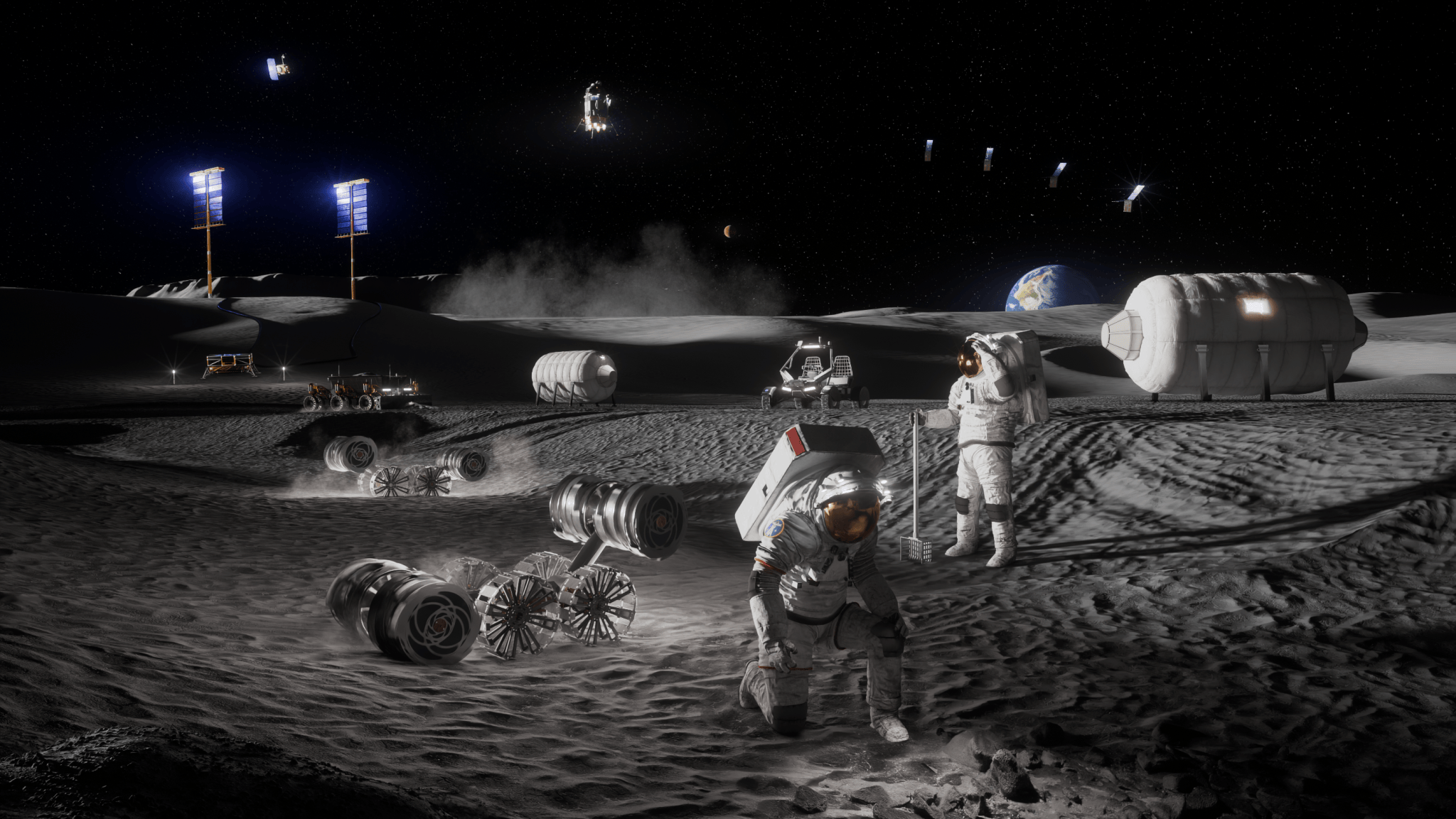
NASA Announces $1 Million to Students for Moon Base Challenge

Artist’s concept depicting astronauts, habitats, rovers, power systems, and cargo operations supporting sustained human activities at the Mo...