More than 300 million people in the United States potentially could directly view the Aug. 21 total solar eclipse, and NASA wants everyone who will witness this celestial phenomenon to do so safely.
from NASA Breaking News http://ift.tt/2uiWRQL
via IFTTT

Friday, 21 July 2017

NASA Television Coverage Set for Next International Space Station Crew Launch
Three new crew members for the International Space Station are scheduled to launch on Friday, July 28.
from NASA Breaking News http://ift.tt/2uJ7bUh
via IFTTT
from NASA Breaking News http://ift.tt/2uJ7bUh
via IFTTT
From Mars Rover: Panorama Above 'Perseverance Valley'
NASA's Mars Exploration Rover Opportunity recorded a panoramic view before entering the upper end of a fluid-carved valley that descends the inner slope of a crater's rim.

from News and Features http://ift.tt/2uNmxbd
via IFTTT
Tuesday, 18 July 2017
New Study Shows the Amazon Makes Its Own Rainy Season
New research finds the southern Amazon rainforest triggers its own rainy season. The finding highlights the close connection between the rainforest ecosystem and climate.

from News and Features http://ift.tt/2u2CIzF
via IFTTT
Saturday, 15 July 2017
For Moratorium on Sending Commands to Mars, Blame the Sun
This month, movements of the planets will put Mars almost directly behind the sun, from Earth's perspective, causing curtailed communications between Earth and Mars.

from News and Features http://ift.tt/2uogSYd
via IFTTT
Friday, 14 July 2017
NASA Offers Space Station as Catalyst for Discovery in Washington
NASA astronauts, scientists and engineers will join industry and academia for a three-day, in-depth conversation about the International Space Station (ISS) as a catalyst for discovery during the sixth annual ISS Research & Development Conference July 17-20 in Washington.
from NASA Breaking News http://ift.tt/2tbrr16
via IFTTT
from NASA Breaking News http://ift.tt/2tbrr16
via IFTTT
NASA Awards Mission Systems Operations Contract
NASA has awarded a contract to Stinger Ghaffarian Technologies, Inc., of Greenbelt, Maryland, for support of mission operations systems at NASA’s Johnson Space Center in Houston.
from NASA Breaking News http://ift.tt/2tNUx5t
via IFTTT
from NASA Breaking News http://ift.tt/2tNUx5t
via IFTTT
Thursday, 13 July 2017
NASA's Juno Spacecraft Spots Jupiter's Great Red Spot

Images of Jupiter's Great Red Spot reveal a tangle of dark, veinous clouds weaving their way through a massive crimson oval. The JunoCam imager aboard NASA's Juno mission snapped pics of the most iconic feature of the solar system's largest planetary inhabitant during its Monday (July 10) flyby. The images of the Great Red Spot were downlinked from the spacecraft's memory on Tuesday and placed on the mission's JunoCam website Wednesday morning.
"For hundreds of years scientists have been observing, wondering and theorizing about Jupiter's Great Red Spot," said Scott Bolton, Juno principal investigator from the Southwest Research Institute in San Antonio. "Now we have the best pictures ever of this iconic storm. It will take us some time to analyze all the data from not only JunoCam, but Juno's eight science instruments, to shed some new light on the past, present and future of the Great Red Spot."
As planned by the Juno team, citizen scientists took the raw images of the flyby from the JunoCam site and processed them, providing a higher level of detail than available in their raw form. The citizen-scientist images, as well as the raw images they used for image processing, can be found at:
"I have been following the Juno mission since it launched," said Jason Major, a JunoCam citizen scientist and a graphic designer from Warwick, Rhode Island. "It is always exciting to see these new raw images of Jupiter as they arrive. But it is even more thrilling to take the raw images and turn them into something that people can appreciate. That is what I live for."
Measuring in at 10,159 miles (16,350 kilometers) in width (as of April 3, 2017) Jupiter's Great Red Spot is 1.3 times as wide as Earth. The storm has been monitored since 1830 and has possibly existed for more than 350 years. In modern times, the Great Red Spot has appeared to be shrinking.
All of Juno's science instruments and the spacecraft's JunoCam were operating during the flyby, collecting data that are now being returned to Earth. Juno's next close flyby of Jupiter will occur on Sept. 1.
Juno reached perijove (the point at which an orbit comes closest to Jupiter's center) on July 10 at 6:55 p.m. PDT (9:55 p.m. EDT). At the time of perijove, Juno was about 2,200 miles (3,500 kilometers) above the planet's cloud tops. Eleven minutes and 33 seconds later, Juno had covered another 24,713 miles (39,771 kilometers), and was passing directly above the coiling, crimson cloud tops of the Great Red Spot. The spacecraft passed about 5,600 miles (9,000 kilometers) above the clouds of this iconic feature.
Juno launched on Aug. 5, 2011, from Cape Canaveral, Florida. During its mission of exploration, Juno soars low over the planet's cloud tops -- as close as about 2,100 miles (3,400 kilometers). During these flybys, Juno is probing beneath the obscuring cloud cover of Jupiter and studying its auroras to learn more about the planet's origins, structure, atmosphere and magnetosphere.
Early science results from NASA's Juno mission portray the largest planet in our solar system as a turbulent world, with an intriguingly complex interior structure, energetic polar aurora, and huge polar cyclones.
"These highly-anticipated images of Jupiter's Great Red Spot are the 'perfect storm' of art and science. With data from Voyager, Galileo, New Horizons, Hubble and now Juno, we have a better understanding of the composition and evolution of this iconic feature," said Jim Green, NASA's director of planetary science. "We are pleased to share the beauty and excitement of space science with everyone."
JPL manages the Juno mission for the principal investigator, Scott Bolton, of Southwest Research Institute in San Antonio. The Juno mission is part of the New Frontiers Program managed by NASA's Marshall Space Flight Center in Huntsville, Alabama, for the Science Mission Directorate. Lockheed Martin Space Systems, Denver, built the spacecraft. JPL is a division of Caltech in Pasadena. More information on the Juno mission is available at:
The public can follow the mission on Facebook and Twitter at:
https://www.twitter.com/NASAJuno
More information on the Great Red Spot can be found at:
More information on Jupiter can be found at:
News Media Contact
DC Agle
Jet Propulsion Laboratory, Pasadena, Calif.
818-393-9011 / 818-354-6278
agle@jpl.nasa.gov
Dwayne Brown / Laurie Cantillo
NASA Headquarters, Washington
202-358-1726 / 202-358-1077
dwayne.c.brown@nasa.gov / laura.l.cantillo@nasa.gov
2017-190
from News and Features http://ift.tt/2tOfmfC
via IFTTT
NASA Opens Media Accreditation for Upcoming Space Station Cargo Launch
Media accreditation is open for launch of the next SpaceX commercial cargo resupply services mission to the International Space Station, currently targeted for August.
from NASA Breaking News http://ift.tt/2uaevZe
via IFTTT
from NASA Breaking News http://ift.tt/2uaevZe
via IFTTT
Wednesday, 12 July 2017
Curiosity Mars Rover Begins Study of Ridge Destination
The car-size NASA rover on a Martian mountain, Curiosity, has begun its long-anticipated study of an iron-bearing ridge forming a distinctive layer on the mountain's slope.

from News and Features http://ift.tt/2uONLef
via IFTTT
NASA's Juno Spacecraft Completes Flyby over Jupiter's Great Red Spot
This science pass offered front-row seats to the planet's most iconic feature, the Great Red Spot.

from News and Features http://ift.tt/2uaUC3V
via IFTTT
Subscribe to:
Posts (Atom)
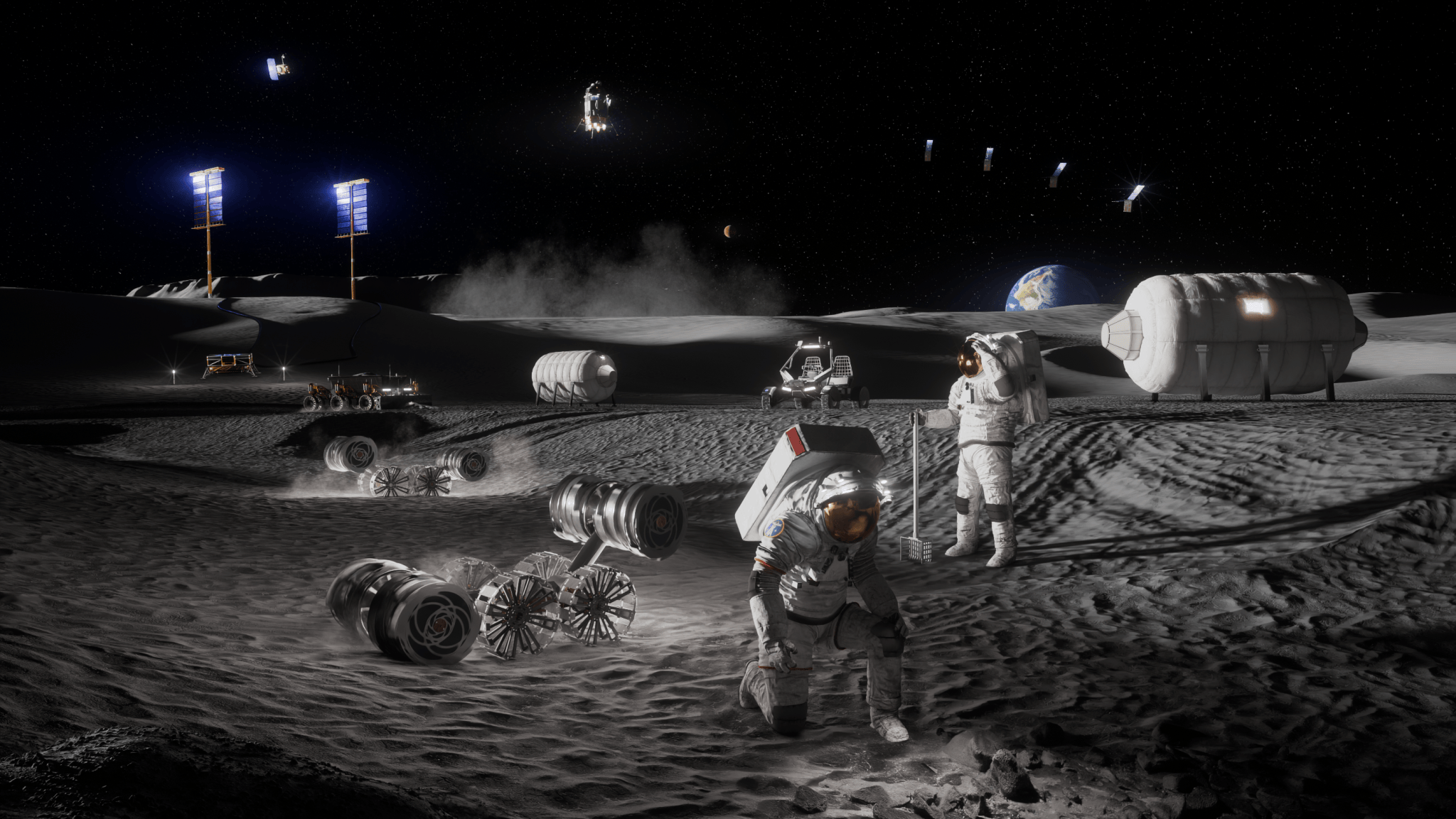
NASA Announces $1 Million to Students for Moon Base Challenge
Artist’s concept depicting astronauts, habitats, rovers, power systems, and cargo operations supporting sustained human activities at the Mo...
-
NASA has exercised the second option of its Information Technology and Multimedia Services (ITAMS) contract with DB Consulting Group, Inc., ...
-
Science Earth Observatory A Subtle Return of La Niña Earth Earth Observatory Image of the Day EO Explorer All Topics ...
