NASA has awarded the Support for Atmospheres, Modeling, and Data Assimilation (SAMDA) contract to Science Systems and Applications, Inc., of Lanham, Maryland. This contract will support the atmospheric science and data assimilation research conducted by scientists at NASA’s Goddard Space Flight Center in Greenbelt, Maryland.
from NASA Breaking News http://ift.tt/2frWEp2
via IFTTT

Tuesday, 15 November 2016

Monday, 14 November 2016
Space Science Image of the Week: NAVCAM close-ups
A trio of the closest NAVCAM images of Comet 67P-Churyumov Gerasimenko is featured as our ESA Space Science Image of the Week.

During the last few weeks of its mission at Comet 67P/C–G, the Rosetta spacecraft ventured closer than it had ever been to the surface of the nucleus. Eventually, it came to rest on the small lobe of the comet in a daring descent on 30 September 2016. No navigation images were taken during the descent; the last five NAVCAM images were taken several hours earlier, between about 20 and 17 km from the comet centre.
This montage features the three closest images of the comet's surface taken by Rosetta's navigation camera – acquired in the first half of September.
The left image in the composite (also shown below) was taken on 8 September, some 2.6 from the comet surface.

Enhanced NAVCAM image of Comet 67P/C-G taken on 8 September 2016, 4.3 km from the comet centre and about 2.6 km from the surface. The distance from Rosetta to the closest pixel in this image is 2.3 km. The scale is 0.2 m/pixel and the image measures about 225 m across. Credits: ESA/Rosetta/NAVCAM – CC BY-SA IGO 3.0

Context view for the 8 September NAVCAM image. Credit: ESA
The image shows a portion of the large comet lobe, portraying the boundary between the Ash and Seth regions. A context view is provided in the image on the right.
This view reveals the dust-covered terrains of Ash in the lower right part of the frame, declining towards Seth in the upper left, where part of one of the many round features present in this region is visible.
The central frame in the composite (also shown below) was taken on 14 September, about 2.6 km from the comet surface.

Enhanced NAVCAM image of Comet 67P/C-G taken on 14 September 2016, 4.2 km from the comet centre and about 2.6 km from the surface. The distance from Rosetta to the closest pixel in this image is 2.4 km. The scale is 0.2 m/pixel and the image measures about 225 m across. Credits: ESA/Rosetta/NAVCAM – CC BY-SA IGO 3.0

Context view for the 14 September NAVCAM image. Credit: ESA
This image provides a detailed view of small and large boulders scattered in the Anubis region, which is also located on the large comet lobe and separated by a scarp from Seth. A context view is provided in the image on the right.
On the right in the composite (and shown below), an image from 11 September shows another view of the Seth region.

Enhanced NAVCAM image of Comet 67P/C-G taken on 8 September 2016, 4.5 km from the comet centre and about 3.5 km from the surface. The distance from Rosetta to the closest pixel in this image is 3.2 km. The scale is 0.3 m/pixel and the image measures about 310 m across. Credits: ESA/Rosetta/NAVCAM – CC BY-SA IGO 3.0

Context view for the 8 September NAVCAM image. Credit: ESA
Taken about 3.5 km from the comet surface, the view reveals a terrace casting dramatic shadows on the underlying terrain, covered in dust and boulders. A context view is provided in the image on the right.
Comet 67P/Churyumov–Gerasimenko is now moving along the part of its orbit that is farthest from the Sun, in the outer Solar System, between the orbits of Mars and Jupiter. Today, it is over 600 million km from the Sun and over 740 million km from Earth.
All images from Rosetta's navigation camera are available online via the Archive Image Browser.
The three original NAVCAM images are provided below.


from Rosetta – ESA's comet chaser http://ift.tt/2fMJPUl
via IFTTT
Friday, 11 November 2016
An encounter with Klim Churyumov

Artist's impression of Philae landing on Comet 67P/Churyumov-Gerasimenko. Credit: ESA/ATG medialab
Two years ago this week, the entire world was getting ready for a historic endeavour in space: the first soft landing of a human-made probe on a comet.
On 12 November 2014, Rosetta's lander Philae landed on Comet 67P/Churyumov–Gerasimenko, and while the landing didn't go exactly as planned, Philae finally managed to secure itself to the nucleus and to conduct a series of scientific experiments in situ, while Rosetta kept observing the comet from a distance until the mission's end last September.
As communicators of ESA's science missions, we gathered at the European Space Operations Centre (ESOC) in Darmstadt, Germany, to follow Philae's landing and report it via ESA's web and social media. During the week, ESOC was packed with scientists and engineers from the Rosetta and Philae teams, members of the international press and a number of special guests. Among them was also Professor Klim Churyumov, who together with Svetlana Gerasimenko had discovered the comet back in 1969, and who sadly passed away last month.

Professor Churyumov and his translators with a 3D model of Comet 67P/Churyumov-Gerasimenko at ESOC on 11 November 2014. Credit: ESA/C.Carreau
The day before landing – two years ago today – I had the pleasure to briefly meet Professor Churyumov and even asked him a few questions, taking down notes with the help of his translators. Back then, I was planning to write down a transcript of that conversation for this blog, but in the end the chance did not materialise at the time. Then recently, while going through my old notebooks, I found the notes from that brief interview and finally had some time to share them with the readers of the blog.
At the time, in November 2014, Rosetta had been at the comet for only three months, during which it had taken many striking pictures of this incredible little world. I asked Klim what were his expectations of how “his” comet would look like, and the reaction to Rosetta's first close-up images. He said he was very amazed to discover that 67P/C-G consists of two lobes. Of course, he was not surprised that it had an irregular shape, as most comets do because of their small mass.
According to my notes and to the translation, Klim had compared Comet 19P/Borrelly to a potato, Comet 81P/Wild (also known as Wild 2) to an elongated grapefruit, and Comet 67P/C-G... well, to him it looked like a shoe! Indeed, he said the unexpected and beautiful shape of the comet nucleus reminded him of some traditional Ukranian shoes made of straw and used by local farmers. We all joked of how “his” comet was in fact a “cosmic slipper”.

Klim Churyumov at ESOC on 11 November 2014. Credit: ESA/C.Carreau
He added that the landscapes of the comet reminded him of mountain ranges on Earth, with peaks and valleys, like in the Alps or in the Carpathians, but smaller.
He also pointed out that this comet has spent most of its life time much farther away from the Sun than it currently does, as it was an encounter with Jupiter in 1959 that reduced the comet's perihelion and led it to its present orbit, incidentally making it possible for Svetlana Gerasimenko and himself to discover it ten years later. As such, he thought of the comet as a time capsule, a “Greetings from the Past” message for scientists to investigate.
I also asked him about the next steps and what he'd be most looking forward to in terms of the scientific exploitation of the data from Rosetta. He was eagerly waiting for Philae's descent and the first measurements to be performed on the surface of a comet.
He also mentioned that comets might have brought to our planet water and other molecules crucial to the emergence of life as we know it on Earth, and recalled the findings of NASA's Stardust mission, which detected the amino acid glycine at Comet Wild 2. He was hoping Rosetta would find amino acids at “his” comet too... and many months later, it actually happened, as Rosetta detected glycine at Comet 67P/C-G.
As for water, Klim said he had no doubts that Earth's water comes from space, and was looking forward to Rosetta's measurements of the isotopic composition of water at the comet. In fact, that result was published only a month after our conversation, demonstrating that water at Comet 67P/C-G contains three times more deuterium than water on Earth, and fuelling once again the debate on the main carriers of water to our planet’s oceans – comets or asteroids?

Klim Churyumov (left) with Sam Gulkis (right), principal investigator of the MIRO instrument on Rosetta, at Philae's comet landing event in ESOC. Credit: ESA/C.Carreau
Klim said he was also looking forward to the measurements of the electric and magnetic field by the Rosetta Plasma Consortium suite of sensors on the orbiter and the ROMAP instrument on Philae, as well as to the results of the Radio Science Experiment (RSI) and of the CONSERT radar experiment to probe the comet's interior. Several studies based on data from these instruments were published on scientific journals in the past couple of years, and I hope that he had a chance to read about these interesting results.
As a final remark, he mentioned having a dream: he would have loved to be an astronaut, travel to the comet to have a walk on the surface, take some pictures and safely come back to Earth. And he was sure something like this would become possible in the future.
from Rosetta – ESA's comet chaser http://ift.tt/2fr6STT
via IFTTT
NASA Awards Contract for Flight Operations Support
NASA has awarded contracts to nine companies to provide specialized engineering, aeronautics, and manufacturing support for Flight Operations Directorate work, facilities, and aircraft at the agency’s Johnson Space Center in Houston.
from NASA Breaking News http://www.nasa.gov/press-release/nasa-awards-contract-for-flight-operations-support
via IFTTT
from NASA Breaking News http://www.nasa.gov/press-release/nasa-awards-contract-for-flight-operations-support
via IFTTT
Thursday, 10 November 2016
Next Space Station Crew Set for Launch Nov. 17, Watch Live on NASA TV
NASA astronaut Peggy Whitson, Oleg Novitskiy of the Russian space agency Roscosmos, and Thomas Pesquet of ESA (European Space Agency) will launch Thursday, Nov. 17, for a six-month stay aboard the International Space Station.
from NASA Breaking News http://www.nasa.gov/press-release/next-space-station-crew-set-for-launch-nov-17-watch-live-on-nasa-tv
via IFTTT
from NASA Breaking News http://www.nasa.gov/press-release/next-space-station-crew-set-for-launch-nov-17-watch-live-on-nasa-tv
via IFTTT
Rosetta Legacy winner announced

The authenticity and ingenuity of the submitted entries was overwhelming, and it has been challenging to pick one top prize winner (apologies for the delay!).
One entry in particular caught the attention of the ESA judges for the combination of creative effort and motivation, so we selected Cristina Romero from Spain as the top prize winner. The prize consists in a special visit to ESTEC, ESA’s technical heart in Noordwijk (The Netherlands).
Below is Cristina's winning entry (translated into English):
“Missions like the one of Rosetta have allowed me to discover the wonderful world of space, and as a result I started to look for more information about these topics and I discovered my passion: space.
Since then, every day I need to learn something new, to read the news about advances in aerospace industry and follow the current missions.
I ended up with such a fascination with all this, that my big dream is to be able one day to study Aerospace Engineering, in order to take part to wonderful missions like this one. This is what's pushing me to keep working hard every day, to save up to accomplish my dream, and every time it takes a little less effort to achieve it.

Cristina Romero's pendant inspired by Rosetta, Philae and Comet 67P.
On September 30, the day Rosetta landed on the comet, while I was watching the webcast, I created this pendant-shaped piece to remember everything that this mission has meant to me. It is entirely handmade with polymer clay, crafted while Rosetta was landing to finally rest on Comet 67P, together with Philae.
Many thanks to ESA and the entire team for sharing this mission with us.
Cristina”
We wish to thank again everyone who shared with us what the mission meant to them, and all followers of Rosetta and Philae worldwide. It is also thanks to you that the legacy of this extraordinary mission will live on forever.
from Rosetta – ESA's comet chaser http://blogs.esa.int/rosetta/2016/11/10/rosetta-legacy-winner-announced/
via IFTTT
Rosetta’s deep-space ringtone
Editor's note: Today's post was sent in by Armelle Hubault, a Spacecraft Operations Engineer here at ESOC. Armelle worked on the Rosetta Flight Control Team until the mission ended on 30 September, and she is now part of the Cluster team. As background, note that at ESA, spacecraft are operated by a team comprising an experienced Spacecraft Operations Manager (SOM) and a Flight Control Team, who typically comprise from six to as many as fifteen experienced system engineers, analysts and other experts (depending on the complexity of the spacecraft and the mission – for more details, see Building a team).
One of the responsibilities of the engineers on any mission's Flight Control Team is to monitor the spacecraft and react immediately in case of trouble.

The Rosetta phone Credit: ESA
There are two levels of support for this:
- The Spacecraft Controllers ('Spacons'), who sit in the dedicated control room on shift and perform routine spacecraft control actions (monitor ground station passes, upload commands, etc.) as well as a undertake some contingency recovery activities
- The Spacecraft Operation Engineers (SOEs), who take turns being 'on-call' and who can be called by the Spacon in case an anomaly must be further investigated or if a critical problem is detected beyond the expertise of the Spacon
Typically, SOEs must remain within one hour travel time to ESOC when on call.
In order to make the Spacon's life easier (give them just a single number to call) and avoid that engineers must make calls via their personal mobile phones when having to call abroad in the middle of the night (in case of an on-board instrument failure requiring the intervention of the instrument teams, which can be anywhere in Europe or overseas), 'on-call phones' are available for all missions.
In 2004, we got a phone that was quite modern at the time – it had a colour display and rear-lit keyboard – and selected the only available ringtone that was not a beep or a ring, called 'Luminaa'.
This phone has followed us through the whole mission, its battery still holding almost the whole week (when not being called) even after 10 years. Its ringtone was literally engraved in our psyches, such that whenever it would ring, anywhere within earshot, the whole team would jump up and start looking around (until we remembered who was actually on call).
When on call, it also happened to several of us that we would hear the phone ring and we'd start frantically looking for it, before realising it was just a similar sound via the TV – with some of us then realising, 'Oh, I'm not the one having it this week anyway!'.
So when did the phone ring, for real?
Countless times! We all recall being rung up by the Spacon to tell us that a Safe Mode had happened (inevitably in the middle of the night), or that instrument temperatures were running through the roof (usually on Sundays), that ground stations were snowed in and had lost contact with the spacecraft while it was still busy downloading recorded science data (which – unavoidably – was then lost).
It also rang to tell to us that Philae had called home in June 2015, after we all thought we'd never hear from it again (see: How we heard from Philae).
We were also rung up for a multitude of smaller, less dramatic issues – things that needed an explanation or a just quick look. On a normal on-call shift, at least a few calls were to be expected.
I am quite certain that many years from now, we will still pause and look around, startled, if we happen to hear that 'Luminaa' ringtone or anything that sounds even close.
The ringtone @ESA_Rosetta engineers have been dreading for 10 years. Phone is now off too... http://pic.twitter.com/5OH923eShI
— Armelle Hubault (@Marmelleade) October 6, 2016
from Rosetta – ESA's comet chaser http://blogs.esa.int/rosetta/2016/11/10/rosettas-deep-space-ringtone/
via IFTTT
Tuesday, 8 November 2016
NASA Small Satellites Set to Take a Fresh Look at Earth
Beginning this month, NASA is launching a suite of six next-generation, Earth-observing small satellite missions to demonstrate innovative new approaches for studying our changing planet.
from NASA Breaking News http://ift.tt/2fwLKfX
via IFTTT
from NASA Breaking News http://ift.tt/2fwLKfX
via IFTTT
Friday, 4 November 2016
NASA Announces Media Briefing on New Hurricane Mission
NASA will hold a media briefing at 1 p.m. EST Thursday, Nov. 10, to discuss the upcoming Cyclone Global Navigation Satellite System (CYGNSS) mission, a constellation of eight microsatellites that will gather never-before-seen details on the formation and intensity of tropical cyclones and hurricanes.
from NASA Breaking News http://ift.tt/2fIWSsz
via IFTTT
from NASA Breaking News http://ift.tt/2fIWSsz
via IFTTT
Thursday, 3 November 2016
NASA to Hold Media Call on New Small Satellite Missions to Study Earth
NASA will host a teleconference at 2:30 p.m. EDT Monday, Nov. 7, to preview several Earth science missions using small satellites heading into space, starting this year, to help us better understand our home planet.
from NASA Breaking News http://ift.tt/2e33hhL
via IFTTT
from NASA Breaking News http://ift.tt/2e33hhL
via IFTTT
Tuesday, 1 November 2016
NASA Sets GOES-R/Atlas V Launch Events Coverage
The first spacecraft in a new series of NASA-built advanced geostationary weather satellites is set to launch into orbit aboard a United Launch Alliance Atlas V rocket Wednesday, Nov. 16. The two-hour launch window opens at 4:42 p.m. EST. Liftoff will occur from Space Launch Complex 41 at Cape Canaveral Air Force Station in Florida.
from NASA Breaking News http://ift.tt/2faG89n
via IFTTT
from NASA Breaking News http://ift.tt/2faG89n
via IFTTT
Subscribe to:
Posts (Atom)
October’s Night Sky Notes: Spooky Stargazing
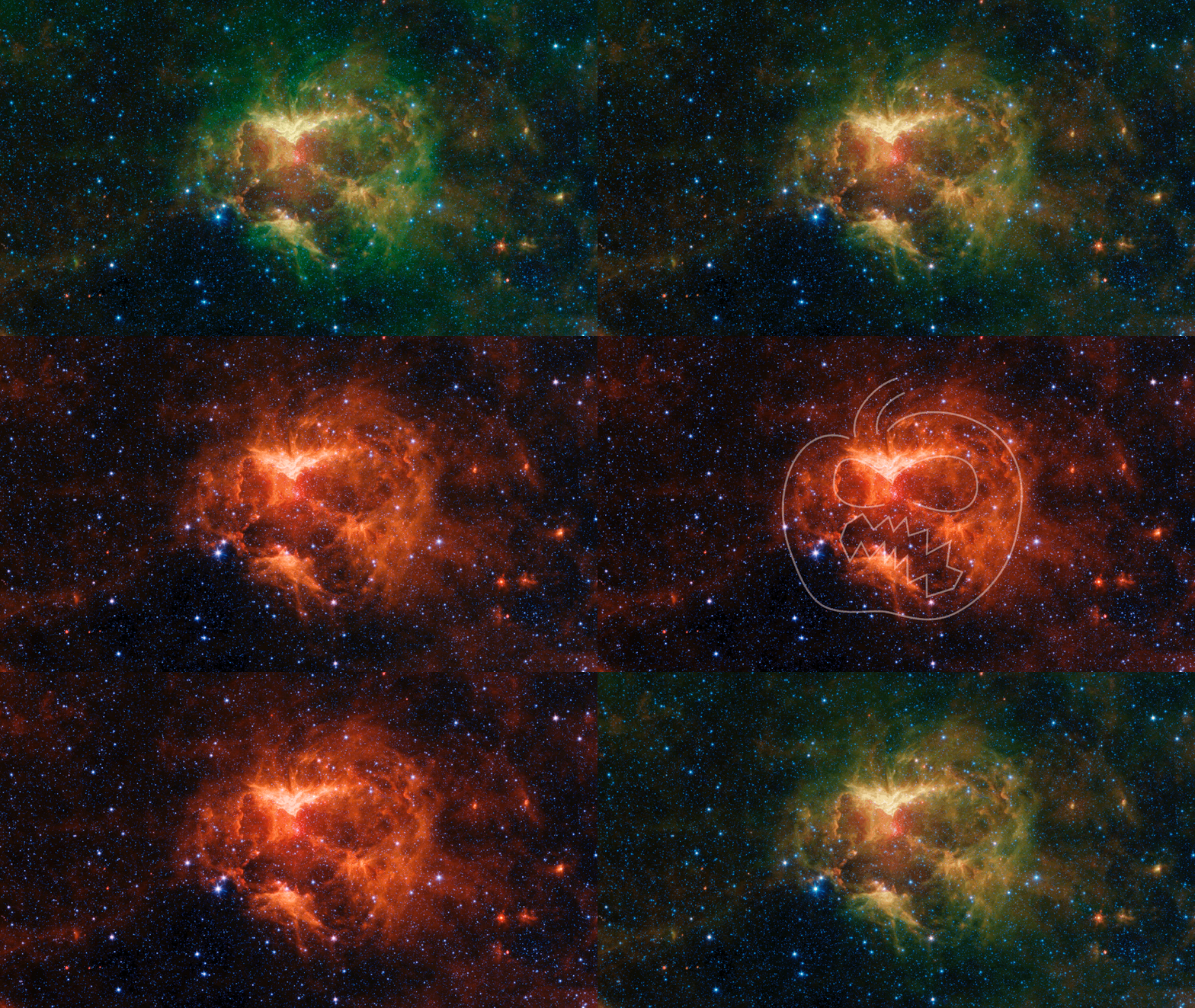
2 Min Read October’s Night Sky Notes: Spooky Stargazing This infrared image from NASA’s Spitzer Space telescope shows a...
-
NASA has exercised the second option of its Information Technology and Multimedia Services (ITAMS) contract with DB Consulting Group, Inc., ...
-
Science Earth Observatory A Subtle Return of La Niña Earth Earth Observatory Image of the Day EO Explorer All Topics ...
