The United States and United Arab Emirates (UAE) have entered into an agreement to cooperate in aeronautics research, and the exploration and use of airspace and outer space for peaceful purposes, working together in the peaceful use of outer space for the benefit of humanity.
from NASA Breaking News http://ift.tt/1tksyah
via IFTTT

Sunday, 12 June 2016

Saturday, 11 June 2016
NASA TV Airs Return of NASA Astronaut, Two Crewmates from Space Station
Three International Space Station crew members are scheduled to depart the orbiting outpost Saturday, June 18. NASA Television will provide coverage of their preparations for departure and return to Earth, beginning at 9:15 a.m. EDT Friday, June 17.
from NASA Breaking News http://ift.tt/1YfAh5a
via IFTTT
from NASA Breaking News http://ift.tt/1YfAh5a
via IFTTT
Friday, 10 June 2016
NASA Highlights Research in X-Planes, Safer, Greener Aviation at Aviation 2016
NASA’s leadership and top aeronautics innovators will discuss the agency’s 10-year plan to transform aviation at the American Institute of Aeronautics and Astronautics (AIAA) annual Aviation and Aeronautics Forum and Exposition, or Aviation 2016.
from NASA Breaking News http://ift.tt/25S2Wje
via IFTTT
from NASA Breaking News http://ift.tt/25S2Wje
via IFTTT
CometWatch 2 June
This week's CometWatch entry is an image of Comet 67P/Churyumov-Gerasimenko taken with Rosetta's NAVCAM on 2 June 2016, when the spacecraft was 23.6 km from the comet centre.

Enhanced NAVCAM image of Comet 67P/C-G taken on 2 June 2016, 23.6 km from the nucleus. The scale is 2.0 m/pixel and the image measures 2.1 km across. The faint vertical striping effect, especially visible in the top right corner of this view, is an image artifact. Credits: ESA/Rosetta/NAVCAM – CC BY-SA IGO 3.0
In this orientation, the small comet lobe is in the right half of the image, while the large lobe is in the lower left.
The smooth-covered terrains visible on the small lobe are part of Ma'at, a region blanketed in dust and punctuated with several boulders, especially towards the lower edge in this view. Below the boulders is the scarp that separates Ma'at from Anuket, a rougher region, cast in shadow in this image, which declines steeply towards the comet neck.
In the lower part of the image, on the neck region of Hapi, streaks of boulders stand out against a smooth cover of dust. Towards the left, parts of the Babi region can be seen, degrading smoothly into the terrains of Seth, in the lower left corner.
A few days later, on 6 June, Rosetta's OSIRIS narrow-angle camera captured a striking view of a different portion of the large comet lobe, showing the boundary between Imhotep, in the top half, and Ash, in the lower half.

OSIRIS narrow-angle camera image taken on 6 June 2016, when Rosetta was 22.9 km from Comet 67P/C-G. The scale is 0.40 m/pixel and the image measures about 820 m. Credits: ESA/Rosetta/MPS for OSIRIS Team MPS/UPD/LAM/IAA/SSO/INTA/UPM/DASP/IDA
The image (above) shows the variety of smooth and rocky terrains found on Imhotep, as well as the 45-m boulder Cheops and two neighbouring large boulders towards the top right. The complexity of Imhotep contrasts nicely with the dust-covered portions of Ash, in the lower part of the image.
Another OSIRIS narrow-angle camera image, taken on 7 June about 64 km from the nucleus, portrays one more patch of the large lobe of Comet 67P/C-G.

OSIRIS narrow-angle camera image taken on 7 June 2016, when Rosetta was 64.2 km from Comet 67P/C-G. The scale is 1.16 m/pixel and the image measures about 2.4 km. Credits: ESA/Rosetta/MPS for OSIRIS Team MPS/UPD/LAM/IAA/SSO/INTA/UPM/DASP/IDA
Along the top-right-to-bottom-left diagonal, the image (above) shows the complex terrains of Atum, characterised by numerous depressions and linear features; in the lower part of the image, a small portion of the Anubis region is visible, housing with many boulders, and transitioning towards Ash in the lower right corner.
The original NAVCAM image is provided below.

from Rosetta – ESA's comet chaser http://ift.tt/1YhKpul
via IFTTT
Thursday, 9 June 2016
NASA TV to Broadcast U.S. Cargo Ship Departure from Space Station
After delivering almost 7,500 pounds of cargo to support dozens of science experiments from around the world, the Orbital ATK Cygnus cargo spacecraft is set to leave the International Space Station Tuesday, June 14. NASA Television will provide live coverage of Cygnus' departure beginning at 9 a.m. EDT.
from NASA Breaking News http://ift.tt/1UDugcI
via IFTTT
from NASA Breaking News http://ift.tt/1UDugcI
via IFTTT
NASA Showcases Technologies Available for Licensing at ‘TechBreakfast’
NASA will showcase four demonstrations of its technologies now available for licensing at TechBreakfast, a monthly event in the Washington area, at 7:45 a.m. EDT Friday, June 10.
from NASA Breaking News http://ift.tt/1U7PdiW
via IFTTT
from NASA Breaking News http://ift.tt/1U7PdiW
via IFTTT
Tuesday, 7 June 2016
NASA Awards Grants to Two Universities for STEM Education Programs
NASA's Minority University Research and Education Project (MUREP) has selected two minority serving institutions for cooperative agreement awards totaling approximately $1 million to help strengthen science, technology, engineering and math (STEM) curricula at the schools.
from NASA Breaking News http://ift.tt/1Y42ADj
via IFTTT
from NASA Breaking News http://ift.tt/1Y42ADj
via IFTTT
Friday, 3 June 2016
CometWatch 30 May
Today’s CometWatch entry features a NAVCAM image of Comet 67P/Churyumov-Gerasimenko taken by Rosetta on 30 May from a distance of about 6.5 km from the surface.

Enhanced NAVCAM image of Comet 67P/C-G taken on 30 May 2016, 7 km from the nucleus centre (about 6.5 km from the surface taking into account the comet's orientation and inclination with respect to the spacecraft). The average scale is 0.55 m/pixel and the image measures about 570 m across. Credits: ESA/Rosetta/NAVCAM – CC BY-SA IGO 3.0
The image captures the boundaries between Imhotep (the smooth region to the right), Bes (left) and Khepry (top and centre) on the large comet lobe. It encapsulates a wide variety of different terrains in a relatively small area, from smooth patches to cross-cutting fractures on exposed walls, and to boulders of various shapes and sizes.
The OSIRIS team also released a new image from the wide-angle camera this week (below), captured on 1 June when Rosetta was 8 km from the comet nucleus. It features part of the fractured Bastet and Wosret regions on the small lobe in the foreground, with the large lobe in the background (and much of the neck region in shadow in between).

OSIRIS wide-angle camera image taken on 1 June 2016, when Rosetta was 8.4 km from the centre of Comet 67P/C-G. The scale is 0.79 m/pixel. Credits: ESA/Rosetta/MPS for OSIRIS Team MPS/UPD/LAM/IAA/SSO/INTA/UPM/DASP/IDA
Meanwhile an image from the narrow-angle camera (below), taken later in the day on 1 June from a distance of about 20 km, reveals the incredibly dusty nature of the comet. It acts as a reminder of the challenging conditions Rosetta is facing flying close to the nucleus, even many months after the comet's most active period around perihelion (13 August 2015), the closest approach of the comet to the Sun along its orbit.

OSIRIS narrow-angle camera image taken on 1 June 2016, when Rosetta was 20 km from the centre of Comet 67P/C-G. The scale is 0.36 m/pixel. The exposure time of the image was 12.5 seconds, allowing the dust grains to be imaged as they moved in front of the camera’s field of view. Credits: ESA/Rosetta/MPS for OSIRIS Team MPS/UPD/LAM/IAA/SSO/INTA/UPM/DASP/IDA
The image also captures some impressive details of the neck region of the comet, in particular the fractured boulders that scatter the otherwise smooth surface of Hapi. The rugged cliffs of Hathor on the small comet lobe are also hinted at to the left of the image.
The images featured in this post were captured after Rosetta experienced a safe mode event over the weekend, which was triggered by the spacecraft’s star trackers being confused by comet dust when it was flying ~5 km from the comet surface. The spacecraft has since been recovered and is en route to its planned 30 km orbit.
The original 1024 x 1024 pixel image from today’s NAVCAM CometWatch entry is provided below:

from Rosetta – ESA's comet chaser http://ift.tt/1U2g29z
via IFTTT
The changing comet – call for contributions
Do you enjoy poring over images of Comet 67P/Churyumov-Gerasimenko? Have you spotted any changes in its surface features since Rosetta first arrived at the comet in August 2014? We are keen to hear from you!
Between NAVCAM and OSIRIS, and not forgetting the regular “OSIRIS image of the day” images and our NAVCAM CometWatch entries, there are over 20 000 images publicly available to browse covering the 667 days Rosetta has to date spent at the comet.

The latest batch of images can be found in folder 'Rosetta Extension 2 MTP028'
Indeed, 780 new images have been added to our NAVCAM Archive Image Browser this week, covering the period 6 April – 3 May 2016. Thanks to the hard work of the Rosetta downlink and archive group, this means that from now on, every month you will be able to access the full set of NAVCAM images taken during the previous month, and be able to keep even more up to date with the comet’s appearance than ever before.
Furthermore, with plentiful images available both before and after perihelion (Rosetta’s closest approach to the Sun along its orbit, when the comet’s activity was at its peak), including those captured from as close as 5-10 km from the comet’s surface at various times during the course of the mission, it is becoming easier to spot changes in surface patterns – as some of you have already pointed out in the comments section of this blog.

Changes reported by Rosetta scientists in the Imhotep region between May and July last year. Credits: ESA/Rosetta/MPS for OSIRIS Team MPS/UPD/LAM/IAA/SSO/INTA/UPM/DASP/IDA
We’d therefore like to make this a dedicated blog thread to invite you to submit your observations on possible changes that you may have noticed.
Feel free to post the before and after images as links to the archived images and a short description of what changes you can see, or links to your own or other blogs or image galleries where you may have already presented and discussed these images. In any case, please be sure to include the dates of the before and after images so we can follow up.
Do remember to be cautious when comparing images of the same region that have been taken under varying illumination conditions, or from different distances and therefore have a different scale – this can sometimes lead to mistaken identification.
In the coming months, as we approach the end of the mission, we hope to use your contributions to feature in future blog posts.
Happy hunting!
from Rosetta – ESA's comet chaser http://ift.tt/1r4TY2s
via IFTTT
NASA Showcases Cygnus Spacecraft at Wallops Ahead of Space Station Mission
Media are invited to view and photograph Orbital ATK’s Cygnus spacecraft, packed with cargo for the International Space Station, at 10:30 a.m. EDT Tuesday, June 7 at NASA’s Wallops Flight Facility in Wallops Island, Virginia.
from NASA Breaking News http://ift.tt/24lkPUO
via IFTTT
from NASA Breaking News http://ift.tt/24lkPUO
via IFTTT
NASA Awards Contract for Suborbital Flight Services
NASA has selected Blue Origin, LLC, in Van Horn, Texas, to integrate and fly technology payloads near the boundary of space on their New Shepard suborbital spacecraft in support of NASA’s Flight Opportunities Program.
from NASA Breaking News http://ift.tt/1RRIS6E
via IFTTT
from NASA Breaking News http://ift.tt/1RRIS6E
via IFTTT
Subscribe to:
Posts (Atom)
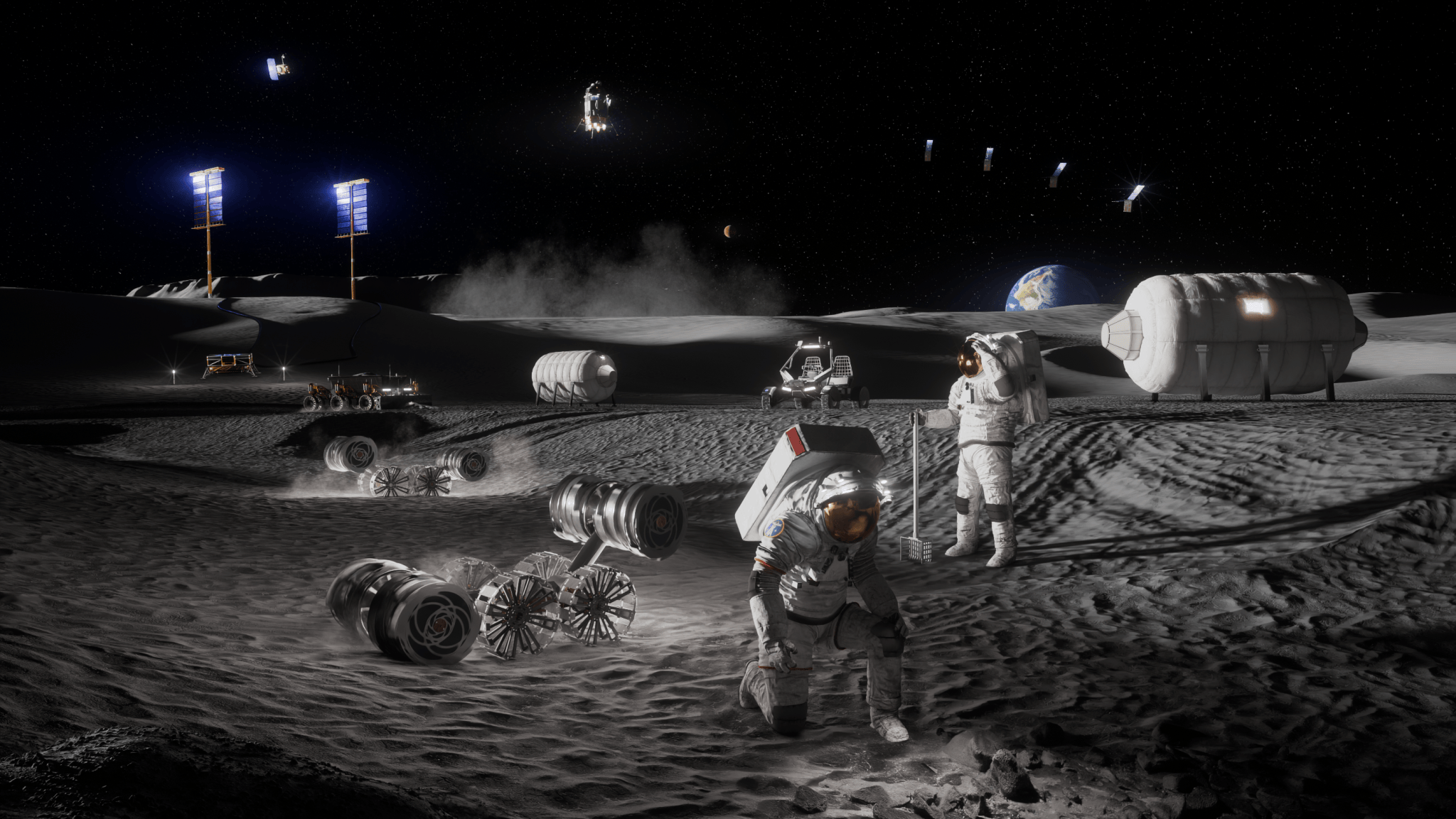
NASA Announces $1 Million to Students for Moon Base Challenge
Artist’s concept depicting astronauts, habitats, rovers, power systems, and cargo operations supporting sustained human activities at the Mo...
-
NASA has exercised the second option of its Information Technology and Multimedia Services (ITAMS) contract with DB Consulting Group, Inc., ...
-
Science Earth Observatory A Subtle Return of La Niña Earth Earth Observatory Image of the Day EO Explorer All Topics ...
