NASA astronaut Kate Rubins will be available for live satellite interviews from Moscow on Wednesday, June 1, before her launch to the International Space Station. She will answer questions about her upcoming mission aboard the world’s only orbiting laboratory from 9-10 a.m. EDT, airing live on NASA Television and streaming on the agency’s website.
from NASA Breaking News http://ift.tt/1qHDRrp
via IFTTT

Wednesday, 25 May 2016

Tuesday, 24 May 2016
NASA Telescopes Find Clues For How Giant Black Holes Formed So Quickly
Using data from NASA’s Great Observatories, astronomers have found the best evidence yet for cosmic seeds in the early universe that should grow into supermassive black holes.
from NASA Breaking News http://ift.tt/1XunWcW
via IFTTT
from NASA Breaking News http://ift.tt/1XunWcW
via IFTTT
Next SpaceX Commercial Cargo Launch Targeted for Mid-July, NASA Opens Media Accreditation
Media accreditation now is open for the next SpaceX commercial cargo resupply services mission to the International Space Station, targeted for launch no earlier than approximately 1:32 a.m. EDT Saturday, July 16.
from NASA Breaking News http://ift.tt/1XOuCD0
via IFTTT
from NASA Breaking News http://ift.tt/1XOuCD0
via IFTTT
Monday, 23 May 2016
NASA Televises, Hosts Events for Deployment of First Expandable Habitat on International Space Station
The Bigelow Expandable Activity Module (BEAM) will be deployed to its full size Thursday, May 26, and begin its two-year technology demonstration attached to the International Space Station. NASA Television will provide coverage of the expansion beginning at 5:30 a.m. EDT.
from NASA Breaking News http://ift.tt/1OIPmET
via IFTTT
from NASA Breaking News http://ift.tt/1OIPmET
via IFTTT
Saturday, 21 May 2016
NASA Televises, Hosts Events for Deployment of First Expandable Habitat on International Space Station
The Bigelow Expandable Activity Module (BEAM) will be deployed to its full size Thursday, May 26, and begin its two-year technology demonstration attached to the International Space Station. NASA Television will provide coverage of the expansion beginning at 5:30 a.m. EDT.
from NASA Breaking News http://ift.tt/1U5RaJz
via IFTTT
from NASA Breaking News http://ift.tt/1U5RaJz
via IFTTT
Launch of First U.S. Spacecraft to Sample Asteroid Set for September, NASA Media Accreditation Open
NASA has opened accreditation for media to attend the September launch of the first U.S. mission to sample an asteroid. NASA’s Origins, Spectral Interpretation, Resource Identification, Security - Regolith Explorer (OSIRIS-REx) spacecraft will travel to and collect surface material from the asteroid Bennu, and return it to Earth for study.
from NASA Breaking News http://ift.tt/1sHojWp
via IFTTT
from NASA Breaking News http://ift.tt/1sHojWp
via IFTTT
Friday, 20 May 2016
CometWatch 15 May
This week’s CometWatch entry from Rosetta’s NAVCAM was taken on 15 May 2016 when the spacecraft was 9.88 km from Comet 67P/Churyumov-Gerasimenko.

Enhanced NAVCAM image of Comet 67P/C-G taken on 15 May 2016, 9.88 km from the nucleus. The scale is 0.84 m/pixel and the image measures 862 m across. Credits: ESA/Rosetta/NAVCAM – CC BY-SA IGO 3.0.
This impressive close-up captures the relatively flat regions of Aker and Khepry on the comet’s small lobe. These regions are characterised by distinctive layers and in places cross-cutting fracture lines – these are particularly visible in the exposed faces at the top left. A number of large boulders can also be seen sitting within an island of smoother terrain towards the top of the view.
The large comet lobe lies to the bottom left of this view with the ridge-like feature separating Sobek (foreground) from Bastet (behind and out of view). A small portion of boulder-strewn Hapi can also be seen at the foothill of Aker. The largely shadowed region to the lower right marks the transition to Anhur.
With Rosetta currently at these close distances the OSIRIS cameras are also capturing stunning details of the comet.

OSIRIS narrow-angle camera image taken on 11 May 2016, when Rosetta was 9.97 km from Comet 67P/Churyumov–Gerasimenko. The scale is 0.16 m/pixel. Credits: ESA/Rosetta/MPS for OSIRIS Team MPS/UPD/LAM/IAA/SSO/INTA/UPM/DASP/IDA
The image above shows fracture patterns similar to those seen in this week’s NAVCAM entry, but on the comet’s small lobe, in the Wosret region.
Two additional views released this week capture parts of the Imhotep region on the large lobe.

OSIRIS narrow-angle camera image taken on 17 May 2016, when Rosetta was 9.4 km from Comet 67P/Churyumov–Gerasimenko. The scale is 0.89 m/pixel. Credit: ESA/Rosetta/MPS for OSIRIS Team MPS/UPD/LAM/IAA/SSO/INTA/UPM/DASP/IDA
The beautiful oblique view (above) shows the wider region – and was imaged by the wide-angle camera – while the close-up (below) was taken by the narrow-angle camera.

OSIRIS narrow-angle camera image taken on 11 May 2016, when Rosetta was 9.9 km from Comet 67P/Churyumov–Gerasimenko. The scale is 0.16 m/pixel. Credit: ESA/Rosetta/MPS for OSIRIS Team MPS/UPD/LAM/IAA/SSO/INTA/UPM/DASP/IDA
The close-up captures boulders of a range of sizes, likely associated with erosion from the surrounding slopes. The transition from these eroded regions on the outskirts of Imhotep to the central smoother plains is nicely highlighted in this scene.
The original NAVCAM from today’s release is provided below:

from Rosetta – ESA's comet chaser http://ift.tt/1W5NI8f
via IFTTT
Wednesday, 18 May 2016
NASA Invites Media, Social Media to June Deep Space Rocket Booster Test
Media and social media followers are invited to watch as NASA tests the largest, most powerful booster in the world for the agency's new deep space rocket, the Space Launch System (SLS), on June 28 at Orbital ATK Aerospace System's test facility in Promontory, Utah. SLS and NASA’s Orion spacecraft will launch astronauts on missions to explore multi
from NASA Breaking News http://ift.tt/1sspfgD
via IFTTT
from NASA Breaking News http://ift.tt/1sspfgD
via IFTTT
Monday, 16 May 2016
Wisconsin Students Make Long-Distance Call to Space Station Astronaut
Students in Winter, Wisconsin, will have the opportunity to speak with a NASA astronaut living and working aboard the International Space Station at 11:15 a.m. EDT Thursday, May 19. The 20-minute, Earth-to-space call will air live on NASA Television and the agency’s website.
from NASA Breaking News http://ift.tt/1TiacAo
via IFTTT
from NASA Breaking News http://ift.tt/1TiacAo
via IFTTT
Friday, 13 May 2016
From ‘Magnetoshells’ to Growable Habitats, NASA Invests in Next Stage of Visionary Technology Development
NASA has selected eight technology proposals for investment that have the potential to transform future aerospace missions, introduce new capabilities, and significantly improve current approaches to building and operating aerospace systems.
from NASA Breaking News http://ift.tt/1ZNaMXx
via IFTTT
from NASA Breaking News http://ift.tt/1ZNaMXx
via IFTTT
Thursday, 12 May 2016
Artistic tributes to the Rosetta mission
Over the past two years, Rosetta has approached, reached and followed Comet 67P/Churyumov-Gerasimenko, collecting unprecedented images and other scientific data and dropping the Philae lander on to its surface to perform in-situ measurements.
While communicating the mission's milestones, operational activities and scientific results via this blog and other social media channels, we have been pleased with the enormous impact that the mission had – and still has – on the public.

A selection of artworks inspired by the Rosetta mission. Top row: Christine Rueter; Solimán López; Ekaterina Smirnova. Middle row: Edward Blakeley; Stephen Oliver; John Elcock; David Delgado, Dan Goods & Studio KCA. Bottom row: Siobhan Logan; Angelina Yershova & Stefano Giovanardi; Guilherme Pontes. For more details about these and other artworks, visit: http://ift.tt/1WseZkX
Among the many comments, questions and feedback we have received over the months, there were also some special messages: they came from artists across the world, who had been especially impressed and inspired by the incredible adventure of Rosetta and Philae.
They had spontaneously dedicated paintings, poems, songs, symphonies and a variety of other artworks to this unique mission, and wanted to share them with us.
Then we started searching the web, and were astonished to find even more artistic tributes to the mission.
Today, we are sharing this collection online by launching a new web-based platform: the “Rosetta Art Tribute” tumblr, to collect artworks based on different media that have been inspired by ESA's comet-chasing mission.
This repository of artistic tributes expands on a post, “Music of the irregular spheres”, that was published on this blog in late 2014 to celebrate the many musical tributes that had been dedicated to Rosetta, Philae and Comet 67P/C-G around the time of comet landing.
So far, the Rosetta Art Tribute collection includes paintings, silk-prints, sculptures, etchings, drawings, photographs, poems, musical suites, symphonies, songs, live-concerts, performances, installations, a sci-fi film (co-produced by ESA), comics, cartoons, and more.
We are delighted to see that the Rosetta mission has such a strong and long-lasting impact on the imagination and work of many artists. This is a testament to the mutual spirit of quest, research and exploration that is pursued, albeit with different tools, by scientists and artists alike.
We wish to send our warmest thanks to all the artists who chose to dedicate their pieces to Rosetta for their enthusiasm and for having let the mission become part of their artistic process.
This collection is by no means complete, and is maintained on a best-effort basis. We hope that it will grow with time, and if you are an artist (or know one) who has been inspired by the Rosetta mission and would like your work to be featured, please contact us via the tumblr or via this blog.

The Ars Electronica Center in Linz, Austria. Credit: N. Ferrando & L. Lammerhuber
As a final note, we would like to advertise an artistic residency that ESA has recently launched in partnership with the Austrian institution Ars Electronica to research an interdisciplinary project bridging the domains of art and space science.
The residency project can be based on any subject from ESA’s space science programme (including, of course, the Rosetta mission!) and will take place in the second half of 2016. The deadline to apply is 6 June.
from Rosetta – ESA's comet chaser http://ift.tt/1WseZl1
via IFTTT
Subscribe to:
Posts (Atom)
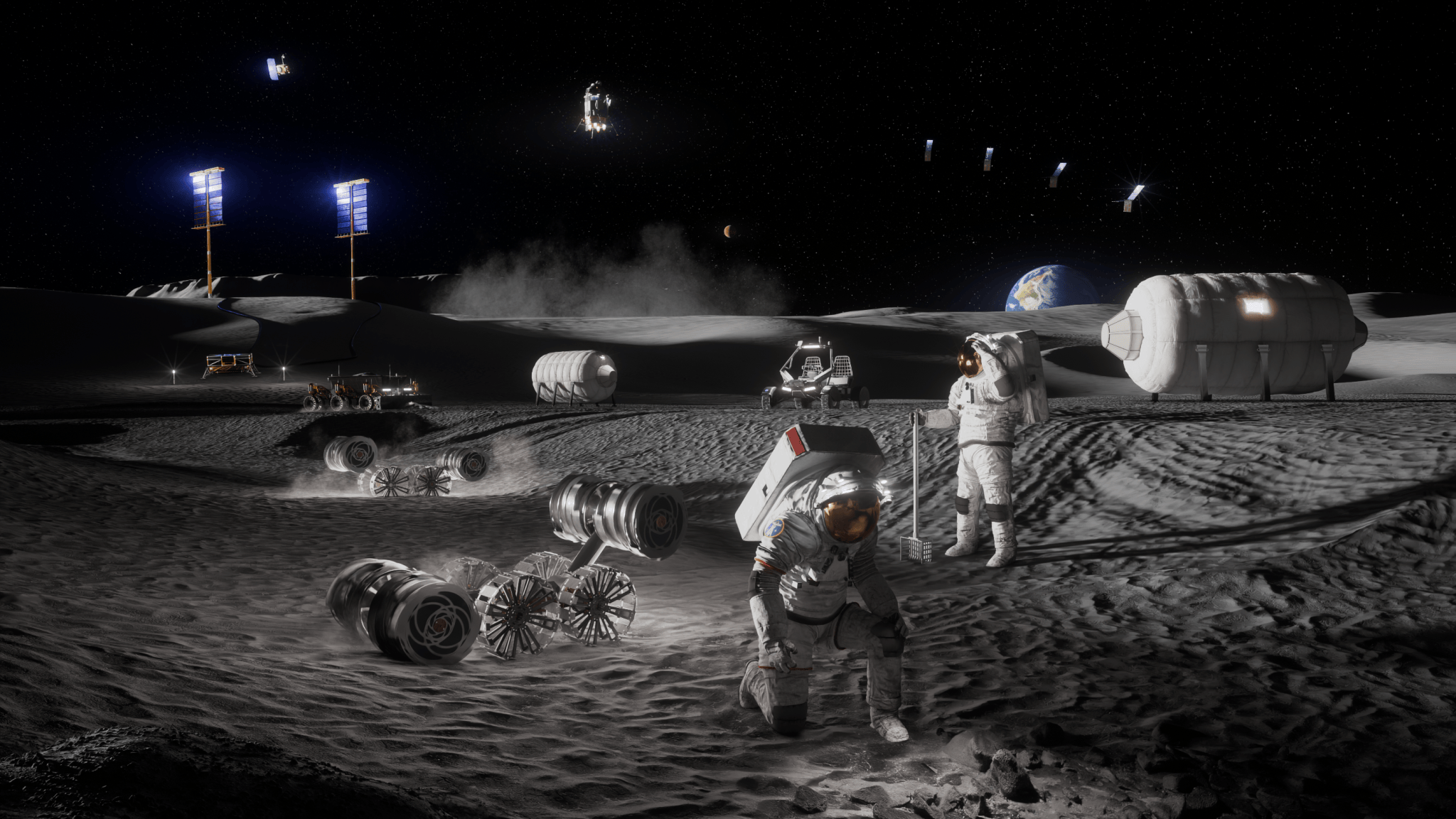
NASA Announces $1 Million to Students for Moon Base Challenge
Artist’s concept depicting astronauts, habitats, rovers, power systems, and cargo operations supporting sustained human activities at the Mo...
-
NASA has exercised the second option of its Information Technology and Multimedia Services (ITAMS) contract with DB Consulting Group, Inc., ...
-
Science Earth Observatory A Subtle Return of La Niña Earth Earth Observatory Image of the Day EO Explorer All Topics ...
