A SpaceX Dragon cargo spacecraft splashed down in the Pacific Ocean at 2:51 p.m. EDT Wednesday, May 11, about 261 miles southwest of Long Beach, California, with more than 3,700 pounds of NASA cargo, science and technology demonstration samples from the International Space Station.
from NASA Breaking News http://ift.tt/1X1Duob
via IFTTT

Thursday, 12 May 2016

Tuesday, 10 May 2016
NASA's Kepler Mission Announces Largest Collection of Planets Ever Discovered
NASA's Kepler mission has verified 1,284 new planets – the single largest finding of planets to date.
from NASA Breaking News http://ift.tt/1ZBEFtD
via IFTTT
from NASA Breaking News http://ift.tt/1ZBEFtD
via IFTTT
CometWatch 1 May
This week's CometWatch is an image taken with Rosetta's NAVCAM on 1 May 2016, when the spacecraft was 18.8 km from the nucleus of Comet 67P/Churyumov-Gerasimenko.

Enhanced NAVCAM image of Comet 67P/C-G taken on 1 May 2016, 18.8 km from the nucleus. The scale is 1.6 m/pixel and the image measures 1.6 km across. Credits: ESA/Rosetta/NAVCAM – CC BY-SA IGO 3.0
The view shows a portion of the large comet lobe on the left, while hints of the neck and small lobe are visible in the lower right corner. On the large lobe, the image reveals the striking difference between the Atum region, on the left, and Anubis, on the right.
The irregular terrains of Atum display the complex morphology of this region, with depressions, a wealth of linear features and only a few boulders. The adjacent Anubis, instead, is characterised by smooth terrains punctuated with several boulders.
The sharp boundary separating Anubis and Seth is visible on the right edge, and a small portion of Anuket, on the small lobe, can be see in the lower right.
A different perspective is portrayed in this recent image captured by Rosetta's OSIRIS narrow-angle camera on 3 May. In this orientation, the Wosret region, on the small comet lobe, is visible on the left, declining towards Sobek, on the neck, and further to the large lobe on the right.

OSIRIS narrow-angle camera image taken at 05:43 UTC on 3 May 2016, when Rosetta was 18.8 km from Comet 67P/C-G. The scale is 0.33 m/pixel. Credits: ESA/Rosetta/MPS for OSIRIS Team MPS/UPD/LAM/IAA/SSO/INTA/UPM/DASP/IDA
Another OSIRIS image, taken with the same camera just a few hours earlier, shows a patch of Imhotep, on the large lobe, in staggering detail, uncovering the smooth deposits and boulders that cover this region.

OSIRIS narrow-angle camera image taken at 00:22 UTC on 3 May 2016, when Rosetta was 18.8 km from Comet 67P/C-G. The scale is 0.33 m/pixel. Credits: ESA/Rosetta/MPS for OSIRIS Team MPS/UPD/LAM/IAA/SSO/INTA/UPM/DASP/IDA
The original NAVCAM image is provided below.

from Rosetta – ESA's comet chaser http://ift.tt/1WnfxJC
via IFTTT
Friday, 6 May 2016
NASA, Space Station Partners Announce Future Mission Crew Members
NASA and its International Space Station partners have announced the crew members for missions to the orbiting laboratory in 2017. The selection includes first-time space flyer NASA astronaut Scott Tingle and veteran Randy Bresnik.
from NASA Breaking News http://ift.tt/1SU7eOW
via IFTTT
from NASA Breaking News http://ift.tt/1SU7eOW
via IFTTT
NASA TV to Broadcast Dragon Departure from International Space Station
After delivering almost 7,000 pounds of cargo to the International Space Station, including the Bigelow Expandable Activity Module (BEAM), the SpaceX Dragon cargo spacecraft is set to leave the orbital laboratory with valuable science research and return to Earth on Wednesday, May 11. NASA Television will provide live coverage of Dragon's departure
from NASA Breaking News http://ift.tt/1SS5HsR
via IFTTT
from NASA Breaking News http://ift.tt/1SS5HsR
via IFTTT
Wednesday, 4 May 2016
OSIRIS data release: close orbits and lander delivery
The Rosetta Downlink and Archive group are pleased to announce the release of over 4000 OSIRIS images to the Archive Image Browser and the Planetary Science Archive. An Archive Science Review was successfully held in February resulting the need for some improvements in the data and metadata being delivered by the Rosetta instruments, some of which have been taken into account in this OSIRIS release. The release covers the period 16 September – 19 December 2014 and includes narrow- and wide-angle camera images from Rosetta’s close observation phase when the spacecraft was just 8 km from the surface of Comet 67P/Churyumov-Gerasimenko, as well as pre- and post-landing imagery. They show the astonishing detail of the comet surface at close range, including images used to help characterise Philae’s landing site at Agilkia. The image set also includes incredible views of Philae drifting across the surface of the comet on 12 November 2014 as it approached Agilkia and then bounced out of view. One example is shown below – can you spot Philae? (Hint: check against the image mosaic of Philae's journey across the surface released after landing here). The new images can be found in the folders labelled MTP007, MTP008, MTP009 and MTP010.
from Rosetta – ESA's comet chaser http://ift.tt/1ZcbBIS
via IFTTT
from Rosetta – ESA's comet chaser http://ift.tt/1ZcbBIS
via IFTTT
Tuesday, 3 May 2016
NASA to Provide Coverage of May 9 Mercury Transit of the Sun
NASA is inviting media and viewers around the world to see a relatively rare celestial event, with coverage of the Monday, May 9 transit of the sun by the planet Mercury. Media may view the event at NASA’s Goddard Space Flight Center in Greenbelt, Maryland.
from NASA Breaking News http://ift.tt/1TIygLA
via IFTTT
from NASA Breaking News http://ift.tt/1TIygLA
via IFTTT
NASA Welcomes New Director for its Jet Propulsion Laboratory
The following is a statement from NASA Administrator Charles Bolden on the selection of Michael Watkins as the new director of the agency’s Jet Propulsion Laboratory (JPL) in Pasadena, California.
from NASA Breaking News http://ift.tt/24jQ8Vt
via IFTTT
from NASA Breaking News http://ift.tt/24jQ8Vt
via IFTTT
NASA Awards Contract for Aeronautics, Exploration Modeling, Simulation
NASA has selected Science and Technology Corporation of Hampton, Virginia, to provide support services at the agency’s Ames Research Center, Moffett Field, California under the Aeronautics and Exploration Mission Modeling and Simulation (AEMMS) contract.
from NASA Breaking News http://ift.tt/26M5IrA
via IFTTT
from NASA Breaking News http://ift.tt/26M5IrA
via IFTTT
NASA Astronauts to Call Chicago Area Students from International Space Station
Students from 11 schools in South Holland, Illinois, will have the opportunity to speak with two NASA astronauts currently living and working aboard the International Space Station at 11:55 a.m. EDT Thursday, May 5. The 20-minute, Earth-to-space call will air live on NASA Television and the agency’s website.
from NASA Breaking News http://ift.tt/1SIY9s7
via IFTTT
from NASA Breaking News http://ift.tt/1SIY9s7
via IFTTT
Subscribe to:
Posts (Atom)
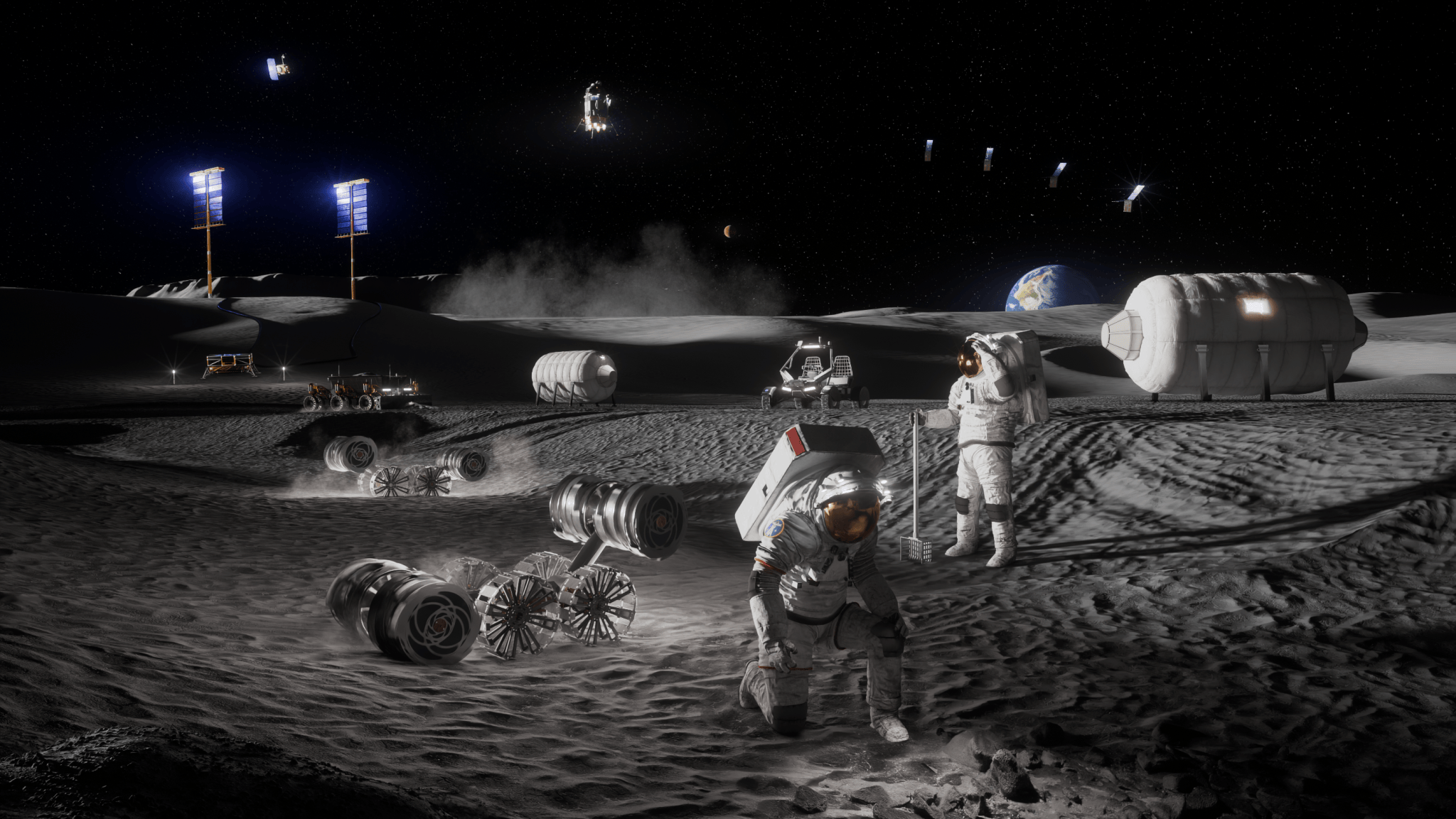
NASA Announces $1 Million to Students for Moon Base Challenge
Artist’s concept depicting astronauts, habitats, rovers, power systems, and cargo operations supporting sustained human activities at the Mo...
-
NASA has exercised the second option of its Information Technology and Multimedia Services (ITAMS) contract with DB Consulting Group, Inc., ...
-
Science Earth Observatory A Subtle Return of La Niña Earth Earth Observatory Image of the Day EO Explorer All Topics ...
