NASA has awarded a contract to Jacobs Technology Inc. of Tullahoma, Tennessee, for continued test and operations support at the agency’s White Sands Test Facility (WSTF) in Las Cruces, New Mexico.
from NASA Breaking News http://ift.tt/1LaILHh
via IFTTT

Tuesday, 8 March 2016

NASA, Honeywell Bring Hip-Hop Education Show to West Coast
NASA and Honeywell are visiting the West Coast with the FMA Live! Forces in Motion show for a spring 2016 tour designed to ignite students' interest in science, technology, engineering and math (STEM).
from NASA Breaking News http://ift.tt/1R0LBut
via IFTTT
from NASA Breaking News http://ift.tt/1R0LBut
via IFTTT
Friday, 4 March 2016
NASA Deputy Administrator Visits Home State for Aviation, STEM Talks; Available for Media Interviews
NASA Deputy Administrator Dava Newman will return to her hometown of Helena, Montana March 5-12 to discuss next-generation aviation, meet with students at her alma mater high school and tour a local science museum.
from NASA Breaking News http://ift.tt/1TePVfW
via IFTTT
from NASA Breaking News http://ift.tt/1TePVfW
via IFTTT
CometWatch 1 March
This week, CometWatch features an image of Comet 67P/Churyumov-Gerasimenko taken by Rosetta's NAVCAM on 1 March 2016, when the spacecraft was 26.7 km from the comet nucleus. With Rosetta back at close distances from the comet, NAVCAM images no longer cover the whole nucleus but only parts of it, displaying a variety of interesting details on the surface. This image shows a portion of the large comet lobe, where the Imhotep region slopes down towards Bes, on the southern hemisphere. A jet of activity is clearly seen emanating from the lower left edge, even in the original image (at the end of the post), while portions of the Khonsu region are visible towards the right. Imhotep and Bes are also featured in a image taken with Rosetta’s OSIRIS narrow-angle camera on 10 February, and released last week via the OSIRIS image of the day website. Portions of Khepry can also be seen on the left side of this image. Another narrow-angle OSIRIS image, taken on 27 February and released this week, shows a different portion of the large lobe, focussing on the Ash region. This week, a new batch of 826 new NAVCAM images was also released, spanning the weeks between 21 October and 15 December 2015. You can browse through them via the NAVCAM Image Browser tool. The original NAVCAM image is provided below.
from Rosetta – ESA's comet chaser http://ift.tt/1TeBvfR
via IFTTT
from Rosetta – ESA's comet chaser http://ift.tt/1TeBvfR
via IFTTT
NASA to Provide Live Coverage, Interviews, and Social Media for March 8 Solar Eclipse
NASA, in partnership with the Exploratorium Science Center in San Francisco, will host activities around the March 8 total solar eclipse, including opportunities to talk with solar scientists and live coverage of the eclipse originating from Woleai island in Micronesia.
from NASA Breaking News http://ift.tt/1TvmtCU
via IFTTT
from NASA Breaking News http://ift.tt/1TvmtCU
via IFTTT
NASA Extends Media Credentials Deadlines for Commercial Cargo Mission
NASA has extended media accreditation deadlines for the next launch of a commercial resupply services mission to the International Space Station, now targeted for Tuesday, March 22, during a 30-minute launch window that opens at approximately 11 p.m. EDT.
from NASA Breaking News http://ift.tt/1TcmStt
via IFTTT
from NASA Breaking News http://ift.tt/1TcmStt
via IFTTT
Thursday, 3 March 2016
Update on NASA Astronaut Scott Kelly’s Return to Houston
NASA astronaut Scott Kelly now is expected to return to Houston at about 12:55 a.m. EST Thursday (11:55 p.m. CST Wednesday, March 2), based on the current transportation plan. NASA Television will broadcast Kelly’s arrival back on U.S. soil after an agency record-setting stay in space aboard the International Space Station. Coverage begins at 12:40
from NASA Breaking News http://ift.tt/1UzOOqH
via IFTTT
from NASA Breaking News http://ift.tt/1UzOOqH
via IFTTT
Wednesday, 2 March 2016
Profiling COSIMA’s dust grain family
Rosetta’s COSIMA instrument – the Cometary Secondary Ion Mass Analyser – has detected tens of thousands of dust grains since arriving at Comet 67P/Churyumov-Gerasimenko. The grains collected from 11 August 2014 – 3 April 2015 across nine 1 cm^2 targets, when the comet was moving towards the Sun along its orbit from about 3.5 to 2 AU, provide the focus for a detailed study outlined in a paper published this month in the journal Icarus. The paper, led by Yves Langevin of the Institut d’Astrophysique Spatiale at CNRS/University of Paris-Sud, France, describes the key characteristics of the different grain families imaged under the COSIMA microscope, the COSISCOPE. The images reveal the particles are extremely diverse at scales of just a few 10s of micrometers (μm) to several 100 μm. The grains were characterized according to factors such as the complexity of its appearance and its height above target – determined by analysing its shadow –, which in turn is related to strength of particle. In general, the dust families can be divided into compact particles or clusters, with the cluster group further subdivided into shattered clusters, glued clusters and rubble piles. The clusters are differentiated based on the different size distributions of the components, their spatial relationship on the collection plate, and the existence or not of any connecting matrix. The different grain families are described below, including reconstructed anaglyph images made by combining an image at the nominal position (red) and an image obtained by shifting the target by 4mm away from the LED (blue). The particles follow a naming convention based on COSIMA team members and other Rosetta mission team colleagues. (Note: the credit line for all images is: ESA/Rosetta/MPS for COSIMA Team MPS/CSNSM/UNIBW/TUORLA/IWF/IAS/ESA/BUW/MPE/LPC2E/LCM/FMI/UTU/LISA/UOFC/vH&S/ Langevin et al (2016)) Compact particles Compact particles are defined as those with well-defined boundaries, […]
from Rosetta – ESA's comet chaser http://ift.tt/21CNMQ2
via IFTTT
from Rosetta – ESA's comet chaser http://ift.tt/21CNMQ2
via IFTTT
NASA Astronaut Scott Kelly Returns Safely to Earth after One-Year Mission
NASA astronaut and Expedition 46 Commander Scott Kelly and his Russian counterpart Mikhail Kornienko returned to Earth Tuesday after a historic 340-day mission aboard the International Space Station. They landed in Kazakhstan at 11:25 p.m. EST (10:25 a.m. March 2 Kazakhstan time).
from NASA Breaking News http://ift.tt/1VPGfqh
via IFTTT
from NASA Breaking News http://ift.tt/1VPGfqh
via IFTTT
Tuesday, 1 March 2016
NASA Technology Transfer Roadshow Stops in Texas, New Mexico
NASA’s Technology Transfer program will host events on March 9 and 10 in the El Paso, Texas, area and Las Cruces, New Mexico, to discuss how students and entrepreneurs can capitalize on NASA’s technology research and development.
from NASA Breaking News http://ift.tt/1QQtrSq
via IFTTT
from NASA Breaking News http://ift.tt/1QQtrSq
via IFTTT
NASA Begins Work to Build a Quieter Supersonic Passenger Jet
The return of supersonic passenger air travel is one step closer to reality with NASA's award of a contract for the preliminary design of a “low boom” flight demonstration aircraft. This is the first in a series of ‘X-planes’ in NASA's New Aviation Horizons initiative, introduced in the agency’s Fiscal Year 2017 budget.
from NASA Breaking News http://ift.tt/24xjIEr
via IFTTT
from NASA Breaking News http://ift.tt/24xjIEr
via IFTTT
Subscribe to:
Posts (Atom)
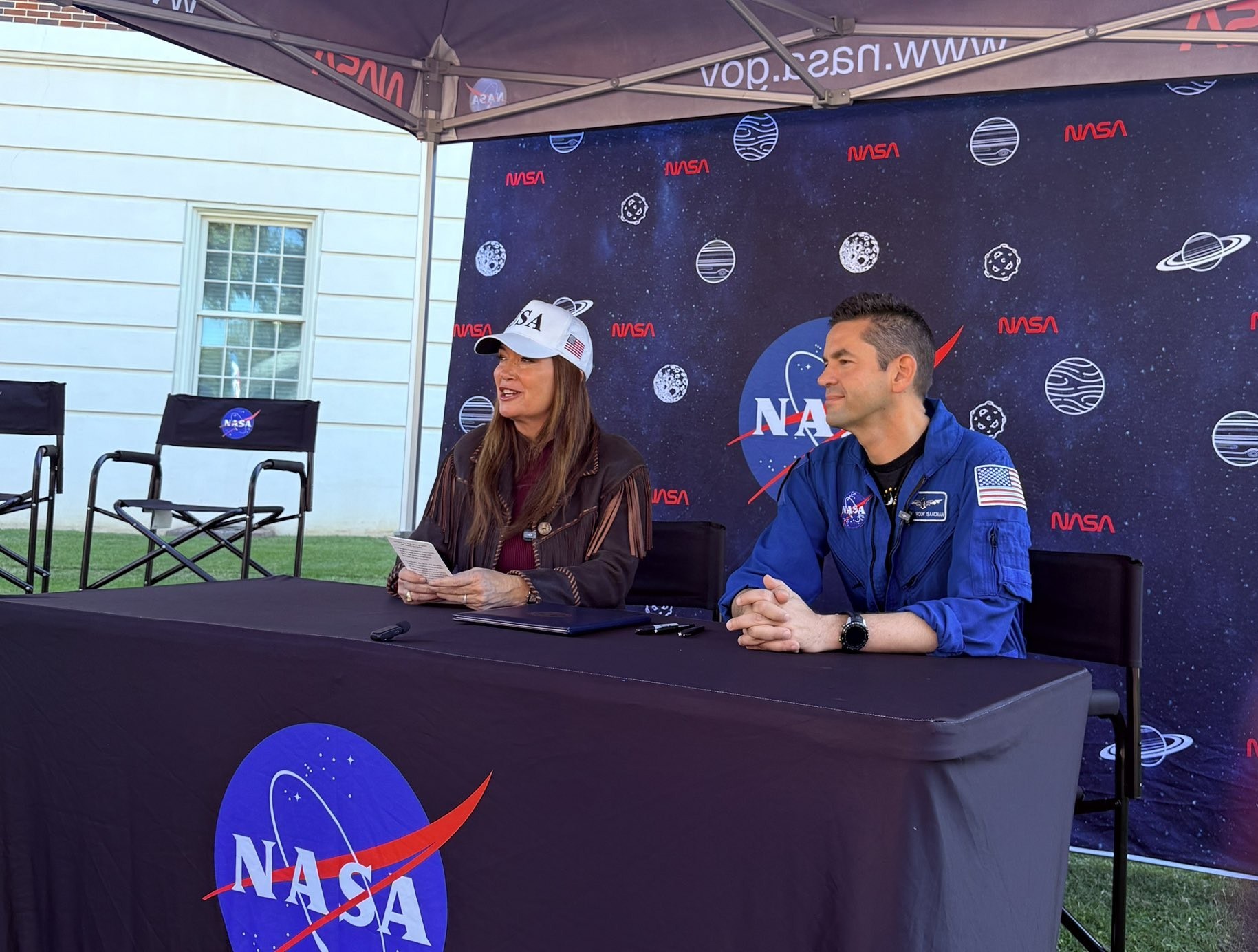
NASA, USDA Sign Agreement Advancing Earth Science, Agriculture
U.S. Secretary of Agriculture Brooke Rollins, left, and NASA Administrator Jared Isaacman signed a Memorandum of Understanding advancing agr...
-
NASA has exercised the second option of its Information Technology and Multimedia Services (ITAMS) contract with DB Consulting Group, Inc., ...
-
Science Earth Observatory A Subtle Return of La Niña Earth Earth Observatory Image of the Day EO Explorer All Topics ...
