This article is mirrored from the main ESA web portal. Silent since its last call to mothership Rosetta seven months ago, the Philae lander is facing conditions on Comet 67P/Churyumov–Gerasimenko from which it is unlikely to recover. Rosetta, which continues its scientific investigations at the comet until September before its own comet-landing finale, has in recent months been balancing science observations with flying dedicated trajectories optimised to listen out for Philae. But the lander has remained silent since 9 July 2015. “The chances for Philae to contact our team at our lander control centre are unfortunately getting close to zero,” says Stephan Ulamec, Philae project manager at the German Aerospace Center, DLR. “We are not sending commands any more and it would be very surprising if we were to receive a signal again.” Philae’s team of expert engineers and scientists at the German, French and Italian space centres and across Europe have carried out extensive investigations to try to understand the status of the lander, piecing together clues since it completed its first set of scientific activities after its historic landing on 12 November 2014. A story with incredible twists and turns unfolded on that day. In addition to a faulty thruster, Philae also failed to fire its harpoons and lock itself onto the surface of the comet after its seven-hour descent, bouncing from its initial touchdown point at Agilkia, to a new landing site, Abydos, over 1 km away. The precise location of the lander has yet to be confirmed in high-resolution images. A reconstruction of the flight of the lander suggested that it made contact with the comet four times during its two-hour additional flight across the small comet lobe. After bouncing from Agilkia it grazed the rim of the Hatmehit depression, bounced again, and then finally settled on […]
from Rosetta – ESA's comet chaser http://ift.tt/1Kfl7Zz
via IFTTT

Friday, 12 February 2016

NASA, University Study Shows Rising Seas Slowed by Increasing Water on Land
New measurements from a NASA satellite have allowed researchers to identify and quantify, for the first time, how climate-driven increases of liquid water storage on land have affected the rate of sea level rise.
from NASA Breaking News http://ift.tt/1SjXnpL
via IFTTT
from NASA Breaking News http://ift.tt/1SjXnpL
via IFTTT
Saturday, 6 February 2016
NASA Administrator Remembers Apollo-Era Astronaut Edgar Mitchell
The following is a statement from NASA Administrator Charles Bolden on the passing of NASA astronaut Edgar Mitchell:
from NASA Breaking News http://ift.tt/1QLu8J7
via IFTTT
from NASA Breaking News http://ift.tt/1QLu8J7
via IFTTT
Friday, 5 February 2016
CometWatch 28 January
Today's CometWatch is an image taken with Rosetta's NAVCAM on 28 January 2016, when the spacecraft was 67.6 km from the comet nucleus. With the declining comet activity, Rosetta is now approaching the nucleus of 67P/C-G at distances that were not possible to attain since March 2015. This is granting us a detailed view of the comet's surface, including of some regions on the southern hemisphere that were still experiencing polar winter at the beginning of last year. In particular, the southern portion of the 'neck' region stands out in today's CometWatch, with a dramatic perspective on the rugged terrains of Sobek. The small lobe, on the left in this orientation, reveals the seemingly flat southern region of Wosret, with hints of Bastet towards the upper edge. The large lobe, on the right, shows a variety of different terrains: from the smooth portions of Aker and Khepry, visible as a bright swath at the top, through the rougher and boulder-rich portions of Khepry and Anhur at the centre, to a side-on view of Imhotep on the right. The great diversity of Imhotep is clearly visible in this image, with smooth areas covered in dust, large circular features, terraces and many boulders. Hints of the Ash region can also be seen towards the right edge. The original 1024 x 1024 image is provided below.
from Rosetta – ESA's comet chaser http://ift.tt/1K2MxSy
via IFTTT
from Rosetta – ESA's comet chaser http://ift.tt/1K2MxSy
via IFTTT
Thursday, 4 February 2016
NASA's James Webb Space Telescope Primary Mirror Fully Assembled
The 18th and final primary mirror segment is installed on what will be the biggest and most powerful space telescope ever launched. The final mirror installation Wednesday at NASA’s Goddard Space Flight Center in Greenbelt, Maryland marks an important milestone in the assembly of the agency’s James Webb Space Telescope.
from NASA Breaking News http://ift.tt/1SKVgdc
via IFTTT
from NASA Breaking News http://ift.tt/1SKVgdc
via IFTTT
Inside Rosetta’s comet
This article is mirrored from the main ESA Web Portal. There are no large caverns inside Comet 67P/Churyumov-Gerasimenko. ESA’s Rosetta mission has made measurements that clearly demonstrate this, solving a long-standing mystery. Comets are the icy remnants left over from the formation of the planets 4.6 billion years ago. A total of eight comets have now been visited by spacecraft and, thanks to these missions, we have built up a picture of the basic properties of these cosmic time capsules. While some questions have been answered, others have been raised. Comets are known to be a mixture of dust and ice, and if fully compact, they would be heavier than water. However, previous measurements have shown that some of them have extremely low densities, much lower than that of water ice. The low density implies that comets must be highly porous. But is the porosity because of huge empty caves in the comet’s interior or it is a more homogeneous low-density structure? In a new study, published in this week’s issue of the journal Nature, a team led by Martin Pätzold, from Rheinische Institut für Umweltforschung an der Universität zu Köln, Germany, have shown that Comet 67P/Churyumov-Gerasimenko is also a low-density object, but they have also been able to rule out a cavernous interior. This result is consistent with earlier results from Rosetta’s CONSERT radar experiment showing that the double-lobed comet’s ‘head’ is fairly homogenous on spatial scales of a few tens of metres. The most reasonable explanation then is that the comet’s porosity must be an intrinsic property of dust particles mixed with the ice that make up the interior. In fact, earlier spacecraft measurements had shown that comet dust is typically not a compacted solid, but rather a ‘fluffy’ aggregate, giving the dust particles high porosity and low […]
from Rosetta – ESA's comet chaser http://ift.tt/1PBVW3J
via IFTTT
from Rosetta – ESA's comet chaser http://ift.tt/1PBVW3J
via IFTTT
Wednesday, 3 February 2016
Bolden Speech Highlights “State of NASA” Events at Agency Centers Feb. 9
NASA centers across the country are opening their doors Tuesday, Feb. 9 to media and social media for “State of NASA” events, including a speech from NASA Administrator Charles Bolden, and unique opportunities for a behind-the-scenes look at the agency’s progress on its journey to Mars. These events follow President Obama’s Fiscal Year 2017 budget
from NASA Breaking News http://ift.tt/1QaBaUW
via IFTTT
from NASA Breaking News http://ift.tt/1QaBaUW
via IFTTT
Tuesday, 2 February 2016
Colorado Students to Speak Live with Space Station Commander
Students from five elementary schools and five middle schools in Colorado will have the opportunity to speak with a NASA astronaut living and working on the International Space Station at 12:35 p.m. EST on Thursday, Feb. 4. The 20-minute, Earth-to-space call will air live on NASA Television and the agency’s website.
from NASA Breaking News http://ift.tt/1KUM9QS
via IFTTT
from NASA Breaking News http://ift.tt/1KUM9QS
via IFTTT
NASA Space Launch System’s First Flight to Send Small Sci-Tech Satellites Into Space
The first flight of NASA’s new rocket, the Space Launch System (SLS), will carry 13 CubeSats to test innovative ideas along with an uncrewed Orion spacecraft in 2018.
from NASA Breaking News http://ift.tt/1P3kTnc
via IFTTT
from NASA Breaking News http://ift.tt/1P3kTnc
via IFTTT
Todd May Named Marshall Space Flight Center Director
NASA Administrator Charles Bolden has named Todd May director of the agency’s Marshall Space Flight Center in Huntsville, Alabama. May was appointed Marshall deputy director in August 2015 and has been serving as acting director since the Nov. 13, 2015 retirement of Patrick Scheuermann.
from NASA Breaking News http://ift.tt/1UE6PSw
via IFTTT
from NASA Breaking News http://ift.tt/1UE6PSw
via IFTTT
NASA Awards Contract for Information Technology, Multimedia Services at Johnson Space Center
NASA has awarded a contract to MORI Associates, Inc. of Rockville, Maryland, for information technology and external communications services at the agency’s Johnson Space Center in Houston.
from NASA Breaking News http://ift.tt/1Pbai7y
via IFTTT
from NASA Breaking News http://ift.tt/1Pbai7y
via IFTTT
Subscribe to:
Posts (Atom)
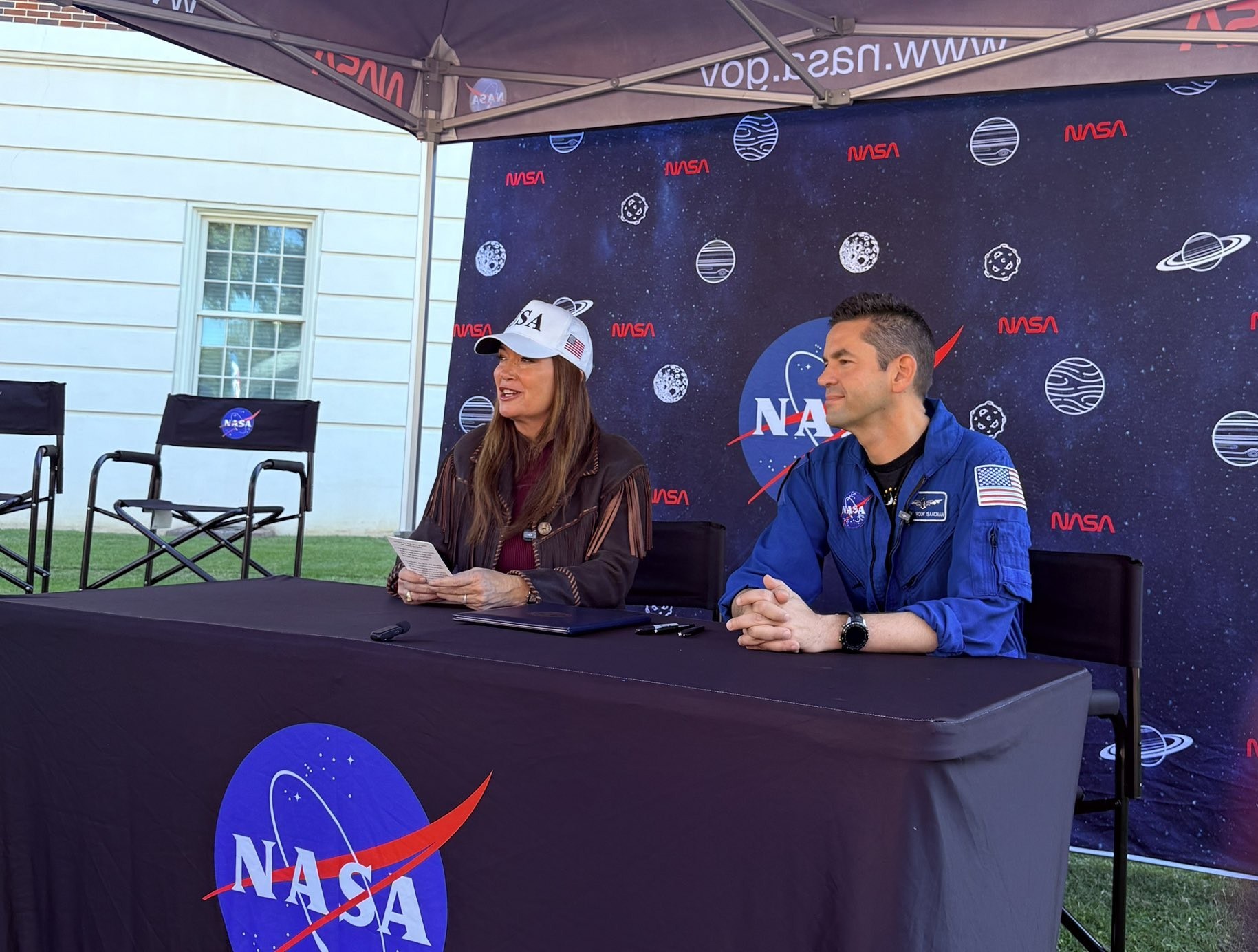
NASA, USDA Sign Agreement Advancing Earth Science, Agriculture
U.S. Secretary of Agriculture Brooke Rollins, left, and NASA Administrator Jared Isaacman signed a Memorandum of Understanding advancing agr...
-
NASA has exercised the second option of its Information Technology and Multimedia Services (ITAMS) contract with DB Consulting Group, Inc., ...
-
Science Earth Observatory A Subtle Return of La Niña Earth Earth Observatory Image of the Day EO Explorer All Topics ...
