NASA’s Johnson Space Center in Houston is inviting education-focused media to attend a two-day #spacED event on Sept. 15 and 16. The event will highlight the International Space Station and the one-year mission with astronaut Scott Kelly and cosmonaut Mikhail Kornienko.
from NASA Breaking News http://ift.tt/1N406zH
via IFTTT

Monday, 10 August 2015

NASA Opens New CubeSat Opportunities for Low-Cost Space Exploration
Space enthusiasts have an opportunity to contribute to NASA’s exploration goals through the next round of the agency’s CubeSat Launch Initiative. Applicants must submit their proposals electronically by 4:30 p.m. EST, Nov. 24.
from NASA Breaking News http://ift.tt/1IEIjd3
via IFTTT
from NASA Breaking News http://ift.tt/1IEIjd3
via IFTTT
Join our Perihelion Hangout!
Join us for a Google hangout with Rosetta mission experts to celebrate perihelion – the closest point to the Sun along the comet’s orbit. The hangout will be streamed live on 13 August at 13:00 GMT / 15:00 CEST – watch it here. The Hangout will be hosted by Emily Baldwin (ESA Space Science Editor) who will be joined by: Nico Altobelli - Acting Rosetta Project Scientist, ESAC Michael Küppers - Rosetta Science Operations Coordinator, ESAC Sylvain Lodiot - Rosetta Spacecraft Operations Manager, ESOC Armelle Hubault - Rosetta Spacecraft Operations Engineer, ESOC Barbara Cozzoni - Philae Lander Engineer, DLR Holger Sierks - OSIRIS Principal Investigator, MPS Joel Parker - Alice instrument Deputy-PI, SwRI Colin Snodgrass - Professional ground-based observing campaign coordinator, Open University Aurelie Moussi-Soffys - Science activities manager for Philae, SONC (CNES) Background info on perihelion, including FAQ: http://ift.tt/1L1M55R Sign up on Google+: http://ift.tt/1gHmumt Watch on YouTube: http://www.youtube.com/watch?v=TaBZbc6WGLs
from Rosetta - ESA's comet chaser » Rosetta - ESA's comet chaser http://ift.tt/1f3couq
via IFTTT
from Rosetta - ESA's comet chaser » Rosetta - ESA's comet chaser http://ift.tt/1f3couq
via IFTTT
Saturday, 8 August 2015
NASA to Share the Universe with Tumblr Users
NASA is launching an official Tumblr profile that will give Tumblr users a regular dose of space in a blog-like format through text, photos, videos and more.

from News and Features - NASA's Jet Propulsion Laboratory http://ift.tt/1IwxPMK
via IFTTT
NASA to Share the Universe with Tumblr Users
NASA is launching an official Tumblr profile that will give Tumblr users a regular dose of space in a blog-like format through text, photos, videos and more.
from NASA Breaking News http://ift.tt/1W6lcS3
via IFTTT
from NASA Breaking News http://ift.tt/1W6lcS3
via IFTTT
Friday, 7 August 2015
Veteran Russian Cosmonauts Set for Spacewalk on NASA TV
NASA Television will broadcast live coverage of a six-hour spacewalk by two Russian crew members aboard the International Space Station beginning at 9:45 a.m. EDT Monday, Aug. 10.
from NASA Breaking News http://ift.tt/1DvrZPi
via IFTTT
from NASA Breaking News http://ift.tt/1DvrZPi
via IFTTT
Amateur astronomers keeping an eye on the comet
This post is an interview with Padma A. Yanamandra-Fisher, a Senior Research Scientist at the Space Science Institute, USA, and the Rosetta Coordinator of Amateur Observations for 67P/C-G. Q: When did the amateur campaign to observe Rosetta's comet start? A: The first observations of Comet 67P/Churyumov-Gerasimenko by amateur astronomers for this stretch of the comet's orbit, leading to the 2015 perihelion, were performed in March 2014. At the time, the comet was very faint and only visible from the southern hemisphere, with a magnitude around 20, just at the limit of detection by small telescopes. In addition, the comet was in a highly dense star field and not always easy to image. From March to November 2014, we received about a dozen or so decent images from amateurs located at various locations such as Australia, South America, the USA and some parts of Europe. We compiled these early amateur images of the comet in a short video produced by Carolyn Collins Petersen. Then, from the end of 2014 to April 2015, the comet was too close to the Sun on the sky to be observed from Earth. On 13 April, amateur astronomers Jean-Francois Soulier, Jean-Gabriel Bosch and Alain Maury recovered the comet using (remotely) the Space Observatory in Chile, at a magnitude of 16.8. This detection kicked off the worldwide campaign to observe 67P/C-G in 2015. Q: How many members joined the campaign so far and where are they based? A: So far, about 250 amateur astronomers have signed up to join the campaign. They are based all over the world, from Europe to South America, from Australia to India, from South Africa to the Caribbean. However, as the comet is very low above the horizon at northern latitudes, it was predominantly observed with telescopes in the southern hemisphere until […]
from Rosetta - ESA's comet chaser » Rosetta - ESA's comet chaser http://ift.tt/1ghhjJ0
via IFTTT
from Rosetta - ESA's comet chaser » Rosetta - ESA's comet chaser http://ift.tt/1ghhjJ0
via IFTTT
Cruise Over Ceres in New Video
Striking 3-D detail highlights a towering mountain, the brightest spots and other features on dwarf planet Ceres in a new video from NASA's Dawn mission.

from News and Features - NASA's Jet Propulsion Laboratory http://ift.tt/1P8GeL9
via IFTTT
NASA, Space Station Partners Announce Crew Members for Missions in 2017
NASA and its International Space Station (ISS) partners have announced the crew members for missions to the orbiting laboratory in 2017. The selection includes first-time space flyers NASA astronauts Mark Vande Hei and Jack Fischer.
from NASA Breaking News http://ift.tt/1IQMGW7
via IFTTT
from NASA Breaking News http://ift.tt/1IQMGW7
via IFTTT
In Africa, More Smoke Leads to Less Rain, NASA Shows
Agricultural fires in North Africa reduce the region's rainfall during the dry season, according to a NASA study.

from News and Features - NASA's Jet Propulsion Laboratory http://ift.tt/1W45c2Q
via IFTTT
Thursday, 6 August 2015
Celebrating a year at the comet
This article is mirrored from the main ESA Web Portal ESA’s Rosetta mission today celebrates one year at Comet 67P/Churyumov–Gerasimenko, with its closest approach to the Sun now just one week away. It’s been a long but exciting journey for Rosetta since its launch in 2004, featuring Earth, Mars and two asteroid flybys before arriving at its ultimate destination on 6 August 2014. Over the following months, the mission became the first ever to orbit a comet and the first to soft land a probe – Philae – on its surface. The mission teams have had to overcome many challenges in learning to fly in an unpredictable and sometimes inhospitable environment, and the spacecraft has returned a wealth of outstanding scientific data from this intriguing comet, spanning its interior, the dramatic surface and the surrounding cloud of dust, gas and plasma. “This mission is about scientific discovery and every day there is something new to wonder at and try to understand,” says Nicolas Altobelli, acting Rosetta project scientist. “A year of observations near to the comet has provided us with a wealth of information about it, and we’re looking forward to another year of exploration.” Highlights thus far have included the discovery that the comet’s water vapour has a different ‘flavour’ to Earth’s oceans, fuelling the debate on the possible role of comets and asteroids in delivering water to our planet in its early history. The first detection of molecular nitrogen in a comet provided important clues about the temperature environment in which the comet was ‘born’. Molecular nitrogen was common when the Solar System was forming, but required very low temperatures to become trapped in ice, so Rosetta’s measurements support the theory that comets originate from the cold and distant Kuiper Belt. Data collected by Rosetta and Philae during […]
from Rosetta - ESA's comet chaser » Rosetta - ESA's comet chaser http://ift.tt/1M6XTCS
via IFTTT
from Rosetta - ESA's comet chaser » Rosetta - ESA's comet chaser http://ift.tt/1M6XTCS
via IFTTT
Subscribe to:
Posts (Atom)
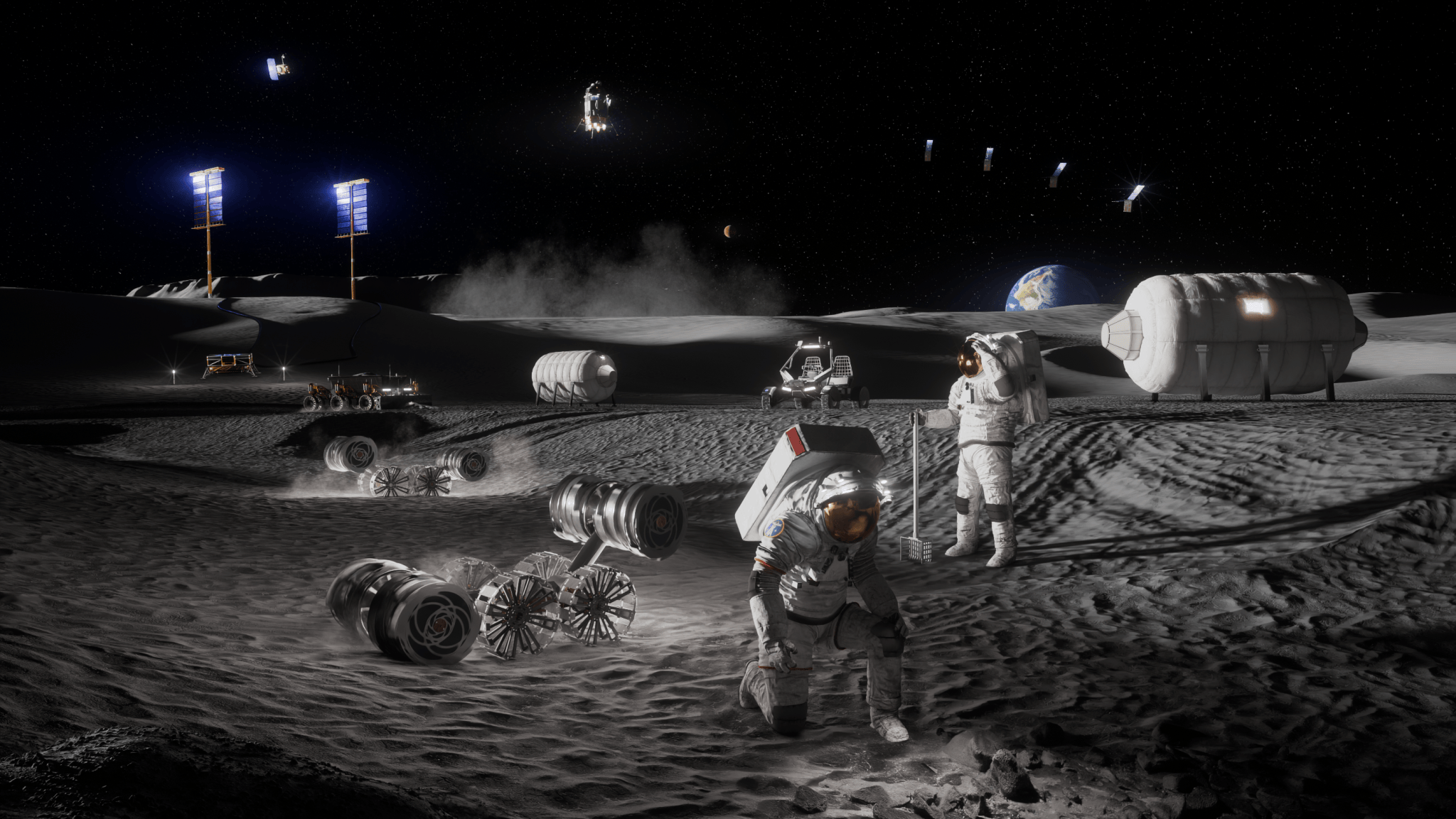
NASA Announces $1 Million to Students for Moon Base Challenge
Artist’s concept depicting astronauts, habitats, rovers, power systems, and cargo operations supporting sustained human activities at the Mo...
-
NASA has exercised the second option of its Information Technology and Multimedia Services (ITAMS) contract with DB Consulting Group, Inc., ...
-
Science Earth Observatory A Subtle Return of La Niña Earth Earth Observatory Image of the Day EO Explorer All Topics ...
