Friday, 14 November 2014

New Map Shows Frequency of Small Asteroid Impacts, Provides Clues on Larger Asteroid Population

This diagram maps the data gathered from 1994-2013 on small asteroids impacting Earth's atmosphere


A new map from NASA's Near Earth Object Program reveals that small asteroids frequently enter and disintegrate in Earth's atmosphere with random distribution around the globe.


from News and Features - NASA's Jet Propulsion Laboratory http://ift.tt/1wztkdO

via IFTTT

Rosetta's Comet Lander Landed Three Times

Image of the first touchdown site for the Rosetta spacecraft's Philae lander on comet 67P/Churyumov-Gerasimenko


The Rosetta mission's Philae comet lander bounced off the surface twice before coming to rest on the surface. Many of its science instruments have already sent back data.


from News and Features - NASA's Jet Propulsion Laboratory http://ift.tt/1GXaFRD

via IFTTT

Three touchdowns for Rosetta’s lander

This is an article from ESA's Space Science Portal to summarise Philae's landing so far. For a live summary and latest status update, watch the Google Hangout starting shortly at 13:00 GMT/14:00 CET. After achieving touchdown on a comet for the first time in history, scientists and engineers are busy analysing this new world and the nature of the landing. Touchdown was confirmed at ESA’s Space Operations Centre in Darmstadt, Germany at 16:03 GMT/17:03 CET on 12 November. Since then, scientists, flight dynamics specialists and engineers from ESA, the Lander Control Centre in Cologne, Germany, and the Philae Science, Operations and Navigation Centre in Toulouse, France have been studying the first data returned from the lander. These revealed the astonishing conclusion that the lander did not just touch down on Comet 67P/Churyumov–Gerasimenko once, but three times. The harpoons did not fire and Philae appeared to be rotating after the first touchdown, which indicated that it had lifted from the surface again. Stephan Ulamec, Philae manager at the DLR German Aerospace Center, reported that it touched the surface at 15:34, 17:25 and 17:32 GMT (comet time – it takes over 28 minutes for the signal to reach Earth, via Rosetta). The information was provided by several of the scientific instruments, including the ROMAP magnetic field analyser, the MUPUS thermal mapper, and the sensors in the landing gear that were pushed in on the first impact. The first touchdown was inside the predicted landing ellipse, confirmed using the lander’s downwards-looking ROLIS descent camera in combination with the orbiter’s OSIRIS images to match features. But then the lander lifted from the surface again – for 1 hour 50 minutes. During that time, it travelled about 1 km at a speed of 38 cm/s. It then made a smaller second hop, travelling at about […]


from Rosetta - ESA's comet chaserRosetta - ESA's comet chaser http://ift.tt/1x0MZHE

via IFTTT

Rosetta mission: Results from comet landing: 14 Nov, 13:00 GMT

Follow our ESA Hangout live today starting at 13:00 GMT / 14:00 CET. Rosetta and Philae teams will provide an update on mission progress.


from Rosetta - ESA's comet chaserRosetta - ESA's comet chaser http://ift.tt/1ECOf44

via IFTTT

NASA Awards NASA Balloon Operations Contract

NASA has awarded the NASA Balloon Operations Contract to Orbital Sciences Corporation of Greenbelt, Maryland for engineering and operations services to support the NASA Balloon Program.


from NASA Breaking News http://ift.tt/1zRnyum

via IFTTT

Thursday, 13 November 2014

Comet with a view

Here is the first panoramic ‘postcard’ from the surface of a comet, returned by Rosetta’s lander Philae, which is currently on the surface of Comet 67P/Churyumov-Gerasimenko: This view, captured by the CIVA-P imaging system on the lander, shows a 360º view around the point of final touchdown. Parts of Philae’s landing gear can be seen in some of the frames. Below is the same image, with superimposed a sketch of the Philae lander in the configuration the lander team currently believe it is in. Confirmation of Philae’s touchdown on the surface of Comet 67P/C–G arrived on Earth at 16:03 GMT/17:03 CET on 12 November.


from Rosetta - ESA's comet chaserRosetta - ESA's comet chaser http://ift.tt/1GSKg7q

via IFTTT

40 metres above a comet

Here is an image that was taken by the ROLIS imager on Rosetta's lander Philae when it was about 40 m above the surface of Comet 67P/Churyumov-Gerasimenko. The image shows that the surface of the comet is covered by dust and debris ranging from mm to meter sizes. The large block in the top right corner is 5 m in size. In the same corner the structure of the Philae landing is visible. *** The ROLIS instrument is a down-looking imager that acquires images during the descent and doubles as a multispectral close-up camera after the landing. The aim of the ROLIS experiment which is lead by DLR is to study the texture and microstructure of the comet's surface. ROLIS (ROsetta Lander Imaging System) is a descent and close-up camera on the Philae Lander. It has been developed by the DLR Institute of Planetary Research, Berlin.


from Rosetta - ESA's comet chaserRosetta - ESA's comet chaser http://ift.tt/14i1JHo

via IFTTT

Media briefing 14:00 CET start

Next media briefing on the Philae comet landing will start at 14:00 CET today, at ESA's Operations Centre, Darmstadt, Germany. Watch the media briefing live via webcast.


from Rosetta - ESA's comet chaserRosetta - ESA's comet chaser http://ift.tt/1pUGO7d

via IFTTT

Philae, the ‘happy lander’

Philae is on the surface and doing a marvellous job, working very well and we can say we have a very happy lander!


from Rosetta - ESA's comet chaserRosetta - ESA's comet chaser http://ift.tt/1EybIDu

via IFTTT

Final media briefing from ESOC live now

Live from ESOC at http://ift.tt/1uRImQv


from Rosetta - ESA's comet chaserRosetta - ESA's comet chaser http://ift.tt/10X1RK1

via IFTTT

NASA’s Orion Spacecraft Arrives at Launch Pad, Hoisted onto Rocket Ahead of its First Spaceflight

NASA’s new Orion spacecraft now is at its launch pad after completing its penultimate journey in the early hours Wednesday. It arrived at Space Launch Complex 37 at Cape Canaveral Air Force Station in Florida at 3:07 a.m. EST, where the spacecraft then was lifted onto a United Launch Alliance Delta IV Heavy rocket in preparation for its first trip to space.


from NASA Breaking News http://ift.tt/1Euu2xn

via IFTTT

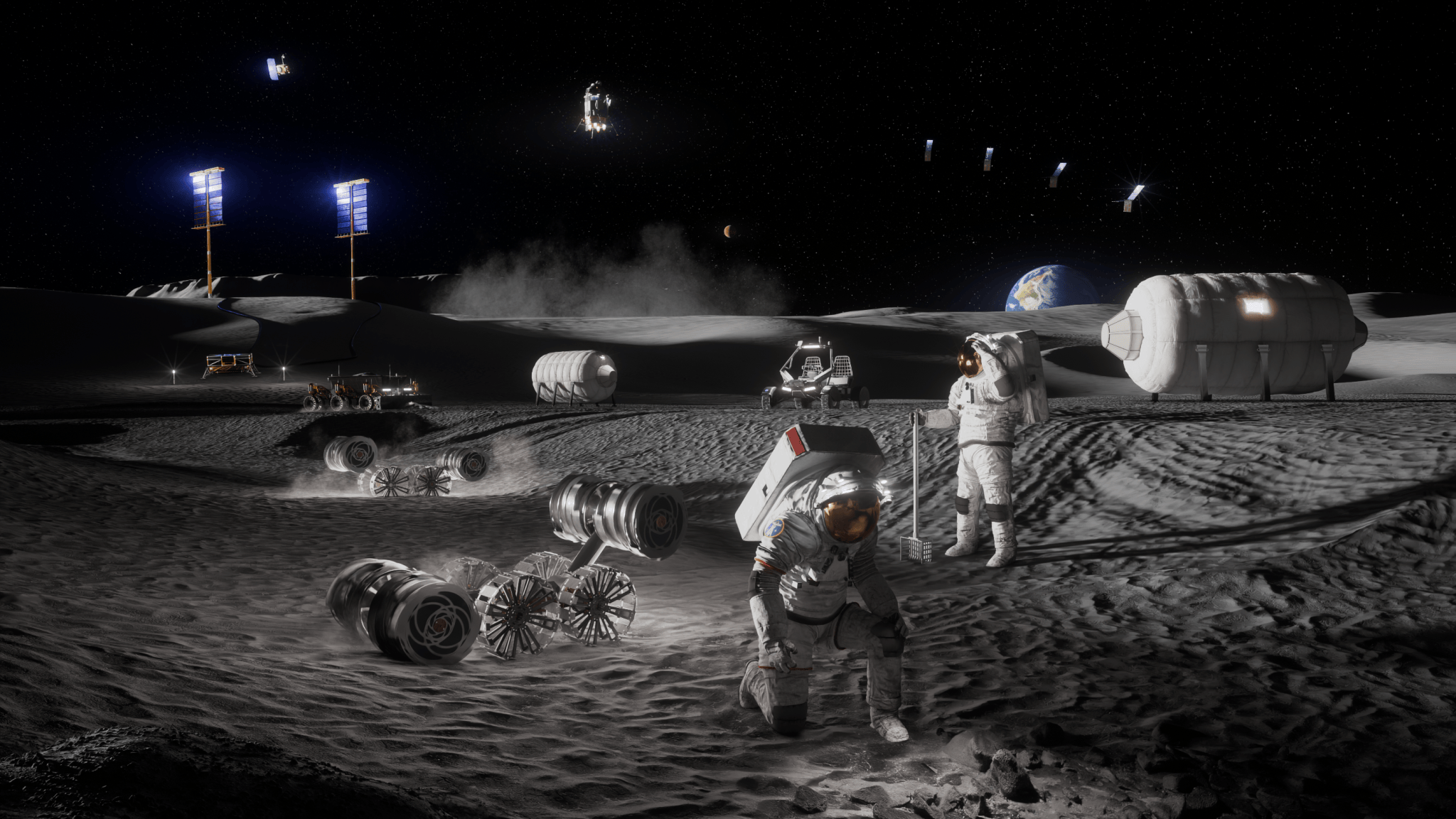
NASA Announces $1 Million to Students for Moon Base Challenge

Artist’s concept depicting astronauts, habitats, rovers, power systems, and cargo operations supporting sustained human activities at the Mo...