Wednesday, 12 November 2014

ESA rolls out the big iron

For landing operations this week, ESA is once again rolling out the 'big iron' - two of the Agency's three ultra-sensitive 35m deep-space tracking stations, these ones located at Malargüe, Argentina, and New Norcia, Australia.


from Rosetta - ESA's comet chaserRosetta - ESA's comet chaser http://ift.tt/1pP2zoQ

via IFTTT

REPLAY: Go/NoGo 2

Replay of the ESATV clip reporting the second Go/NoGo decision at 01:00 CET on 12 November.


from Rosetta - ESA's comet chaserRosetta - ESA's comet chaser http://ift.tt/1wic90g

via IFTTT

Rosetta's Singing Comet

Sound wave superimposed on an image of comet 67P/Churyumov-Gerasimenko


We've seen early images of comet 67P, and now we're able to "hear it sing," thanks to instruments on the European Space Agency's Rosetta spacecraft.


from News and Features - NASA's Jet Propulsion Laboratory http://ift.tt/1v0Tgnc

via IFTTT

European Spacecraft Set to Harpoon a Comet Tomorrow

Jagged Horizon on Rosetta's Destination Comet


European Space Agency's Rosetta mission will attempt to land on a comet tomorrow, Nov. 12.


from News and Features - NASA's Jet Propulsion Laboratory http://ift.tt/10X5Gza

via IFTTT

Jupiter's Red Spot is Likely a Sunburn, Not a Blush

Research suggests effects of sunlight produce the color of Jupiter's Great Red Spot.


The ruddy color of Jupiter's Great Red Spot is likely a product of simple chemicals being broken apart by sunlight in the planet's upper atmosphere, according to a new analysis of data from NASA's Cassini mission.


from News and Features - NASA's Jet Propulsion Laboratory http://ift.tt/1xvSa2a

via IFTTT

Go/NoGo 2 – Commands ready; Rosetta ready

The second Go/NoGo, comprising two steps, confirms that: Telecommands to control separation and delivery are now complete and ready. That is, the Flight Dynamics Team at ESOC have prepared the final instructions to be uploaded to Rosetta to command the delivery operations on board. The Flight Control Team at ESOC have checked and verified the overall health of the spacecraft, ensuring it is ready to perform. The next expected Go/NoGo – confirming Lander health – will be delayed until about 02:35 GMT/03:35 CET The GO was given at 00:00 GMT/ 01:00 CET. The next Go/NoGo decision to confirm that Philae is ready for separation will be made at 01:35 UTC/02:35 CET.


from Rosetta - ESA's comet chaserRosetta - ESA's comet chaser http://ift.tt/1Ez0Err

via IFTTT

REPLAY: Go/NoGo 1

Replay of the ESATV clip reporting on the first Go/NoGo decision taken at 20:30 CET on 11 November.


from Rosetta - ESA's comet chaserRosetta - ESA's comet chaser http://ift.tt/1ywACkR

via IFTTT

Tuesday, 11 November 2014

Comet over cities in Europe

With less than one day until Rosetta deploys Philae on Comet 67P/Churyumov-Gerasimenko, here is a set of images to compare the size of the comet with a few cities across Europe. Let's start with Darmstadt, Germany, home to ESA's European Space Operations Centre (ESOC) where the international media event following the comet landing is taking place this week. Other European cities close ESA's establishments are also featured below: Paris, France, home to ESA's Headquarters; Amsterdam, close to the European Space Research and Technology Centre (ESTEC) in Noordwijk, The Netherlands; Rome, close to ESA’s centre for Earth observation (ESRIN) in Frascati, Italy; Madrid, close to the European Space Astronomy Centre (ESAC) at Villanueva de la Cañada, Spain; London, close to European Centre for Space Applications and Telecommunications (ECSAT) in Harwell, Oxfordshire, UK.


from Rosetta - ESA's comet chaserRosetta - ESA's comet chaser http://ift.tt/1xpW5wk

via IFTTT

Science Update – 11 November: Three months at the Comet

During this morning's media briefing at the European Space Operations Centre (ESOC) in Darmstadt, Germany, there was also an overview of the scientific activities conducted at Comet 67P/C-G so far, presented by Matt Taylor, ESA Rosetta project scientist. Regular readers of this blog are surely familiar with the progress achieved by Rosetta in the past few months, but for those who are relatively new to the mission, we will summarise Matt Taylor's talk and present the highlights from the science operations so far. Rosetta started scientific operations on 7 May 2014, while still at a distance of almost two million km from the comet. At the time, the comet covered less than one pixel on the sensors of the cameras on Rosetta, but as the spacecraft approached its target, scientists started to realise that the shape of the comet was quite different than what had been assumed on the basis of observations from telescopes on the ground and orbiting around Earth. We are now all well familiar with Comet 67P/C-G's curious shape with a smaller and larger lobe - which scientists now almost customarily call the 'head' and 'body', connected by the 'neck'. Rosetta closed in on its target on 6 August, at a distance of about 100 km, and has been conducting a series of manoeuvres ever since, getting down to distances of less than 10 km from the comet's centre. Over the past three months, scientists from the OSIRIS team have been studying the comet and its surface in great detail to enable the selection of a landing site for Philae and the landing itself. Meanwhile, other instruments on Rosetta have been studying the comet under different 'angles', from the global properties of the coma to the very local properties of dust grains. Using VIRTIS observations in infrared, […]


from Rosetta - ESA's comet chaserRosetta - ESA's comet chaser http://ift.tt/1uZETQO

via IFTTT

Tracking Philae’s descent with magnetic data

ROMAP co-principal investigator Hans-Ulrich Auster from the Technische Universität Braunschweig, Germany, explains how the instrument will be used with RPC (on the Rosetta orbiter) to monitor Philae as it descends to the surface of comet 67P/Churyumov-Gerasimenko on 12 November – as well as looking out for any evidence of a ‘fossil’ magnetic field linked to the comet itself. On 12 November, the magnetic field instruments on-board the Rosetta orbiter and lander will be assigned the task of monitoring Philae as it descends to the surface. That’s possible because both the lander and the orbiter generate small magnetic fields of their own, due to the electronic circuits inside the spacecraft. These magnetic fields create perturbations in the data that the scientists normally remove in order to analyse the purely natural magnetic fields from the comet and the solar wind. However, on 12 November, these perturbations can be analysed to tell what is happening to the lander as it slowly drops towards the surface of 67P/C-G. Once the lander has separated, the magnetic perturbation registered near the orbiter will decrease as Philae moves away. Later, when the lander deploys a boom arm for its ROMAP instrument, it will cause a brief variation in the perturbation. A similar variation may also be registered when the three landing legs spring into place. The perturbations may prove too subtle for the RPC instruments, operating on Rosetta at some distance from Philae, but the ROMAP instrument on the lander will register the changes loud and clear. “We will be able tell what is happening on the lander by the changes in its magnetic field,” says ROMAP co-principal investigator Hans-Ulrich Auster. These measurements will add to the overall picture of Philae’s progress to the surface of the comet. Of course, the main focus of these instruments is […]


from Rosetta - ESA's comet chaserRosetta - ESA's comet chaser http://ift.tt/1u61GIH

via IFTTT

The singing comet

Rosetta’s Plasma Consortium (RPC) has uncovered a mysterious ‘song’ that Comet 67P/Churyumov-Gerasimenko is singing into space. RPC principal investigator Karl-Heinz Glaßmeier, head of Space Physics and Space Sensorics at the Technische Universität Braunschweig, Germany, tells us more. RPC consists of five instruments on the Rosetta orbiter that provide a wide variety of complementary information about the plasma environment surrounding Comet 67P/C-G. (Reminder: Plasma is the fourth state of matter, an electrically conductive gas that can carry magnetic fields and electrical currents.) The instruments are designed to study a number of phenomena, including: the interaction of 67P/C-G with the solar wind, a continuous stream of plasma emitted by the Sun; changes of activity on the comet; the structure and dynamics of the comet’s tenuous plasma ‘atmosphere’, known as the coma; and the physical properties of the cometary nucleus and surface. But one observation has taken the RPC scientists somewhat by surprise. The comet seems to be emitting a ‘song’ in the form of oscillations in the magnetic field in the comet’s environment. It is being sung at 40-50 millihertz, far below human hearing, which typically picks up sound between 20 Hz and 20 kHz. To make the music audible to the human ear, the frequencies have been increased by a factor of about 10,000. The music was heard clearly by the magnetometer experiment (RPC-Mag) for the first time in August, when Rosetta drew to within 100 km of 67P/C-G. The scientists think it must be produced in some way by the activity of the comet, as it releases neutral particles into space where they become electrically charged due to a process called ionisation. But the precise physical mechanism behind the oscillations remains a mystery. “This is exciting because it is completely new to us. We did not expect this and we […]


from Rosetta - ESA's comet chaserRosetta - ESA's comet chaser http://ift.tt/1swufJN

via IFTTT

NASA Announces $1 Million to Students for Moon Base Challenge

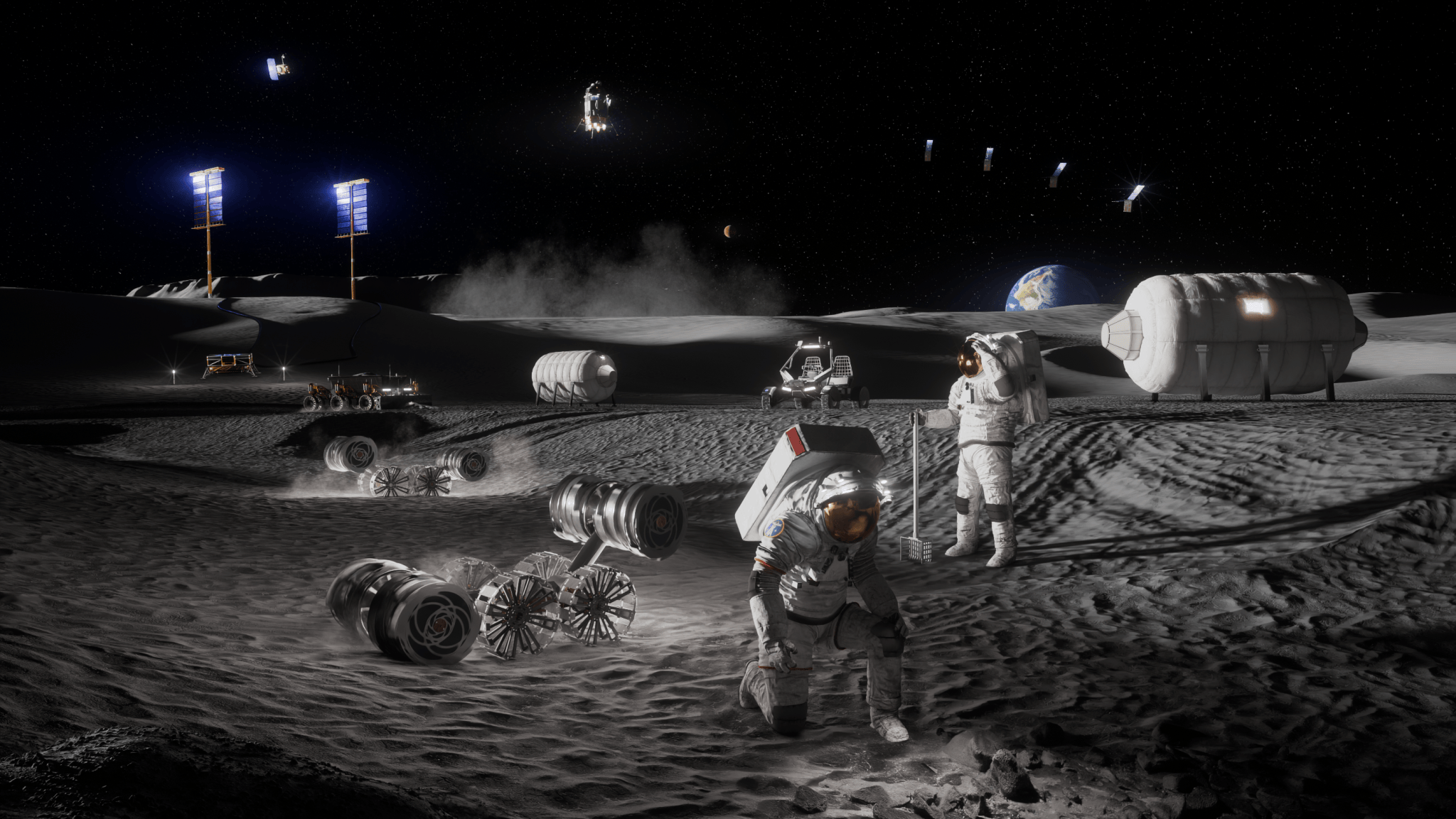
Artist’s concept depicting astronauts, habitats, rovers, power systems, and cargo operations supporting sustained human activities at the Mo...