
5 min read
Preparations for Next Moonwalk Simulations Underway (and Underwater)
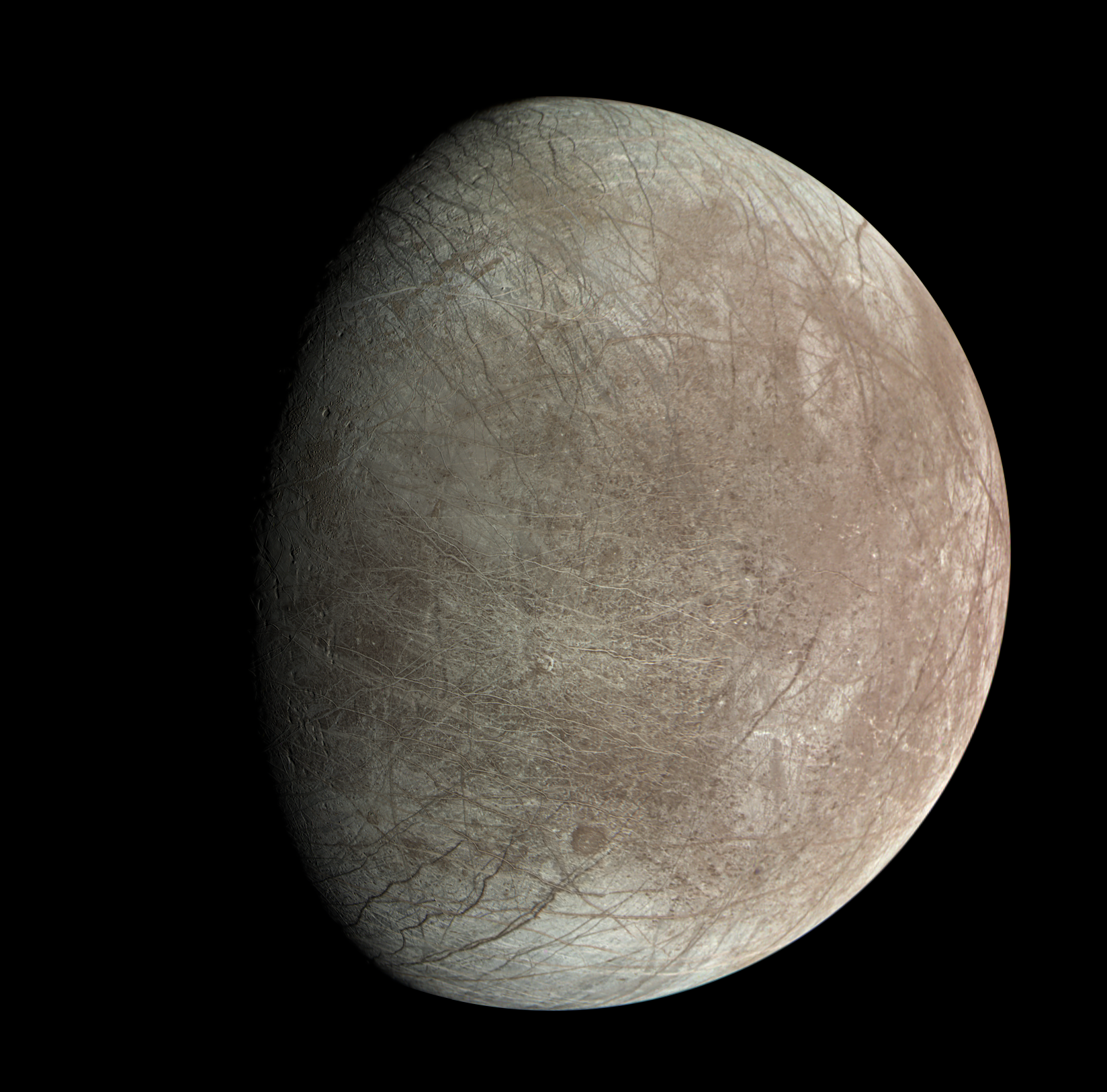
Results from the solar-powered spacecraft provide a new measurement of the thickness of the ice shell encasing the Jovian moon’s ocean.
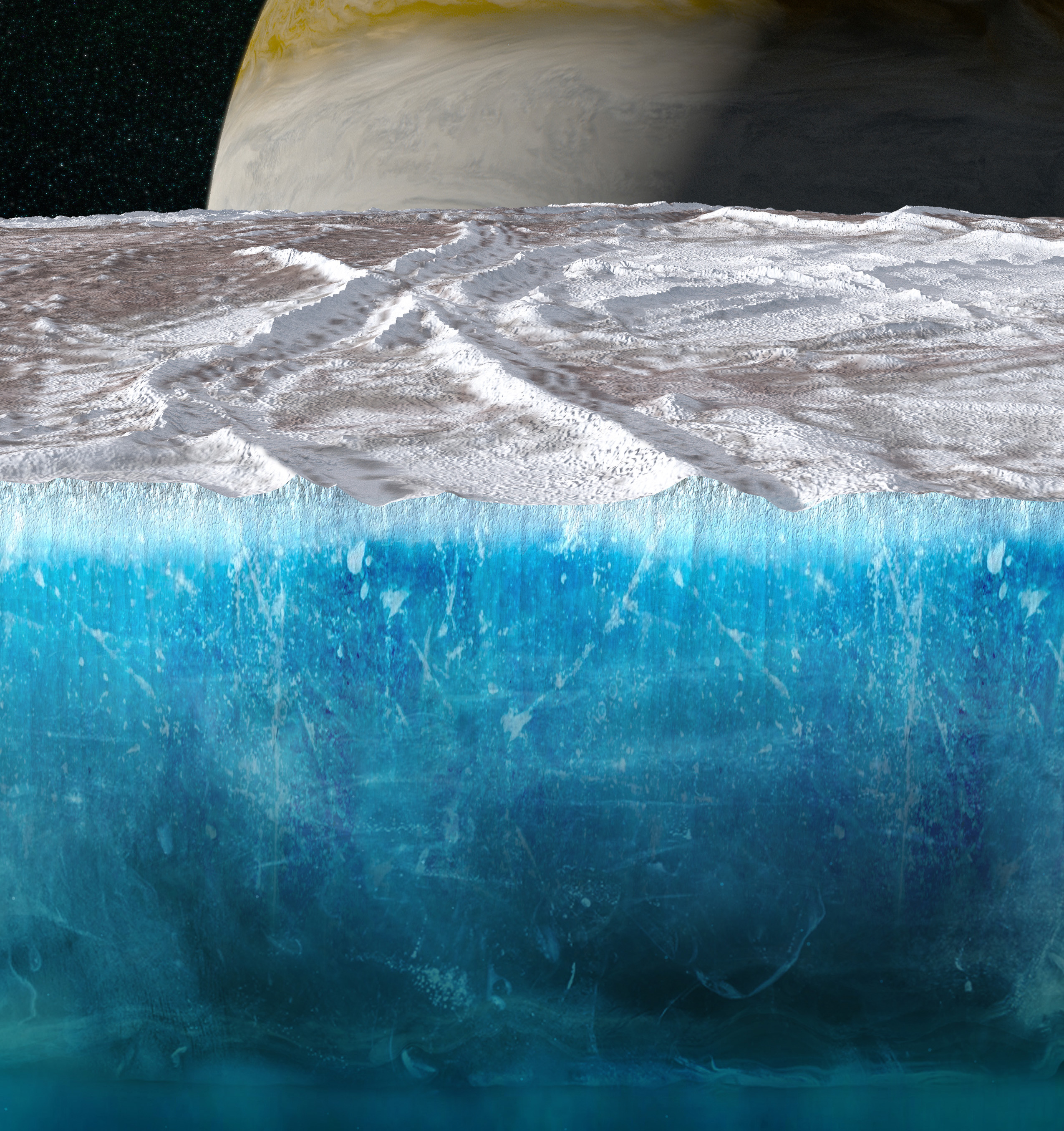
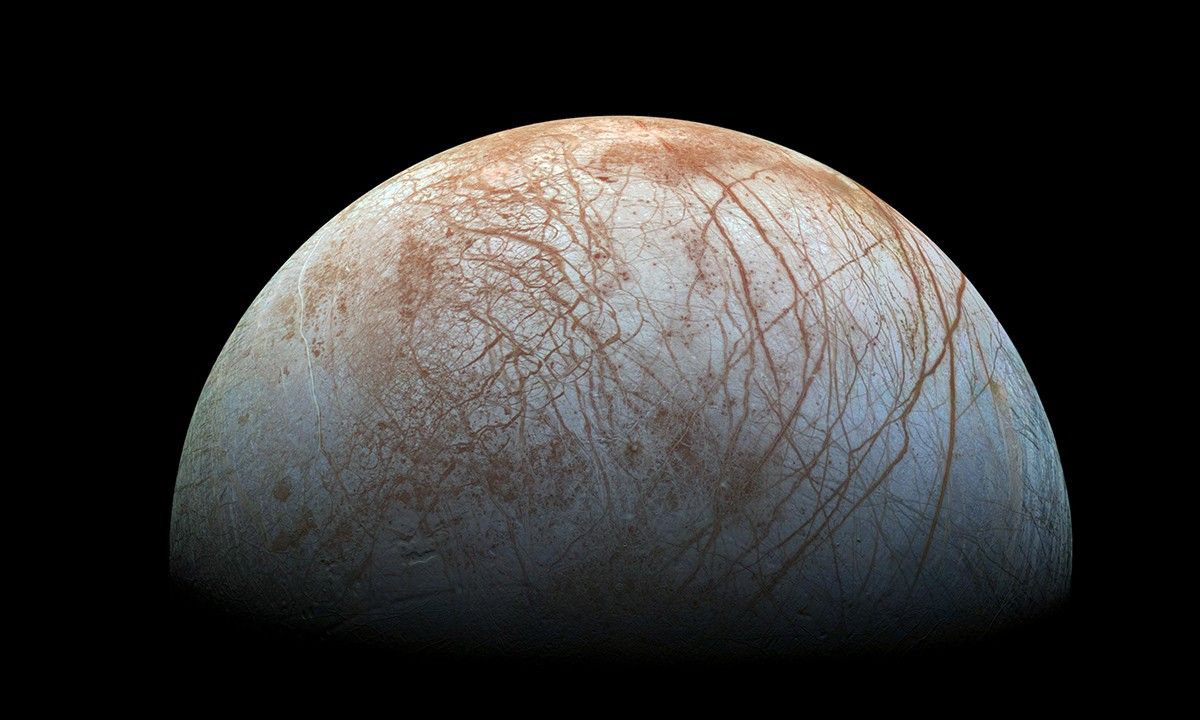
Data from NASA’s Juno mission has provided new insights into the thickness and subsurface structure of the icy shell encasing Jupiter’s moon Europa. Using the spacecraft’s Microwave Radiometer (MWR), mission scientists determined that the shell averages about 18 miles (29 kilometers) thick in the region observed during Juno’s 2022 flyby of Europa. The Juno measurement is the first to discriminate between thin and thick shell models that have suggested the ice shell is anywhere from less than half a mile to tens of miles thick.
Slightly smaller than Earth’s moon, Europa is one of the solar system’s highest-priority science targets for investigating habitability. Evidence suggests that the ingredients for life may exist in the saltwater ocean that lies beneath its ice shell. Uncovering a variety of characteristics of the ice shell, including its thickness, provides crucial pieces of the puzzle for understanding the moon’s internal workings and the potential for the existence of a habitable environment.
The new estimate on the ice thickness in the near-surface icy crust was published on Dec. 17 in the journal Nature Astronomy.
Catching waves
Although the MWR instrument was designed to investigate Jupiter’s atmosphere below the cloud tops, the novel instrument has proven valuable for studying the gas giant’s icy and volcanic moons as well.
On Sept. 29, 2022, Juno came within about 220 miles (360 kilometers) of Europa’s frozen surface. During the flyby, MWR collected data on about half the moon’s surface, peering beneath the ice to measure its temperatures at various depths.
“The 18-mile estimate relates to the cold, rigid, conductive outer-layer of a pure water ice shell,” said Steve Levin, Juno project scientist and co-investigator from NASA’s Jet Propulsion Laboratory in Southern California, which manages the mission. “If an inner, slightly warmer convective layer also exists, which is possible, the total ice shell thickness would be even greater. If the ice shell contains a modest amount of dissolved salt, as suggested by some models, then our estimate of the shell thickness would be reduced by about 3 miles.”
The thick shell, as suggested by the MWR data, implies a longer route that oxygen and nutrients would have to travel to connect Europa’s surface with its subsurface ocean. Understanding this process may be relevant to future studies of Europa’s habitability.
Cracks, pores
The MWR data also provides new insights into the makeup of the ice just below Europa’s surface. The instrument revealed the presence of “scatterers” — irregularities in the near-surface ice such as cracks, pores, and voids that scatter the instrument’s microwaves reflecting off the ice (similar to how visible light is scattered in ice cubes). These scatterers are estimated to be no bigger than a few inches in diameter and appear to extend to depths of hundreds of feet below Europa’s surface.
The small size and shallow depth of these features, as modeled in this study, suggest they are unlikely to be a significant pathway for oxygen and nutrients to travel from Europa’s surface to its salty ocean.
“How thick the ice shell is and the existence of cracks or pores within the ice shell are part of the complex puzzle for understanding Europa’s potential habitability,” said Scott Bolton, principal investigator of Juno from the Southwest Research Institute in San Antonio. “They provide critical context for NASA’s Europa Clipper and the ESA (European Space Agency) Juice (JUpiter ICy moons Explorer) spacecraft — both of which are on their way to the Jovian system.” Europa Clipper will arrive there in 2030, while Juice will arrive the year after.
Juno will carry out its 81st flyby of Jupiter on Feb. 25.
More about Juno
A division of Caltech in Pasadena, California, JPL manages the Juno mission for the principal investigator, Scott Bolton, of the Southwest Research Institute in San Antonio. Juno is part of NASA’s New Frontiers Program, managed at NASA’s Marshall Space Flight Center in Huntsville, Alabama, for the agency’s Science Mission Directorate in Washington.
To learn more about Juno, go to:
https://science.nasa.gov/mission/juno
News Media Contacts
DC Agle
Jet Propulsion Laboratory
818-393-9011
agle@jpl.nasa.gov
Karen Fox / Molly Wasser
NASA Headquarters, Washington
240-285-5155 / 240-419-1732
karen.c.fox@nasa.gov / molly.l.wasser@nasa.gov
Deb Schmid
Southwest Research Institute, San Antonio
210-522-2254
dschmid@swri.org
2026-004
Explore More




from NASA https://ift.tt/JdefEh8


No comments:
Post a Comment