Students at Laing Middle School in Mount Pleasant, South Carolina, which is near Charleston, will speak with a NASA astronaut living, working and doing research aboard the International Space Station at 10:20 a.m. EDT Friday, Sept. 8.
from NASA Breaking News http://ift.tt/2vLGwI0
via IFTTT

Wednesday, 6 September 2017

NASA Astronauts Back From Space, Available To Talk With Media
NASA astronauts Peggy Whitson and Jack Fischer, who returned to Earth on Sept. 2 after spending months aboard the International Space Station, will take part in a news conference to discuss their mission at 11 a.m. EDT on Monday, Sept. 11. The hour-long event will air live on NASA Television and the agency’s website.
from NASA Breaking News http://ift.tt/2xaXjVe
via IFTTT
from NASA Breaking News http://ift.tt/2xaXjVe
via IFTTT
Tuesday, 5 September 2017
President Trump Welcomes Home Record-breaking NASA Astronaut Peggy Whitson
NASA astronauts Peggy Whitson and Jack Fischer received a special welcome as they were flying home to Houston Sunday evening. President Donald Trump spoke by phone with Whitson and Fischer on a NASA plane following Whitson’s record-breaking mission to the International Space Station.
from NASA Breaking News http://ift.tt/2iXayCJ
via IFTTT
from NASA Breaking News http://ift.tt/2iXayCJ
via IFTTT
Sunday, 3 September 2017
Three International Space Station Crewmates Safely Return to Earth
NASA astronaut Peggy Whitson, who set multiple U.S. space records during her mission aboard the International Space Station, along with crewmates Jack Fischer of NASA and Commander Fyodor Yurchikhin of Roscosmos, safely landed on Earth at 9:21 p.m. EDT Saturday (7:21 a.m. Kazakhstan time, Sunday, Sept. 3), southeast of the remote town of Dzhezkazga
from NASA Breaking News http://ift.tt/2gAiqt6
via IFTTT
from NASA Breaking News http://ift.tt/2gAiqt6
via IFTTT
Saturday, 2 September 2017
NASA Statement on Nomination for Agency Administrator
The following is a statement from acting NASA Administrator Robert Lightfoot on Friday’s announcement of the intended nomination by President Donald Trump of U.S. Rep. Jim Bridenstine to serve as the 13th NASA administrator:
from NASA Breaking News http://ift.tt/2vScnlu
via IFTTT
from NASA Breaking News http://ift.tt/2vScnlu
via IFTTT
Friday, 1 September 2017
Apply to Be a NASA Solar System Ambassador

Could you be one of them? If you want to share your passion of space with the public, being a NASA Solar System Ambassador is the perfect platform to do so.
The annual Solar System Ambassadors application period begins on Sept. 1 and ends on Sept. 30. Chosen applicants will begin a one-year, renewable term on Jan. 1, 2018.
VIDEO
› DOWNLOAD VIDEO Meet Richard, A NASA Solar System Ambassador
The Solar System Ambassadors Program is a public engagement effort that works with motivated volunteers across the nation to communicate the science and excitement of NASA's space exploration missions and discoveries in their communities. The program -- which started in 1997 -- currently consists of 730 ambassadors who conduct approximately 2,400 annual events that ,reach about 500,000 people directly, with millions reached via publications, social media, TV and radio.
To qualify, an applicant must be at least 18 years of age. An ideal applicant is a space enthusiast active in his or her community with a desire to learn more about space exploration and share the story of NASA. It is advisable to submit a thoughtful, complete application. If selected, the ambassador volunteers must host and report at least four community-based events per year.
The Solar System Ambassadors program provides professional development in the form of teleconferences with NASA mission scientists and engineers in which volunteers learn the latest in space science. NASA's Jet Propulsion Laboratory, a division of Caltech in Pasadena, California, supports the program.
To apply, fill out and submit the application available on Sept. 1 here:
News Media Contact
Elizabeth Landau
Jet Propulsion Laboratory, Pasadena, Calif.
818-354-6425
Elizabeth.R.Landau@jpl.nasa.gov
Written by Elyssia Widjaja
2017-235
from News and Features http://ift.tt/2wmdca0
via IFTTT
NASA Working with Partners to Provide Harvey Response

NASA is using its assets and expertise from across the agency, including from NASA's Jet Propulsion Laboratory in Pasadena, California, to help respond to Hurricane Harvey -- now Tropical Storm Harvey -- which has been a disaster of unprecedented proportions for those who live and work in Southeast Texas. With no atmospheric steering mechanism to move the storm once it made landfall, Harvey has been producing rainfall totals measured in feet, rather than inches, presenting exceptional challenges to local, state and federal emergency managers and first responders.
"This is an immense weather event that is creating a unique challenge," said Thomas Zurbuchen, associate administrator for NASA's Science Mission Directorate at the agency's headquarters in Washington. "NASA is working to enable and enhance the capabilities of our partners across federal agencies and elsewhere to ensure they are able to do the best job possible in assessing the threat and providing rescue and response services."
For more NASA resources on Harvey and other tropical systems, visit:
At the forefront of the agency's efforts, the NASA Earth Science Disasters Team is providing support to local, state and federal agencies in their response to the extreme flooding in the Houston area and related damage associated with Harvey. As a result of this team's activation, scientists at NASA centers and external partners are working closely with the state of Texas, the United States Geological Survey Hazards Data Distribution System, the Federal Emergency Management Agency (FEMA), the National Guard and other partners to leverage their science and application experience to provide analysis of satellite imagery, output products and other decision-support aids to inform disaster mapping and response efforts.
Coordination so far has included the generation and distribution of flood maps, using NASA analyses applied to data from several synthetic aperture radar (SAR) instruments on international partner satellites. The orbiting SAR instruments penetrate clouds and operate day and night, providing detailed, high-resolution, all-weather imagery of Earth's surface. NASA's partners tasked their spacecraft to make measurements of Southeastern Texas after the United States activated the humanitarian International Charter on Space and Major Disasters. Feedback from FEMA and other responders indicates these maps have been helpful in confirming coastal and river flood depths and identifying areas where inundation may be ongoing.
As another example, NASA's Global Precipitation Measurement (GPM) mission team has produced rainfall accumulation graphics and unique views of the structure of Harvey during various phases of development and landfall. GPM products help to identify the center of circulation and intense eyewall convection, and these images are provided to the National Oceanic and Atmospheric Administration's (NOAA's) National Hurricane Center via NASA's Short-term Prediction Research and Transition (SPoRT) Center and the Naval Research Laboratory. Based at NASA's Marshall Space Flight Center in Huntsville, Alabama, SPoRT is a project to transition unique observations and research capabilities to the operational weather community to improve short-term forecasts on a regional scale.
In addition, NASA's Land Information System developed at the agency's Goddard Space Flight Center in Greenbelt, Maryland, and operated at Marshall, is being used to track soil moisture information relevant to flooding and agricultural impacts. This involves incorporating real-time satellite data that includes vegetation health and an experimental version that assimilates soil moisture data from NASA's Soil Moisture Active Passive (SMAP) mission. SMAP is managed for NASA's Science Mission Directorate in Washington by JPL, with instrument hardware and science contributions made by NASA Goddard.
Starting Thursday, NASA will fly the JPL-managed Uninhabited Aerial Vehicle Synthetic Aperture Radar (UAVSAR) instrument aboard a NASA Gulfstream-III aircraft to collect higher spatial resolution SAR observations over rivers, flood plains and critical infrastructure. The response team also will use other SAR data of opportunity, including the ESA's (European Space Agency's) Sentinel 1A and 1B mission SAR data made available through ESA open-data sharing to support flood response efforts.
As skies clear over the area, the team will leverage NASA's constellation of Earth observing satellites -- including the Moderate-Resolution Imaging Spectroradiometer (MODIS) instrument aboard NASA's Terra and Aqua satellites, the Advanced Spaceborne Thermal Emission and Reflection Radiometer (ASTER) aboard Terra, Landsat, and the Visible Infrared Imaging Radiometer Suite (VIIRS) aboard the Suomi-National Polar-orbiting Partnership (Suomi-NPP) satellite -- to assist with flood mapping, and in the case of Suomi-NPP, mapping of utility and power outages through a reduction in emitted night lights. ASTER's U.S. Science Team is located at JPL.
Beyond the technical assistance and scientific expertise the agency is providing, NASA is working to ensure the continued safety of its employees and their families in the path of the storm, communicating closely with the recovery team at the agency's Johnson Space Center in Houston, which continues to assess conditions onsite in an effort to ensure a smooth transition back to normal operations once the center re-opens next week.
News Media Contact
Alan Buis
Jet Propulsion Laboratory, Pasadena, California
818-354-0474
alan.buis@jpl.nasa.gov
Sean Potter
NASA Headquarters, Washington
202-358-1536
Sean.potter@nasa.gov
2017-233
from News and Features http://ift.tt/2vNmvMx
via IFTTT
NASA Television to Air Return of Three International Space Station Crew Members
Record-breaking NASA astronaut Peggy Whitson and her Expedition 52 crewmates are scheduled to depart the International Space Station and return to Earth Saturday, Sept. 2. NASA Television and the agency’s website will provide complete coverage of their departure and landing.
from NASA Breaking News http://ift.tt/2gmgmRQ
via IFTTT
from NASA Breaking News http://ift.tt/2gmgmRQ
via IFTTT
NASA Satellite Images Show Evolution of Hurricane Harvey

Hurricane Harvey continues to churn toward the Texas coast, and is expected to make landfall as a major hurricane sometime late Aug. 25 or early Aug. 26, according to the National Hurricane Center. It would be the first major hurricane to make landfall in the United States since 2005.
The rapid intensification of Harvey is depicted in this set of false-color images from NASA's Atmospheric Infrared Sounder (AIRS) and Advanced Microwave Sounding Unit (AMSU) instruments on NASA's Aqua satellite. The earlier images were acquired at 3:05 p.m. CDT (19:05 UTC) on Wednesday, Aug. 23, when Harvey became a tropical storm soon after crossing from the Yucatan Peninsula over warm waters in the Gulf of Mexico. The later images were acquired at 2:59 a.m. CDT (7:59 UTC) on Friday, Aug. 25, when Harvey was a Category 2 hurricane.
Warm colors in the infrared images (red, orange, yellow) show areas with little cloud cover. Cold colors (blue, purple) show areas covered by clouds that have developed sufficiently to reach high, cold altitudes, creating strong thunderstorms. The darker the color, the colder and higher the clouds and the stronger the thunderstorms. In the microwave images, blue indicates areas of heavy rainfall beneath the coldest clouds.
These images illustrate how, over a 36-hour period, Harvey became more organized (shown by its more circular shape and more-developed rain bands in the later images), intensified (shown by the growing area of blue and purple colors in the infrared) and moved northwest toward Texas. The microwave images show how the areas with rain have grown in area and intensity.
Together, these two instruments give a detailed picture of the atmospheric conditions in and around a storm like Harvey. These observations are used by weather forecasters to predict how Harvey will move and change strength.
For more information on AIRS, visit:
News Media Contact
Alan Buis
Jet Propulsion Laboratory, Pasadena, California
818-354-0474
alan.buis@jpl.nasa.gov
2017-229
from News and Features http://ift.tt/2wTKIG4
via IFTTT
Thursday, 31 August 2017
Juno Scientists Prepare for Seventh Science Pass of Jupiter

NASA's Juno spacecraft will make its seventh science flyby over Jupiter's mysterious cloud tops on Friday, Sept. 1, at 2:49 p.m. PDT (5:49 p.m. EDT and 21:49 UTC). At the time of perijove (defined as the point in Juno's orbit when it is closest to the planet's center), the spacecraft will be about 2,200 miles (3,500 kilometers) above the planet's cloud tops.
Juno launched on Aug. 5, 2011, from Cape Canaveral, Florida, and arrived in orbit around Jupiter on July 4, 2016. During its mission of exploration, Juno soars low over the planet's cloud tops -- as close as about 2,100 miles (3,400 kilometers). During these flybys, Juno is probing beneath the obscuring cloud cover of Jupiter and studying its auroras to learn more about the planet's origins, structure, atmosphere and magnetosphere.
NASA's Jet Propulsion Laboratory, Pasadena, California, manages the Juno mission for the principal investigator, Scott Bolton, of Southwest Research Institute in San Antonio. The Juno mission is part of the New Frontiers Program managed by NASA's Marshall Space Flight Center in Huntsville, Alabama, for the Science Mission Directorate. Lockheed Martin Space Systems, Denver, built the spacecraft. JPL is a division of Caltech in Pasadena, California.
More information on the Juno mission is available at:
The public can follow the mission on Facebook and Twitter at:
http://www.twitter.com/NASAJuno
News Media Contact
DC Agle
Jet Propulsion Laboratory, Pasadena, Calif.
818-393-9011
agle@jpl.nasa.gov
Dwayne Brown / Laurie Cantillo
NASA Headquarters, Washington
202-358-1726 / 202-358-1077
dwayne.c.brown@nasa.gov / laura.l.cantillo@nasa.gov
2017-234
from News and Features http://ift.tt/2wTUQ1k
via IFTTT
NASA and Iconic Museum Honor Voyager Spacecraft 40th Anniversary
NASA and the Smithsonian National Air and Space Museum will celebrate 40 years of the Voyager 1 and 2 spacecraft -- humanity's farthest and longest-lived mission -- with a public event at 9:30 a.m. PDT (12:30 p.m. EDT), Tuesday, Sept. 5.
The observance will take place at the Smithsonian's museum located at Independence Avenue at 6th street SW in Washington. The event will be broadcast live on NASA Television and streamed on the agency's website.
Activities will include panel discussions about the Voyagers' creation and mission history, their unprecedented science findings and imagery, impact on Earth's culture and how the spacecraft inspired countless scientists, engineers and the next generation of explorers. The event also will include a galactic message transmitted toward the Voyager 1 spacecraft by a celebrity guest.
The Voyagers' original mission was to explore Jupiter and Saturn. Although the twin spacecraft are now far beyond the planets in the solar system, NASA continues to communicate with them daily as they explore the frontier where interstellar space begins.
Participants in the Sept. 5 event are:
- Thomas Zurbuchen, associate administrator for NASA's Science Mission Directorate, NASA Headquarters, Washington
- Ed Stone, Voyager project scientist, Caltech, Pasadena, California
- Suzanne Dodd, Voyager project manager, NASA's Jet Propulsion Laboratory, Pasadena
- Gary Flandro, Voyager Mission Grand Tour creator, University of Tennessee, Knoxville
- Alan Cummings, Voyager researcher, Caltech
- Ann Druyan, writer/producer, Golden Record Visionary
- Morgan Cable, researcher, JPL
- Eric Zirnstein, researcher, Princeton University, New Jersey
- Matthew Shindell, curator, National Air and Space Museum
The public can ask questions on social media using #AskNASA.
Commemorative posters for the mission, celebrating the Voyagers' launches and incredible journeys, are available at:
 › Download posters
For more information on Voyager, visit:
and
News Media Contact
Elizabeth Landau
Jet Propulsion Laboratory, Pasadena, Calif.
818-354-6425/818-359-3241
Elizabeth.landau@jpl.nasa.gov
Dwayne Brown
NASA Headquarters, Washington
202-358-1726
dwayne.c.brown@nasa.gov
Karen Fox
Goddard Space Flight Center, Greenbelt, Md.
301-286-6284
karen.c.fox@nasa.gov
2017-232b
from News and Features http://ift.tt/2xNKEE4
via IFTTT
Subscribe to:
Posts (Atom)
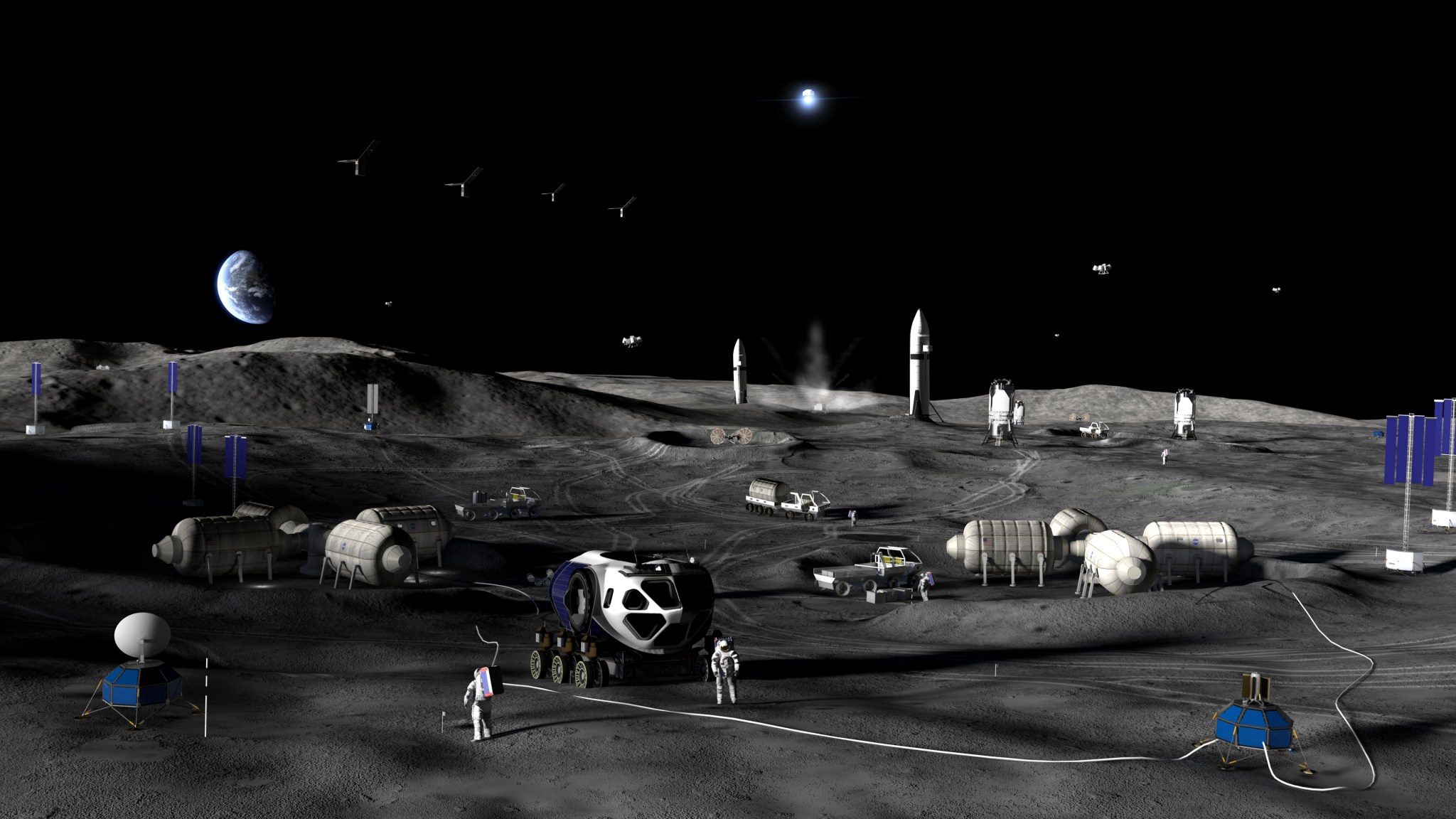
NASA Provides Update on Moon Base Rovers, Landers, Missions
Artist’s concept of Phase 3 of NASA’s Moon Base. Credit: NASA During a Moon Base event Tuesday at NASA’s Headquarters in Washington, the ag...
-
NASA has exercised the second option of its Information Technology and Multimedia Services (ITAMS) contract with DB Consulting Group, Inc., ...
-
Science Earth Observatory A Subtle Return of La Niña Earth Earth Observatory Image of the Day EO Explorer All Topics ...
